
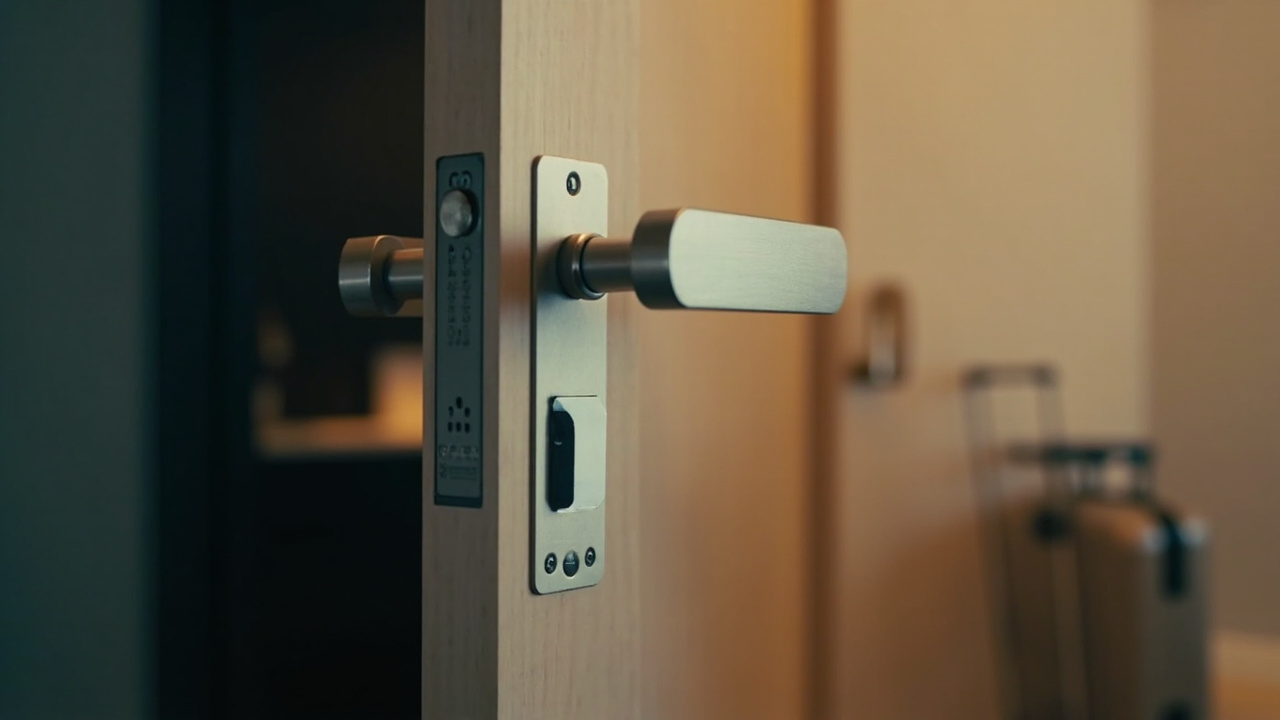
Smart Locks for Hotel Chains: Credential Model that Survives Card Encoding and Room-Move Churn
Hotel chains credential model is what this piece covers for this kind of building. Briefing memo
Direct answer. In short, hotel chains credential model is the subject of this piece. hotel chains credential model is where the work on hotel chains credential model sits. hotel-chains is what has to be evidenced before anyone signs. A hotel chains credential model maps one building type to its door classes. hotel chains credential model comes first. Each class states what hotel chains credential model requires and how it is evidenced.
To: Hotel Group procurement, security, property operations and front-office systemsFrom: Access systems evaluation teamSubject: Credential architecture for a multi-property smart-lock programmeStage: Evaluation
Recommendation: Use a hotel chains credential model that separates identity, room entitlement and card encoding. The pilot should prove that a guest can move rooms without retaining access to the old room, that a property can issue within an approved offline rule set, and that every card action reconciles to the central record. The evaluation identifier hotel-chains should appear in the pilot evidence so one decision can be traced across properties.
flowchart TD
    A[Approve credential architecture] --> B[Define group object schedule]
    B --> C[Separate identity entitlement and encoding]
    C --> D[Prove room move and offline issuance]
    D --> E[Govern staff credentials]
    E --> F[Run transition tests]
    F --> G[Verify ownership and technical evidence]
    G --> H[Control rollout risks]
    H --> I{Release condition met}
    I -->|Yes| J[Chain release]
    I -->|No| K[Hold pilot]
Decision requested — hotel chains credential model
Approve the credential architecture and its acceptance tests, rather than approving hardware on the basis that it accepts the group's existing cards. The architecture should specify which system owns identity, which system owns room access, what the property card encoder writes, and which records prove that the two remain synchronized.
The pilot should cover normal arrival, a same-night room move, checkout after a move, a staff-role change and operation during a network outage. A chain-wide release should depend on evidence from those transactions, not on a successful demonstration at one property. Reference the catalogue record: the SLK-002 Keypad RFID Lock for Guesthouses, SKU confirmed on its dated product page.
The group should also settle three policy boundaries during evaluation:
- Whether a room move re-encodes the returned card or issues a replacement.
- How long a property card encoder may operate from its cached issuance rules.
- Which exceptions to the normal room entitlement require security approval.
Build a reusable group object schedule
The group standard should define the objects that remain consistent; each property should maintain only the values that legitimately differ. This prevents a local workaround at one hotel from becoming an undocumented group rule.
| Group-controlled object | Property-specific record | Evidence at acceptance |
|---|---|---|
| Door and room map | Local room numbers and approved changes | Reconciled mapping export |
| Lock and reader asset record | Door position and installed configuration | Signed site inventory |
| Property card encoder | Approved configuration and accepted card formats | Versioned setup record |
| Credential classes | Guest, staff and controlled exception rules | Issued test credentials |
| Central-system mapping | Property code, room and role identifiers | Test transaction and response |
| Audit record | Event fields and approved retention setting | Sample record and reconciliation |
Use the Office Smart Lock Site Survey and Smart Lock Retrofit Site Survey to collect the site-dependent inputs. Neither survey should define the credential rules: the group owns those, while the property records the door, room and encoder values that implement them.
Separate identity, entitlement and encoding
The hotel card encoding layer must be treated as a translation step, not as the authoritative access policy. A practical model separates five objects:
- Identity record: establishes who the guest or staff member is.
- Entitlement record: establishes which rooms, zones or periods that identity may access.
- Encoded credential: carries the approved subset needed at the door.
- Door decision: applies the lock's configured access rule.
- Audit event: records what was requested and what completed.
This separation makes a room move a controlled transaction. The central entitlement changes first, the property card encoder performs the required card action, and the central record is updated again only after the outcome is known. A property operator must not correct the room map in one system while leaving a different entitlement active elsewhere.
Before crediting a selected SKU with re-encoding, offline issuance, expiry handling or audit export, confirm on the dated product page for the specific SKU and require matching evidence in the technical response. The response should identify the card fields, accepted format versions and interface behaviour rather than relying on a general compatibility statement.
Define the room move credential workflow
A room-move credential workflow must state what happens to the old room access before the guest receives the new room credential. The selected route depends on whether the guest keeps the physical card, whether a replacement is acceptable and what the selected product and interface can demonstrate.
| Route | Use when | Required control | Reject when |
|---|---|---|---|
| Re-encode the same card | The guest returns the card and keeps it after re-encoding | Test the new room and close the previous scope | The old card still opens the previous room |
| Issue a replacement card | The original is unavailable or must remain with the guest | Expire the old entitlement and link both credentials to one move | Two valid room credentials have no assigned owner |
| Transfer a digital credential | The selected SKU and interface pass the transfer test | Prove that the previous credential is invalidated | Capability is assumed rather than evidenced |
Each move should carry one transaction identifier. The front desk confirms the guest and destination room; the central system records the change; the property card encoder completes the card action; staff verify the intended door; and the system reconciles the result. Checkout after the move must close the final entitlement without reopening the original room.
A maintenance-driven room swap uses the same transfer discipline, but the authorization owner changes. Housekeeping can report that a room is unavailable, while security or duty management should approve which guest or staff entitlement moves.
Make offline issuance bounded and auditable
Offline credential issuance should be a continuation of group policy, not permission for each property to create local access rules. The property card encoder may use an approved cached rule set, but the technical response must show how that cache expires, which identities can be issued against it and what happens when the central system returns.
Require a recovery record containing the last central synchronization point, the affected property, the issuing staff member, the credential and the next reconciliation action. If the rule set has exceeded its approved freshness window, issuance should stop and escalate rather than extend indefinitely.
Offline operation does not replace the emergency route. The Smart Locks for Hotel Chains: Emergency and Out-of-Hours Access for Hotel Chains procedure should remain separate from guest-card issuance, with a named local owner and a way to record exceptional entries.
CONFIRM-WITH-LOCAL-FIRE-AUTHORITY: Confirm the accepted emergency-opening and egress arrangement for each door type before the pilot is approved.
Govern staff credentials and the key hierarchy
Staff access control should reuse the same identity, entitlement and encoding objects. The credential lifecycle must make role changes, temporary access, contract end dates and forgotten cards visible to the central system. A staff member moving from one property to another should receive a new local entitlement rather than carrying an old property scope with them.
The key hierarchy belongs in the same object schedule, even when part of it remains mechanical. It should identify which credentials carry guest-room access, limited service access, public-area access and exceptional authority. The detailed custody decision can be developed with the Smart Lock Key Control and Master Key Decisions for Hotel Chains guidance.
When staff credentials change, reconciliation must show whether the old card was returned, reissued or explicitly time-limited. Audit records should distinguish an expired entitlement, a re-encoded card and a replacement card; treating all three as generic updates would conceal credential duplication.
CONFIRM-WITH-LOCAL-DATA-PROTECTION-REVIEWER: Confirm the credential fields, audit fields, access roles, retention periods and deletion or reconciliation process permitted in each operating jurisdiction.
Test the transitions rather than the hardware
The pilot should test transitions because room-move churn and encoding changes expose failures that a static door demonstration misses. A pass requires evidence from the central record, the property card encoder and the intended door.
| Scenario | Pass condition | Evidence retained |
|---|---|---|
| New guest issuance | The card opens the assigned room only | Entitlement, encoding and door test |
| Same-night room move | The new room opens and the previous room no longer does | Move transaction and paired door tests |
| Checkout after move | The final active entitlement closes | Closure record and credential disposition |
| Staff-role change | Prior scope closes and replacement scope is bounded | Role update and expiry evidence |
| Network outage | Issuance follows the cached rule and later reconciles | Cache state and reconciliation report |
| Accepted card-format change | The group can identify unsupported credentials and handle them consistently | Version record and exception report |
| Returned or duplicate card | The group can identify both physical cards and their active status | Card register and status history |
The acceptance session should also include an attempted stale room assignment. The test should fail safely and create a visible exception instead of opening the wrong door.
Assign ownership and demand technical evidence
Group access governance should own credential classes, entitlement rules, card-format policy and release approval. Property systems should own the local room map, encoder configuration and reconciliation queue. Front-office staff should initiate moves after verifying the guest, while security owns exceptional access. The supplier should demonstrate behaviour and provide dated technical evidence rather than describing the workflow as standard.
Readers comparing approaches usually start with smart locks for shopping centers. That is the same question hotel chains credential model has to answer here.A vendor response should answer these questions directly:
- Which system is authoritative for identity and room entitlement?
- Which fields are written during hotel card encoding, and which remain centrally held?
- Can the selected SKU re-encode the same physical credential, and how is the previous room scope closed?
- What transaction evidence proves that a room move completed?
- How long may the property card encoder use cached issuance rules?
- What happens when an accepted card format or configuration changes?
- How are returned, replaced and duplicate credentials distinguished?
- Which audit events can be exported and reconciled after an outage?
- What physical and service fallback exists when a lock cannot read an issued card?
Use the RFQ Template for Smart Locks for Hotel Chains to capture these answers consistently. Responses that substitute general platform statements for SKU-level evidence should remain unresolved.
Control the main rollout risks
| Risk | Early warning | Control |
|---|---|---|
| Stale room mapping | A card opens a room different from the central record | Automated reconciliation and paired door testing |
| Local policy drift | One property encodes exceptions without group approval | Versioned configuration and named configuration owner |
| Unsupported card state | Guests receive credentials after a format change | Approved format register and controlled migration test |
| Old access survives a move | The previous room accepts the moved credential | Mandatory closure evidence before handover |
| Audit backlog | Offline transactions remain unmatched after recovery | Time-bound reconciliation queue with named escalation |
CONFIRM-WITH-LOCAL-BUILDING-AUTHORITY: Confirm which lock changes require review and which authority signs off the arrangement at each property.
Release condition and recommended action
Approve the pilot once the group object schedule, the room move credential workflow and the offline recovery procedure are written as testable controls. The hotel chains credential model should be released only when the same evidence can be produced at each pilot property and reviewed without site-specific interpretation.
The desired outcome is not one card workflow copied mechanically into every hotel. It is one controlled entitlement architecture with property-owned data, tested encoding transitions, visible room moves and a reconciled credential lifecycle across the chain.
Close the loop with requesting a quote.