
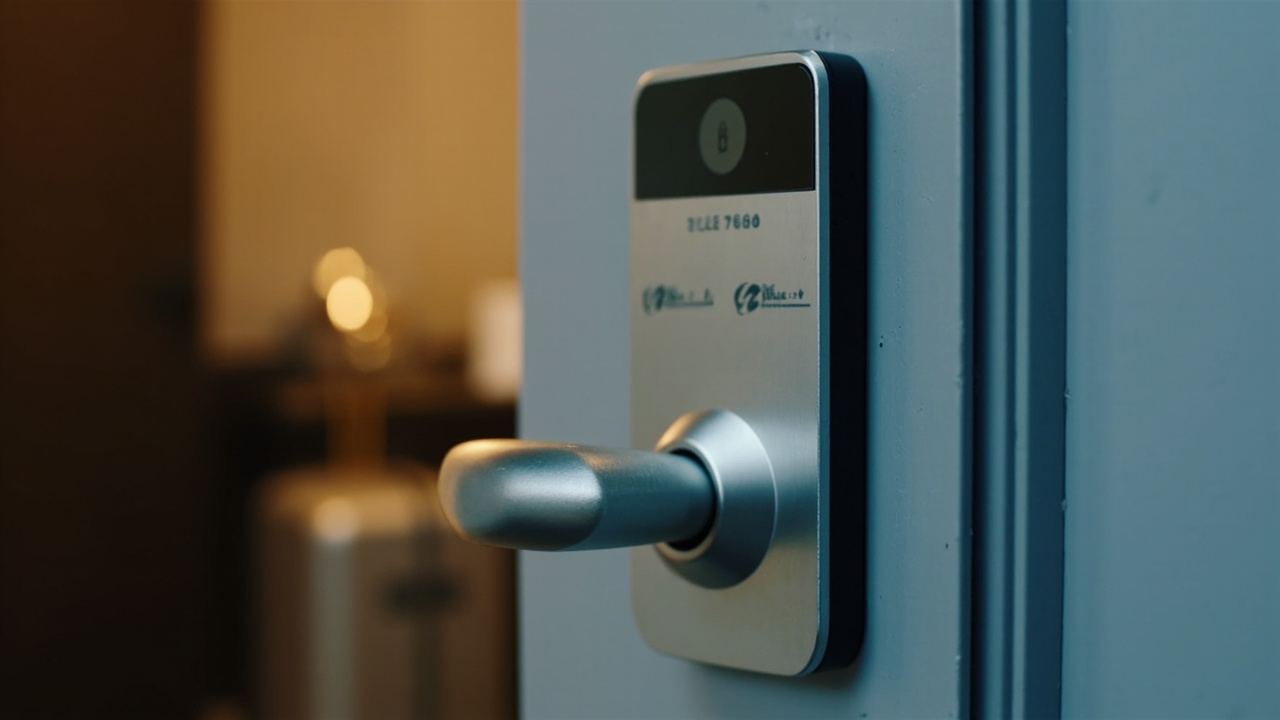
Access Policy for Hotel Chains: Front Office and Housekeeping Permissions Design
This diary follows a hotel chains access policy design from a central standards room into two illustrative properties. I am carrying a draft role map, not a finished lock specification. At each stop the same four questions remain: who may open which door, for which event, for how long, and what evidence remains when the network is unavailable? The answer must work for hundreds of identical guest rooms, public-area doors and back-of-house routes without being rebuilt site by site. All entries are illustrative.
Direct answer. In short, hotel chains access policy design is the subject of this piece. hotel chains access policy design is where the work on hotel chains access policy design sits. hotel-chains is what has to be evidenced before anyone signs. A hotel chains access policy design works through one building type door class by door class. hotel chains access policy design is the first class to close. hotel chains access policy design cannot be quoted until it is.
- Separate the door families — sort the door population into classes that behave alike, starting from hotel chains access policy design
- Map each to its grade — state what hotel-chains needs before anything is quoted
- Test the fit — record the measurement that closes hotel chains access policy design
- In hotel chains access policy design, this sequence is what hotel chains is checked against.
Front office access permissions and housekeeping room access look adjacent on an org chart, but they represent different obligations. Reception owns arrival, room assignment and departure. Housekeeping owns a bounded service task. Neither role needs a permanent room master simply because the employee is trusted. The policy separates actor, door, purpose, time window and approving authority. That is role-based access control for hotels expressed as daily work rather than badge marketing.
Before departure: pack decisions, not features
Before leaving the central standards room, I converted the project from a list of preferred locks into an object schedule. The schedule names the maintained objects: door group, credential class, person or role, trigger event, lifetime, issuer, record and approved exception. That is what I could carry between properties without pretending that a survey completed in one building settles the next. A single unclear line in this schedule becomes hundreds of operational decisions when the same door specification is repeated. The nearest catalogue entry is the SLK-230-F RFID Hotel Card Lock (Front Mount); the specific SKU is confirmed on its dated product page.
Two survey disciplines stayed in the bag: Office Smart Lock Site Survey and Smart Lock Retrofit Site Survey. The first asks what the existing door set can accept; the second asks what a retrofit touches beyond the lock. Neither should be replaced by a product photograph. For every candidate SKU, confirm on the dated product page for the specific SKU the reader form, credential format, power arrangement, fit dimensions and operating conditions, then attach the evidence to the relevant object-schedule line.
07:10: the hotel-chains rulebook becomes an object schedule
At Property A, the central policy became a matrix. The first column was not a lock model; it was the operational door group. Public, guest and service doors required different actors and different evidence.
flowchart TD
    A[Stay or task event] --> B[Identify person and role]
    B --> C[Resolve door group]
    C --> D{Access permitted}
    D -->|No| E[Stop and escalate]
    D -->|Yes| F[Set purpose and expiry]
    F --> G[Issue or activate credential]
    G --> H[Record issuer evidence and custody]
    H --> I[Revoke or reconcile at close]
| Door group | Normal actor | Trigger | Credential life | Policy owner |
|---|---|---|---|---|
| Guest room | Assigned guest | Check-in or room move | From arrival to approved departure | Front office |
| Public perimeter | Guest, visitor or staff as locally defined | Entry event | Per visit or stay rule | Property operations |
| Back-of-house | Assigned employee | Work order or shift | Task or shift | Department lead |
| Staff office | Named employee | Employment or assignment | Role period | Operations |
| After-hours access | Authorized person | Recorded exception | Event window | Duty manager |
| Emergency | Custodian | Safety event | Custody-controlled | Named accountable role |
No row grants a blanket master. Smart Lock Key Control and Master Key Decisions for Hotel Chains covers why emergency, engineering and front-desk keys need separate custody. For the hotel-chains programme, I marked which lines could use a credential, which required a physical override and which had to be removed pending a local decision. The table became the reusable part of the policy; a particular property could add exceptions without changing the roles.
08:05: front office access permissions at arrival
At the desk, the test was whether a supervisor could explain every card leaving the counter. A guest received access after identity and room assignment were complete. The credential linked to the stay, opened the assigned room and applicable common areas, and lost validity at the approved departure point. A room move created a new event and made the earlier room entitlement obsolete. The central system remained the source of the stay record; the property-level card encoder handled local issuance where the operating model required it.
Front office access permissions did not include a blank card for future use. A colleague receiving a guest, a visitor pass and an after-hours room entry were different actions with different approvers. If the network was unavailable, the desk could use only the locally authorised contingency route and record who issued what, when and why. That preserves the distinction between a normal arrival and a staff member bypassing the stay workflow.
09:40: housekeeping room access at room handover
Housekeeping room access was the sharper test. A housekeeper assigned to one room needed that room for the assigned service window, not every room on the floor. The task credential expired at the end of that window and could not be forwarded. When the assignment changed, the old entitlement was withdrawn and a new one issued. A supervisor handling an exception received a named event and a recorded reason, not an ordinary copy of the housekeeper’s card.
Service corridors, linen rooms and equipment areas followed a separate shift rule. That rule could authorize a person to enter the service environment without granting access to occupied or recently vacated guest rooms. When a credential failed or a task was interrupted, the housekeeper reported the location and task state; nobody solved the incident by passing a card to another employee. The later Training Front Office and Housekeeping to Run Smart Locks in Hotel Chains session tested these boundaries using handover and shift-change scenarios rather than a feature demonstration.
11:15: compare four permission patterns
I compared four permission patterns. The test was not convenience at issuance; it was the damage left by misuse, copying or an unclosed exception.
| Option | Scope | Life | Evidence | Main weakness | Decision |
|---|---|---|---|---|---|
| Shared front office master | Every guest room | Ongoing | Card issuance | Shared card masks actor | Reject |
| Floor-wide housekeeping card | All rooms on floor | Shift | Person and shift | Excess room scope | Exception only |
| Room-and-task card | Assigned room | Named service window | Person, room and purpose | Reissue after interruption | Default |
| Named-event after-hours grant | Selected room | Specific event | Approver, reason and actor | More administration at night | Controlled use |
The room-and-task card became the default because it matched the work event and produced the most useful record. The floor-wide card was allowed only where a named operational exception could explain why room-level scoping was impractical. The shared front office master was removed, not softened. This was not a product comparison: lock capability and system integration still had to be demonstrated. It was a decision about what access the organisation was prepared to administer.
12:30: set the expiry rule before issuing the credential
The hotel credential expiry policy was written as a set of reasons to stop, rather than one timer copied across every card. Guest validity followed the stay and room assignment. Housekeeping validity followed the task. An after-hours grant ended when the authorised event closed. A contractor followed the visit or work window agreed for that person. In every case, the expiry trigger, issuing authority and revocation action had named owners in the property workflow.
At 13:50 I repeated the exercise at Property B with the network disconnected. The policy did not assume that online lookup would be available. Pre-cleared contingency issuance, the property-level encoder and a bounded exception log were treated as acceptance conditions. I did not need to decide whether a particular lock family offered offline operation; the acceptance test had to show the selected SKU and the surrounding system working together. A card issued during the outage received a reconciliation identifier, and the property team reconciled it after service returned.
15:05: make the audit explain a decision
A smart lock audit trail for hotels is useful only when a reviewer can reconstruct the event. For each access decision, the policy named the credential identifier, the linked person or accountable role, the door group, the purpose, the issuer, the valid window and the revocation or override event. Where the selected system did not create a field, the surrounding property system had to supply it or the policy marked the evidence as unavailable. Absence of a record could not be rewritten as proof that an event did not happen.
The retention decision belongs with the hotel credential model and the evidence schedule. Data Retention and Privacy for Smart Locks in Hotel Chains separates what an operation needs from what it merely tends to keep. The diary ended with a short data-minimisation review: no free-text reason unless the exception process required one, no duplicate copy of a guest profile, and a defined owner for each retained record. Smart Locks for Hotel Chains: Credential Model that Survives Card Encoding and Room-Move Churn was used to reconcile guest, housekeeper and temporary access states.
CONFIRM-WITH-LOCAL-DATA-PROTECTION-REVIEWER: Confirm the identity fields, access-event records, disclosure rules and retention periods that the chain may use at each operating location.
18:00: carry a core policy across the border
The border crossing produced two documents: a group core and a property annex. The core defined role names, triggers, credential lifetimes, custody, reconciliation and evidence. The annex recorded local exceptions, approved door changes, emergency procedures and local retention decisions. The hotel-chains rulebook remained stable, while the annex could change without creating a new meaning for housekeeping access at another site.
Safety and building decisions stayed out of the portable template. The evaluator asked the relevant local authority to review the proposed locking arrangement, escape release, door swing, signage and any alteration. The policy did not treat one property’s approval as evidence for the next. This also kept product evidence separate from local approval: the supplier provided dated evidence for the selected SKU, and the property obtained the local decisions it needed.
Readers comparing approaches usually start with hotel smart lock total cost of ownership. That is the same question hotel chains access policy design has to answer here.CONFIRM-WITH-LOCAL-BUILDING-AUTHORITY: Confirm which lock, hardware and door alterations require review or approval at each property.
CONFIRM-WITH-LOCAL-FIRE-AUTHORITY: Confirm the locking arrangement, escape release and operating procedure for each protected escape route.
Next morning: hand over an evidence pack
The final handover contained an evidence pack, not a declaration that the system was ready.
| Control question | Evidence to sign |
|---|---|
| Role scope | Approved role-to-door matrix |
| Issue and expiry | Task, stay and exception flows |
| Offline continuity | Tested issuance and reconciliation record |
| Evidence | Event fields, custody and retention schedule |
| Local fit | Door schedule and dated SKU evidence |
| Training | Front office and housekeeping exercises |
The evaluator signed each line by role. A door exception remained open rather than being hidden in a note. A missing offline test blocked approval of the continuity claim. A missing expiry owner blocked the credential workflow. This kept the hotel chains access policy design tied to work that could be performed at 07:00 or 23:00. When the package is ready, send the object schedule, door survey, target door classes and evidence request through request a quote, with every SKU marked for confirmation on the dated product page.