
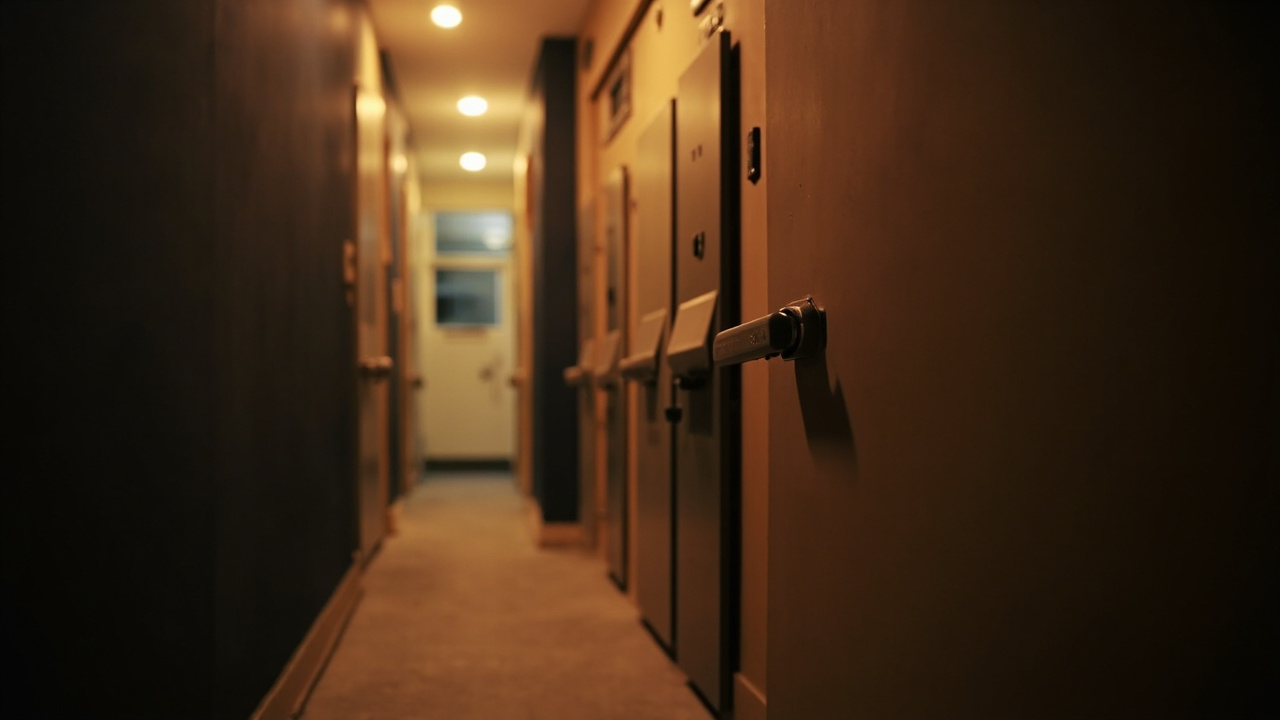
Vandalism, Misuse and Environmental Load on Locks in Government and Municipal Buildings
A public counter does not present the same load as a records store, while a service entrance may combine weather, deliveries and repeated staff movement. This component teardown treats government buildings misuse load as an operating condition to be tested at each door, not as a feature to be purchased. A smart lock vandalism assessment should begin with what people do to the door, what the environment reaches, and which component absorbs the resulting force.
Begin with the load budget, not the lock feature list
Direct answer. A property manager evaluating replacements needs a method that connects a visible symptom to a component and then to a decision. The method must also distinguish deliberate damage from ordinary but intensive use. Otherwise
Build a door-by-door load budget with four entries: the people and vehicles using the opening, the actions performed at the lock, the environmental exposure present at the installed position, and the consequence of failure. The budget then becomes part of the purchase record rather than a verbal expectation. It also gives evaluators a common language for comparing public building access hardware across sites. The earlier published note on this is Smart Locks for Government Buildings. Every commercial claim here has to be checked against the smart door locks.
For the credential and zone arrangements, use Smart Lock Key Control and Master Key Decisions for Government and Municipal Buildings as a companion control rather than treating key control as an automatic consequence of installing electronic locks.
Follow the force through each component
Damage does not always appear first in the electronic reader. A pushed handle transfers load through the spindle and lock body into the latch or deadbolt, then through the strike into the frame. Repeated impact can loosen the frame before the lock body appears faulty. Environmental exposure may affect several interfaces at once.
flowchart TD
    A[Public use and hostile force] --> B[Handle and spindle]
    A --> C[Reader and credential input]
    B --> D[Lock body latch and bolt]
    D --> E[Strike and door frame]
    C --> F[Controller power and network]
    E --> G[Opening failure]
    F --> H[Access denial]
    G --> I[Service call and disruption]
    H --> I
| Component | Load to inspect | Warning sign | Evidence required | Decision consequence |
|---|---|---|---|---|
| Door leaf and frame | Pushing, impact and repeated operation | Movement, distorted strike area or rubbing | Frame condition and door measurements | Repair or adjust the opening before changing the lock |
| Lever or handle | Rotation, pulling and possible misuse | Wobble, bent spindle or poor return | Movement, fixings and operating feel | Replace the damaged component if alignment cannot restore it |
| Lock body | Repeated turning, latch and bolt movement | Grinding, incomplete throw or free movement | Test method and component condition | Identify the failed mechanism before selecting another lock |
| Latch, deadbolt and strike | Entry force and repeated impacts | Scraping, incomplete engagement or bolt drag | Strike alignment and engagement evidence | Correct the cause rather than masking it with more torque |
| Reader and input surface | Contact by users, cleaners and visiting staff | Unresponsive input, worn markings or residue | Device condition, cleaning method and test result | Separate input failure from credential or power failure |
| Controller and credential store | Shared administration and changing permissions | Incorrect rights or unexplained denial | Permission source, audit fields and test accounts | Correct administration and access policy |
| Power and communications | Interruption, condensation or weak coverage where present | Unstable operation or loss of access | Power source, outage procedure and coverage evidence | Define fallback access before selecting the electronic architecture |
The teardown is complete only when the evidence explains the symptom. “The reader failed” is not an adequate conclusion when a loose strike has stopped the latch from entering cleanly.
Separate deliberate damage from operational misuse
Misuse does not always mean hostile entry. Several recurring patterns need different controls:
- Shared or copied access: a code or visitor credential is passed to another person. The lock may operate correctly while the access boundary fails.
- Forced handle movement: users pull, twist or push the handle beyond its normal travel. The resulting load can reach the spindle, lock case and frame.
- Door abuse and collision: equipment, bins or maintenance activity strikes an inward or outward opening. This is not solved by choosing a more secure credential.
- Incorrect override use: a mechanical override or service function is used routinely because the normal access route is inconvenient.
- Surface contamination: cleaning material, moisture or residue reaches a reader or input surface. The first diagnosis must distinguish contamination from an electronic or credential fault.
Lock abuse resistance should therefore be tested at component level. Ask what evidence distinguishes deliberate force from normal operation and which parts are intended to deform, replace or absorb load. The supplier should explain the test boundary instead of offering an unqualified “vandal-resistant” description.
Match environmental exposure to the door’s job
Environmental load is location-specific. A lock inside a records store may see little weather but still face cleaning, dust and repeated access by authorised staff. A service entrance may experience rain, temperature variation, delivery equipment and longer exposure to the outdoor environment. These conditions must be observed rather than inferred from the building type.
| Opening | Dominant operating load | Exposure to verify | Component question |
|---|---|---|---|
| Public counter | Visitors, staff, repeated input and cleaning | Cleaning method and contact around the reader | Can the input surface and mechanism be inspected without dismantling the whole lock? |
| Secure office | Staff circulation and deliberate access hierarchy | Internal environment and cleaning regime | Does the evidence cover the lock body and credential controls separately? |
| Records store | Lower traffic but high consequence of access failure | Moisture, dust and storage conditions if present | Which component would fail first under the recorded environmental conditions? |
| Meeting suite | Scheduled peaks and shared booking credentials | Room entry patterns and override use | Is misuse caused by scheduling, credential design or hardware operation? |
| Service entrance | Deliveries, staff movement and weather exposure | Water ingress, impact, temperature and power location | Which exposed parts require enclosure, service access or a different lock family? |
A second pass through the government buildings misuse load should record door component environmental load beside operational demand. This prevents an indoor component from being accepted for a wet service door merely because both products use electronic credentials. Municipal lock durability is a site-specific claim, not a transferable adjective.
Any proposal affecting emergency exits, fire separation or building access arrangements must be reviewed for the specific opening.
CONFIRM-WITH-LOCAL-FIRE-AUTHORITY: Confirm the locking, release and emergency-egress arrangement for every affected door before hardware selection.
Treat power and access administration as components
Electronic access introduces components outside the lock case: the credential reader, controller, network path, power source and administrative records. A door can be physically intact yet fail the operating requirement because a visitor credential was not issued, a permission was not withdrawn, or power was lost without a defined manual route.
Ask the supplier to identify which functions continue during a network interruption and which require local authorization. Do not accept “offline” as a complete description; identify which credentials remain valid, how events are reconciled later and who can perform recovery. Any data captured during an outage should follow the operator’s approved retention rules.
The security regime may also assign different authority to different door classes. Identify the governing document, its owner and the person authorized to interpret it before the evaluation begins.
CONFIRM-WITH-LOCAL-BUILDING-AUTHORITY: Confirm the governing security rulebook, the authorised interpreter and the approval route for each door class.
Compare response options before selecting hardware
A component view does not force an all-or-nothing replacement. The appropriate response depends on whether the evidence points to the door, the lock, the workflow, the environment or a small number of exceptional openings.
| Response option | Best fit for the evidence | Required before approval | Main operational risk |
|---|---|---|---|
| Repair and reinforce the existing opening | Frame movement, strike misalignment or handle damage is the primary cause | Door inspection, alignment evidence and repair scope | Recurring damage remains possible if misuse and environmental causes are untreated |
| Replace selected lock components | The door and frame are sound, but a defined lock component is worn or unsuitable | Component identification, compatible replacement evidence and a test method | Parts may be replaced before the operating pattern is corrected |
| Use a mixed lock schedule | Doors have materially different traffic, exposure and access consequences | Door-level load budget, governance approval and maintenance ownership | Too many configurations can become difficult for staff to administer |
| Run a monitored trial before wider rollout | Several causes remain uncertain or the rulebook has unresolved questions | Trial protocol, baseline condition, agreed success measures and exit criteria | Trial conditions may not represent peak public use |
The strongest decision is the one supported by the load budget. A broad replacement may appear efficient on paper, but mixed schedules are often easier to justify where public counters, secure offices, records stores and service entrances perform different jobs.
Use Smart Locks for Government and Municipal Buildings: Door Survey and Fit Reality to establish the door evidence before comparing products. Record whether a proposed component fits the existing opening, requires frame alteration or changes the maintenance route.
Demand a component evidence pack
The supplier response should let an evaluator trace each claim back to a specific component and installed door type. The minimum pack should contain:
- A door schedule showing the leaf, frame, opening direction, handle arrangement, strike position and intended access zone.
- A load narrative for each representative door, including normal use, misuse, impact and environmental exposure.
- Component-level evidence for the lock body, moving parts, reader, input surface, strike interface, power arrangement and communications path.
- The boundary of any test evidence, including the conditions, repetitions and component configuration that were assessed.
- A service and ownership map covering inspection, cleaning, battery or power maintenance, override recovery and damaged-part replacement.
- A fallback route for each door where electronic denial could interrupt public service or secure access.
Requests for general product literature should be treated as background, not proof that a component suits the recorded door. Confirm material specifications on the dated product page for the specific SKU, and ask for the underlying evidence where a specification drives selection.
If the symptom appears after installation, Smart Lock Failure Triage for Government and Municipal Buildings provides a useful format for separating symptom, component, test and action without replacing the original survey.
Write acceptance criteria that can be inspected
Acceptance criteria should describe what the property manager can inspect, not an outcome that cannot be demonstrated. Instead of requiring a lock to “resist vandalism,” define the relevant door, the force or abuse scenario, the components in the load path and the evidence required. The test result should state what passed, what was tested and where the limits of the evidence lie.
For access administration, require clear ownership of credential creation, visitor return, lost-badge handling and staff departure. For physical components, require an inspection route that does not obstruct public service. For environmental exposure, tie any enclosure, seal or material statement to the conditions recorded at that particular opening.
This overlaps with the earlier coverage in the sl 6301 installation. That is the same question government buildings misuse load has to answer here.The final evidence pack should also establish how the building authority or security rulebook interprets each proposed arrangement. A supplier can document its product; the authority or designated owner must determine whether the proposed use fits the operator’s obligations.
CONFIRM-WITH-LOCAL-BUILDING-AUTHORITY: Confirm which written security requirements apply to credentials, overrides, visitor records and door-specific acceptance tests.
Sequence evaluation without creating another incident
Start with representative doors rather than the entire estate. Select at least one public-facing opening, one controlled internal opening, one low-traffic sensitive room and one service or exposed entrance. Record their baseline condition and failure history before changing hardware.
Then separate three workstreams: physical door defects, lock-component selection and access administration. Mixing them into one work order makes it difficult to determine what solved the problem. The result should be a component schedule that states why each door receives the selected arrangement and which evidence must be revisited if use changes.
The build-up behind that decision is in sl 6301 for metal doors. That is the same question government buildings misuse load has to answer here.Access-event information should remain proportionate to the question being asked.
CONFIRM-WITH-LOCAL-DATA-PROTECTION-REVIEWER: Confirm which access-event fields may be retained, who may view them and the approved retention period before including logging in the acceptance criteria.
Turn the teardown into a procurement instruction
The finished output is not a generic lock schedule. It is a traceable chain from door use, through component load, to evidence, acceptance criteria and maintenance ownership. That chain lets the operator challenge a weak claim, explain a mixed decision and show why a component belongs at one opening but not another.
Use RFQ Template for Smart Locks for Government and Municipal Buildings to carry the door-level evidence into supplier questions. Send the supplier a scoped schedule, request SKU-specific evidence and route unresolved authority questions to the named local reviewer before seeking a request for quotation.