
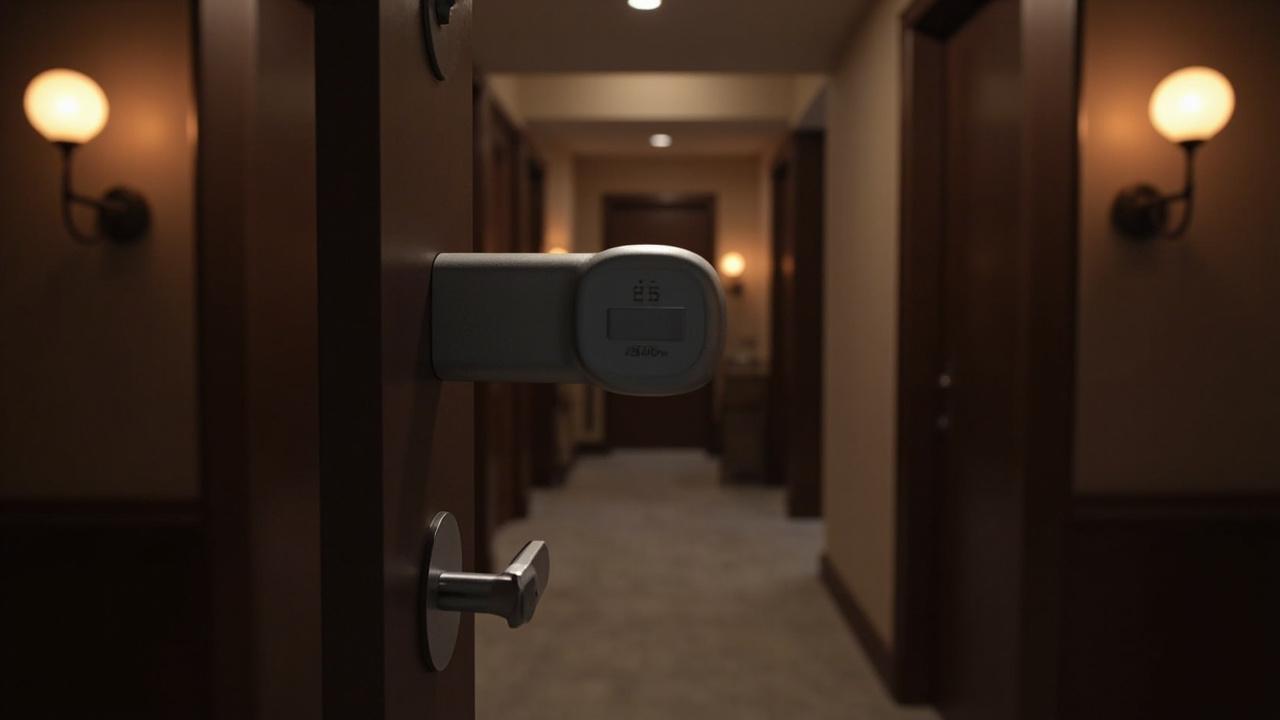
SLK-9936S: Is It Suitable for Hotel Lock Replacement Projects?
Fit is a geometry-and-topology question, not a marketing question. A replacement lock either matches your doors, your credential chain, and your software architecture, or it does not — and every one of those three has a measurable answer from the datasheet.
Short answer: the SLK-9936S is suitable for most RFID-card hotel lock replacement projects where the guest-room doors are 36–100 mm thick, the property can standardize on Mifare 13.56 MHz credentials, and the operator wants a card lock that deploys either standalone or against a centralized database. It is positioned for hotels from 1 to 5 stars, and its retrofit-critical specs — the 36–100 mm thickness envelope, the 5-pin cylinder, the 3-point latch, and mechanical emergency access — are published on the product page, which is exactly what a replacement decision needs.
It is not suitable when the door falls outside that envelope, when the opening is glass or exterior aluminum, when the guest experience is built on biometrics or app unlock at the door, or when the property intends to reuse legacy 125 kHz card stock without re-credentialing. Those are failure-to-fit scenarios, and this article names each one, then hands you the assessment framework to sort your own project into fit, fit-with-conditions, or do-not-fit before a single sample is ordered.
The companion to this piece is the process view: hotel smart lock replacement guide covers the stage-gate timeline once a model is chosen. This article answers the earlier question — is this model the right one.
The Spec Block Is a Set of Fit Tests, Not a Feature List
Most buyers read a datasheet for reassurance. In a replacement project, each published line is instead a test your doors and operations either pass or fail. The SLK-9936S product page publishes the following first-party specifications; the right-hand column converts each into the test it imposes.
| Published spec (product-page-documented) | What it tests on your project | Pass condition |
|---|---|---|
| Door thickness 36–100 mm | Measure every door type, not a sample of one | All surveyed doors land inside 36–100 mm |
| RFID Mifare 1 @ 13.56 MHz | Card technology alignment with front-desk encoders and any retained card stock | Property standardizes on or already uses Mifare 13.56 MHz |
| Read distance 0–5 cm, read time <0.25 s | Guest-experience expectation at the door | Instant tap behavior is acceptable; no long-range entry required |
| Power 4 × AA, battery operating cycles >15,000 | Housekeeping and maintenance battery policy | Battery PM rounds can be scheduled per floor or per lock |
| Audit/event records up to 1,000 | Security reporting depth held on-lock | 1,000-event history meets your reporting need or centralized mode supplements it |
| 5-pin cylinder, 3-point latch | Existing door prep and latch interaction | Bore/face dimensions compatible or carpentry scoped per door type |
| Mechanical emergency access | Key-control and fire/response protocol | Physical key override fits your emergency procedure |
| Multilingual management software; standalone or centralized database modes | IT topology and staffing model | One of the two architectures matches your property |
| Stainless steel + alloy body, multiple finish options | Brand-standard appearance across the property | A finish maps to your design standard |
| Positioned for 1–5 star hotels | Segment fit | Your service tier sits inside that range |
Read this way, the datasheet stops being advertising and becomes a measurement instrument. Nothing here is aspirational: the thickness envelope, the credential frequency, the cylinder format, and the dual software architecture are all published numbers you can verify doors against before requesting anything.
Five Axes of a Fit Assessment
A replacement decision fails along five independent axes. A model can pass four and die on the fifth, which is why "looks like a good lock" is not a procurement answer. Run SLK-9936S through all five and record one of three verdicts per axis — fits, fits with conditions, does not fit:
- Axis 1 — Door geometry. Thickness, material, edge prep, latch interaction.
- Axis 2 — Credential chain. Card frequency, encoder workflow, card stock continuity.
- Axis 3 — Deployment topology. Standalone versus centralized database; software and IT readiness.
- Axis 4 — Operations load. Battery program, event-log and audit policy, emergency access rules.
- Axis 5 — Positioning and finish. Star-tier fit, finish standard, aesthetic consistency across room types.
Decision rule: any single "does not fit" on Axis 1 or Axis 2 disqualifies the model for that door population. Axes 3–5 failures are usually convertible — to a different deployment mode, a different property population, or a different model in the same family.
That asymmetry matters. You cannot negotiate with a 110 mm door. You can, however, run the same lock standalone on an annex building with no cabling.
Axis 1: Door Geometry — the Envelope Governs Everything
The 36–100 mm published thickness range is the single most consequential number for a retrofit. Doors at a property cluster into populations: original timber slabs, replaced hollow-cores, fire-rated assemblies, heavier solid entry doors to suites. Measure each population — minimum three doors per distinct door type, calipers at the thickest point away from the edge — and map results against the envelope.
Three mechanical details inside Axis 1 deserve their own checks:
- 5-pin cylinder format. Replacement locks inherit the door's existing boring in the simplest case, but cylinder format and tailpiece geometry still have to meet the existing (or newly cut) prep. When doors were prepped for a different brand's cam and follower, re-prep is carpentry, not a swap. Scope it per door type during the survey, exactly as the replacement guide stage-gates require.
- 3-point latch. The latch engages multiple contact points into the frame. Frame strike alignment on worn doors must be checked door by door; a lock that fits the leaf can still fight a tired frame.
- Mechanical emergency access. The physical key override needs an outside cylinder position compatible with your emergency key control — and your life-safety egress arrangement on the inside stays a door-level decision, not a lock-line item.
Where the SLK-9936S sits at 36–100 mm, the hidden-reader SLK-9905A publishes roughly 38–100 mm. Two millimeters at the thin end sounds trivial until your survey finds a 37 mm door population on a renovated floor. That is the point of envelopes: they are contractual, and a project lives or dies at the edges.
Axis 2: Credential Chain — Frequency Decides Card Fate
The SLK-9936S reads Mifare 1 at 13.56 MHz, at 0–5 cm, in under a quarter of a second. For a property replacing another 13.56 MHz card system, the credential chain carries over conceptually: front-desk encoding, guest card issue, staff cards, lost-card reissue. For a property running legacy 125 kHz EM stock, nothing carries over — every card, every encoder workflow, and every supplier relationship for card consumables changes.
Run this test before the geometry test, because it changes the project's shape:
| Current credential situation | Fit verdict on SLK-9936S | What changes |
|---|---|---|
| Existing Mifare 13.56 MHz hotel system | Fits | Re-encode to new lock family; card stock plan per room |
| Mixed stock, some 13.56 MHz, some 125 kHz | Fits with conditions | Standardize the whole property on Mifare during the swap |
| All-125 kHz EM, want to reuse card inventory | Does not fit as a reuse plan | Re-credential the property or choose a matching-technology model |
| Key-only property upgrading to cards | Fits | New credential program: guest, staff, cleaning, manager tiers |
| Fingerprint-first or app-first guest experience desired | Does not fit this model | Look at fingerprint/keypad/app categories, not a card lock |
The guest-facing behavior — tap close to the reader, sub-quarter-second response — sets an expectation your front-desk scripting and signage should match. Guests coming from mechanical keys need the one-line education; guests coming from another card system need nothing.
Axis 3: Standalone or Centralized Database — Pick the Topology, Not a Feature
The spec block states the SLK-9936S operates in standalone or centralized database modes, managed through multilingual management software. This is a deployment architecture choice, and in replacement projects it decides more long-term cost than the lock itself.
Standalone means each lock holds its own access decisions; cards are encoded to carry validity, and event records live on the lock (up to 1,000 audit/event records) until downloaded. Centralized database mode puts the property's access records into shared software at the desk or back office, changing how lost cards, staff changes, and reporting are handled.
The decision logic for a replacement:
- Fits standalone: small property, single building, one or two encoding points, minimal IT appetite, phased floor-by-floor swaps where each building closes independently.
- Fits with conditions, choose centralized: multi-floor or multi-building operations, front-desk-driven credential changes, reporting obligations where on-lock history is thin. Conditions: an encoding station location, software installation ownership, and staff roles defined before commissioning.
- Does not fit either way — escalate: properties that want live online locks at every door, remote unlock over the internet as the operating model, or PMS integrations beyond what the hotel software layer covers. These are architecture conversations to have via request-a-quote before committing a model, not after.
Whatever you choose, run one pilot floor in the chosen mode before the full order. That is a stage-gate rule from the replacement guide, and it exists because topology decisions feel abstract until housekeeping actually tries them.
The whole assessment behaves like a state machine — survey data pushes each door population into one verdict, and the verdict dictates the next project move:
stateDiagram-v2
    [*] --> Surveyed
    Surveyed --> Disqualified : Axis 1 or Axis 2 fails
    Surveyed --> Conditional : Axis 3–5 gap found
    Surveyed --> Shortlisted : all five axes pass
    Conditional --> Shortlisted : condition closed \n · mode split · finish mapped · carpentry priced
    Conditional --> Disqualified : condition cannot be met
    Disqualified --> Redirected : glass · outdoor · thin-door · 125 kHz population
    Shortlisted --> PilotFloor : one floor in chosen mode
    PilotFloor --> [*] : door register + topology statement → quote
    Redirected --> [*] : sibling model quoted for that population
Axis 4: Operations Load — Power, Audit, and Emergency Rules
Four AA batteries, more than 15,000 battery operating cycles, event memory of up to 1,000 records, mechanical emergency access. None of these lines is a selling point in a replacement project; all four are operating obligations.
- Battery program. The lock runs on four AAs. A replacement project converts "who changes batteries" from an unanswered question into a scheduled duty. Decide before rollout: per-lock alerting when available, or per-floor PM rounds; disposal handled by housekeeping or engineering. Properties that skip this step discover the battery program during a busy season, at 2 a.m.
- Audit depth. Up to 1,000 on-lock event records is the published figure. Match it against your reporting duty: incident lookbacks of days fit on-lock memory; portfolio-level retention belongs in centralized mode and your own export discipline. Do not assume the lock is your archive.
- Emergency access. The mechanical override means the property still runs a physical key cabinet somewhere — for engineering, for fire response, for the general manager's drawer. A replacement that ignores key control just relocates an old problem. Define how many emergency keys exist, where they live, and who signs them out.
Axis 5: Positioning and Finish — the Consistency Test
The SLK-9936S is positioned for hotels from 1 to 5 stars, with a stainless steel and alloy body and multiple finish options. In a replacement, the test is not "is this a nice lock" — it is "will every door type across every room category present one standard."
A practical consistency protocol: pick your three representative room categories (standard, upgraded, suite). Choose a finish per category from the published options. Before ordering, view full lock sets in those finishes under the actual corridor lighting — finishes photograph uniformly and read differently under warm 2700 K sconces versus downlights. Where a heritage floor keeps original brass hardware, the finish-mapping decision is exactly the kind of thing the broader how to choose hotel smart locks gates cover; here it is one axis, not the whole war.
One caution on segment language: the 1–5 star positioning means the product line serves the full range; it does not mean one configuration is identical across budget and premium properties. What changes between a 2-star and a 5-star deployment on the same lock is usually Axis 3 topology and the credential/finish program, not the reader.
Failure-to-Fit Scenarios — When to Say No to SLK-9936S
A fit assessment earns trust only if it can end in rejection. These are the named scenarios where SLK-9936S is the wrong model for at least part of the project:
| Scenario | Why it fails | What to do instead |
|---|---|---|
| Doors under 36 mm (thin hollow-cores, some renovated interior leaves) | Outside the published thickness envelope | Re-hang doors to spec, or match a model whose envelope covers the actual thickness — survey first, then shortlist |
| Doors over 100 mm (heavy solid entry, some fire assemblies) | Outside the envelope at the thick end | Confirm per door type; move those openings to a model built for them, or modify the prep where engineering allows |
| Glass entrances, partitions, or French doors | Not a timber-door cylinder lock | Glass-door series such as SLK-G200 |
| Aluminum exterior and outdoor doors | Envelope and environment mismatch | The catalog's outdoor/aluminum-door series instead of a room lock |
| Property wants to reuse a large 125 kHz EM card stock inventory | Reader is Mifare 1 @ 13.56 MHz; stock will not authenticate | Re-credential on Mifare with the swap, or select by frequency match |
| Biometric-first or app-first guest entry at the room door | 9936S identification is RFID card plus mechanical emergency access | Fingerprint, keypad, or app-enabled categories in the hotel-lock line |
| Real-time online locks with remote unlock as the operating model | Published architecture is standalone or centralized-database software, not per-door live networking | Raise the architecture requirement up-front as a distinct question in RFQ |
| Existing door preps incompatible with the 5-pin cylinder and 3-point latch without carpentry | Mechanical form-factor conflict | Price re-prep per door type; if carpentry exceeds replacement value on those leaves, replace doors, not just locks |
| Single-occupant serviced units wanting per-stay app self-check-in | Room-fleet credential model differs from hotel card program | Evaluate residential/apartment-side models before standardizing on a hotel card lock |
The middle row of every failure is "verify with survey data." None of these rejections needs a factory concession letter; they need calipers, a card inventory, and an honest topology statement from the operator.
Where SLK-9936S Sits Against Its Siblings
The factory's hotel line is 24 models of the 79-model catalog, so a "does not fit" verdict is a redirect, not a dead end. Compare the replacement-relevant differences that the published pages actually support:
| Decision factor | SLK-9936S | SLK-9905A (hidden reader) | Other hotel models (9936G, 9951TH, 9962S, RFTC card/code series) |
|---|---|---|---|
| Published door thickness envelope | 36–100 mm | ~38–100 mm | Confirm on each product page before shortlisting |
| Identification | RFID Mifare 1, mechanical emergency access | RFID reader with concealed reader styling | Card-only and card-plus-code variants exist in the RFTC/RF line |
| Deployment architecture | Standalone or centralized DB, multilingual software | Per its product page | Per each product page |
| On-lock audit records | Up to 1,000 | Not assumed here | Not assumed here |
| Replacement-project role | Default card-lock candidate when the envelope fits | Thin-door-adjacent or styling-driven alternative | Mix-and-match per property area: pool, back-of-house, code-access rooms |
Two discipline notes. First: only the SLK-9936S block and the SLK-9905A thickness figure are quoted from published pages here; anywhere this table says "confirm," it means confirm — sibling specs are not interchangeable. Second: hotels routinely split a replacement across models (card locks on guest rooms, code locks on pool and back-of-house) on purpose. A shortlist of two SKUs from one family is a feature, not indecision.
The Fit Scorecard
Use this worksheet per door population, not per property. A 120-room building with three door types is three assessments. Score each line against measured data; a 0 on any Axis 1 or Axis 2 line caps the whole population at "does not fit — redirect."
| # | Fit test | Evidence required | Score 2 = fits, 1 = conditions, 0 = fails |
|---|---|---|---|
| 1 | Door thickness inside 36–100 mm on 100% of surveyed leaves | Caliper sheet, 3+ doors per door type | ☐ |
| 2 | Edge/bore prep compatible with 5-pin cylinder, or carpentry priced | Door prep photos + measurements | ☐ |
| 3 | Frame condition carries a 3-point latch without re-shimming | Latch-strike check on worn doors | ☐ |
| 4 | Credential plan lands on Mifare 13.56 MHz | Card inventory count by frequency | ☐ |
| 5 | Encoder/front-desk workflow defined for new cards | Desk walkthrough note | ☐ |
| 6 | Standalone vs centralized mode chosen deliberately | One-page topology statement | ☐ |
| 7 | Battery PM owner named and scheduled | Ops roster line item | ☐ |
| 8 | 1,000-record on-lock audit depth meets reporting duty | Security requirement statement | ☐ |
| 9 | Mechanical emergency key control policy exists | Key cabinet count + sign-out sheet | ☐ |
| 10 | Finish maps to brand standard under real lighting | Sample set viewed on site | ☐ |
| 11 | Glass/exterior openings excluded from this model's scope | Door-type register with locations | ☐ |
| 12 | No biometric/app/self-check-in requirement on these rooms | Guest-journey statement | ☐ |
Reading the score: 20–24, standardize on SLK-9936S for that population. 15–19, proceed with the named conditions documented per line. Under 15, or any Axis 1/2 zero, redirect that population to the matching model before sampling anything. The how to upgrade traditional hotel locks to smart locks article covers the survey discipline that feeds lines 1–3 for key-era properties.
Illustrative Scenario: A 120-Room Property, Three Door Populations
Consider a 120-room property, built in two phases, replacing an aging card system. The survey finds: 84 original solid doors measuring 40–45 mm; 24 renovated hollow-cores at 35 mm; and a 12-room garden wing whose rooms open onto an exterior corridor with 50 mm doors plus nine glass French-door openings to patios. Card inventory: 13.56 MHz throughout, plus a drawer of dead 125 kHz staff cards from a prior regime.
The assessment lands cleanly:
- The 84-door main population — fits. Thickness mid-envelope, existing 13.56 MHz credential chain carries over with re-encoding, standalone mode chosen for phase one with centralized software planned for the office wing.
- The 24 renovated doors — does not fit at 35 mm. One millimeter below the published floor. Two options, both honest: re-hang those leaves with 38–40 mm slabs (cheap, permanent) or move those rooms to a model whose envelope covers 35 mm. What the property must not do is "make it work" with shims and hope; the envelope is a specification, not a suggestion.
- The garden wing — split. The 50 mm room doors fit and join phase one. The nine glass openings redirect to the glass-door series as line items of their own.
- The dead 125 kHz cards — a cleanup, not a constraint. Nothing to reuse, nothing to carry; confirm the encoder station retires with them.
One model, one property, three verdicts, zero surprises at installation week. This is what a fit assessment is for: the redirect happens on a survey sheet in week two, not under a crowd of guests in week twelve.
From Verdict to Order — What to Confirm with the Factory
Once the scorecard passes, the shortlist converts into two documents: a door-type register (thickness, material, prep, count per door population) and a topology statement (standalone or centralized, encoder locations, staff roles, reporting duty). Attach both when you request a quote, and ask the factory to verify in writing on record:
- Cylinder/latch interaction against your door prep — per door type, not generically.
- Which management-software build and languages your centralized deployment uses, and on what hardware.
- Credential and encoder compatibility with your chosen Mifare program, including card stock supply.
- Finish samples for the mapped brand standard before bulk production.
- Pilot-floor quantities and the event-log readout procedure for acceptance.
Pricing, MOQ, and lead time resolve through the quote against that confirmed scope — this factory sells on quote-based commerce, so the door register and topology statement are what make the quote comparable across shortlisted models. If the earlier choice of category itself still feels open, how to choose hotel smart locks runs the property-level gates; if the decision here passes, the replacement guide picks the project up at the first stage-gate.
The Verdict Rule
SLK-9936S is a legitimate default for RFID-card hotel replacement projects, and it earns that status the way fit defaults should: by publishing the numbers that decide fit — the 36–100 mm envelope, Mifare 13.56 MHz, standalone or centralized database modes, 5-pin cylinder, 3-point latch, mechanical emergency access, on-lock audit depth — and by carrying a 1–5 star positioning across a hotel line deep enough to absorb the redirects when doors, glass, or credentials say no.
Hold the rule: measure every door population, name your topology, inventory your cards. If all three land inside the published envelope, standardize. If any one lands outside, redirect that population — and let the survey, not the datasheet's best day, decide which model you actually order.