
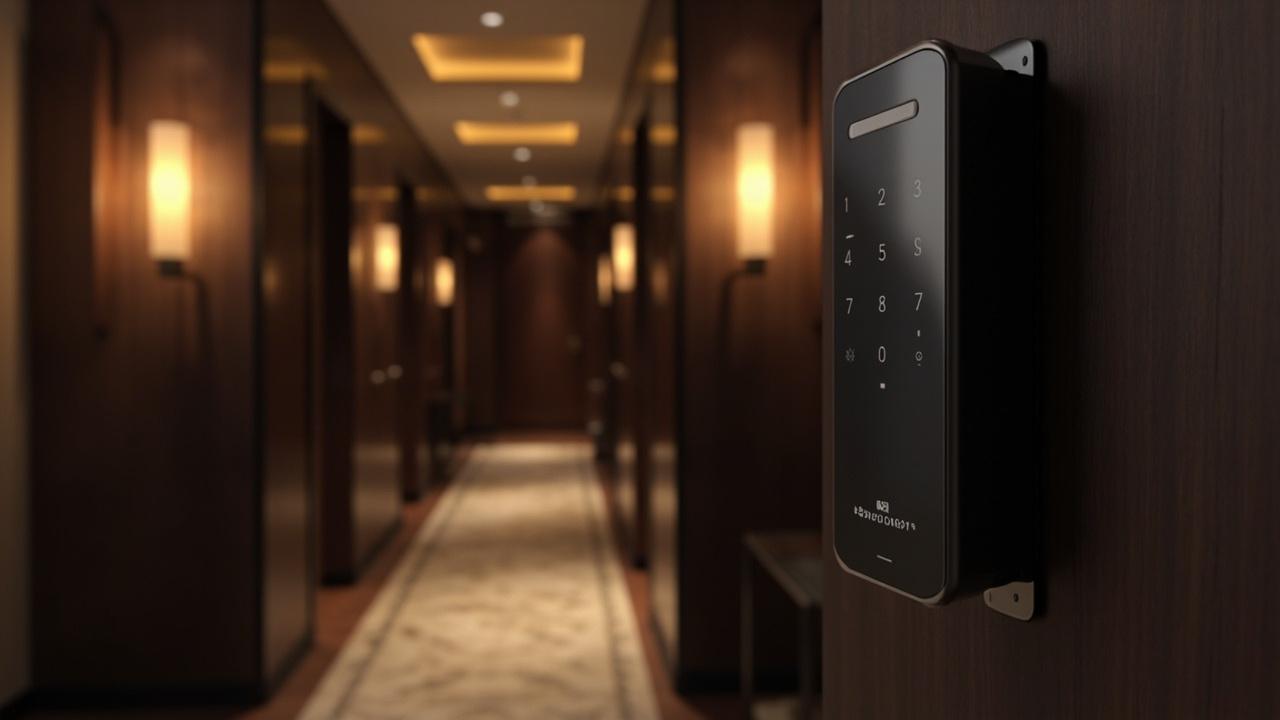
Stainless Steel Smart Locks
A "stainless steel smart lock" is a smart lock whose lock-case and external trim are fabricated from a chromium-bearing iron alloy whose passive chromium-oxide layer is the corrosion mechanism — not a coating applied afterwards. In SmartLockFactory's 79-model published catalog, "stainless steel" appears as a body descriptor in two verifiable places only: the SLK-9936S hotel lock carries the first-party line "stainless steel + alloy body · multiple finish options", and the stainless-keypad heritage line names 022 / 019 series, with stainless steel body options also documented on three RF hotel card & code locks (019 / 022 / 309) of the legacy RFTC/RF family. Every other "stainless" claim in any product description, RFQ response, or sample-card is — by our fact discipline — a documentation item until the factory drawing names the alloy and the grade. This article walks through what those lines actually commit to, what they leave out, and how to read a stainless claim on a smart-lock datasheet before the engineering prequalification letter is signed.
Stainless steel grade chemistry and what each component actually controls
Lock buyers who read "stainless steel" as a single uniform material are reading past the chemistry. The four alloy families a smart-lock factory might name (or hide) on a datasheet behave differently in chloride-fog, in pool-corridor humidity, and in coastal-marine air.
Austenitic 300-series (304, 316, 321) is non-magnetic in the annealed state, work-hardens during stamping, and carries ~16–20% chromium with 8–14% nickel. 316 adds 2–3% molybdenum, which is the variable that separates "good indoor-humidity stainless" from "coastal-marine stainless." 304 is the workhorse; 316 is the spec for chloride exposure.
Ferritic 400-series (430, 434, 436) is magnetic, lower-cost, and carries chromium without meaningful nickel. It holds finish well on a brushed pattern but loses chloride resistance relative to 316. Factories choose 430 when cost matters more than coastal performance.
Martensitic 400-series (410, 420) is magnetic and can be hardened by heat treatment. It is the family you see on mechanical-key cylinders and on lock pins where hardness matters more than chloride resistance — not on lock bodies where surface staining is the failure.
Economy austenitic (201, 202) substitutes manganese for part of the nickel. Cost goes down, chloride resistance drops, deep-drawing behaviour changes. Several 79-model-tier factories substitute this for 304 in price-sensitive SKUs without disclosing on the datasheet.
Chromium-plated mild steel is the bluff. A lock body that looks polished can be mild steel with a flash chrome or PVD-tinted coating. The corrosion mechanism is now a coating, not a passive layer. Salt-spray hours drop from a 304 grade's natural behaviour to whatever the coating survives — typically tens of hours rather than hundreds.
The buyer-relevant question is therefore never "is it stainless steel?" but "is the substrate stainless steel, and which grade?" The lock-case, the handle spindle bushing, the cylinder faceplate, and the striking plate may each carry different answers inside the same model.
The catalog's verified stainless footprint — three anchors only
Three datapoints in the public catalog fact base are stainless-related and PDP-cited. Everything else in this article is a documentation item.
- SLK-9936S hotel smart door lock — first-party spec line: "stainless steel + alloy body · multiple finish options." This is the highest-stakes line in the article: the substrate is partly stainless, partly alloy, and the finish stack is the factory's choice. "Multiple finish options" is not "any finish" — the available palette is named on the product page, not assumed.
- 022 / 019 series stainless-keypad heritage line — keypad body in stainless, model options living in the legacy RFID-card and code-lock family.
- 019 / 022 / 309 RF hotel card & code locks — these three model numbers within the RFTC/RF legacy family are documented as carrying stainless-steel body options. Every other RF hotel card lock (118 / 118E / 228 / 230 / 232 / 238 / 239 / 253 / 305 / 306 / 308 / 502 / 620 / 621 / 911 / 002 / 2020 / 760) is a documentation item for body material — the catalog fact base does not document the substrate explicitly, and the buyer must request the drawing.
The honest answer to "which of your 79 models is stainless steel" is therefore "three named, three by series prefix, the rest unverified by PDP." That admission is the article's spine.
Decoding the SLK-9936S first-party spec block, line by line
The SLK-9936S is the only hotel lock in the catalog with a product-page-documented spec block; treat each line as a contract, with the knowledge that the contract leaves a defined set of variables to the engineering conversation.
| product-page-documented line | What this line actually commits to | What's NOT in the line |
|---|---|---|
| Door thickness 36–100 mm | The mortise pocket fits a 36–100 mm door without door modification. | It does not name backset, mortise pocket length, or pocket corner radius. |
| RFID Mifare 1 @ 13.56 MHz | The card protocol is 13.56 MHz Mifare 1; the credential is interoperable with hotel PC software at this frequency. | It does not say whether Mifare DESFire, Ultralight, or NFC pass-through is included. |
| Read distance 0–5 cm | The user waves a card within 0–5 cm of the reader face. | It does not name read rate under card-stack presentation. |
| Read time <0.25 s | First tap is recognised in under 0.25 seconds. | It does not commit to a latency under dead-battery or full-audit conditions. |
| Power 4 × AA | The lock runs on four AA cells. | It does not name alkaline vs lithium tolerance or the battery-low trip voltage. |
| Battery operating cycles >15,000 | The lock survives more than 15,000 open/close cycles on one cell set, in the test that the factory ran. | It does not name the test standard (cycle count, not salt-spray; not humidity). |
| Audit / event records up to 1,000 | The lock buffers up to 1,000 events before needing a sync to the management software. | It does not commit to loss-of-power retention of those 1,000 records. |
| 5-pin cylinder | The mechanical-override cylinder is a 5-pin format. | It does not name the pin-and-tumbler brand, the drill-resistance rating, or the pick resistance class. |
| 3-point latch | Closing the lock engages three latch points. | It does not name the door-side pocket geometry required to clear all three. |
| Stainless steel + alloy body | The substrate is partly stainless, partly a specified alloy — not pure stainless and not pure zinc. | It does not name the stainless grade, the alloy family, or the ratio of the two substrates in the visible face vs. the lock case. |
| Multiple finish options | The 9936S ships in more than one finish within the same SKU family. | It does not enumerate the finish stack (e.g. brushed 304 / PVD black / satin) per option. |
| Mechanical emergency access | A mechanical key path exists independent of electronics. | It does not commit to a key-override protocol for power loss or audit-full states. |
| Multilingual management software | The hotel PC software is delivered in multiple languages. | It does not enumerate the supported language list. |
| Standalone or centralized database modes | The same lock supports both standalone (each door is its own database) and centralized (every door syncs through the PC software) deployment. | It does not commit to a hybrid mode or to the migration cost between modes. |
| Positioned for 1–5 star hotels | The product brief targets hotel corridors across the 1-to-5-star rating range. | It does not assert any certification by hotel star rating. |
Every "Check the model’s published specification" cell above is the article's discipline alive: a PDP line tells you what the factory has decided to commit to publicly, and the engineering prequalification letter pulls out everything the line leaves silent.
The grade × environment matrix — what to demand for each project site
The form factor here is annotated datasheet; the central artefact is the matrix below. Rows are stainless grades the datasheet might name; columns are the lock environments a B2B site actually ships to. Each cell carries one of three states: a chemistry-driven typical fit (a first-principles reading, not a per-SKU commitment), a DOCUMENTED cell where the catalog fact base pins the substrate to a specific model (cell colour-coded), or a open specification item where the buyer must require the factory to name the substrate before the engineering prequalification letter closes.
| Grade / substrate row ↓ → environment column | Indoor dry hotel corridor | Indoor humid (bathroom, pool corridor) | Outdoor sheltered (covered entry) | Outdoor exposed (open-air gate) | Coastal-marine (salt air) | Pool & chlorine atmosphere | Kitchen (cleaning chemistry) | Mechanical / back-of-house | Utility / service door |
|---|---|---|---|---|---|---|---|---|---|
| 316 austenitic | typical fit | typical fit | typical fit | typical fit — chloride exposure is the gating case | typical fit — Mo content is the reason to choose 316 here | typical fit — Mo content holds in chloramine atmosphere | typical fit — verify finish-stack against alkaline cleaners | typical fit | typical fit |
| 304 austenitic | typical fit | typical fit — humidity only, no chloride splash | typical fit — sealed mounting | NOT typical — choose 316 or move to to verify in writing upgrade | NOT typical — chloride attack on 304 within months | NOT typical — chloride carry-over from pool deck | typical fit — alkaline cleaners may stain; verify | typical fit | typical fit |
| 430 ferritic | typical fit | typical fit — humidity without chloride | typical fit — verify drainage | NOT typical | NOT typical — 430 has no Mo; chloride pits visible | NOT typical | typical fit | typical fit | typical fit |
| 201 / 202 economy austenitic | typical fit — verify finish retention | NOT typical | NOT typical | NOT typical | NOT typical — Ni-saving hurts chloride | NOT typical | typical fit — verify | typical fit | typical fit |
| Chrome-plated mild steel | typical fit — coating-driven, not substrate-driven | NOT typical — coating blister under humidity cycling | NOT typical — coating blister under thermal cycling | NOT typical | NOT typical | NOT typical | NOT typical — alkaline cleaners undercut coating | NOT typical | NOT typical |
| SLK-9936S — stainless steel + alloy body (DOCUMENTED — first-party line) | DOCUMENTED — substrate line "stainless steel + alloy body" applies; grade of stainless portion is check the model’s published specification | DOCUMENTED substrate; grade + alloy ratio check the model’s published specification | DOCUMENTED substrate; grade + alloy ratio check the model’s published specification | DOCUMENTED substrate; grade + alloy ratio check the model’s published specification — chloride environment is the most demanding case for this substrate line | DOCUMENTED substrate; grade + alloy ratio check the model’s published specification | DOCUMENTED substrate; grade + alloy ratio check the model’s published specification | DOCUMENTED substrate; grade + alloy ratio check the model’s published specification | DOCUMENTED substrate; grade + alloy ratio check the model’s published specification | DOCUMENTED substrate; grade + alloy ratio check the model’s published specification |
| 019 / 022 / 309 — RF hotel card & code locks with stainless steel option (DOCUMENTED — body-material option line) | DOCUMENTED — option exists; whether a specific sub-SKU ships in stainless is check the model’s published specification | DOCUMENTED — option exists; per-sub-SKU check the model’s published specification | DOCUMENTED — option exists; per-sub-SKU check the model’s published specification | DOCUMENTED — option exists; per-sub-SKU check the model’s published specification — coastal-marine use requires verification | DOCUMENTED — option exists; per-sub-SKU check the model’s published specification | DOCUMENTED — option exists; per-sub-SKU check the model’s published specification | DOCUMENTED — option exists; per-sub-SKU check the model’s published specification | DOCUMENTED — option exists; per-sub-SKU check the model’s published specification | DOCUMENTED — option exists; per-sub-SKU check the model’s published specification |
| 022 / 019 series — stainless-keypad heritage line (DOCUMENTED — body line) | DOCUMENTED — body line; per-SKU environment rating check the model’s published specification | DOCUMENTED — body line; per-SKU environment rating check the model’s published specification | DOCUMENTED — body line; per-SKU environment rating check the model’s published specification | DOCUMENTED — body line; per-SKU environment rating check the model’s published specification | DOCUMENTED — body line; per-SKU environment rating check the model’s published specification | DOCUMENTED — body line; per-SKU environment rating check the model’s published specification | DOCUMENTED — body line; per-SKU environment rating check the model’s published specification | DOCUMENTED — body line; per-SKU environment rating check the model’s published specification | DOCUMENTED — body line; per-SKU environment rating check the model’s published specification |
| Any other 79-model SKU the buyer is considering | to verify in writing — substrate grade check the model’s published specification | — | — | — | — | — | — | — | — |
Cells marked — have no documented value in this article’s sources; obtain the figure from the supplier’s written specification.
The matrix is intentionally graded, not binary. "Typical fit" is a chemistry read, not a warranty; "DOCUMENTED" is a catalog line the factory has decided to publish; "to verify in writing" is the engineering conversation that has to happen before the order is signed.
Lock-environment severity ladder — what fails first on stainless
Salt-spray hours and humidity ratings are the most-stated smart-lock performance numbers on factory datasheets — and the most over-stated when the figure is not tied to a standard. The buyer-relevant ladder is the failure sequence, not the headline number.
Stage 1 — finish loss. PVD, brushed-polish, electrophoretic, and powder-coated stacks show wear first. Pin-wear points on the lever handle, RFID-reader face, and keypad bezel are where the human contact is. A PVD black finish on a 304 substrate and a PVD black finish on a 316 substrate look identical in week one; the underlying substrate decides which one keeps its colour through year three.
Stage 2 — substrate pitting. Once the finish wears through at a wear point, chloride reaches the substrate. On 316 the passive layer re-heals in oxygen and the pit is shallow. On 304 the pit propagates. On chrome-plated mild steel the substrate rusts outwards from under the coating, lifting the coating in a flake that announces itself before the lock fails.
Stage 3 — mechanical-override failure. The 5-pin cylinder on the SLK-9936S is one of the few anchored mechanical facts in the catalog. The cylinder's metallurgy is separate from the lock case's: a 316 lock case on a non-stainless cylinder still has a cylinder-corrosion risk under chloride. Check the model’s published specification for cylinder material, not for lock-case material — these are two answers inside the same product family.
Stage 4 — gasket and seal failure. Gaskets, O-rings, and battery-box seals are polymer, not metal. A 316 lock case with a degraded gasket is no longer a 316 lock — it is a 316 lock with a chloride pathway the chemistry does not defend. Check the model’s published specification for gasket material, replacement interval, and IP-style sealing claims (no specific IP figure is asserted in this article).
Stage 5 — finish-stack substrate mismatch. A PVD coating on 201 austenitic, a brushed polish on chrome-plated mild steel, an electrophoretic coating on zinc — each of these combinations lets the marketing read "stainless finish" while the chemistry has already been replaced by a coating. The lock-environment severity ladder ends here, with the discrepancy between the datasheet sentence and the substrate.
Stainless-claim verification scorecard — what to put in the RFQ
The engineering prequalification letter has to pull the matrix above into line items. The scorecard below is the worksheet; each row is a verification cell a buyer fills in before the engineering prequalification letter is signed.
| Verification cell | What to ask the supplier | Severity if left blank | What the answer must contain | Typical factory answer pattern |
|---|---|---|---|---|
| Substrate grade on the lock case | What is the exact stainless grade on the visible face of the lock case? | BLOCKING | AISI/SAE grade number (e.g. 304, 316, 430) and the substrate ratio if hybrid | "304" or "stainless steel + zinc alloy" |
| Substrate grade on the cylinder faceplate | What grade is the cylinder faceplate? | CRITICAL | Grade number | "304" or equivalent — otherwise pin |
| Substrate grade on the striking plate | What grade is the strike plate? | RECOMMENDED | Grade number; substitute: 304 acceptable | "stainless steel" without grade → pin |
| Finish stack on each surface | What is the finish on face, lever handle, and reader face? | CRITICAL | Stack name + thickness + post-finish sealer | "brushed + PVD" or "mirror polish + electrophoretic" |
| Salt-spray test record | What is the documented salt-spray duration on the lock case as shipped? | BLOCKING | Test standard + hours + substrate | "96 h ASTM B117 304" — or to verify in writing |
| Cylinder metallurgy | Cylinder brand, pin material, pick resistance class? | CRITICAL | Brand name + pin count + class | "5-pin, brass pins" or "5-pin, stainless pins" — check the model’s published specification |
| Gasket / seal material | Material and IP-equivalent figure (if any)? | CRITICAL | Material name + replacement cycle | "silicone, replace every 24 months" — to verify in writing |
| Body-to-handle mechanical interface | Material of the internal clutch / spring? | RECOMMENDED | Material + cycle count | "stainless spring, 100,000 cycles" — to verify in writing |
| Surface hardness (martensitic areas only) | Hardness figure on the cylinder or pin area? | LATER | Hardness value | "HRC 50" or equivalent |
| Drawing traceability | Does the engineering drawing name the alloy and the finish? | BLOCKING | Drawing revision + alloy call-out | Drawing must name alloy & grade |
A response that lists "stainless steel" without grade, or that names finish without substrate, leaves the BLOCKING cells open. Engineering prequalification letters that close on that basis do not survive the first chloride event on the floor.
Finishes on stainless bodies — paint, plating, polish, and what's underneath
The "multiple finish options" line on the SLK-9936S is a finish-stack statement, not a finish-claim statement. Each finish layer sits on top of a substrate that has its own corrosion behaviour, and the layer count changes both the look and the warranty profile.
Brushed (number-4 or scotch-brite on 304/316). Mechanical abrasion produces a directional grain. The passive layer is intact beneath; chloride still attacks grain boundaries. Brushed 316 holds colour longer than brushed 304 in pool atmosphere.
Satin / matte. A finer mechanical abrasion; close to a mirror polish in substrate behaviour but with lower reflectivity.
Mirror (8+ polish on 304/316). A high-reflectivity surface that shows every fingerprint and shows chloride staining early — useful in low-touch display locks, problematic on lever handles.
PVD black / PVD bronze / PVD gold. Physical-vapour-deposition colour on a polished or satin substrate. The colour is a ceramic layer, not a paint; it survives alkaline cleaners better than paint. PVD on 316 holds years in chloride; PVD on chrome-plated mild steel looks identical in week one but lifts within two salt-spray cycles.
Powder coating. Polymer powder fused onto the substrate. Substrate decides failure mode. Powder on 316: highly durable. Powder on zinc: sees powder lift as substrate corrodes.
Electrophoretic coating. Polymer deposited from a bath, then cross-linked. The same substrate-dependence as powder; the deposition is more uniform on complex shapes (good for lock bodies with cylinder pockets).
The multiple-finish line scoped to the SLK-9936S therefore declares that finishes exist, not which finishes exist on which substrate. The factory draws the surface treatment into the catalog drawing per SKU; the buyer must ask for that drawing.
Side-by-side — stainless steel vs zinc alloy vs aluminum
A B2B buyer who is choosing among the three substrates on this article's sibling piece (/blog/stainless-steel-vs-zinc-alloy-smart-locks) reads this section as the project-fit punch list.
| Substrate family | Typical body strength | Chloride behaviour | Cost-class within the 79-model catalog | Suitability for this grade (typical) | Common across the 79-model catalog? |
|---|---|---|---|---|---|
| Stainless steel (304 / 316 / 430 / 201 / 202) | High tensile; varies with grade. | 316: high. 304: indoor-good, outdoor-poor. 430: indoor-good. 201/202: economy-indoor only. | High | Indoor humid / outdoor sheltered / coastal-marine (grade-dependent) | Named on PDP for SLK-9936S only + option code on 019 / 022 / 309 + 022 / 019 keypad series. Every other SKU is verified in writing. |
| Zinc alloy | Moderate tensile; high pressure-cast accuracy. | Coating-driven; bare zinc fails quickly without plating. | Medium | Indoor dry / indoor humid | Confirmed across the 79-model catalog (PDP-cited family). |
| Aluminum alloy | Light; moderate tensile; soft surface. | Anodised surface defends; bare aluminum whitens. | Medium-low | Indoor dry / outdoor sheltered with anodising | Confirmed across the outdoor family (PDP-cited series D11, D12, D15, ODS, DQ). |
The honest read: stainless steel is the substrate of choice for chloride-bearing environments and high-traffic lever handles, but it is not the only substrate in the catalog, and not every "stainless smart lock" conversation needs to commit to stainless substrate — zinc alloy on the indoor dry hotel corridor is often the cost-correct answer.
This is the cross-link the matrix table above is built to point toward — the stainless-vs-zinc-alloy article owns the head-to-head; this article owns the chemistry.
Hotel-stainless specifics — corridor door, bathroom door, exterior door
A hotel corridor door (interior side of a guest room), a bathroom door (inside the guest room), and an exterior entry door (back-of-house or staff corridor to outside) carry three different exposures inside the same property.
Corridor door (interior guest room) — chloride exposure is low. Humidity exposure is low. Cleaning chemistry is light (glass cleaner, neutral detergent). The substrate question is finish durability (Stage 1 of the severity ladder) and lever-handle cycle behaviour. 304 stainless or a coated zinc alloy is fine. SLK-9936S is a candidate.
Bathroom door (guest-room interior) — humidity exposure is high, in cycles (shower steam + drying). Chloride exposure is low unless the property is near salt air. Cleaning chemistry is alkaline (bathroom cleaners). 304 stainless with a brushed or satin finish holds; mirror polish on 304 in a bathroom shows water-spot staining inside weeks. Check the model’s published specification whether the SLK-9936S as a hotel-corridor-only product is rated for in-room bathroom door service — typically the answer is the alternative model from the catalog family.
Exterior entry door (back-of-house) — chloride exposure is the gating case; thermal cycling is the second; UV exposure is the third. The substrate decision is 316 stainless as default, 304 as compromise, 430 only with explicit finish-stack commitment. Check the model’s published specification whether any "stainless" SKU in the catalog family is rated for full exterior exposure — typically the answer is the outdoor family (D11 / D12 / D15 / ODS / DQ with aluminum substrate) with stainless as an upgrade SKU option rather than the default.
The three-door rule of thumb: the substrate decision is not made once per property. It is made three times — corridor, bathroom, exterior — and the buyer walks the catalog three times because the catalog contains three answer-sets.
Illustrative scenario — 160-door resort inventory with mixed exposure
A 160-door property is illustrative here, not a customer story. The doors break down into four exposure buckets, and the substrate decision reads out differently for each.
Bucket 1 — 120 interior guest-room corridor doors (indoor dry hotel corridor). Chloride exposure: nil. Humidity: low. Cleaning chemistry: light. Cleaning frequency: daily. Substrate decision: 304 stainless or zinc alloy — the substrate is not the most expensive line on the property. The 9936S substrate line "stainless steel + alloy body" plus its standalone / centralized database modes matches a 120-room scenario where housekeeping cycles 80–100 doors per shift.
Bucket 2 — 24 interior bathroom doors (indoor humid, no chloride). Same room, different door surface exposure — humidity cycling, alkaline cleaners. Substrate decision: 304 stainless with brushed finish or coated zinc. Finish-stack durability is the variable. Per-door RFQ cell: substrate grade + finish stack + door-side gasket material.
Bucket 3 — 12 back-of-house exterior staff doors (outdoor exposed, no coastal). Outdoor sheltered or outdoor exposed; thermal cycling present; UV present. Substrate decision: 316 stainless as default, 304 as compromise if 316 unavailable. The catalog's outdoor family is aluminum-substrate (D11 / D12 / D15 / ODS / DQ) — a stainless upgrade is a custom-line conversation with /request-a-quote, not a catalog shelf pick.
Bucket 4 — 4 pool-corridor service doors (outdoor sheltered, chloramine carry-over). Chloride + chloramine atmosphere even under cover. Substrate decision: 316 stainless on body and on cylinder faceplate. Electrophoretic or PVD finish on 316 only. Per-door RFQ cell: substrate grade 316 + finish stack + cylinder metallurgy + gasket material + IP-equivalent sealing figure.
Across the four buckets, the engineering prequalification letter walks three different substrate answers, three different finish stacks, and four different per-door verification cells. The grade-by-environment matrix above is the writing instrument for that walk; the matrix is the dossier, not a single line.
Closing — stainless is a chemistry choice, not a finish choice
A B2B buyer reading "stainless steel smart lock" on a datasheet should leave the page with four habits:
- Pull the substrate grade out of any datasheet that names only "stainless steel," and route the question to check the model’s published specification for every SKU not explicitly named in the catalog (currently SLK-9936S for the hotel line, 022 / 019 / 309 of the RF legacy line, 022 / 019 keypad heritage line).
- Read the SLK-9936S spec block line by line; every line carries a delivery and an unstated variable, and the unstated variables are the engineering prequalification letter's actual work.
- Treat finish as a stack on a substrate, not a finish in itself. The matrix is grade × environment, not finish × environment.
- Carry the scorecard above into the engineering prequalification letter before the engineering conversation closes; cells with "Check the model’s published specification" answers are the cells that buy the buyer the warranty conversation two years from now.
The next read is Stainless Steel vs Zinc Alloy Smart Locks for the head-to-head substrate comparison, Smart Lock Corrosion Resistance for the salt-spray / humidity / thermal exposure family that this article's matrix lives inside, and Smart Lock Materials: Complete Buyer Guide for the umbrella across every substrate the catalog names. Get the per-SKU substrate grade confirmed per door before the engineering prequalification letter closes — via /request-a-quote referencing the per-model drawing, via /order-samples for the physical sample, or via /request-catalog for the catalog PDF on the SKU family.