
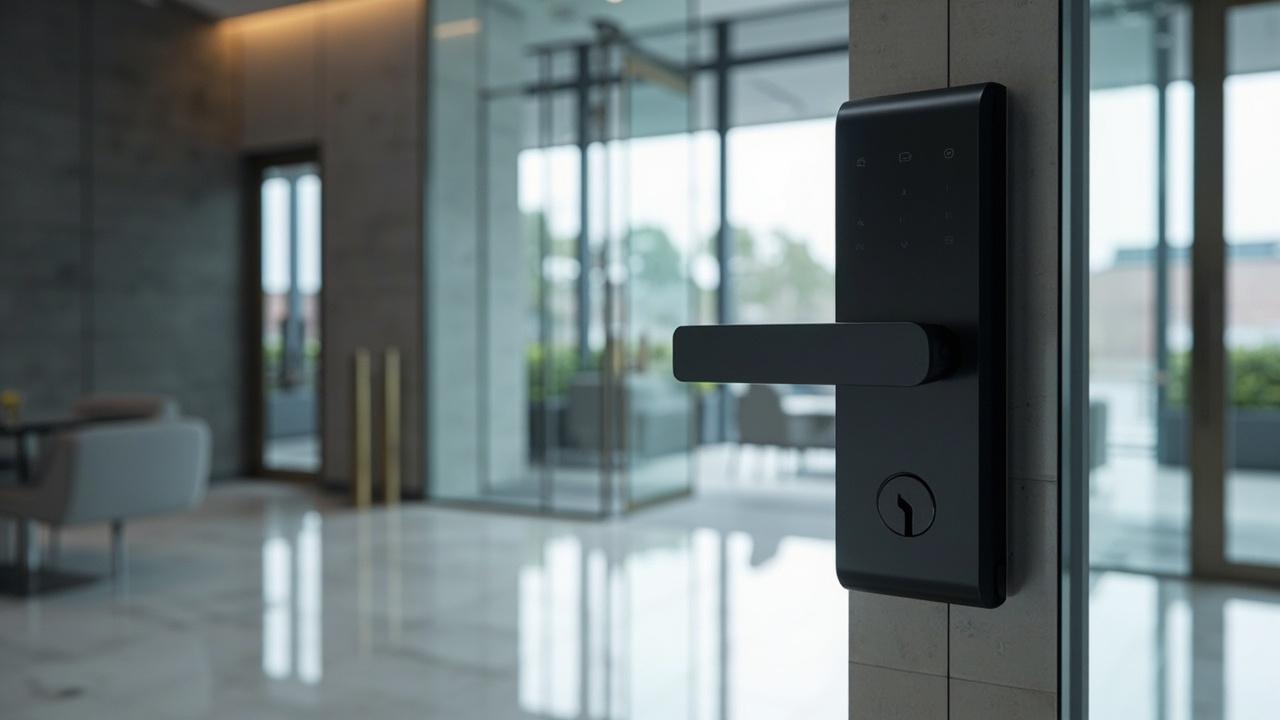
Smart Locks for Critical Infrastructure
The honest answer, before anything else
Smart locks for critical infrastructure is the question of where a SmartLockFactory door-lock product — an electronic door lock from our 79-model catalog — is the right instrument inside a regulated site, and where it is not. Our catalog fits the administrative and technician doors on a utility site, telecom shelter compound, or transit substation: site offices, dispatch rooms, equipment rooms accessed by named staff, technician-only storage rooms, control-house lavatories, training rooms, and similar doors with normal everyday access. Our catalog does not fit the perimeter fence, the high-security substation control house, the SCADA/ICS cabinet, the telecom shelter's regulated bay, or any door that an authority having jurisdiction, an internal regulator, or a sector framework treats as the regulated layer of the site. That boundary — catalog-eligible administrative doors on one side, perimeter and regulated doors on the other — is the only honest answer we can give. Everything in this article is a description of how to walk toward that boundary without crossing it.
This is a manufacturer-voice piece. We are not the regulator, we are not the AHJ, we are not the security consultant, and we are not the system integrator. We are the factory that publishes 79 models with verified product-page specs, and our job here is to describe, honestly, where our locks sit in a critical-infrastructure site and what they cannot replace.
What we mean by "critical infrastructure" in this article
The phrase covers a lot of ground. In different jurisdictions it pulls in different sectors — energy, water, telecommunications, transportation, finance, healthcare, government services, food and agriculture, chemicals — and each sector carries its own regulator, its own compliance regime, and its own door taxonomy. We are not going to redefine the term. We are going to use it as a buyer would: a site where loss of containment, loss of service, or unauthorised access would produce unacceptable public consequences, and where some combination of sector-specific rules (NERC CIP for parts of the North American bulk-power grid, TSA pipeline directives, IEC 62443 for industrial automation, NIST guidance for federal systems, EN standards for telecom, local building and fire codes everywhere) governs what is allowed at the door.
That is the only frame in which the rest of this article makes sense. The first question any infrastructure buyer must answer is which regime applies to which door. Until that question has an answer, a lock product page is the wrong place to start.
The catalog's actual address on a regulated site
Strip a regulated site of its perimeter and its regulated layer and what remains is still a building. It has offices. It has a break room. It has a tool crib for the technicians. It has a training room, a records room, a parts-and-consumables room. It has lavatories, a small meeting room the supervisor uses for shift handover, and an admin door between the staff parking and the operations corridor. These doors are administrative doors on a regulated site. They are not the regulated layer. They have normal everyday access patterns. They are opened by named employees and named contractors with time-bounded credentials. They have audit expectations a step above a domestic door but a step below a PACS cardholder database.
This is where our catalog sits. It sits in the second tier — above the rim-locks the building came with, below the PACS cardholder-grade access control that the perimeter and the high-security rooms get. The catalog is not the lock for the regulated layer; it is the lock for everything around it.
The door-stack is the whole argument in one table. Read it before you read a product page.
| Door layer on a regulated site | Who governs the door | Is the catalog the right instrument? | Where the conversation belongs |
|---|---|---|---|
| Perimeter — fence, vehicle gate, boundary reader | Perimeter ACS and the sector regime | No | Perimeter intrusion detection and PACS-grade boundary readers |
| Regulated access point — control house, SCADA, classified, SOC | The sector regime names credential, audit, cable | No | Regulated PACS on a separate procurement track |
| Egress door on a means of egress | The AHJ and a fire-listed assembly | No | The qualified door-hardware professional and the AHJ |
| Administrative door — offices, dispatch, technician rooms, records, cribs | Everyday access, named population, audit a step above domestic | Yes | This catalog, with per-model confirmation on the product page |
| Lockers, cabinets, small enclosures | Site housekeeping | Cabinet class — confirm per model | The catalog's cabinet class |
| Plumbing — the rim-locks the building came with | Not a lock purchase | Out of scope | Not a conversation |
For a utility site, that means site offices, dispatch, the records room, the safety-officer's office, the technician training room, the parts crib that feeds the crews, the small server room that holds the office IT (not the SCADA cabinet — the office IT), the meter-test lab if it is accessed by named staff, the on-site contractor sign-in room, and similar doors.
For a telecom shelter compound, it means the operations shed that houses the cable plant documentation, the technician sign-in room, the small stock room for jumper rolls and splice closures, the on-site generator room (a separate door from the regulated equipment compound), the crew shelter, the lavatory, the small workshop for connector work.
For a transit substation, it means the supervisor's office, the technician locker room, the records storage room, the small office-IT room, the maintenance briefing room, the welfare facilities, the named-contractor induction room, the small stock room for relays and consumables.
Across all of these, the pattern is the same: a small named population, a small contractor lane, normal everyday access, an audit expectation a step above domestic, and no sector-specific credential or compliance regime to satisfy.
Where the catalog explicitly does not fit
We have to be unambiguous here. Our catalog is not the right instrument for:
The perimeter. Fence gates, compound vehicle gates, the regulated access point at the boundary of a site. These belong to a perimeter access control system — turnstiles, mantraps, vehicle barriers, PACS-grade readers at the boundary, often sector-specific (PACS for federal sites, regulated PACS for nuclear, perimeter intrusion detection systems with classified-cable requirements for the bulk-power grid). Our catalog is a door product. It does not own the boundary. For the boundary and the network it sits on, the access control security and network architecture siblings frame where a door-lock product ends and an access-control conversation begins.
The regulated access point on the inside. The high-security substation control house door, the SCADA cabinet, the telecom shelter's regulated bay, the protected telecommunication room, the SOC door, the classified-materials storage door, the keys-and-crypto room. Sector-specific rules apply to these doors, and they will name the credential regime, the audit regime, the cable regime, the lock certification regime, and the operational regime — and our catalog does not, and will not, assert compliance with those regimes.
Classified doors. Any door that processes classified information, holds classified material, or sits behind a classified boundary. The supply chain, the firmware integrity regime, the audit regime, and the operational regime for classified doors are not what our catalog is designed for. We will not claim that any 79-model SKU meets classified-door requirements, and we will not pretend a firmware update can turn a door lock into a classified-lock product.
Egress doors. Doors that sit on a means of egress. These belong to a fire-listed assembly with panic hardware where required by the AHJ, and they cannot be locked against egress in the way a security door is. The catalog does not own this question; the qualified door-hardware professional and the AHJ do.
Doors inside a regulated PACS. A regulated physical access control system on a critical-infrastructure site is not the same thing as a standalone smart lock on a door. The catalog is a standalone lock class. It can be app-managed, it can support Bluetooth enrolment on TTLock / Tuya / Doodle, and it can carry a local audit buffer — but it is not, and is not claiming to be, an enterprise PACS reader, an OSDP-compliant credential reader, or a FICAM-approved cardholder stack.
If a buyer is told otherwise — if any supplier tells them a 79-model SKU with a generic spec sheet will satisfy the regulated layer of a critical-infrastructure site — they should treat that claim with caution. Our position is that the regulated layer is not where we play, and saying so plainly is part of being a credible supplier for the administrative layer that we do serve.
The door-stack mental model
When we look at a critical-infrastructure site through the lens of locks, we see a stack rather than a single problem.
At the top is the regime: the sector-specific rule set that names what compliance looks like on this site — for the bulk-power grid, the rail corridor, the water utility, the telecom carrier, the federal tenant, the airport. The regime names the boundary, the credential standard, the audit standard, the cable standard, the operational standard.
Below the regime sits the regime-controlled doors: perimeter, control house, SCADA, classified, regulated telecom bay, regulated SOC, and similar. These belong to the regime and to the qualified professionals who interpret it.
Below those sit the administrative doors on a regulated site: site offices, dispatch, technician rooms, records rooms, training rooms, parts cribs, lavatories, briefing rooms, induction rooms, and similar. These are the doors the catalog serves.
Below those sit the lockers, cabinets, and small enclosures on the site — the cabinet class (six models in our catalog), which is its own scope.
And at the very bottom, the plumbing: the rim-locks the building came with, which are not what we are discussing.
flowchart TD
    R["Regime\nsector rule set names the standards"] --> RC["Regime-controlled doors\nperimeter · control house · SCADA · classified"]
    RC --> AD["Administrative doors\noffices · technician rooms · records · cribs"]
    AD --> CB["Lockers · cabinets · small enclosures"]
    CB --> PL["Plumbing\nthe rim-locks the building came with"]
    AD -- "catalog address · see model spec" --> FIT["Standalone lock class\napp-managed · local buffer"]
    RC -- "not a door-lock conversation" --> NO["PACS · perimeter ACS · AHJ"]
The mistake we see buyers make is treating the regime-controlled doors and the administrative doors as the same question. They are not the same question. They share a site. They do not share a lock specification.
Catalog coverage for the administrative layer
For the administrative layer, the catalog has usable inventory.
Across the published range, the 79-model catalog includes 77 smart door locks, 37 fingerprint, 18 keypad, 9 RFID (13.56 MHz Mifare 1 in our hotel-class spec block), 24 hotel-class, 10 outdoor, 6 face recognition (3D face on a small number of models), 6 cabinet, 3 video camera, 3 glass, plus multi-function and narrow-edge classes. Unlocking methods span fingerprint, passcode, RFID/IC card, mechanical key, app/Bluetooth on the TTLock / Tuya / Doodle families, remote control, 3D face (few models), camera/cat-eye (few models), and 4G (few models). Palm-vein, Matter, Zigbee, and Apple Home Key are not in our catalog; we will not invent them into scope.
For the administrative layer on a regulated site, the realistic shortlist lives in the keypad class, the RFID class, the fingerprint class, the multi-function 5-in-1 class, the narrow-edge weatherproof class (where the door sits in a more exposed part of the building envelope), and the cylindrical-latch round-code class for retrofit on standard cylindrical-prep doors. The hotel class is a documentation yardstick — the SLK-9936S spec block (door thickness 36–100 mm, RFID Mifare 1 @ 13.56 MHz, read distance 0–5 cm, read time <0.25 s, 4 × AA battery platform, battery operating cycles >15,000, audit/event records up to 1,000, 5-pin cylinder, 3-point latch, stainless steel + alloy body, multiple finish options, mechanical emergency access, multilingual management software, standalone or centralized database modes) sets the documentation granularity we expect per model — not the lock for an administrative door on a regulated site. We invoke it once as a yardstick and explicitly do not port its figures sideways.
For a buyer, the practical reading is: the catalog has roughly two to four classes of lock that are plausible fits for the administrative doors on a utility site, telecom shelter compound, or transit substation. The right way to choose between them is door by door, against the questions below.
The per-model spec block, re-read as a list of product-page questions
Editorial habit. For every administrative door on a regulated site, the buyer should be asking the model page the same set of questions, regardless of which class they are leaning toward. We list them not as answers but as the questions we expect our own product pages to be ready to answer.
What is the door-thickness envelope on this model, in millimetres, for the specific door I am looking at? Check the model’s published specification. A site office on a hollow-metal interior door at 45 mm is a different question from a small external storeroom at 55 mm with insulation, and neither is the same as a retrofit on an existing cylindrical-prep door at 35–50 mm.
What is the credential lane mix on this model? Check the model’s published specification. Our catalog supports PIN, RFID, fingerprint, mechanical key, and app/Bluetooth across the range — but no single SKU ships with every lane; the lane mix is per model.
What is the credential capacity on this model — how many PIN codes, how many RFID cards, how many fingerprint templates, how many app/Bluetooth enrolments? Check the model’s published specification. Administrative doors on a regulated site tend to need a small named population, but the upper limit on each lane matters for the future case where the population grows.
What is the per-credential expiry and time-window behaviour on this model? Check the model’s published specification. A contractor lane that hard-expires at 17:00 on Friday, a visitor PIN that auto-revokes on departure, a shift-window PIN that opens only between 06:00 and 14:00 — these are per-model behaviours and the product page is the source of truth.
What is the audit-log depth, retrieval path, and per-event fields on this model? Check the model’s published specification. We do not assert a per-model audit ceiling here; we expect the product page to name the on-device buffer, the maximum record count, the read-out path, and the per-event fields (credential identity, time, method, outcome).
What is the mechanical-override behaviour on this model — cylinder type, key duplication policy, mechanical-key distinguishability into the audit record where supported? Check the model’s published specification.
What is the battery platform, low-battery warning channel, and dead-battery mechanical rescue on this model? Check the model’s published specification. We will not invent an autonomy figure.
What is the app platform identity — TTLock, Tuya, or Doodle? Check the model’s published specification. A regulated site may already have one of these app families in use elsewhere on the building; consistency matters.
What is the operating-temperature envelope and weatherproof language on this model — particularly for narrow-edge, outdoor class, and cylindrical retrofit models? Check the model’s published specification.
What is the finish suitability on this model — stainless, alloy, painted — for the door's environment? Check the model’s published specification.
We could keep going. The point is not the length of the list. The point is that for a buyer who is going to spend public money on an administrative door on a regulated site, the lock product page should be able to answer these questions. If the page cannot, that is a useful signal before any RFQ is sent.
The honest limits of "outdoor" and "weatherproof" labels
A buyer on a critical-infrastructure site will often search first for an "outdoor" lock because the doors they actually need — the parts-cupboard door on the side of an equipment shed, the door on the back of a small telecom compound shelter, the door on a substation welfare facility — are exposed to weather. We have ten outdoor models in the catalog. We will not assert that any of them is the right lock for the perimeter, the regulated substation control house, or any door that the AHJ or a sector regime has named.
We will say this: the outdoor class exists for administrative doors with weather exposure. The narrow-edge 4-in-1 class (the SLK-1104 line, door thickness 36–100 mm, multi-method credentials, weatherproof positioning) sits in the same category. The 019/022/309 stainless keypad class is a candidate for doors that need a tougher finish in a more aggressive environment. For every one of these, the operating-temperature envelope, the IP-style wording (which we will not assert without per-model confirmation), the dust-seal wording, the chemical-resistance wording, and the impact-resistance wording are questions for the product page, not assumptions to carry forward from the brochure.
A substation welfare building in a coastal environment is a different question from an inland equipment shed. The same catalog class, the same brochure line, will not cover both without per-model product-page confirmation.
An illustrative scenario, framed honestly
Consider a 4.2-hectare transmission substation in a coastal municipality, commissioned in 1989, with a perimeter fence that is out of scope for this article, a regulated control house that is out of scope for this article, and a single-storey welfare-and-admin block inside the compound that is in scope.
The welfare-and-admin block has eight doors. A supervisor's office. A dispatch room where shift logs are kept. A small records room with as-built drawings and a paper backup of the SCADA tag list. A technician locker room with 24 named lockers (cabinet class). A training-and-briefing room used for daily pre-shift toolbox talks. A small office-IT room holding two PCs, a printer, and a managed switch — not the SCADA cabinet, which is in the control house. A welfare-and-lavatory block. A small parts crib with relays, fuses, and consumables for the technicians on call.
The buyer here is the site manager, with a procurement officer in the regional office. The site manager's first move is verified in writing with the utility's security lead that none of these eight doors is on the regulated-door list — the regulated list names the control house and the SCADA cabinet, both of which are handled by a different procurement track. Once that confirmation is in writing, the eight doors become a SmartLockFactory catalog conversation.
The eight in-scope doors, written as the door register the site manager would hand the supplier. The populations, lanes, override custody and audit cadence are the buyer's planning output; every capability behind a lane is a per-model product-page confirmation:
| Door in scope | Population and credential lane, as the scenario names them | Mechanical override | Audit expectation |
|---|---|---|---|
| Supervisor's office | One named user (the site manager) plus two deputies; PIN + RFID | Key held by the site manager | The regulated-tenant's quarterly review |
| Dispatch room, where shift logs are kept | Three named shift dispatchers plus the supervisor; PIN + RFID + fingerprint where the dispatcher's hands are clean | Sealed envelope at the supervisor's desk | Every shift handover |
| Records room, with as-built drawings and a paper backup of the SCADA tag list | Four named reviewers (the site manager, the deputy, the regional engineer on rotation, the records officer); PIN + RFID with per-credential expiry on the rotating engineer's card | The same sealed envelope as the dispatch room | Monthly |
| Technician locker room, 24 lockers, cabinet class | PIN + RFID for the technician's assigned locker, with per-credential expiry tied to the technician's rotation | Held by the supervisor | Not named for this door |
| Training-and-briefing room, used for daily pre-shift toolbox talks | Open most of the day; PIN + RFID with a time-window that hard-expires at 18:00 | Held by the supervisor | Not named for this door |
| Small office-IT room holding two PCs, a printer, and a managed switch — not the SCADA cabinet, which is in the control house | PIN + RFID with per-credential expiry on any contractor's card | Sealed | Weekly |
| Welfare-and-lavatory block | PIN only, with a time-window aligned to the shift roster | Held by the supervisor | Not named for this door |
| Small parts crib with relays, fuses, and consumables for the technicians on call | PIN + RFID with per-credential expiry on any contractor's card | Sealed | Every parts withdrawal |
The scenario is illustrative, not a customer story. None of the names are real. The point is that eight doors on a single regulated site produce eight different lock decisions, none of which touch the perimeter or the regulated control house, and all of which sit inside the catalog's address.
What the supplier cannot assert about regulatory compliance
We will not assert, and we want to be plain about this, that any product in our catalog carries NERC CIP, NIST, TSA, IEC 62443, EN 50131, ATEX, IECEx, FCC Part 90, DO-160, or any other sector-specific compliance by the act of being on our product page. Sector compliance is a property of the site, the credential regime, the cable regime, the audit regime, the operational regime, and the qualified professionals who interpret those regimes for the specific site. Our product page names the lock. It does not name the regime.
A buyer who needs a regulated-door product needs to ask the regime. The questions are not for us. They are for the utility's security lead, the regulator, the AHJ, the qualified door-hardware professional, the fire safety officer, and the system integrator who carries the PACS contract. We do not play that role, and we will not pretend to.
A buyer who needs an administrative-door product on a regulated site needs to ask the lock. The questions are for the product page, with the answers routed through /request-a-quote and the supplier's application engineering team. We do play that role, and we will not pretend otherwise either.
The RFQ-shape discipline for an administrative-door order
If the buyer walks into the RFQ with the door-stack mental model already in hand, the RFQ itself becomes shorter and harder to misread.
A workable RFQ shape for the administrative layer of a critical-infrastructure site names:
- The site and the sector, with the regime explicitly out of scope for this RFQ and named as "handled by a separate procurement track."
- The door-by-door register for the administrative layer: door name, location, door-thickness measured, door material, expected daily traffic, named population, contractor lane expectation, and the per-door credential mix the buyer is leaning toward.
- The mechanical-override custody policy across the site: who holds the override key for which door, in what envelope, with what audit register.
- The audit expectation: how often the buyer expects to read out the per-door log, against what report template, and whether the read-out path is on-device, app-managed, or a separate retrieval procedure.
- The app-family expectation: if the site already uses TTLock, Tuya, or Doodle elsewhere, the RFQ should name the family.
- The lifecycle expectation: how long the buyer expects the lock to remain in service before refresh, and what the buyer expects the supplier to provide in writing on lifecycle.
- The out-of-scope items, named explicitly: perimeter, regulated control house, classified, egress doors, PACS cardholder-grade doors, fire-rated assemblies.
- The commercial request: pricing, MOQ, lead time, warranty — routed to
/request-a-quotewith the door register attached. The supplier answers in writing; the buyer does not assume any of these from the catalog page.
When the RFQ carries this shape, the supplier's response carries the same shape. The buyer and the supplier are talking about the same doors, in the same language, with the same out-of-scope items named on both sides.
Cross-link to the sibling articles
This article sits inside the C06 Applications cluster alongside the government-buildings, public-buildings, financial-offices, bank-offices, data-centers, and server-rooms siblings. The data-centers sibling covers the data-hall layer of a similar conversation; the server-rooms sibling covers single-population office server rooms; the government-buildings sibling covers public-sector buildings under a different compliance regime with a different door taxonomy; and the public-buildings sibling covers the civic door set. The current article is not a substitute for any of those. The current article's job is to name, honestly, the administrative layer of a critical-infrastructure site — utility, telecom, transit — and the catalog's address on it.
For a buyer whose question is which doors on a regulated site can a SmartLockFactory lock serve, the answer here is: the administrative doors, the technician rooms, the equipment rooms with normal access — and nothing else.
For a buyer whose question is which doors must be left to a PACS, a perimeter ACS, a regulated credential reader, an AHJ-named fire-listed assembly, or a sector-specific supplier, the answer here is: every door named by the regime. We do not play that game, and we will not pretend to.
That boundary is the catalog's honest address on a critical-infrastructure site. Everything else — pricing, MOQ, lead time, warranty, per-model confirmation against the door register, app-family alignment, lifecycle planning — belongs in the quote, which is where the buyer takes the conversation next.
For per-model confirmation against a specific door register on a utility site, telecom shelter compound, or transit substation, route the request through /request-a-quote with the door-by-door list attached. For sample evaluation on the administrative layer, /order-samples carries the request through the application-engineering team. The catalog's job is the administrative door; the regime-controlled door belongs to a different conversation.