
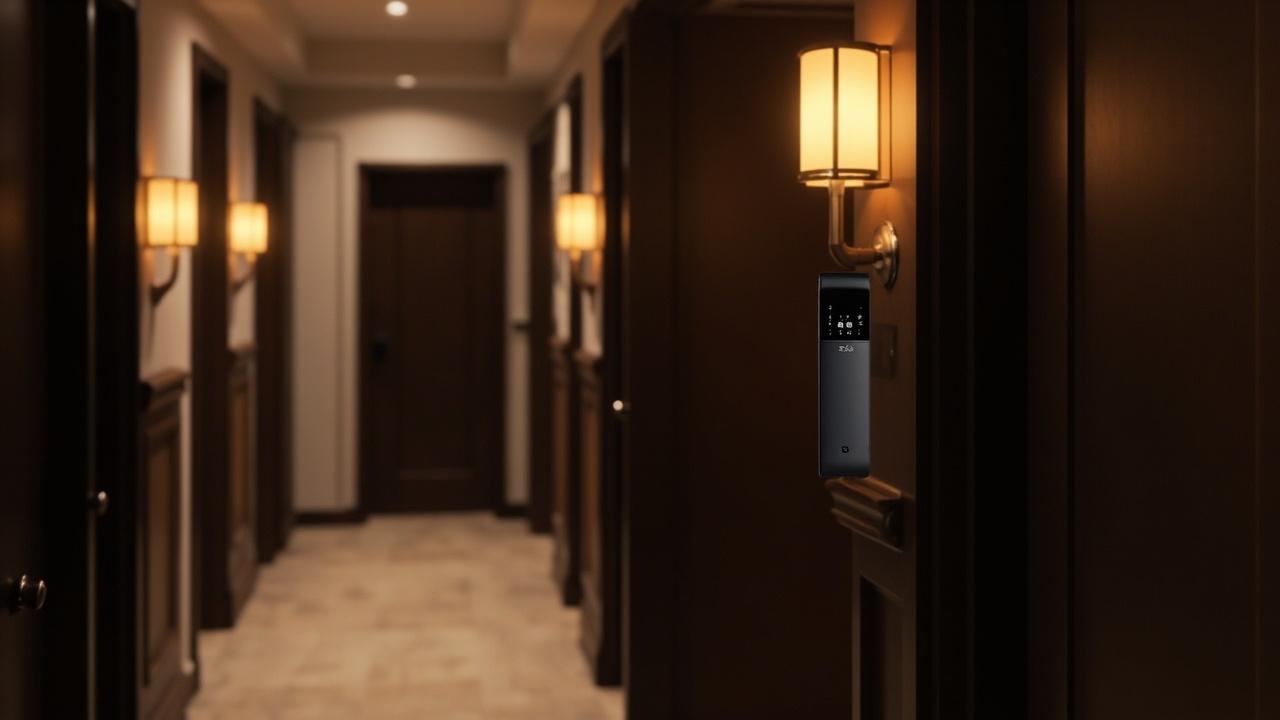
SLK-9936S vs RFID Hotel Lock Alternatives
Four other hotel locks sit next to the SLK-9936S in the same catalog: SLK-9936G, SLK-9951TH, SLK-9962S and the hidden-reader SLK-9905A. A hotel buyer comparing them usually builds a table from product photos and model numbers, then discovers the table compares nothing. Here is the honest answer up front, before any of the machinery below.
When you compare SLK-9936S against the RFID hotel lock alternatives inside the same factory line, the deciding fact is asymmetric evidence, not feature superiority. The SLK-9936S publishes a complete spec block — door thickness 36–100 mm, Mifare 1 at 13.56 MHz, up to 1,000 audit/event records, 4 × AA power, standalone or centralized database modes — which makes it the benchmark model: choose it by default unless one of three triggers fires (a door population outside its published envelope, a front-of-door presentation policy its dressed face cannot satisfy, or a software/credential requirement its documented lines do not cover). Each trigger routes you to a sibling model, and each sibling must produce its own datasheet to FACT-REQUIRED standard before it displaces the benchmark.
That paragraph is the whole decision in miniature. The rest of this article is the framework that lets you apply it to your own property without inventing specifications the catalog has not published.
The problem with comparing models from one catalog
Hotel lock catalogs layer models for market coverage. Twenty-four hotel locks out of seventy-nine published models is not twenty-four versions of one argument; it is one factory answering different buyer situations — door stocks that vary, front desks that want different presentation, chains that standardize and independents that improvise. Manufacturers rarely publish a model-to-model comparison because the axes that separate the models are buyer-specific, and because a fair comparison table would require every model to carry the same disclosure depth.
That last part is where buyers get hurt. On your desk, one model — the SLK-9936S — has a full published block: numbers, interfaces, modes. The siblings have names, images, category pages. The instinct is to fill the blank cells with assumptions: "same family, probably the same radio," "9936G must be the upgraded 9936S," "hidden reader means thinner-door friendly." All three are guesses dressed as data, and a procurement file built on them collapses the first time a door is measured or a card fails to read.
The framework below therefore treats the comparison differently. The SLK-9936S spec block is the evidence standard. A sibling model earns shortlist status only when its datasheet answers the same lines at the same granularity. You are not choosing the best-described lock; you are choosing the lock whose documented commitments your building can verify.
Pass 1: narrow the field before comparing anything
Three pre-filters run before any model-vs-model table is worth building. Each filter asks a question of your property, not of the catalog. A model that fails a pre-filter is out regardless of how attractive its photos are.
Filter one — the door population. The single spec line that most often eliminates hotel lock models is door thickness. The SLK-9936S documents 36–100 mm; every sibling's envelope is verified in writing until published on its PDP or datasheet. Your survey results — measured, not remembered — decide which models are physically installable. Full measurement protocol lives in the SLK-9936S door-thickness compatibility guide; what matters here is the sequence: measure first, shortlist second.
Filter two — the credential fleet you already own or intend to issue. The 9936S reads Mifare 1 at 13.56 MHz. If your property runs a legacy card stock, the compatibility question goes to each supplier model individually — card format, encoder tooling, re-encoding policy are per-model facts, and the 9936S's own card-stock compatibility is itself a supplier question (see SLK-9936S Hotel Lock Replacement Guide's credential-transition gates). Choosing a lock means choosing the front-desk ecosystem around it, and that ecosystem must be documented for whichever model wins.
Filter three — presentation policy. Some properties treat the lock face as interior design: guest-room doors can carry a dressed reader face; office, back-of-house and heritage-adjacent doors may demand that nothing visible marks the door as electronic. The catalog publishes at least one hidden-reader model by name — SLK-9905A — which exists precisely for that policy. This filter does not require you to pick a model; it requires you to state, per zone, whether a visible reader face is acceptable.
| Pre-filter | Question you answer about the property | How the SLK-9936S behaves | Sibling models |
|---|---|---|---|
| Door population | What thickness range(s) do guest doors actually measure? | Documented 36–100 mm; doors outside it eliminate this model | Envelope to verify in writing per PDP/datasheet |
| Credential fleet | What card format, encoders and spare stock will the desk run? | Documented Mifare 1 @ 13.56 MHz, 0–5 cm, <0.25 s; fleet compatibility still a supplier question | Interface to verify in writing per model |
| Presentation policy | Where is a visible reader face acceptable, zone by zone? | A dressed-face hotel lock by its published positioning; hidden-face demand is outside its documented form | SLK-9905A published as a hidden-reader lock (name only — specs to verify in writing) |
A property that clears all three filters with a single model has no comparison to make — order it. Most properties that come back to this article have either a second door population outside the documented envelope, or a zone where presentation policy overrides the default. That is when the alternatives become real candidates.
The anchor block: reading the 9936S spec as decision commitments
The published SLK-9936S block (product-page-documented throughout this article) is reproduced here once, reorganized from marketing order into decision order. Each line is read as a commitment the buyer can hold the supplier to, and as a template for the question you will paste into every sibling datasheet request.
| Spec line (SLK-9936S, product-page-documented) | What it commits | The sibling-model question this line generates |
|---|---|---|
| Door thickness 36–100 mm | Installable on your surveyed population without door work inside that band | "What is your published door-thickness envelope, in millimetres?" |
| RFID Mifare 1 @ 13.56 MHz | Credential platform, card-stock family, encoder class | "What card chip family and frequency does this model read?" |
| Read distance 0–5 cm, read time <0.25 s | Deliberate-touch guest gesture and front-desk throughput | Same gesture question — or is the read window different? |
| 4 × AA power, >15,000 battery operating cycles | Service route (commodity cells) and drive-path endurance class | "Same power architecture? What endurance figure do you publish?" |
| Audit/event records up to 1,000 | Evidence depth and log-pull cadence ceiling | "What record capacity does this model's log hold?" |
| 5-pin cylinder, 3-point latch, mechanical emergency access | Mechanical class, keying depth, fallback path when the credential chain breaks | "Cylinder pin count, latch points, mechanical override — documented?" |
| Stainless steel + alloy body, multiple finish options | Finish schedule and material exposure by zone | "Which finishes exist for this model?" |
| Multilingual management software, standalone or centralized database modes, 1–5 star positioning | Software ecosystem and architecture optionality; tier breadth | "Does this model run the same management software, in both modes?" |
Notice what the block does not say: it does not promise PMS integration, mobile credentials, specific certifications or lifespan years in calendar time, and this article does not extend it to cover them. Line-by-line dissection of the block — including where bluffs hide in paraphrases of these lines — is the job of SLK-9936S Smart Lock Specifications Explained; the point here is narrower. This table is the standard. Any alternative that cannot answer these eight questions at this granularity has not yet earned a cell in your comparison.
The five axes that actually split the family
Model numbers in hotel lines cluster around a handful of genuine engineering and positioning differences. Comparing SLK-9936S against its alternatives only makes sense along these axes; anything else is cosmetic.
Axis 1 — Fit envelope. The mechanical geometry a lock must survive: door thickness band, case depth, strike and latch alignment. The 9936S's 36–100 mm band covers the overwhelming majority of standard hotel doors plus unusually thick heritage and assembly doors. Sibling envelopes are verified in writing. This axis is a hard filter, not a preference.
Axis 2 — Credential interface and reader presentation. Same-frequency RFID is not the same product. A dressed reader face teaches the guest where to tap and gives the property a design surface (the 9936S ships in multiple finishes on a stainless steel + alloy body). A hidden-reader configuration — SLK-9905A is published under exactly that descriptor — removes the visible marking from the door front. The radio behind each face is per-model to verify in writing data; the presentation difference is a naming fact you can act on immediately, provided you pull the 9905A datasheet before assuming anything else about it.
Axis 3 — Software architecture and record depth. The 9936S documents multilingual management software that runs in standalone or centralized database modes, with audit/event records up to 1,000. This is the axis most often mishandled in comparisons: buyers assume every model in a hotel line shares the software. Cross-model compatibility of encoders, card stock and database is verified in writing per supplier — it decides whether a mixed fleet (default locks plus one alternative for a special zone) is even administrable. The architecture trade-off itself is worked through in Standalone vs Centralized Hotel Lock Systems; here, it is a scoring axis.
Axis 4 — Power and service model. 4 × AA cells and a published endurance figure (>15,000 battery operating cycles) make the 9936S's servicing route commodity-simple and its drive-path endurance class auditable. For any alternative, ask the same two questions: what powers it, and what endurance figure does the supplier publish. A sibling that answers "rechargeable, approximately" is not worse engineering — it is a different service model, and yours is a different procurement file.
Axis 5 — Mechanical class and emergency fallback. 5-pin cylinder, 3-point latch, mechanical emergency access: the 9936S commits to a complete mechanical story. Sibling models must state their own pin count, latch points and override path or be treated as unknowns. Emergency access is governance, not marketing (see SLK-9936S Emergency Mechanical Access for the 9936S's mechanical path run as a controlled protocol); a comparison table that leaves this row blank is a table that will embarrass whoever presents it to a risk committee.
Axis-by-axis decision matrix
The matrix below is the article's working core. Left column documented, right column demanded. Default rule applies the asymmetry principle: the 9936S holds the slot until a trigger fires AND the sibling's evidence arrives.
| Selection axis | SLK-9936S documented position | Documented on 9936G / 9951TH / 9962S / 9905A | Default rule |
|---|---|---|---|
| Door fit | 36–100 mm published band | Published envelope in mm, per model | If all surveyed doors sit inside 36–100 mm, fit cannot differentiate the field — 9936S stands |
| Credential interface | Mifare 1 @ 13.56 MHz, 0–5 cm, <0.25 s | Chip family, frequency, read window | A sibling only wins by matching the fleet you own, not by claiming a better radio |
| Reader presentation | Dressed face, multiple finishes, stainless + alloy | Face style (visible/hidden), finish list | Presentation policy (Pass 1, filter three) is the one axis where routing away from 9936S is a positive choice, e.g. toward the hidden-reader 9905A |
| Software modes | Multilingual software, standalone or centralized database modes | Whether the model joins the same software in the same modes | Mixed fleets require written encoder/card/database compatibility per supplier — no assumption, ever |
| Record depth | Up to 1,000 audit/event records | Published capacity, export fields, pull cadence | Match the evidence your risk/insurance file needs; depth parity favors the documented model |
| Power architecture | 4 × AA, >15,000 battery operating cycles | Power source, published endurance figure | Servicing-route equivalence (commodity cells, same swap practice) keeps 9936S as default |
| Mechanical class | 5-pin cylinder, 3-point latch, mechanical emergency access | Pin count, latch points, override path | Emergency fallback must be documented, not implied; blank row disqualifies |
| Tier positioning | Positioned for 1–5 star hotels | Positioning statement per model | A sibling needs a documented reason to exist in your configuration, not a catalog position |
Three reading rules prevent the classic misuse of this table. First, an empty to verify in writing column is a score of zero, not a tie. Second, a supplier answer in prose ("suitable for all standard doors") is treated as level-1 narrative evidence, not a commitment — the scorecard below quantifies this. Third, you are scoring models for one property; a verdict matrix that ignores your survey, your fleet and your policies is decoration.
Where the 9936S wins on documented lines alone
For the median hotel procurement file, three of the five axes resolve without ever opening a sibling datasheet, and that resolution is worth stating plainly so the framework does not look like it dodges a verdict.
Fit: a guest-room population measured inside 36–100 mm is served by a published band; there is nothing left to ask. The engineering-data layer of this decision — the measurement itself — is where most model comparisons should die.
Evidence quality: the 9936S answers all eight anchor questions with published lines. In a two-horse comparison against any alternative whose datasheet is still outstanding, it wins the evidence axis by default, and evidence is what a procurement file, an insurance review or a chain standards audit actually consumes.
Operational story: 4 × AA cells on a commodity route, a published endurance figure, a documented mechanical override, software with both standalone and centralized modes, and finish options for zone-level presentation work on a dressed face. That is a complete commitment set on every axis the family is divided by — held against, not assumed.
This is not brand loyalty written into a decision framework. It is the structural consequence of one model publishing its numbers while the alternatives have not yet been asked to. The moment a sibling's datasheet arrives at matching granularity, the verdict is genuinely contestable on your property's specific facts.
Where the 9936S should not be forced: routing rules
A default is not an answer to every condition. The routing rules below are written IF-THEN because that is how they get used: at a survey sheet, a design review, or a front-desk argument. Each THEN sends you to a named sibling PDP; each rule's evidence column lists what must come back before the routing becomes a selection.
| IF this is true of your property | THEN route to | Evidence required before the route converts to a decision |
|---|---|---|
| A door population measures outside 36–100 mm (thin heritage doors, unusual assemblies) | Sibling PDPs: 9936G, 9951TH, 9962S, 9905A | Each model's published door-thickness envelope, in mm, on a spec sheet — to verify in writing |
| Presentation policy bans a visible reader face on specified zones | SLK-9905A (published as a hidden-reader hotel lock) | 9905A's credential interface, software-mode support, record depth, power and mechanical lines at anchor granularity |
| Existing card stock / encoders predate Mifare 1 @ 13.56 MHz and re-issuance is unacceptable | Any sibling whose published interface matches the fleet | Chip family + frequency + encoder tool list per model — to verify in writing; expect the answer to be "re-fleet," budget accordingly |
| Centralized database mode is required property-wide | The model that documents that mode — currently only 9936S in this article's evidence base | Written confirmation the sibling runs the same management software in the same mode |
| Record depth, latch class or override path is not documented on a sibling sheet | Stay on 9936S for those doors | Nothing — an undocumented axis keeps the slot with the documented model |
| Both a fit-exception population and a presentation policy exist | Mixed fleet: 9936S default + sibling(s) for exception zones | Cross-model software and credential compatibility statement from the supplier — the binding constraint on mixed fleets |
The fifth row is the one buyers skip. Routing is not a favor to a sibling model; every exception zone you hand to an undocumented datasheet is an audit gap you accept. If a heritage wing needs a hidden reader, the right response is a hidden reader with published lines — pull them or price the risk.
The routing table as one decision sweep — triggers in, evidence check out:
flowchart LR
    A["Surveyed doors all inside 36-100 mm \nno policy override"] --> K["SLK-9936S keeps every slot"]
    B["Door population outside the published band"] --> R1["Sibling PDPs: 9936G · 9951TH · 9962S · 9905A"]
    C["Presentation policy bans a visible reader face"] --> R2["Hidden-reader SLK-9905A \nname only until the sheet arrives"]
    D["Legacy card fleet · re-issuance unacceptable"] --> R3["Only a sibling with a published interface \nmatching the fleet"]
    E["Sibling spec row left blank"] --> K
    R1 --> V{"Anchor-granularity evidence \nreturned in writing?"}
    R2 --> V
    R3 --> V
    V -- "yes" --> W["Sibling wins the exception zone only"]
    V -- "no" --> K
Mixed-fleet properties: decide by zone, not by model
Real properties rarely present one condition. A 120-room building might hold 100 standard doors inside the documented band, a handful of heritage doors with unknown thickness, one office suite whose design brief excludes visible electronics, and a back-of-house corridor that wants maximum audit visibility rather than minimum. Forcing a single model onto all four populations either fails the fit filter or concedes the design brief.
The zone-first resolution splits the file into one default and a bounded set of exceptions:
| Zone / population | Governing axis | Default assignment | What must be true before the order |
|---|---|---|---|
| Standard guest rooms (fit verified) | Fit + credential | SLK-9936S | Doors surveyed inside 36–100 mm; card fleet confirmed Mifare-family or re-fleet budgeted |
| Exception door population | Fit | Sibling with published envelope covering the measurement | Envelope to verify in writing; if none publishes, door remediation or retention of existing hardware is the honest scope answer |
| Presentation-restricted doors | Presentation | Hidden-reader configuration — SLK-9905A by published name | 9905A's interface + software-mode lines match the fleet's ecosystem |
| Back-of-house / risers | Mechanical + override | Documented mechanical class wins | Cylinder/latch/override lines on the chosen model's sheet — no blanks |
| Mixed-fleet administration | Software | Whatever the supplier documents in writing | Cross-model encoder, card and database compatibility statement; one management software, or two explicit ones |
A mixed fleet is a governance commitment before it is a purchase: two or three models means two spare silos, two datasheet families in the FM file, and a change-control rule that exceptions never creep back onto standard doors. Chain groups should freeze the zone table into the brand standard (the configuration-string discipline of Hotel Smart Locks for Hospitality Projects: A Multi-Property Rollout's rollout gates applies directly). Independents should keep exceptions under roughly a tenth of the population — a ratio you derive from your own zone table, not from supplier guidance.
Pass 3: the evidence-acquisition scorecard
This is the step that converts "alternatives" from a brochure shelf into a decision. Send the same anchor-generated questions (the third column of the spec table) to each sibling model's supplier contact, and score what returns on a three-level granularity scale. The scorecard below is the article's procurement tool: use it verbatim.
| # | Required line per sibling model | Level 2 — numeric commitment | Level 1 — narrative only |
|---|---|---|---|
| 1 | Door-thickness envelope | Published mm band | "fits most doors" |
| 2 | Card family + frequency | Named chip + MHz | "RFID" |
| 3 | Read distance / time | Both figures | one or neither |
| 4 | Power source + endurance figure | Cells + cycles published | "low power" |
| 5 | Record capacity + export | Count + fields named | "event log" |
| 6 | Cylinder / latch / override | Pin count + latch points + override path | "secure cylinder" |
| 7 | Body material + finish list | Materials + finish schedule | "premium finish" |
| 8 | Software + modes | Named software, standalone/centralized status | "with software" |
Reading the score: 16/16 — the sibling has reached anchor parity; compare it against the 9936S on your property's axes honestly. 11–15 — shortlist with a written gap-closure list; order nothing while rows 1, 2 or 8 sit below level 2, because those three are disqualifying axes (fit, fleet, administration). 6–10 — the model is a marketing entry, not a procurement candidate; route exceptions elsewhere. ≤5 — the comparison you were about to run is fiction; archive it.
Three negotiation-grade habits make this pass cheap. One: paste the anchor block itself into the request ("answer at this granularity") — suppliers respond to specificity. Two: demand the answer on the PDP or a dated spec sheet, not in email prose, so it becomes a durable commitment. Three: log every level-1 paraphrase; a supplier whose narrative outruns its numbers for model two straight rounds has shown you its documentation practice for the whole line.
Scenario: a 120-room property runs the framework
Illustrative scenario, constructed to exercise every pass. Consider a 120-room city hotel — 1998 concrete frame, guest doors replaced in two waves, front desk running an aging card fleet, one ground-floor office suite in a heritage-stripped finish the designer refuses to mark with electronics.
Pass 1 produces the facts. The survey returns 104 guest doors measuring 40–46 mm, 12 doors in the oldest wing at a borderline 37–39 mm — all inside the SLK-9936S documented 36–100 mm — plus 4 office/service doors, one of which measures 104 mm and sits outside the published band. The desk's fleet is pre-Mifare; re-issuing guest stock at the front desk is acceptable to the GM, re-issuing staff masters is not. Presentation policy is written down: hidden reader on the heritage suite, visible face elsewhere.
Pass 2 on the decision matrix. Fit: 116 doors clear the documented band; the 104 mm door routes to the exception lane — sibling envelopes requested (to verify in writing — check the product page). Credential: fleet decision is re-issue, which keeps Mifare 1 @ 13.56 MHz viable and holds the 9936S default, with card-stock and encoder compatibility confirmed per supplier. Presentation: the heritage suite routes to the SLK-9905A PDP by name; its interface, software-mode and record lines go out for anchor-granularity answers. Software: the group IT lead wants centralized database mode from day one — the 9936S documents it; the 9905A's mode support must match before the mixed fleet is administrable, and that written cross-model compatibility statement becomes the critical path item.
Pass 3 grades the returns. The 9905A datasheet answers 14 of 16 lines at level 2, with record capacity and endurance as the gaps; the buyer shortlists it for the two heritage doors with a gap-closure list rather than defaulting the suite back to a dressed face the designer rejected. The three other siblings return narrative-level sheets and stay shelved — correctly, because no trigger fired for them in this scenario. Final configuration: 116 doors of SLK-9936S, 2 doors of hidden-reader 9905A pending the two level-2 answers, 1 door outside every published band resolved by door remediation or deferral, one staff-master re-issue plan dropped once the encoder compatibility statement arrived narrower than hoped. The file's risk register grew instead of shrinking — and every entry in it names a document, not a surprise.
The comparison you are actually running
Step back from the tables and name the manufacturer-view insight underneath them: in a layered catalog, the default model is the one engineered for the widest verified envelope, and the alternatives are the one-axis deviations your property's facts might require. The 9936S's documented band, radio, modes and records are not decoration on a hero SKU — they are the published proof that a configuration exists which answers every axis the family splits by. Sibling models earn attention axis by axis, datasheet by datasheet.
Three closing rules, portable beyond this catalog: never let an empty spec cell cast a tie vote; never accept cross-model software or credential compatibility as an assumption, in writing or not; and run the framework against your own survey and fleet facts before it runs against a price sheet — the model that survives Pass 1 and Pass 2 is usually decided before quotations differentiate anything. The broader selection logic for hotel locks as a category — before SKU names enter the room — is covered in How to Choose Hotel Smart Locks; credential-depth questions belong to RFID Hotel Smart Locks: Complete Buyer Guide and How to Choose an RFID Hotel Lock; the architecture choice underneath axis 3 is Standalone vs Centralized Hotel Lock Systems: Which Architecture Fits.
Verdict: which buyer lands on which model
| Buyer profile | Typical trigger pattern | Framework verdict | First action |
|---|---|---|---|
| Single independent hotel, standard doors | Survey sits inside documented band; dressed face acceptable | SLK-9936S for the whole population; siblings stay unopened | Publish your door survey, confirm card-stock path, request quote on one model |
| Hotel with design-restricted zones | Presentation policy on specified doors | 9936S default + hidden-reader route (9905A PDP) at anchor-granularity evidence | Request the 9905A's eight anchor lines before the designer's sign-off |
| Mixed door stock (heritage wing, replacements at two dates) | Fit trigger on one population | 9936S where measured; sibling envelopes to verify in writing for exceptions; remediation as honest third option | Re-survey the exception doors to the SLK-9936S Door Thickness Compatibility Guide protocol, then ask suppliers for mm bands |
| Small chain / group standardizing | Axis 3 and record depth dominate | Documented-modes model anchors the standard; exceptions frozen to named zones with change control | Write the configuration string and the cross-model compatibility demand into the RFQ (Hotel Smart Lock Project Procurement Checklist) |
| Distributor building a hotel line | Every axis, forever | Stock the fully documented SKU as the datasheet-complete flagship; hold sibling depth to PDP granularity before cataloging it | Run the eight-line scorecard against each model's sheet as published |
No row of that table recommends a model the buyer cannot document. That is the whole discipline of SLK-9936S vs the RFID hotel lock alternatives: the benchmark wins on evidence until an alternative produces evidence of its own on the axis your building actually presents. Your survey sheet, your credential fleet and your presentation policy are the judges; the catalog merely fields the candidates.
Start where the framework starts — with your doors. Send the anchor block with your survey ranges to the supplier, demand the eight lines for any sibling your triggers route to, and place the configuration that clears every gate. The quote conversation that follows will be about units, phases and logistics instead of undiscovered specifications: that is the point of running the framework before the form. → Request a quote · Hotel lock category