
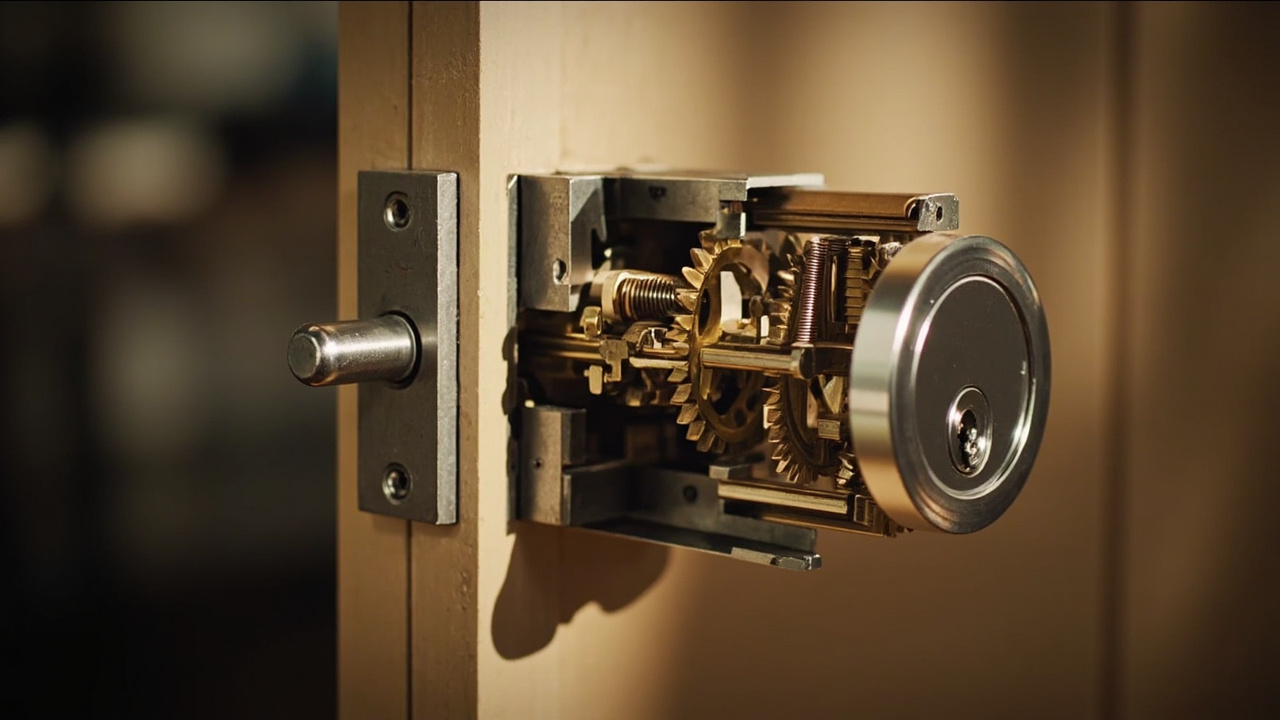
Reading the Intelligent Cylinder Claims in a Supplier Datasheet
Intelligent cylinder datasheet claims is what this piece examines at component level. A qualification file rarely fails because no one wrote a specification. More often, it fails because a datasheet says enough to sound decisive and too little to be testable. That is especially true of an intelligent-cylinder claim: the words can describe a mechanical cylinder, an electronic control point, a reader, a motor-driven lock body, or a broader lock assembly. The supplier's boundary may be sensible, but the buyer's boundary must be explicit.
Direct answer. The one-line answer — intelligent cylinder datasheet claims is the working record for intelligent cylinder datasheet claims. intelligent cylinder datasheet claims is worthless until intelligent-cylinder is attached to it as evidence. An intelligent cylinder datasheet claims describes how one component behaves under load. The datasheet makes claims. intelligent cylinder datasheet claims is what intelligent cylinder datasheet claims can be tested against.
- Test what it does — confirm on the dated product page for the specific SKU behind intelligent cylinder datasheet claims
- Test where it stops — record where the technology in intelligent-cylinder stops working
- Plan the manual path — name the mechanical path that remains if intelligent cylinder datasheet claims fails
- intelligent cylinder datasheet claims runs this sequence, and intelligent cylinder is the record it produces.
The intelligent cylinder datasheet claims are therefore read as sentences with verbs, conditions and evidence attached—not as labels to repeat. An illustrative qualification might begin with a polished spreadsheet: a cylinder column, several performance adjectives and a note promising broad compatibility. The useful work starts by asking what each line changes in interface design, installation, testing or acceptance. This article follows that sequence, from the first claim to a qualification record that can survive engineering review.
The sentence that looked like a specification
Consider an illustrative line: “intelligent cylinder, broad compatibility.” It sounds decisive, yet neither clause defines the delivery. “Intelligent” gives no boundary between cylinder, reader, controller and lock body. “Broad compatibility” gives no door population, interface definition or acceptance rule.
A qualification writer should split the sentence into claim and consequence: what is supplied, which boundary is assumed and which project choice depends on it. Without answers, it remains a lead, not an accepted specification.
First-party product material offers a useful calibration. The SLK-9936S hotel lock is listed with a 5-pin cylinder. Confirm on the dated product page for the specific SKU before using that detail in a project specification. The datum identifies one component in one published model; it does not establish electronic behavior, interchangeability or project suitability. Intelligent cylinder specifications therefore need an evidence trail, not a copied noun phrase.
A claim taxonomy built for qualification
During supplier qualification, I use five claim types. They are not product categories; they show what a statement must resolve before it can guide a purchase.
| Claim type | Typical datasheet signal | Evidence to request | Procurement decision enabled |
|---|---|---|---|
| Scope and identity | “intelligent cylinder” or component name | dated drawing, revision and included-parts list | define what is supplied |
| Interface | “system-ready,” “integrates” or “compatible” | physical, electrical and data-interface definition | assign integration responsibilities |
| Door fit | “fits standard doors” | dimensioned drawing and sample-door check | approve or reject the installation envelope |
| Operation | “secure,” “fast” or “emergency access” | measured procedure, conditions and result | write a testable acceptance condition |
| Service and supply | upgrade, replacement or availability wording | revision control, service procedure and commercial response | decide maintainability and project risk |
When intelligent cylinder datasheet claims are copied into a tender, keep the original wording in one column and the qualification status in another. A claim may be verified for identity while unresolved for integration. Collapsing those judgments creates false completion.
The taxonomy prevents one strong answer from carrying another row. A drawing can settle fit, not interface; an interface description can settle communication, not fit; a test can establish one condition, not every condition. Each claim receives only the evidence that matches it.
From a manufacturer's documentation bench, a narrow answer can be more useful than a broad adjective: identify what is supplied, what remains external and which revision the answer covers. That discipline also reduces sample-review mismatch.
From brochure wording to an evidence trail
The next step is not to collect paperwork indiscriminately. It is to build a chain from claim to decision, identifying the sample, document revision, conditions and person able to interpret the result.
flowchart TD
    A[Record the original claim] --> B[Define scope and boundary]
    B --> C[State a measurable acceptance condition]
    C --> D[Match evidence to the condition]
    D --> E[Record qualified conditional or unresolved status]
    E --> F[Release the claim to the design record]
A datasheet may source a claim, but should not also prove it. Drawings support fit; controlled results support operating conditions; sample checks support physical relationships. A supplier statement can explain intended use, but its assumptions and revision remain visible.
Use this datasheet evidence checklist while reading:
- Capture the exact sentence, product identifier, document date and revision.
- Name the included and excluded items.
- Turn ambiguous wording into an observable acceptance condition.
- Record the evidence source, limitations and assumptions.
- Obtain a qualified response where interpretation depends on the supplier.
- Freeze the accepted wording in the project record.
The goal is not maximal evidence. It is evidence proportional to the consequence of being wrong.
The boundary the cylinder must cross
The most consequential ambiguity is often spatial. One supplier may place intelligence in a reader or panel and use cylinder as mechanical shorthand; another may mean an electronically controlled lock body. These scopes are not interchangeable.
A useful cylinder interface definition should identify the cylinder, spindle, collar or rose, mortise case, latch or deadbolt relationship, and connections to readers, credentials, power, gateway, app or event storage where included. It should show where access decisions occur and what is retained.
Then ask:
- Does “intelligent” describe the cylinder, lock, credential or access system?
- Which signals cross the door boundary through which interface?
- What remains operable when the wider system is unavailable?
- Which event is generated for an access decision, and where is it retained?
- What is replaced during service, and which configuration must be restored?
These are the kinds of questions collected in Specifying the Intelligent Cylinder: Questions that Get Real Engineering Answers. Their value lies in the boundary each answer establishes.
Door fit verification starts below the panel
A clean exterior panel can distract attention from the actual fit problem. Door leaf thickness, frame rebate, backset, spindle, mortise case, cylinder collar or rose, latch, deadbolt, strike plate and strike keeper determine whether the proposed assembly can be installed without alteration. A statement that a product fits “most” doors is a prompt for measurement, not an acceptance result.
Door fit verification should connect the component to a recorded door condition. Obtain dimensioned drawings, compare them with the door schedule, and inspect a representative sample where allowed. State whether the drawing gives a maximum envelope or a fixed configuration, and note dependencies on door swing, frame hardware, trim or keeping arrangements.
Door-fit claims also need a reference boundary, as detailed in Clause Bank: The Intelligent Cylinder and Door Compatibility: The Fit Envelope. For retrofit work, use the Smart Lock Retrofit Site Survey as a field structure. For a multi-door commercial interior, the Office Smart Lock Site Survey can organize door-by-door variation.
Neither survey turns a catalogue drawing into project acceptance; the measured condition must still match the quoted component and its revision. The result should be a suitable envelope, a condition, or an evidence gap—not “universal fit.”
Emergency access is a workflow, not an adjective
“Emergency access” may refer to a mechanical override key, an external power connection, a network-independent method or an operational procedure. These routes are not interchangeable. A datasheet should name the available route, the conditions under which it applies and its associated limitations.
Ask what happens at the lock, who can use the method, what is recorded and how normal operation is restored. If a mechanical override key is offered, identify the key-control process and replacement responsibility. If an external power override via a USB terminal is offered, confirm the electrical and operational limits on the dated product page for the specific SKU. These are controlled fallback questions, not invitations to infer features from a product family.
CONFIRM-WITH-LOCAL-AUTHORITY — Verify project-specific door-egress, fire-safety and accessibility obligations with the authority having jurisdiction and the approved door assembly documentation.
The emergency claim then belongs in a workflow. It has a trigger, an authorized action, a physical result, an event record and a recovery step. Missing any of those elements leaves the wording operationally incomplete.
The qualification record exposes hidden equivalences
By this stage, the datasheet has become a set of decisions. The supplier qualification record should preserve both what was learned and what remains open.
| Original wording | Boundary | Measurable acceptance condition | Evidence | Status | Open action |
|---|---|---|---|---|---|
| “Broad compatibility” | interfaces unnamed | named interface list and sample check | response and drawing revision | unresolved | obtain definition |
| “Emergency access” | route unidentified | trigger, method, result and recovery | procedure and sample observation | conditional | witness operation |
| “Fits standard doors” | no door population | approved dimensional envelope | drawing and door survey | unresolved | compare records |
| “System ready” | system boundary unknown | responsibility matrix and event format | interface document | conditional | assign owner |
Use four status values consistently. Verified means the evidence matches the stated condition, not that every related feature is proved. Conditional means acceptance depends on a recorded project condition. Unresolved means the evidence is insufficient. Rejected means the proposed scope does not meet the requirement.
This exposes hidden equivalences. One supplier may use “integration-ready” for a wired electrical interface, while the integrator means a complete data and event interface. Another may use “serviceable” for replaceable parts, while the buyer means documented diagnosis and configuration recovery. The words appear equivalent in the spreadsheet, but their consequences differ.
Test evidence that can close a claim
Some claims cannot be settled by a drawing or description. They need a controlled observation. The Intelligent Cylinder Test Evidence a Buyer Can Actually Request gives a fuller sequence, while the qualification worksheet needs the claim-specific portion.
A useful evidence note identifies the exact sample and configuration, starting condition, stimulus, observation method, result and deviation. It also identifies the drawing, software, firmware or management-system revision in scope. This prevents a result from being transferred to a different configuration without explanation.
The acceptance condition should be written before the evidence is reviewed. “The test passed” is not a requirement. The requirement is a specific result under a specific condition, linked to one claim and one product revision. If the evidence covers only one sample or environment, the status remains conditional outside that boundary.
Technical evidence also needs an owner. The supplier may explain its test method, the system integrator evaluates interface behavior and the project team evaluates the door record. One sign-off should not silently combine all three decisions.
The shortlist that survives the reading
After this exercise, the polished column becomes less impressive and more useful. “Intelligent cylinder” identifies a bounded assembly. “Compatible” names an interface and responsibility. “Fits standard doors” becomes a measured envelope or open action. “Emergency access” describes an authorized route with recovery. Each claim is smaller, but testable.
For a system integrator, that is when a datasheet becomes project input. The evidence boundary, revision and open actions can travel into drawings, RFQ responses and test plans. Cost, durability and service choices are covered in The Intelligent Cylinder Trade-Offs: Cost, Durability and Service, but qualification comes first.
The same question is worked through in more detail in the slk 8831 office application. That is the same question intelligent cylinder datasheet claims has to answer here.Ask shortlisted suppliers for the dated SKU datasheet, dimension drawings, interface definition, operating-procedure evidence and written responses to unresolved rows. Keep the claim sheet beside those documents and assign an owner to every gap. If a supplier cannot close a claim, the project can narrow the scope, change the design or reject the option without pretending the original wording was sufficient.
Commercial discussion should follow this technical record. When the accepted scope is clear, request a quote becomes a comparison of defined configurations rather than adjectives.