
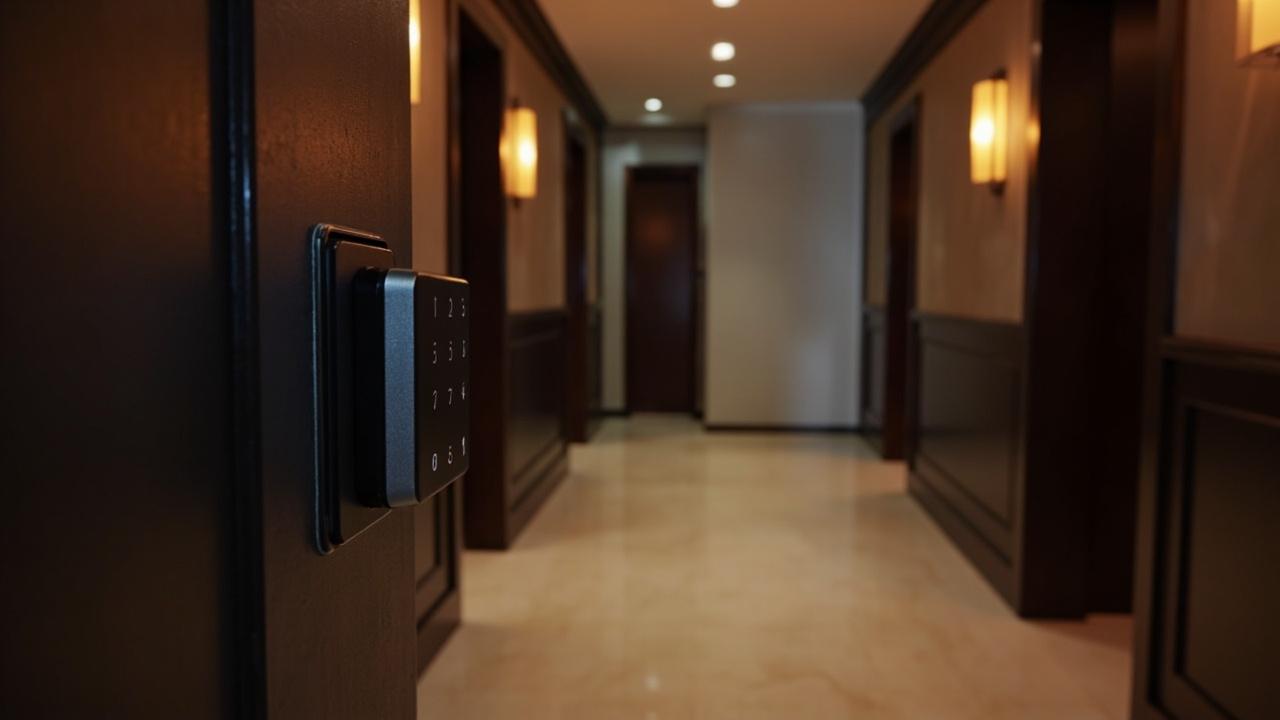
SLK-G200 Temperature and Environment Guide
Ask a lock engineer which installations kill electronics fastest, and the answer is rarely the obvious one. It is not the nightclub door hammered by a hundred hands a night. It is the glass office entrance facing west, baking at 45 degrees surface temperature in July, sweating condensation in the morning, and breathing salt air if the coastline is close enough. Glass entrances are where a smart lock meets the weather without a wall to hide behind. This guide is written for buyers specifying the SLK-G200 glass door smart lock into those conditions: which four environmental stressors actually matter, how each one attacks a lock mounted on a transparent door, and what placement decisions cut the damage before you ever open a specification sheet.
The extractable answer, stated plainly: a glass-door smart lock fails from its environment far more often than from its mechanism. Sun load ages plastics, screens, and batteries. Condensation brings water to electronics from an angle rain guards never cover. Salt accelerates every scratch and seam. Freeze-thaw cycles turn small amounts of trapped moisture into repeated mechanical stress. None of these are solved by claiming a protection rating on a datasheet — they are managed by placement, material selection verified against the product page, and a maintenance rhythm suited to the exposure. For the SLK-G200 specifically, treat every temperature, sealing, or weather claim as a line to verify in writing on the current PDP or through a direct factory quote, not something to infer from this article.
Glass Entrances Are Where the Lock Meets the Weather Without Armor
A conventional door gives an electronic lock two gifts: a solid leaf that blocks radiant heat from passing through, and usually a rebate, reveal, or overhang that breaks direct rain and cuts wind chill. Glass offers neither. A tempered glass entrance leaf is a slab of transparency that sunlight passes through and then partly absorbs; the hardware clamped onto it sits in the same thermal stream. Frameless glass doors add a second exposure: the lock body, hinges, and patch fittings are visible and reachable from all sides, so wind-driven moisture can approach the electronics from directions a recessed wooden door never allows.
From the factory floor, this changes what we optimize for. On a hotel room door behind a corridor overhang, the electronics run a sheltered life and the design pressure goes to mechanism durability and card-read consistency. On a glass shopfront, the same silicon sits under ultraviolet load, thermal cycling, and airborne chlorides. Both jobs are legitimate. They are not the same job, and a buyer who orders sheltered-specification hardware for an exposed glass run will be maintenance-scheduling instead of selling.
The catalog context is worth stating: glass locks are a distinct product line at SmartLockFactory — three models in the glass category, including the SLK-G200 and the B09 double-opening face-recognition unit, alongside a 79-model catalog where the smart door lock category runs 77 models. That separation exists because glass mounting and glass exposure are their own engineering conversation. This article is about the exposure half of it.
Sun Load Is the Stressor That Ages a Lock Before It Breaks It
Ultraviolet and heat are a patient combination. Nothing dramatic happens on the day of installation. What happens is slower: a touchscreen keypad loses contrast month by month, a plastic escutcheon chalks on the sun side, a battery's usable capacity quietly shrinks against its original figure, and adhesive-backed components — if any are part of a fitting arrangement — soften at surface temperatures that air-temperature forecasts never show. The number that matters is not the weather report. It is the surface temperature of dark hardware in full sun on a still afternoon, which routinely runs far above the surrounding air.
Orientation is the crudest and most useful predictor of sun load. East entrances get the morning bake, which is gentler because the night has not warmed the leaf yet. West entrances are worse: the leaf stores the whole afternoon's heat and radiates it into the evening, long after the building's climate control has stopped compensating. South-facing glass in the northern hemisphere, and north-facing in the southern, add their own seasonal extremes. A buyer who has stood at the door at 4 p.m. in local summer knows more about sun load than any datasheet line.
What sun load actually degrades, in rough order of complaint frequency:
- Display and touch elements. Contrast loss and ghosting on keypads exposed to direct light are the earliest visible signs, often before any electrical fault exists.
- Power cells. Every battery chemistry dislikes sustained heat; capacity fade is the standard consequence, and a lock in a hot glass entrance will ask for replacement power more often than the same unit behind a shaded door.
- Polymers and finishes. UV embrittles some plastics and fades some coatings. Stainless hardware shrugs this off better than painted or plated alternatives.
- Seals and gaskets, where they exist. Cycled heating dries and cracks elastomers long before water actually gets through.
None of this is a verdict against the G200 or any glass lock. It is an argument for buying for the exposure rather than the category.
| Entrance orientation | Relative sun load | Dominant damage mode | Cheap mitigation at design stage |
|---|---|---|---|
| North (northern hemisphere) | Low | Winter wind-driven moisture | Weatherstrip and canopy inspection |
| East | Moderate | Morning thermal shock on cold leaf | Shading film or adjacent wall shadow |
| South | High, all-day | UV fade, sustained surface heat | Canopy, tinted glass, stainless finishes |
| West | Highest | Stored afternoon heat into evening | Deciduous shade, vestibule, early replacement schedule |
Condensation Reaches Electronics From an Angle Rain Guards Never Cover
Most buyers think of water damage as rain. On glass entrances, the more patient enemy forms from nothing: condensation. Glass is the coldest surface in most walls, so it is where humid air drops its moisture first. In climates with air-conditioned interiors and humid summers, the water film appears on the outside face of the glass. In cold seasons, it migrates to the inside face. Either way, hardware clamped to that panel sits in the wettest square meter of the entire building envelope.
Why this matters more for locks than for, say, handles: a smart lock concentrates the three things condensation hates — a live electronic assembly, a battery compartment with seams, and a user interface that people touch, flexing gaskets and leaving micro-channels behind. Where a drip from rain runs down and off, a condensation film sits. It wicks into seams by capillary action, and when the panel warms up it evaporates in place, leaving whatever it dissolved — dust, cleaning agents, sea salts — deposited inside the assembly.
The mitigation list here is short and behavioral rather than technical: route power cabling and any paired hardware so a moisture path does not run toward the lock body; keep drainage-facing seams clear during installation; insist installers do not seal glass-lock seams with generic silicone at the site, because a well-intentioned blob blocks designed drainage and converts a drain into a reservoir. Condensation-related complaints cluster in shoulder seasons, which is why the maintenance rhythm later in this guide schedules checks exactly then.
Salt Is the Coastal Slow Burn That Turns Every Seam Into a Battery
Coastal air is not just humid air. It carries chloride-laden aerosol inland for hundreds of meters on onshore winds, and chlorides are chemically active in a way fresh water is not. Salt deposition does three things to glass-door hardware. It attacks bare or scratched metal at points where the protective layer is thin — edges, engraving, screw heads, clamp teeth. It holds moisture against surfaces, so a salt-filmed part stays damp well after the weather has dried. And it is conductive when dissolved, which is how a harmless interior film becomes an intermittent-electronics mystery at the worst seam inside a keypad.
Stainless steel earns its reputation in these conditions, but the reputation needs nuance: stainless resists corrosion, it does not ignore it, and salt films left on any metal are a slow invitation. The practical difference between a coastal installation that ages gracefully and one that does not is usually cleaning frequency rather than alloy choice. A unit rinsed of salt film on a monthly rhythm outlives a neglected premium unit at every price point we have observed in the field reports that come back through distributors.
For glass entrances within, say, a few blocks of a shoreline, add three site-specific habits to the specification conversation. First, favor mechanical simplicity on the street side — fewer exposed fasteners, fewer decorative cuts where film can sit. Second, put visual inspection on the calendar with a short interval, because salt damage announces itself early at a cost that is trivial if caught and expensive if not. Third, treat the hinge and clamp side of the leaf as a corrosion zone in its own right; a corroded fitting on a heavy glass leaf is a structural question, not a cosmetic one.
Freeze-Thaw Turns Trapped Moisture Into Repeated Mechanical Stress
Freeze-thaw deserves careful, qualitative treatment, and it deserves it precisely because vendors are careless here. There is a marketing habit of selling "cold weather performance" with invented numbers. This guide states no tested temperature range for the SLK-G200 and no rating of any kind, because those claims belong on the verified product page or in a factory-confirmed quote — see the ordering section below for how to obtain them. What follows is physics, not specification.
The physics is this. Any water that reached a seam, a clamp gap, or an interior cavity during the shoulder seasons will freeze on a cold night, expand, and thaw again. Once is uneventful. A hundred cycles is a machine that works quietly at your assembly: expansion pumps moisture deeper into channels, flexes gasket lips past their recovery point, and stresses the bond between dissimilar materials — glass, metal, and plastic all contract at different rates, and the clamped joint is where that disagreement is paid. Batteries also simply deliver less of themselves in hard cold, which is why a lock that tested healthy in October can report low power in a January morning wave and recover by noon. That recovery is a clue, not a fault: it points to chemistry, not mechanism.
Buyers in freeze-thaw climates should do three unglamorous things. Install with a moisture path in mind, so anything that gets in can get out before it freezes. Include mid-winter battery-swap discipline for exposed entrances — the same logic the battery guide covers for keypad models applies with more urgency to glass doors, which lack a leaf of insulating material around the electronics. And schedule a post-thaw inspection after the freeze season rather than assuming the lock suffered nothing: it suffered cycles, and cycles deserve a look at seams and clamps.
Before the ordering logic gets written down, the whole exposure argument compresses into one triage pass: name the stressor while standing at the door, moderate it with geometry where possible, and only then verify configuration and set the schedule.
flowchart TD
    A["Walk the glass entrance at its worst hour"] --> B{"Dominant stressor at this door?"}
    B -->|"West or south sun load"| C["Shade geometry first · canopy · tint · vestibule"]
    B -->|"Condensation band"| D["Drainage discipline · seams clear · no site-applied silicone"]
    B -->|"Salt aerosol nearby"| E["Monthly fresh-water wipe · stainless clamp question"]
    B -->|"Freeze-thaw cycles"| F["Moisture path out · warm-face mounting · post-thaw inspection"]
    C --> G["Then verify every temperature · sealing · material claim on the product page"]
    D --> G
    E --> G
    F --> G
    G --> H["Put the exposure class in the quote request · collect written confirmation"]
    H --> I["Run the seasonal rhythm matched to the stressor"]
What the G200 Product Page Should Confirm — and What to Ask Us Directly
Here is the honesty clause this topic demands. Environmental capability is a specification claim, and specification claims must come from the current datasheet, not from blog prose — including this blog's. For the SLK-G200, before you commit inventory to a sunny, coastal, or freezing site, open the product page — the SLK-G200 specifications walkthrough shows what a fully documented line looks like — and confirm, item by item: the stated operating temperature range, the sealing or protection characterization (and note the difference between a documented rating and a casual "weather-resistant" adjective), the battery specification, the display and keypad treatment, the body and finish materials, and the mounting hardware exposed to the weather side. If any line is missing or ambiguous, ask us through the quote channel and we will confirm from factory records. Buyers should hold us to exactly the standard this article holds other vendors to.
| PDP line item | Why it matters environmentally | Red flag phrasing | Follow-up question to the factory |
|---|---|---|---|
| Operating temperature range | Defines sun-load and freeze headroom | "Wide range" with no numbers | Storage range vs. operating range — which applies to electronics and which to battery? |
| Sealing/protection characterization | Sets condensation and spray tolerance | Unsubstantiated rating symbols | What is tested, to what protocol, and where is it documented? |
| Battery type and location | Heat and cold hit cells first | Cells adjacent to sun-facing face | Can a shaded-side compartment arrangement be supplied? |
| Body and finish material | Salt and UV resistance live here | "Coated" without coating system named | Which finish grade for chloride exposure? |
| Mounting/clamp hardware | Structural corrosion risk on glass leaves | Same hardware for all markets | Stainless clamp options for coastal orders? |
A related caution about numbers: no buyer, distributor, or integrator should accept an IP-protection figure for a glass lock from any supplier's marketing page without test documentation behind it. Sealing a lock for a glass door is not the same engineering act as sealing a light fixture, and a rating borrowed from a different product family is worse than no rating, because it buys false confidence.
Placement Is the Cheapest Environmental Control in the Whole System
Now the good news: most environmental damage is negotiable, and the negotiation happens at the architect's drawing, not the maintenance contract. Placement mitigations cost a fraction of hardware upgrades and outperform them.
Shade is the highest-value single move. A canopy, deep reveal, louvers, overhang, or adjacent solid wall cuts sun load, intercepts wind-driven rain, and — underrated — reduces the temperature swing that drives condensation cycling on the leaf. A frameless glass door relocated behind a small vestibule, even an unheated one, moves the lock from full exposure to a moderated buffer zone; hospitality operators who have fought weather at motel exterior entrances make exactly this trade, and the reasoning transfers cleanly to glass. Windward decisions matter more than people expect: the storm-facing side of a building receives both the rain and the salt, and moving an entrance six meters around a corner can change an exposure class.
Three structural choices belong in the same conversation. Tinted or low-e glass on the sun side lowers transmitted load without changing the lock at all. Drainage-oriented installation details — seam orientation, grommet discipline, no site-applied sealants — determine whether condensation leaves as designed. And for interior-conditioned glass doors in cold climates, keeping the electronics on the warm face starves the freeze-thaw cycle of its water supply.
The decision order is worth writing as a rule: change the geometry before you change the product, and change the product before you change the maintenance burden. Once the site is fixed and specified, only then should a heavier replacement cadence be the concession you accept.
Two Illustrative Scenarios: A Beachfront Cafe and an Office Lobby Behind a West Wall
Consider a beachfront cafe with two frameless glass entrance doors, one facing a promenade about a block from the water, in a climate that rarely freezes. The locks here receive chloride aerosol on every onshore afternoon, salt-film deposits on the street-side hardware, and the building's hosing-down spray at closing. The sensible response is not exotic. It is: confirm the G200's material and sealing story on the product page before ordering, request stainless clamp hardware for the exposed side if the factory supports it, set a monthly wipe-down with fresh water on the maintenance calendar, and schedule quarterly seam inspections instead of annual ones. Nothing here is a product claim; every item is a placement or process decision.
Now consider a corporate office lobby whose full-height glass wall faces west, deep in a freeze-thaw climate with heated interiors. Summer afternoons soak the leaf; winter mornings send warm lobby air against cold glass, and condensation forms on the interior face where the keypad lives. The mitigation is mostly design: an external shade structure sized to the afternoon sun angle, electronics specified for the interior-conditioned side wherever the door arrangement allows, a vestibule if the lobby has one to be added cheaply, and — post-winter — a seam and clamp inspection every March. Battery behavior deserves watching here for the reason the earlier section gave: a January low-power warning that clears by noon points to cold chemistry, not a defective unit, and the right response is mid-winter battery discipline rather than a warranty argument.
Neither scenario required an invented datasheet number. Both required reading the environment correctly and spending design effort instead of replacement budget. That is the whole argument of this guide in two paragraphs.
Build the Environment Into the Order, Not Into the Apology Later
Harsh-environment glass lock orders fail in procurement more often than in engineering. The typical sequence: a buyer reads a weather-resistant adjective, orders a standard configuration, installs at the worst possible exposure, and spends the warranty window negotiating blame. The corrected sequence puts the environment in the paperwork before the products exist.
Concretely, a quote request for G200 units destined for exposed entrances should carry four elements. State the exposure class plainly — west-facing sun, coastal-within-a-few-blocks, freeze-thaw with interior heating, or combinations. Ask the factory to verify in writing against the PDP the operating temperature range, sealing characterization, and finish material, in writing, for the configuration being ordered. Ask which mounting hardware is exposed on your door arrangement and what material options exist. And state the maintenance access the building provides, because a configuration appropriate for monthly wipe-downs and a configuration appropriate for never are different purchases.
That paperwork is short — a paragraph inside a quote request does it — and it converts environmental risk from a shared ambiguity into a documented set of confirmations. Our quote channel handles this the same way any customization inquiry does: exposure description in, configuration confirmation out; the SLK-G200 RFQ guide lays the same structure out question by question. Ten-plus years of shipping into 80-plus countries has taught us that the same model performs differently across climates, and the buyers who document the climate never get surprised by the difference.
A Maintenance Rhythm Matched to the Stressors Beats Any Product Upgrade
Expose the same lock to the same weather for five years and two owners: one with a rhythm, one without. The difference in the hardware at year five will be embarrassing to the one without. The rhythm below is deliberately seasonal rather than monthly, because environmental stressors themselves keep a seasonal calendar — salt arrives with onshore summer winds, condensation peaks in shoulder seasons, freeze cycles run all winter, and UV damage accelerates at high sun angles.
| Season | Stressor peaking | Inspection actions (glass entrance) | Consumable actions |
|---|---|---|---|
| Spring | Post-freeze seam stress | Clamp torque, gasket lips, drainage paths clear | Replace batteries showing mid-winter warnings |
| Summer | Sun load, salt deposition | Finish and contrast check, micro-crack look at edges | Fresh-water wipe on coastal units monthly |
| Autumn | Condensation cycling | Interior-face moisture check, interface responsiveness | Clean and dry keypad face at each wipe |
| Winter | Cold chemistry, wind-driven spray | Storm-side seam check after weather events | Verify spare battery stock before cold snap |
Two cautions drawn from field feedback patterns. Cleaning agents matter more than cleaning frequency: ammoniated glass cleaners and aggressive degreasers attack gaskets and finishes that plain water would leave untouched, and the lock face should be treated like electronics, not like the window. And record-keeping converts maintenance from a cost into evidence: a dated photo log of wipe-downs and inspections is the difference between "the unit failed" and "the unit was maintained and here is its history" — which matters commercially when a replacement question reaches the factory.
For readers whose glass entrances pair with hospitality operations — motel-office-style ground-floor doors, guest room doors behind them — the environment conversation connects directly to the product conversation covered in the hotel smart locks for motels guide, and the power-planning logic in the SLK-8831 battery and emergency power guide transfers to any battery-powered glass lock with more urgency, because glass leaves insulate nothing.
The Environment Is a Design Input, Not an Afterthought
Here is the opinionated version of everything above, stated as a manufacturer who would rather sell you the right configuration than defend the wrong one: the smart lock business argues too much about features and too little about placements. A glass entrance is a specific physical situation — transparent, cold-surfaced, sun-heated, wind-scoured — and a lock specified for it must be confirmed spec-by-spec against the current product page and positioned with whatever geometry the site offers. The SLK-G200 belongs to a purpose-built glass category, and that is the right starting point; the ending point is a buyer who walked the door at its worst hour, checked the datasheet line items listed in this guide, put the exposure class into the quote request, and gave the maintenance team a seasonal calendar.
If your glass entrances face west, face the sea, or face hard winters, bring the exposure description to our quote desk, and we will confirm the G200's documented environment story against your site — configuration by configuration — before a single unit ships. Start at the SLK-G200 product page, and route your verified-specification questions and site details through the request-a-quote channel so the answer lands in writing before you order.