
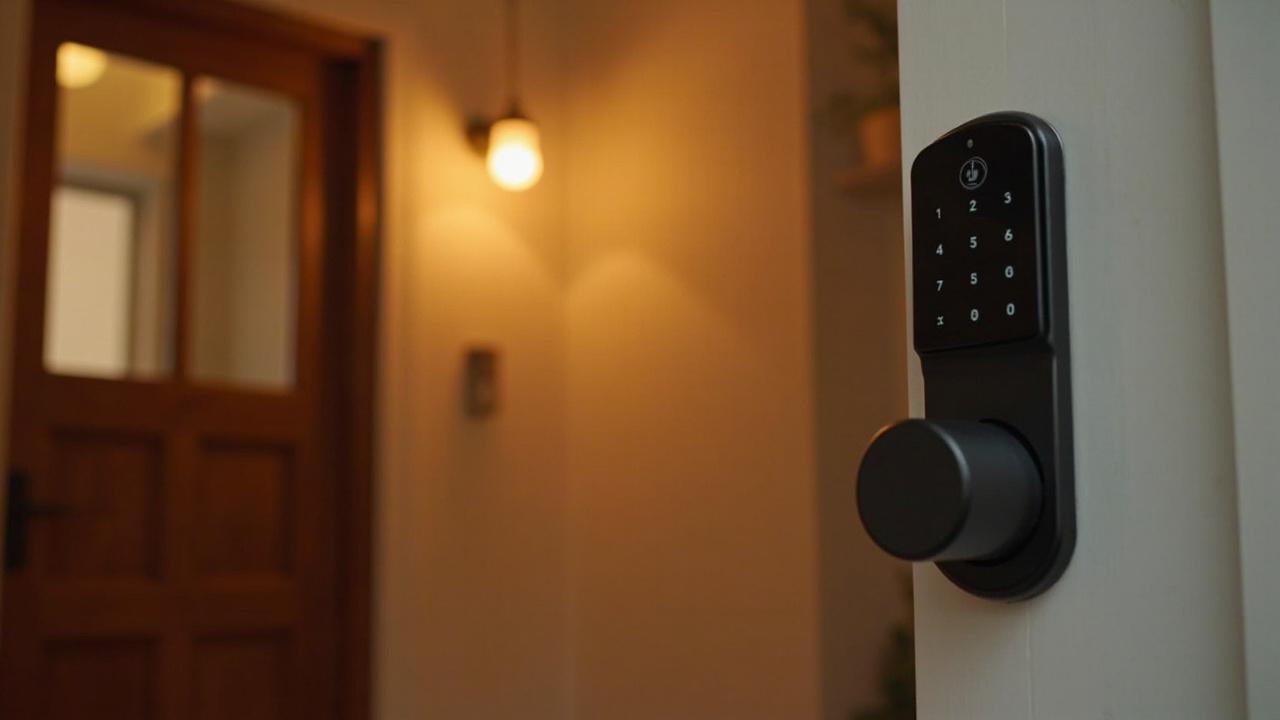
Smart Locks for Residential Communities
A residential community is not one door. It is a stack of at least seven distinct door layers, each with a different material composition, a different traffic profile, a different credential population, and a different boundary of who controls the lock. Treating them as a single procurement category is the mistake that produces meeting-room overruns, taped-over keypads, and the post-installation discovery that the pool gate keypad gets washed by chlorine mist within a year.
Smart locks for residential communities, in technical terms, are door-level electronic locks drawn from the catalog (keypad, RFID, fingerprint, app-connected, multi-method 5-in-1 or 4-in-1 combinations) matched door-by-door to seven layers of a community's openings — perimeter vehicle gates (a different trade; covered honestly as out of scope), pedestrian perimeter doors, amenity buildings, internal garage pedestrian doors, building-service and plant doors, management and leasing offices, and unit entrance doors. The material and door-type cross-cutting matrix, plus a single honesty boundary about vehicle gates, is the working instrument.
This article walks the seven layers one at a time, then overlays a material/door-type matrix that classifies every common door substrate against every common lock class with honest suitability ratings. It is the technical companion to two siblings: Smart Locks for Gated Communities, which handles the HOA governance and procurement-decision side, and Smart Locks for Apartment Common Areas, which handles the resident-facing amenity tear-off card deck door by door. The per-building fleet-buying mechanics, including credential unification across multiple door classes, live in Smart Locks for Apartment Buildings: Buyer Guide. The article you are reading is the layer-by-layer technical taxonomy that those three siblings reference.
The Honest Boundary First: What a Door-Lock Catalog Is Not
SmartLockFactory's catalog covers door locks: keypad, RFID, fingerprint, app-connected, multi-method combinations, glass-door locks, narrow-edge-profile locks, outdoor-rated units. It is read in the following pages by the same scale the factory tests it on: the door itself — its thickness, its material, its edge geometry, its interior or exterior exposure, the battery-compartment reach on installation day.
What the catalog does not cover, and what every sensible procurement plan for a residential community separates into a separate procurement track:
- Vehicle gate booms, sliding gates, swing gates with gate motors
- License-plate recognition (LPR) cameras and barriers
- Visitor intercom kiosks, video doorbells serving the entire community
- Access-control head-end servers, controllers, and Wiegand wiring plants
- Automatic door operators on pedestrian doors (closers, low-energy swing operators)
- Panic hardware and listed fire-exit devices
- Elevator destination-dispatch control hardware
These are valid, real product categories; they are not in this catalog. The community will still likely need some of them. The mistake is asking a door-lock supplier to quote them, or expecting a door-lock supplier's product page to settle questions about them. The honest procurement posture is: doors go to this catalog; vehicles and head-end electronics go to a different supplier, coordinated by an integrator. The remaining sections of this article deal only with the doors.
Layer One — Perimeter Vehicle Gates
Layer one is the most visible community door and the one a door-lock supplier cannot help with. A perimeter vehicle gate is a swinging or sliding gate leaf on a motorized operator, often paired with a guard kiosk, an LPR camera, and a barrier arm. The mechanical artifact a guest sees is not a door — it is a gate leaf, and the credential readers on it are part of the gate-automation vendor's stack, not part of a door-lock catalog.
Where a door-lock supplier does intersect the perimeter — and it is a small intersection — is the pedestrian sally port door cut into the perimeter wall beside the vehicle gate, used by residents who walk in rather than drive in. That door is in scope and discussed in layer two below. The vehicle gate itself belongs in a separate procurement track, and the community plan should name it as such early; the two streams meet at the integration layer, not at the supplier layer.
Layer Two — Pedestrian Perimeter Doors and Sally Ports
Pedestrian perimeter doors are the secondary access points cut into the wall, fence, or guardhouse around the community. They are pedestrian-scale (single-leaf, 900–1,000 mm typical), framed in metal or aluminum, frequently equipped with a self-closer, sometimes with a panic bar on the egress side. They see high volume during commute hours and remain mostly idle overnight.
The catalog supplies this layer with care. The constraints that shape the lock choice:
- Credential class is usually keypad plus RFID, not fingerprint — pedestrian traffic is large-volume and intermittent, and fingerprint enrollment drift across thousands of irregular uses is real friction. A keypad with a permanent staff code and time-boxed visitor codes, or an RFID reader with a community-issued fob, is the standard pattern.
- Weather exposure is full exterior, often with wind-driven rain. The lock body and credential reader need an outdoor rating; the catalog's outdoor category and aluminum-door series designations (D11, D12, D15, ODS, DQ per the catalog spec) are where the candidates live. Verify the waterproof class on the product page — outdoor-rated is a positioning claim, the test report is a separate document the supplier must furnish on request.
- Egress requires mechanical override that meets local code. The lock must fail-open or fail-secure per the authority-having-jurisdiction's direction; this is a code question, not a catalog question, and the verification belongs to the project's code consultant.
- Visitor flow routes through the sally port or guard kiosk alongside, not through the residential locks. The catalog handles the door; visitor signage and intercom handling live elsewhere.
Layer Three — Amenity Buildings (Clubhouse, Pool, Fitness, Multipurpose)
Amenity buildings are the pedestrian-scale community assets: clubhouse entry, pool gate (pedestrian door, not the pool gate motor), fitness room, multi-purpose room, business-center, sometimes a community kitchen. These doors dominate the visible amenity experience of a community, and the lock on each one drives whether residents use the amenity or stay away from it.
The fitments vary more here than in any other layer, because each amenity room has its own hours policy, its own credential population, and its own material substrate. The pattern that holds across them:
- Clubhouse entry is multi-method day-in-day-out: keypad for short visits, RFID for staff, fingerprint for the long-tenure staff member who is on premises daily. The 5-in-1 and 4-in-1 multi-method units in the catalog (SLK-8831 5-in-1 by product page; the narrow-edge 4-in-1 waterproof class by verified slug) are the right starting point — confirm the credential population cap and the app platform on the product page.
- Pool gate (pedestrian) is high-volume in summer, near-idle in winter, splash-exposed on the credential reader. Outdoor body, weatherproofing above the baseline, fingerprint is structurally fragile here — wet feet, sunscreen, and children's fingers all defeat the optical/capacitive reader. Card or code lane carries this door.
- Fitness room and game room are indoor-conditioned, lower weather stress, and often share a credential population with the clubhouse. A keypad or RFID reader mounted on an interior-rated body is fine; the 18-keypad and 9-RFID counts in the catalog are where these candidates live.
- Multipurpose / function room has a credential population that may include one-time rental guests. Time-boxed PIN codes (issued per booking, expire at the booking end) are the structural answer — check the model’s published specification whether the unit supports scheduled code expiry or only manual rotation.
- Glass conference / business center interior door uses the catalog's glass-door category (SLK-G200 by verified slug is the named line; confirm the glass-cutout dimensions and patch-fitting set on the product page). This is the one amenity layer where the catalog diverges from standard bodies.
Layer Four — Internal Garages and Parking Decks
Internal garages are split into two distinct sub-layers that the lock budget treats very differently:
- The vehicular side of an internal garage is a rolling or sectional door, often motorized, controlled by a remote, keypad, or RF device on the column. The mechanical artifact is a garage door operator, not a door lock. This sub-layer is the same trade as perimeter vehicle gates — a separate vendor. Catalog scope ends at the pedestrian-side door that opens from the lobby or stairwell into the garage.
- The pedestrian side of an internal garage is the door residents walk through from the residential corridor or stairwell to reach their cars, the bike store, the storage cages, or the bin store. This is the door the catalog covers.
The pedestrian-side garage door is high-volume, often weather-exposed when the garage is open on a side, and frequently a fire-rated assembly. The lock choice on this layer is constrained by:
- Door material: steel fire-rated door, sometimes paired with a closer. Mortise or cylindrical body; confirm the latch throw and backset on the product page.
- Fire rating: if the door is listed as fire-rated, the lock modification cannot void the listing. This is a listing question, not a catalog question, and the lock supplier's product page cannot answer it — the door manufacturer and the authority-having-jurisdiction settle it.
- Credential class: keypad or RFID, with optional fingerprint for the resident path. The 5-in-1 multi-method units handle this; confirm the weather rating for any unit whose body sits in a semi-exposed garage vestibule.
- Hours and traffic: car-bound residents exit through this door multiple times daily. The lock's battery cycle budget matters here more than on an interior amenity door — confirm the battery cycle count and low-battery signaling on the product page.
Layer Five — Building-Service, Plant, and Maintenance Doors
These are the back-of-house doors: electrical rooms, riser closets, generator rooms, irrigation controls, mechanical rooms, refuse / bin store exterior doors, plant-room entries. They are dominated by staff and contractor traffic, with bare minimum of resident interaction, and they sit inside the community's security perimeter by a wide margin.
- Credential class: keypad or mechanical-only are the dominant answers. A fingerprint reader on a contractor door invites the enrollment-ladder problem (they need access now; the enrollment takes longer than the visit) — PIN through glove works better.
- Audit need: contractor liability insurance and incident reconstruction push for event logs. Any audit-credit on the catalog unit needs verified in writing by capacity (event records held) and by retrieval path (does it require a smartphone-on-site or a PC station). The SLK-9936S hotel RFID lock cited in the catalog spec has up-to-1,000 audit records in a 4×AA powered body with a 5-pin cylinder and 3-point latch — a format yardstick for "what an audited electronic door looks like." That block does not port to residential service-door specifications; treat it as the format ruler and confirm specifics on the product page of the actual residential unit.
- Weather exposure: exterior plant-room doors may sit fully exposed; bin store doors are splash-prone and corrosive in some communities. Outdoor body and corrosion-resistant finishes are the answer; confirm stainless or alloy body class on the product page.
- Lifetime: the residential community will likely own these doors longer than the original supplier will carry the same SKU. Multi-decade service life demands a lock whose mechanical key override still works when the electronics are dead. Confirm mechanical-override cylinder class on the product page.
Layer Six — Management and Leasing Offices
The on-site management office is the community's operational center: the leasing desk, the property manager's back office, the maintenance supervisor's workstation, the room where keys and credentials live in a safe. The locks on these doors are not glamorous, but they are consequential — every credential handoff in the community passes through this room.
- Front desk / reception door: this is the door residents visit during office hours. Aesthetic finish matters disproportionately here because it shapes the first impression. The catalog's finish options span multiple families — confirm the finish on the product page for the chosen model.
- Manager's office and back-office doors: interior, often wood or wood-composite. Cylindrical-body locks with keypad or RFID; biometric is rarely needed for a small credential population; mechanical override should be on the plan from day one.
- Credential storage safe or key cabinet: not the lock supplier's job — it is a different product class, sourced separately.
- Records archive room: lease files, audit records, sometimes legal discovery records. Access restrictions here are both physical and regulatory; the lock is part of a compliance regime that the property manager's counsel owns. Confirm the credential capacity and user-tier structure on the product page; do not infer from marketing copy.
Layer Seven — Unit Entrance Doors (the Door-Lock Heartland)
Unit entrance doors are the highest-count door class in any residential community. Hundreds of them, sometimes thousands in a tower block, often dozens in a townhome estate, every one of them an independent security perimeter under the resident's control. The product choice for a unit entrance lock feeds more square-meter demand into the catalog than every other layer combined.
The door population here is heterogeneous:
- Apartment unit door on a corridor: usually a fire-rated solid-core timber or composite door, 38–55 mm thick, with a peephole or a removable escutcheon, sometimes a kickplate. The catalog's hotel-lock class (24 hotel locks in the catalog per the catalog spec) and residential multi-method products (cylindrical-latch Tuya round-code by verified slug; SLK-8831 5-in-1 by verified slug) sit in this envelope. Confirm door-thickness band, latch backset, and fire-rating tolerance on the product page for the specific unit.
- Townhouse or villa entry door: larger, often timber with a security strike and a separate deadbolt. Multi-method units work; a heavier mortise body may be desired for the larger leaf. The stainless-keypad and stainless-finish lines (019 / 022 / 309 series with stainless options per the catalog spec) are the candidates here. Confirm the body depth and the strike pocket on the product page.
- Studio / co-living pod door: lighter, sometimes a hollow-core or composite frame inside a converted building. Narrow-edge-profile locks are the right class — the narrow-edge 4-in-1 by verified slug is named in the catalog, and the door-edge geometry determines fit; confirm the edge minimum on the product page.
- Accessory dwelling unit door: similar to a townhouse door, separate from the main house, sometimes on a different lighting circuit. Independent battery behavior matters; confirm the battery cycle count and replacement-tool class on the product page.
The unit door is where fingerprint enrollment is structurally the right answer — a stable household, a closed credential population, low traffic per resident, no shared-staff handoff. The 37-fingerprint count in the catalog covers the full range from optical to capacitive. Sensor type, capture area, enrollment posture, and worst-case fallback must all be answered in writing on the product page; the supplier's general product line should never be treated as the spec for any individual household.
The Material and Door-Type Cross-Cutting Matrix
The matrix below crosses the dominant door substrates (rows) against the dominant lock classes (columns). Suitability ratings are honest, generic, and pre-supplier-verification: a rating of "fit candidate" means the substrate is compatible with the lock class in principle; "verify-on-product-page" means the substrate places specific demands that the supplier must answer in writing; "rare-fit" means the combination works only in unusual conditions.
| Door substrate | Keypad | RFID | Fingerprint | App/Bluetooth | Multi-method (5-in-1 / 4-in-1) | Glass-door | Outdoor body |
|---|---|---|---|---|---|---|---|
| Solid-core timber interior | fit candidate | fit candidate | fit candidate | fit candidate | fit candidate | not applicable | not applicable |
| Solid-core timber exterior | fit candidate | fit candidate | fit candidate | fit candidate | fit candidate | not applicable | verify-on-product-page (weatherproof class) |
| Hollow-core / composite frame | verify-on-product-page (thickness, edge geometry) | verify-on-product-page | verify-on-product-page | fit candidate | verify-on-product-page | not applicable | not applicable |
| Steel fire-rated | fit candidate | fit candidate | verify-on-product-page (sensor height vs. fire-door hardware) | fit candidate | fit candidate | not applicable | not applicable |
| Aluminum profile door (D11/D12/D15/ODS/DQ family) | verify-on-product-page (edge geometry) | fit candidate | rare-fit (drainage, sun glare) | fit candidate | verify-on-product-page | not applicable | verify-on-product-page |
| Stainless-steel-clad door (019/022 series compatible) | fit candidate | fit candidate | verify-on-product-page | fit candidate | fit candidate | not applicable | fit candidate |
| Glass door with patch fittings | not applicable | rare-fit (cutout required) | rare-fit (cutout required) | rare-fit (cutout required) | rare-fit | fit candidate (SLK-G200 class by verified slug) | rare-fit |
| Narrow-edge profile door | verify-on-product-page | verify-on-product-page | rare-fit | fit candidate | verify-on-product-page | not applicable | rare-fit |
| Garage pedestrian door (steel, exterior) | fit candidate | fit candidate | rare-fit (vehicle splash, mud) | fit candidate | fit candidate | not applicable | fit candidate |
| Bin store / refuse door (steel, exterior, splash-exposed) | fit candidate | fit candidate | not recommended (dirty hands, gloves) | verify-on-product-page | fit candidate | not applicable | fit candidate |
Two reading rules apply to the matrix:
- A "fit candidate" cell means the lock class can physically mount and operate on that substrate; it does not mean any given SKU from that class fits — confirm thickness band, edge profile, latch backset and fire-rating tolerance on the specific product page.
- A "verify-on-product-page" cell means the substrate imposes a constraint (edge geometry, weatherproofing class, sensor height, drainage) that varies by model within the same lock class — the supplier's product page answers it per model, the catalog does not answer it at the class level.
This matrix is read alongside — not in place of — the supplier's product pages. The product page is the source of truth for any individual lock; the matrix is the cross-cutting instrument that prevents the lock-by-lock buying path from missing a category mismatch at the door substrate.
When the seven layers meet the material matrix, every door class lands in one of three cells, and only one of those cells lets a sample order proceed unblocked.
flowchart TD
    A["Door class from the audit worksheet"] --> B{"Material x lock-class cell"}
    B -->|"fit candidate"| C["Sample order on its track"]
    B -->|"verify-on-product-page"| D["Written answers before RFQ"]
    B -->|"rare-fit"| E["Re-score against adjacent layer"]
    D --> F{"Supplier answers verified in writing"}
    F -->|"yes"| C
    F -->|"no"| G["Halt the line · re-spec or substitute"]
    E --> B
    C --> H["One credential vocabulary · every door class"]
Boundary Discipline: Catalog Scope vs. Adjacent Trades
The matrix above counts only the door-lock scope. Inside a real residential community, the procurement is wider. The list below is the boundary discipline every well-run community procurement settles at the planning stage, not at the supplier-quote stage:
| Scope | Inside door-lock catalog | Outside door-lock catalog — separate procurement |
|---|---|---|
| Perimeter vehicle gate | (not in scope) | Boom motor, gate operator, LPR camera, barrier, gate-control kiosk |
| Perimeter pedestrian sally port | Keypad, RFID, fingerprint, multi-method | Intercom station, video calling hardware, guard kiosk phone system |
| Amenity amenity room doors | All seven classes | Booking software, payment integration, time-slot apps |
| Garage vehicle door | (not in scope) | Garage door motor, photo-eye safety, RF remote, in-garage lighting |
| Garage pedestrian door | All seven classes | Fire-listing documentation, fire-door modifications, AHJ sign-off |
| Building-service and plant doors | All seven classes | Listed fire-exit hardware, panic bars, door closers, panic-rated assemblies |
| Management office doors | All seven classes | Records safe, key cabinet, fire-rated archive-room enclosure |
| Unit entrance doors | All seven classes | Door leaf itself, frame installation, fire-rated assembly, peephole |
| Indoor corridors and doors-not-requiring-credential | (not in scope — no lock) | Door closers, hold-opens, signage |
The pattern that protects a community budget from scope creep: name the door, name the trade, then assign the supplier category. A door with a credential reader, a closer, and a panic bar needs two suppliers (or one if the integrator takes on both), and the procurement document must say so.
A Door-by-Door Audit Worksheet for a Mixed Community
The audit instrument below is a generic sample; communities vary. Adapt to local realities, then send the populated version to each shortlisted supplier as the specification-of-record.
For each door in the community, fill the columns. A row that cannot be answered in the field at the door is a row that the supplier cannot quote against.
| Door ID | Location | Substrate | Thickness (mm) | Fire rating | Edge / backset | Credential class chosen | App platform | Door-count in class | Notes |
|---|---|---|---|---|---|---|---|---|---|
| P-01 | Perimeter sally port | aluminum | ___ | ___ | ___ | keypad + RFID | ___ | ___ | To verify in writing if not surveyed |
| A-01 | Clubhouse entry | solid timber | ___ | rated | ___ | 5-in-1 multi-method | TTLock / Tuya / Doodle (verify on page) | ___ | confirm finish on page |
| A-02 | Pool gate (pedestrian) | aluminum | ___ | not rated | ___ | RFID or keypad | ___ | ___ | confirm outdoor class on page |
| G-01 | Garage pedestrian door | steel | ___ | rated | ___ | keypad + RFID | ___ | ___ | confirm latch throw on page |
| S-01 | Electrical room | steel | ___ | rated | ___ | keypad | not required | 1 | audit log desirable |
| S-02 | Bin store door | steel | ___ | not rated | ___ | keypad | not required | 1 | corrosion class confirm |
| M-01 | Manager's office | timber | ___ | not rated | ___ | keypad + RFID | ___ | 1 | interior body |
| U-01 through U-N | Unit entrance doors | mixed | ___ | rated (apartments) / not rated (townhomes) | ___ | multi-method (per household) | TTLock / Tuya (verify per model) | tens to hundreds | per-door audit; apartment-rated default |
Two rules:
- A row marked To verify in writing must be measured at the door before it is sent to the supplier. Thickness varies within a single community; one number does not represent all doors of the same class.
- The audit is a snapshot; the door inventory changes during construction warranty claims, after storm damage, and during renovation phases. Re-audit annually, and treat any audit older than twelve months as historical, not current.
Six Procurement Patterns That Hold Up at the AGM
The patterns below are not guarantees — they are the moves that prevent the most common community-level failures. None of them changes the catalog; all of them change how the catalog is consumed.
- Standardize the credential vocabulary, not the lock SKU. Decide whether RFID fobs, PIN codes, fingerprints, or app passes are each class's primary and fallback credentials, and apply that vocabulary across every door class. A community with three app platforms and two credential formats on day one ends year three with an unmanageable credential graph.
- Decide fire-rating and code-compliance obligations before choosing finishes. The aesthetic decision follows the compliance decision, not the other way around. The lock supplier's product page cannot answer fire-rating questions — that is a door manufacturer / AHJ conversation; route it there first.
- Match each layer to a single procurement track with a single accountable supplier. Perimeter vehicles go to one integrator; pedestrian doors go to the door-lock supplier; fire-rated hardware modifications go to a third specialist. The integrator coordinates the three tracks; the supplier that crosses tracks is the supplier to walk away from.
- Pilot before estate-wide. Deploy four to six doors across at least three different layers, run them for ninety days through one full weather cycle, then roll. The pilot phase catches credential vocabulary mistakes, weatherproofing surprises, and battery-replacement logistics that no product page catches.
- Plan mechanical-key-override discipline at procurement, not after. Every electronic lock fails occasionally; the override key is non-optional. Confirm on each product page whether the override cylinder class is field-replaceable, and keep a small emergency stock of blank credentials and override keys in the property manager's safe.
- Schedule a credential-lifecycle review twelve months after go-live. What enrollments are stale? What staff codes from departed contractors are still valid? What fobs from former residents are unaccounted for? The audit at month twelve is the moment the program proves itself or quietly rots.
Verification Discipline: What Must Be Confirmed on Each Product Page
Treat any claim that is not visible on the supplier's product page, with a model number, a date stamp, or a verifiable reference number, as not yet known. The list below is the universal documentation register; community procurement teams that walk through it line by line rarely get surprised at installation.
- Door-thickness band and edge profile (not "fits most doors")
- Latch backset and body depth (for retrofit doors)
- Material / finish options (for community aesthetic standards)
- Credential class breakdown (which of keypad / RFID / fingerprint / app / Bluetooth is in the unit, and what is absent)
- Credential population cap (codes, cards, fingerprints, app users — separately)
- Event-record capacity and retrieval path
- Battery count, type, expected cycle count, low-battery signaling
- Mechanical-override cylinder class and replacement procedure
- App platform (TTLock / Tuya / Doodle are the catalog lanes; confirm the platform on the specific product page, not from a brochure)
- Weatherproof or outdoor rating (a positioning claim is not a test report; request the test report when the door sits exposed)
- Fire-rating compatibility statement (which is a door-manufacturer / AHJ question, not a lock-supplier question, but it must be in the project file)
- Warranty terms (your supplier-quote document carries these; no product page is a warranty contract)
The SLK-9936S hotel RFID lock — first-party spec block in the catalog spec — door thickness 36–100 mm, RFID Mifare 1 at 13.56 MHz, read distance 0–5 cm, read time under 0.25 s, 4×AA batteries, more than 15,000 battery cycles, up to 1,000 audit records, 5-pin cylinder, 3-point latch, stainless steel and alloy body, mechanical emergency access — that block is the format ruler for "what a complete lock spec looks like in writing." It is a hotel lock and does not port to residential community specifications. The exercise it supports is the question what should I be demanding in writing from the supplier of the residential unit I'm buying? — and the answer is: every line of that block, or its equivalent, sourced per model and dated.
The Six Out-of-Catalog Capabilities, Stated Once
The catalog does not claim any of the following. A buyer who sees any of them in marketing copy should demand the citation, and a supplier who supplies them without one is not in this catalog's supply chain:
- Palm-vein recognition (not in catalog)
- Matter smart-home protocol support (not in catalog)
- Zigbee radio support (not in catalog)
- Apple Home Key support (not in catalog)
- Vehicle gate automation, boom barriers, LPR cameras (different trade)
- Listed fire-exit device modifications (door manufacturer / AHJ trade)
Each is a valid product class elsewhere; none is a guarantee from this catalog.
Closing Hand-Offs and What to Send the Factory
The deliverable to send to the factory when the audit is done is a single document per door class, with: substrate, thickness, edge profile, credential population target, app platform selected, weather exposure stated, fire-rating tolerance stated, and the chosen lock class with one or two specific model candidates from the catalog. The document asks four questions per row: does the lock class fit the substrate; does the lock class support the credential population; does the lock class survive the exposure; does the lock class integrate with the app platform chosen. When the four answers are yes, the row is ready for a quote.
The recommended next step is to request the catalog as the master document, then order samples of the two or three model candidates that survive the audit on each layer, then request a quote for the audit-populated specification. The governance and HOA-procurement side of this conversation — who pays for what, what scope belongs to a community-wide pilot, what to take to the annual meeting — is settled in Smart Locks for Gated Communities. The amenity-door tear-off card deck for one building at a time lives in Smart Locks for Apartment Common Areas. The fleet-buying mechanics across many doors in a single apartment building live in Smart Locks for Apartment Buildings: Buyer Guide. This article is the anatomical map the three siblings reference when a door has to be classified before it is quoted.