
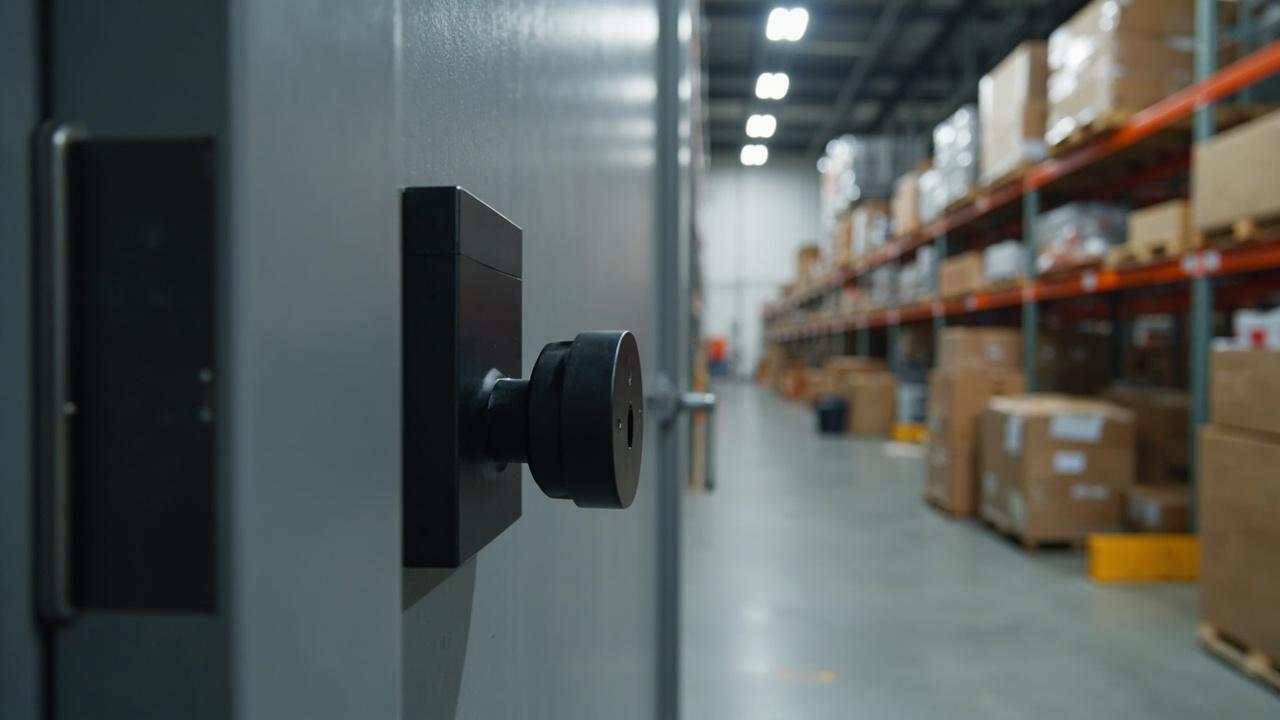
Smart Locks for Distribution Centers: A 24-Hour Operational Arc from Shift Change to Last-Mile Dispatch Handoff
A distribution center does not run on a 9-to-5. It runs on a 24-hour arc in which the same building, the same dock doors, and the same staff corridors host four different populations in a single calendar day: the night-shift inventory team handing off to the day-shift pickers, the inbound carriers arriving inside a strict slot window, the returns sweep crew that owns the back half of the afternoon, and the last-mile dispatch coordinator who closes the day by handing the outbound queue over to a fleet of third-party drivers. Smart locks for distribution centers are not chosen for one of those populations in isolation. They are chosen because the lock on a dock door has to behave correctly at 03:30 when the night-shift lead opens it, at 11:45 when a regional carrier waves a card at it, at 16:10 when a returns clerk re-enters the sweep zone, and at 21:00 when the dispatch coordinator logs out and a substitute driver needs an auditable but temporary credential.
This article treats that arc as a process with four named phases — Phase A: shift change, Phase B: carrier slot windows, Phase C: returned-goods sweep, Phase D: last-mile dispatch coordinator handoff — and writes the access program around the seams between them. It is deliberately distinct from two sibling articles in this cluster: Smart Locks for Warehouses reads the building as a door datasheet (per-door hardware selection and what each spec line means), and Smart Locks for Logistics Facilities reads it as site-level logistics governance (carrier scoring, yard flow, dock-level compliance). This one is the 24-hour arc — what happens at each door at each hour, and which access decision has to be made before the next hour starts. A third sibling, Smart Locks for Warehouse Access Management, owns the policy spine (who is allowed on the registry); the policy is referenced here, not re-stated.
The framing is simple: the door is not the problem. The handoff between roles at the door is the problem. The smart lock is the instrument that makes the handoff auditable without making it slow.
What "Smart Lock" Means in a 24/4-Population Building
In a single-tenant office or in a hotel, a smart lock usually serves one population with one credential type and one schedule. In a distribution center, the same lock hardware is asked to recognize, in a rolling 24-hour window, at least four different populations on four different schedules with four different audit obligations:
- Employees (full-time and agency) who enter on a set shift schedule through staff doors and need biometric or PIN or RFID verification that maps to a payroll record.
- Carriers (inbound truck drivers, line-haul contractors, third-party logistics fleets) who need short-validity credentials that match a slot window and that can be revoked the moment the slot is cancelled.
- Contractors and vendors (forklift techs, racking inspectors, pest-control suppliers, scale-calibration technicians) who are on-site by appointment and need time-bounded credentials scoped to specific doors.
- Returns and reverse-logistics crews whose access windows are not aligned to a shift schedule at all but to a sweep cadence (every 90 minutes, every four hours, or on an exception basis).
A lock that handles employee RFID but cannot issue a four-hour contractor token without re-flashing a card batch is the wrong lock for this building. The selection lens for distribution-center work therefore starts with the populations, then with the door categories they cross, then with the lock models that can be configured per door category — not the other way around. Where a per-model specification matters (read distance, battery count, audit-record capacity, door-thickness range, app or platform binding), the verified product page is the authority; this article avoids asserting per-model numbers beyond the SLK-9936S PDP-cited block reproduced below as anchor, and treats every other variant-level claim as a CONFIRM-ON-PRODUCT-PAGE item sent through Request a quote.
SLK-9936S hotel smart door lock — first-party spec block (PDP-cited, hotel-side value shown for illustration of category capability).Door thickness 36–100 mm · RFID Mifare 1 @ 13.56 MHz · read distance 0–5 cm · read time <0.25 s · power 4 × AA · battery operating cycles >15,000 · audit/event records up to 1,000 · 5-pin cylinder · 3-point latch · stainless steel + alloy body · mechanical emergency access · multilingual management software · standalone or centralized database modes · positioned for 1–5 star hotels.Distribution-center applicability of this spec block is conditional, not default: the numbers above establish the category-level read time, audit capacity, and battery endurance a distribution buyer should demand back in writing on whichever model is selected for that door category. Check the model’s published specification for any model actually specified.
Door categories a distribution lock program has to govern
The 24-hour arc is a property of the doors, not the lock brand. Before any RFQ, a distribution buyer should classify every controlled opening in the building into one of the seven categories below. A lock that is correct for one category is commonly wrong for the next.
| Door category | Who crosses it | When it is crossed | Audit obligation | Hardware priority | Common wrong choice |
|---|---|---|---|---|---|
| 1 · Staff entrance | Employees, agency temps | Shift change (06:00, 14:00, 22:00) | Per-person, per-shift | PIN + RFID or fingerprint, audit-trail export | Mechanical only; no audit trail |
| 2 · Dock door (inbound) | Inbound carriers | Within a slot window | Per-carrier, per-slot, with carrier ID | Short-validity RFID, mechanical emergency | Mechanical + padlock (key loss, no audit) |
| 3 · Dock door (outbound) | Outbound carriers, dispatch staff | Hour-by-hour | Per-trailer, per-carrier | Same as category 2 plus cross-dock re-issue capability | Single-tenant mechanical with shared key |
| 4 · Returns zone | Returns clerks, sorters | Sweep schedule (every 90–240 min) | Per-event | PIN + RFID, audit-trail export | Lock with no time-bounded credentials |
| 5 · Cross-dock corridor | Multiple roles, multiple shifts | Throughout the day | Per-event, per-role | Time-zone scheduling in firmware | Lock with flat access for all |
| 6 · Yard gate (vehicle) | Yard jockeys, security | Day and night | Per-vehicle entry | RFID at vehicle speed, integration with yard system | Card-only at low read range |
| 7 · Server / BMS / scale-calibration | Vendors by appointment | Episodic, scheduled | Per-vendor, per-appointment | Time-bounded credential, scoped doors | Reusable contractor card without expiry |
A door classification worksheet is the first artifact a buyer should produce before writing the RFQ. It is also the artifact the factory should be asked to comment on, line by line, in the technical response. Without it, the conversation collapses into "which lock do you recommend" — which is a question a 79-model catalog cannot answer without knowing which door categories the building contains.
The 24-Hour Arc at a Glance
The arc below is sequenced in calendar order. Each phase has an entry condition (what must be true before the phase starts), a core decision set, and an exit artifact (what must exist before the next phase starts). Owners are BUY (the distribution operator or buying entity), MFG (the lock manufacturer), and the role owner in the building (shift lead, yard coordinator, returns lead, dispatch coordinator). Where any of the three has a "no" or a "not yet", the phase is not closed.
| Phase | Window (illustrative) | Role owner | Entry inputs | Core decision set | Exit artifact | Who can block the next phase |
|---|---|---|---|---|---|---|
| A · Shift change | 05:30–07:00, 13:30–15:00, 21:30–23:00 | Shift lead | Active roster, lock firmware schedule set | Biometric/PIN verification per employee, agency-temp enrollment window | Signed shift-change handover log + audit export | Shift lead |
| B · Carrier slot windows | All day, 30-min slots | Yard coordinator | Carrier booking, slot ID, dock door assignment | Short-validity credential issuance, slot cancellation re-issue, carrier-PIN override | Per-slot event record, dock-by-dock summary | Yard coordinator |
| C · Returns sweep | 12:00–16:00 + episodic | Returns lead | Returns queue, sweep cadence, segregate-vs-restock decision | Sweep-zone PIN entry, audit-trail capture, "sweep done" timestamp | Sweep-completion log + exception list | Returns lead |
| D · Last-mile dispatch handoff | 18:00–22:00 | Dispatch coordinator | Outbound queue, driver roster, third-party carrier mix | Driver self-issuance, time-bounded credential for substitute drivers, lock-out at handoff close | Dispatch handover pack + driver-by-driver audit | Dispatch coordinator |
The four phases do not run as cleanly as the table implies. Carrier slot windows overlap with shift change. The returns sweep bleeds into dispatch handoff. A weather event or a slot cancellation will reorder the day. The structure is not a clock; it is a list of which decision has to be owned at which time, and which lock configuration each decision depends on.
Phase A — Shift Change: The First 30 Minutes Decide Whether the Day Started Right
A distribution center that loses the first thirty minutes of shift change loses one full hour of throughput by lunchtime, because the pickers never start where they should have started. Three things have to happen in the first thirty minutes, and the lock is involved in all three:
- The night-shift staff exits through an audited event. Every departing employee's credential should leave a single "exit" record inside the lock's audit log, exported to the WMS or HR system as a roster-reconciliation input. This requires a lock that stores per-event records in a retrievable audit log; the SLK-9936S class cited above is one such category example (audit/event records up to 1,000 — check the model’s published specification for any model actually specified).
- The day-shift staff enters with the same credential, but with a different authorization scope. Entering employees should not be able to open the returns-zone door at 06:15 just because the audit-trail says they were in the building at 06:15. Authorization is set by door, not by presence.
- Agency temps and substitutes are enrolled and un-enrolled inside the same shift window. A distribution center routinely adds 10–40% headcount on a peak day through agencies. The lock system has to enroll, scope, time-bind, and un-enroll these credentials without re-flashing every employee card.
The decision matrix below is the gate that decides whether a candidate lock survives the shift-change test.
Phase A — Shift-change lock decision matrix
| Decision | What the lock has to do | What the building has to provide | What the buyer has to confirm in writing | Bluff to refuse |
|---|---|---|---|---|
| Biometric/PIN/RFID per employee | One credential per person, used at the staff entrance | Roster file per shift, agent list, day-of additions | Per-model user capacity, biometric template storage location (on-device vs server) | "Unlimited users" — capacity is a hardware number; demand the figure |
| Audit-trail export per shift | Export events to WMS/HR/payroll at the change point | Endpoint agreement (CSV, API, flat file) | Export format, retention, who can pull | "Real-time integration" without an API spec |
| Agency-temp time-binding | Time-bounded credential scoped to one shift | Agency roster with shift end time | Maximum temp-credential duration, auto-revoke rules | "Reusable contractor card without expiry" |
| Mechanical key override | Emergency access that does not bypass audit if possible | Key custody log | Whether mechanical override leaves an event record | Override key issued to the wrong party |
| Battery state at shift change | No lock dying mid-shift | Battery-check protocol | Expected battery life on door-class usage, low-battery warning behavior | "Years of battery" without usage profile |
A buyer who walks through these five decisions and receives written answers on all five — even answers that say "not supported, here is the work-around" — is in a different position than a buyer who walks through them and gets verbal reassurance on none. The factory's willingness to answer these in writing is itself a signal.
Phase B — Carrier Slot Windows: 30-Minute Slots, 80+ Carrier Brands, Zero Spare Minutes
The single most error-prone phase of the distribution-center day is the carrier slot window. A typical mid-sized hub may run 60–120 truck slots per day, scheduled in 30-minute bands. Each slot is owned by a different carrier (or by the same carrier under a different trailer number), each driver arrives with a different credential type, and each slot can be cancelled, reassigned, or extended inside the same hour. A lock program that cannot keep up with this cadence is the lock program that gets bypassed by a padlock.
There are three discrete sub-decisions inside Phase B, and the lock is involved in each:
B.1 — Credential issuance at scale
Carriers do not arrive at a kiosk to be enrolled. They arrive at a dock door with a card. The lock program has to accept credentials that were issued outside the building — by the carrier's own dispatch system, by a yard management platform, or by a slot-booking SaaS — and translate them into lock events. The lock that cannot ingest third-party credentials without manual re-enrollment will be circumvented by the third shift of operation.
| Slot-window sub-decision | What the lock has to support | What the building has to provide | What is commonly missed | Where it shows up first |
|---|---|---|---|---|
| Short-validity credential | Time-bounded RFID or PIN valid for the slot duration only | Slot ID per carrier, slot start/end time | Driver sharing a credential across slots | First audit dispute after a missed slot |
| Slot cancellation re-issue | Ability to revoke an in-flight credential before the slot | Cancellation workflow between yard coordinator and lock | No revocation path; the credential stays live | First yard congestion event |
| Carrier-fleet cross-issue | Multi-carrier interoperability on a single door class | List of allowed carriers and their credential schemes | Locking the lock to one carrier's spec | First time a new carrier is added |
| Yard-vs-dock separation | A credential that opens a yard gate must not open a dock door by default | Per-credential scope policy | One credential opens both by default | First security audit |
B.2 — The dock door as a perishable access surface
A dock door that is locked at 09:00 is the wrong door; a dock door that is open at 09:00 when no trailer is at it is also the wrong door. The lock has to enforce occupancy-bound states: locked when no trailer, accessible when a trailer is present, locked again when the trailer departs. The mechanical hardware does not enforce this; the configuration does. A buyer should demand a written description of how a given lock behaves in each state (locked idle / locked with trailer / open / re-locked after departure) and should not accept "configurable" as an answer.
B.3 — Carrier handoff to inbound clerk
At the moment a carrier driver walks from the cab to the dock, the credential event should attach to a load record. A distribution-center lock that produces an event record but does not bind it to a dock-door number, a slot ID, and a carrier ID is producing noise, not evidence. The buyer-facing requirement is therefore not "an event log" but a structured event record. Check the model’s published specification whether the candidate lock emits enough fields per event (door ID, credential ID, timestamp, slot ID, direction) to populate a slot-by-slot reconciliation report downstream.
Phase C — Returns Sweep: The Phase That Owns the Mistakes of Every Other Phase
Returns and reverse logistics operate on a different clock than the rest of the building. A returns sweep does not run "at 14:00" the way a shift change does; it runs between everything else, in a cadence that varies by hub, by carrier mix, by season, and by the volume of undeliverables from the previous day's outbound load. Smart locks for distribution centers have to be specified for this phase specifically because it is the phase where audit trail and exception-handling matter most.
The returns zone is also the highest-loss zone in the building. Inventory shrink, mis-routed returns, and "we don't know what happened to it" disputes originate here more often than anywhere else, and they originate because the access record does not show who crossed into the sweep zone when, and the segregation-vs-restock decision was made by an individual without a verifiable timestamp.
A returns sweep has four sub-decisions and a lock is involved in three of them:
| Returns sub-decision | What the lock has to capture | What the building has to provide | What is commonly missed | Failure mode that surfaces the miss |
|---|---|---|---|---|
| Sweep-zone entry | Per-person, per-entry credential event | Sweep roster + sweeper assignments | Sweep zone left open during a meal break | Unrecorded sweep window |
| "Sweep done" timestamp | Lock-side timestamp + clerk-side log | Clock consistency across systems | Phone-clock used as timestamp source | Dispute over when sweep was actually finished |
| Exception-zone segregation | Lock cannot be re-used for restock path without crossing an "excepted" flag | Segregate path vs restock path | One door used for both | Mixed inventory lost |
| High-value exception handling | Separate audit log for high-value returns items | High-value items flagged at receiving | Audit log shared across low- and high-value sweeps | High-value items unaccounted for |
A lock program that supports the four rows above — especially the third (segregation via door scope rather than badge-only logic) — is a lock program that changes the loss profile of the returns zone. A lock program that supports only the first row is the same program in a different color.
The lock firmware has to allow a sweep cadence configuration that does not align to shift schedules. A buyer who needs sweeps every 90 minutes during peak and every 4 hours overnight should not have to negotiate that with the lock vendor after the first sweep is missed.
Phase D — Last-Mile Dispatch Coordinator Handoff: The 90-Minute Window That Decides Tomorrow
The day does not end when the dispatch coordinator clocks out. The day ends when the last trailer is loaded and the substitute driver — the one assigned twenty minutes ago to take over the route of a driver who called in sick — has left with a credential that expires at the right moment and is auditable to the right person. This is the hardest phase for a lock program because it is the phase that mixes every other population:
- Outbound drivers (own fleet and third-party).
- Substitute drivers with whom the building has no prior relationship.
- Dispatchers themselves, who are rotating out.
- Yard hosts, who may be on a different shift.
The handover pack produced at the end of Phase D is the artifact a buyer should demand by name from any candidate lock program. It is the artifact that lets tomorrow's day-shift start where yesterday's night-shift left off.
| Dispatch-handoff decision | What the lock has to support | What the building has to provide | What is commonly missed | Failure mode |
|---|---|---|---|---|
| Driver self-issuance for known routes | Self-service credential issuance window at dispatch desk | Route list, driver list, vehicle list | Token issuance requires supervisor override for every driver | Queue at dispatch desk at hour 19:30 |
| Substitute-driver temp credential | Time-bounded credential (≤ 4 hours) scoped to one vehicle, scoped to one gate | Substitute-driver ID verification at dispatch | Same credential reused across shifts | Substitute driver returns the next day with the same credential |
| Lock-out at handoff close | Automatic lock state reversion after the dispatch handoff window closes | Dispatch window definition per day | Lock left open because no one logged out | First unlocked door at 04:00 the next morning |
| Audit export to dispatch ledger | Per-driver, per-vehicle, per-gate event record at hand-off | Endpoint agreement with dispatch ledger | Audit log only viewable on the lock itself | Dispute over who left with what |
| Mechanical override governance | Override key is named, signed out, and returned | Key custody log | Shared override key in a break room | First missing-key incident |
A buyer who treats the dispatch handoff as a configuration problem (which it is, mostly) rather than a behavior problem will buy the wrong lock. Configuration is the easy half; behavior is the half that depends on the dispatch coordinator doing their job under time pressure.
Boundary note. This article stops at the dispatch handoff. Yesterday's audit log, yesterday's exception queue, and yesterday's mechanical override register belong in the policy spine covered by Smart Locks for Warehouse Access Management. Owning that boundary keeps the day-of operations document from drifting into a policy document, which it is not.
The 30-Minute Handoffs Between Phases Are Where the Day Breaks
A 24-hour arc is not the sum of four phases. It is the product of three handoffs:
| Handoff | From → To | What must be true at the handoff instant | Common break point | What to insist on in writing |
|---|---|---|---|---|
| A → B | Shift lead → Yard coordinator | Audit export from exit events matches the entry roster of the incoming shift | Roster mismatch because agency temps were not de-enrolled | One-line rule: "shift change is not complete until the audit export matches the incoming roster" |
| B → C | Yard coordinator → Returns lead | Slot-closure ledger is locked for the morning window; returns sweep window opens | Open dock door at sweep start | Mechanical-override register inspected at the handoff instant |
| C → D | Returns lead → Dispatch coordinator | Sweep-completion log signed; exception list transferred | Inbound exception still on the dock at handoff | Exception list is signed by both leads; unresolved exceptions route to dispatch desk visibly |
The same three seams read more honestly as exchanges between the role owners than as table rows:
sequenceDiagram
    participant SL as Shift lead
    participant YC as Yard coordinator
    participant RL as Returns lead
    participant DC as Dispatch coordinator
    SL->>YC: A to B · audit export reconciled against the incoming roster
    Note over SL,YC: break point · agency temps never de-enrolled
    YC->>RL: B to C · slot-closure ledger locked for the morning window
    Note over YC,RL: break point · override register not inspected at the instant
    RL->>DC: C to D · sweep-completion log signed · exception list transferred
    Note over RL,DC: break point · inbound exception still on the dock
    DC->>SL: Day closed · audit pack handed to tonight's incoming shift
Each handoff is a couple of minutes long in clock time but a longer process in lock-system time — because the lock has to accept a state change, an event log entry, a credential-scope change, and a reversion timer, all within the same handoff. A lock program that handles these three handoffs in writing and on time is the lock program that survives three months of operation. One that handles them verbally is the lock program whose first incident report names a wrong door at a wrong hour with no record of who opened it.
What Smart Lock Categories Match Each Phase
The earlier door-classification table covers where a lock is installed; this section covers which families of locks from the wider catalog are coherent candidates for each phase, with all per-model figures deferred to the product page.
| Phase | Door classes in scope | Lock families coherent for the phase | Per-model items the buyer must check against the model specification | Why this is not a "buy this model" recommendation |
|---|---|---|---|---|
| A · Shift change | Staff entrance, office-staff corridor | Multi-credential family (PIN + RFID + fingerprint models such as SLK-8831 5-in-1 series, hotel-card systems such as SLK-9936S, SLK-9905A class) | Battery count, audit-record capacity, user capacity, app/platform binding (TTLock / Tuya / Doodle / hotel PC software — check the model’s published specification) | Capacity and binding vary per model; the buyer cannot assume SLK-9936S-class numbers on a different model in the same family |
| B · Carrier slot windows | Dock doors (in/out), yard gate | RFID card models, time-bounded credential models, mechanical-keyover models (SLK-9936S class with Mifare 1 @ 13.56 MHz is one such anchor; read distance and read time are per-model — check the model’s published specification) | Read range, read time, mechanical emergency access, audit-event fields, revocation latency | A model with sub-0.25 s read time but limited user capacity may be wrong for a hub that needs 800+ carrier credentials in flight per week |
| C · Returns sweep | Returns zone entry, segregate/restock door pair | Any model with per-event audit and scoped credential lanes (multi-credential models, including glass-door models such as SLK-G200 for office-side glass walls bordering a sweep zone) | Event record fields, scope-change latency, sweep-cadence configuration support | A lock with adequate audit but no scope-change latency fast enough to clear a sweep window is the wrong lock; confirm latency, not just record count |
| D · Dispatch handoff | Dispatch office door, vehicle-gate, outbound staging corridor | Same family as Phase B plus any model supporting a self-issuance mode and time-bounded temporary credentials | Self-issuance availability, temporary-credential max duration, automatic lock-out reversion, per-vehicle event binding | "Self-issuance supported" without a written max-credential duration is one of the most common vendor overclaims; demand the figure in writing |
A lock program that lights up all four phases does not require four different vendors. It may require four configurations of one vendor's catalog, and that is a structurally different (and usually healthier) supply position than one lock per phase across four vendors. Read the supply-side lens in How to Evaluate a Smart Lock Factory before treating single-vendor breadth as the goal.
Illustrative Scenario — Consider a 60,000 m² Distribution Hub
Illustrative scenario — not a customer story. Numbers below are scenario placeholders for one mid-sized hub; every figure is a planning assumption the buyer should overwrite with the verified product page and a written quote.
A buyer is specifying locks for a 60,000 m² distribution hub with the following planning assumptions: 120 dock doors, four staff entrances, two returns-zone doors, one dispatch corridor, and an average weekday volume of 90 inbound and 110 outbound carrier slots. The hub runs three shifts (06:00–14:00, 14:00–22:00, 22:00–06:00) plus a returns sweep that fires every 120 minutes between 08:00 and 20:00.
The buyer maps the seven door categories to lock families. Staff entrances and dispatch corridor go to a multi-credential family (PIN + RFID + biometric, with a specific model chosen from the verified product page after the user-capacity figure is confirmed). All 120 dock doors go to a short-validity RFID card family with mechanical emergency override. The two returns-zone doors go to a model with explicit scope-change support so the segregate-vs-restock path can be enforced at the door, not by behavior. The yard gates go to a vehicle-speed RFID family.
The 24-hour arc is then written against this specification: at 05:45 the night-shift lead exports the audit log from the four staff entrances; at 06:00 the day-shift roster is reconciled against it; at 06:15 the first inbound slot opens at dock 12; at 08:00 the first returns sweep begins, scoped to doors RZ-1 and RZ-2 only; at 14:00 the day-shift roster is reconciled again, this time against slot-closure records from the 90 inbound slots completed so far; at 18:00 the dispatch desk opens for self-issuance, with a maximum four-hour token validity; at 21:30 the dispatch coordinator hands the day-closed audit pack to the night-shift lead.
What changes when this is written down is not the lock model. What changes is that the lock vendor is being held to a 24-hour specification, not a 9-to-5 specification. The vendor's willingness to engage on that 24-hour spec — and to put its capacity, audit, and scope-change figures next to the arc — is itself a selection signal.
What Per-Model Specifications the Buyer Must Demand in Writing
The buyer walks out of the RFQ process needing answers in writing to the items below. Where this article has used the SLK-9936S PDP-cited block as anchor for category capability, the buyer-side copy of that block belongs in a verification appendix, not in the RFQ narrative. The actual RFQ questions are per model, on the verified product page.
| Per-model specification | Why the building needs this in writing | Where on the product page to verify | Bluffs to refuse |
|---|---|---|---|
| Door thickness range | The building has 36–55 mm interior doors, 38–100 mm exterior doors, and glass partitions that need a different family entirely | Verified PDP, "specifications" tab | "Fits all doors" |
| Read range and read time | Dock doors need sub-second reads at speed; staff entrances tolerate longer reads | Verified PDP, "RFID" or "access specs" tab | "Fast reading" without numbers |
| User capacity | A 24-hour hub may need 800+ active credentials (employees + agency + carriers + vendors) | Verified PDP, "capacity" line | "Unlimited users" |
| Audit-event record count | Phase A and Phase C both depend on a per-shift and per-sweep record existence | Verified PDP, "memory" line | "Audit log" without a number |
| Battery count and expected life on door-class usage | Phase D's automatic lock-out reversion is worthless if batteries die mid-shift | Verified PDP, "power" line and battery-life tests | "Years of battery" without a usage profile |
| Mechanical emergency access behavior | Mechanical override is the difference between a lockout and a safety incident | Verified PDP, "emergency" line | Override key shipped without named custody |
| App/platform binding (TTLock / Tuya / Doodle / hotel PC software) | Phase B and Phase D depend on integration with the WMS, YMS, dispatch ledger — confirm what is supported | Verified PDP, "software" or "platform" tab | "App support" with no platform named |
| Operating temperature and humidity range | Dock doors see cold in winter and humidity in monsoon climates | Verified PDP, "environment" or "operating conditions" tab | "Indoor use" for an exterior door |
These eight items are the floor, not the ceiling. A vendor that answers all eight in writing is one a buyer should listen to even if the answers are partially negative ("our 0–5 cm read range model is not correct for your yard gate at vehicle speed — here is the model that is"). A vendor that answers the first four and waves at the last four is one a buyer should be cautious with.
What a 24-Hour Arc Looks Like Against the Wider Buyer Journey
This article does not exist alone. It is the operational arc layer in a buyer journey that includes sourcing evaluation, factory qualification, per-door hardware selection, and policy governance. Each of those layers is owned by another article, and the cross-links below are the seams:
- The sourcing layer — what a distribution operator should know before signing a master supply agreement — is in Smart lock manufacturer and in the cluster-buyer lens article for distributors at Become a distributor.
- The factory qualification layer — how to test whether the supplier behind the catalog can actually deliver to a hub this size — is in How to Evaluate a Smart Lock Factory.
- The per-door hardware layer — what each spec line on a single lock means and what to demand back — is owned by the sibling article Smart Locks for Warehouses, which is the door-data-sheet lens.
- The policy governance layer — who is allowed to be on the registry, who can issue a credential, and how the exception queue is handled — is owned by the sibling article Smart Locks for Warehouse Access Management.
- The site-level logistics governance layer — how the lock program interfaces with the WMS, YMS, dispatch ledger, and returns platform — is owned by the sibling article Smart Locks for Logistics Facilities.
- The hardware selection for warehouse doors is in Fingerprint Smart Locks for Warehouse Doors, which disambiguates biometric candidates from RFID candidates at the door.
A buyer who reads only this article will understand the day; a buyer who reads the five siblings plus this one will understand the operating model of a 24-hour lock program. The two are not the same.
Common Mistakes at the Phase-Handoff Level
Six mistakes appear repeatedly in distribution-center lock programs that were written competently but run poorly. None of them is a hardware failure; all are configuration or handover failures.
- Specifying "an event log" without specifying the fields per event. A lock that emits "access at 14:03" without door ID, credential ID, slot ID, and direction produces noise. Demand the field list.
- Issuing reusable credentials to contractors. A vendor who keeps the same card for six months is a vendor who will be in the building at hour 04:00 during a future incident. Time-bound the credential; auto-revoke at expiry.
- Treating mechanical override as a fallback that does not need governance. A key in a break-room drawer is an audit hole. Name the custodian, log the issue and return, and reconcile against the override register every shift.
- Letting the dispatch desk self-issuance window stay open 24 hours. A self-issuance window that never closes is a credential factory. Close it at handoff; reopen only with explicit coordinator action.
- Configuring Phase A and Phase C on the same firmware schedule. Shift change runs at 06:00; returns sweep runs every 120 minutes. Different cadences belong to different schedules, not to one merged schedule.
- Buying on catalog breadth alone. A vendor who lists 79 models still has not necessarily shipped to a 60,000 m² hub with a four-population, 24-hour program. Catalog breadth is necessary, not sufficient. Verify per model on the product page before specifying.
What to Send Through /request-a-quote
The request-for-quote that this article implies has six sections. Each section ends with a sentence that says "check the model’s published specification," because that is the only authoritative surface for a per-model figure. None of the sections asks for a price, a minimum order quantity, or a lead time, because those are quote-line items, not specification items.
- Door classification worksheet — the seven-category table from this article, filled in for the building.
- Per-model verification appendix — the eight per-model items from the table above, each line marked "check the model’s published specification at <URL>."
- Phase-by-phase capability statement — for each of Phases A–D, the lock family's name (without per-model numbers), the planned configuration, and the verification path.
- Handoff rule sheet — the three handoffs (A→B, B→C, C→D) named with their lock-side state changes.
- Audit-event field list — the eight fields per event the buyer requires, with a placeholder for the vendor's response.
- Mechanical override register — the policy governing who holds the override key, when it is signed out, and how it is reconciled.
The output of a clean RFQ is not a price list; it is a written configuration a factory can confirm or correct against the catalog. A price list without that configuration is not useful for a hub of this kind.
Boundary Notes and What This Article Does Not Cover
Three topics sit close to this article and might look like they belong here. They do not.
- Carrier scoring and slot optimization — a logistics-governance topic owned by Smart Locks for Logistics Facilities. A lock program that thinks it is doing carrier scoring is doing it wrong; the lock records events, it does not score carriers.
- Warehouse inventory accuracy and shrinkage analytics — a WMS / inventory topic. The lock is an input to shrinkage analytics; it is not the analytics layer.
- Enterprise security architecture, network segmentation, and IT-side identity management — handled outside the lock program. The lock contributes events; the SIEM consumes events. The buyer does not buy a smart lock to fix a SIEM.
Boundary discipline is what keeps an arc document an arc document. The moment this article becomes a logistics-governance article, a WMS article, and a security-architecture article, it stops being useful for the buyer behind the search that brought them here.
Closing — The Handoff Is the Product
The smart lock on a dock door is not the product a buyer is buying. The handoff between the shift lead and the yard coordinator at 06:00 — the handoff between the yard coordinator and the returns lead at 12:00 — the handoff between the returns lead and the dispatch coordinator at 18:00 — and the handoff between yesterday's dispatch coordinator and today's incoming shift at 22:00, those are the product. The lock is the instrument that makes those handoffs auditable. The arc is the architecture that makes them consistent. The configuration is the design that makes them fast.
A distribution operator who reads this article should walk away with three things: a 24-hour arc shaped to the four populations actually in their building, a door classification worksheet that names every controlled opening, and a per-model verification appendix that defers every numeric spec to the verified product page. The first makes the day coherent. The second makes the RFQ answerable. The third keeps the RFQ honest.
For the policy spine underneath this arc — who is on the registry, who can issue a credential, how the exception queue is governed — see Smart Locks for Warehouse Access Management. For per-door hardware selection, see Smart Locks for Warehouses. For site-level logistics governance, see Smart Locks for Logistics Facilities. To begin a written-quote conversation on the lock configuration implied here, the next step is a Phase-by-Phase capability statement sent through Request a quote; to qualify the vendor behind it, How to Evaluate a Smart Lock Factory is the article to send through alongside.