
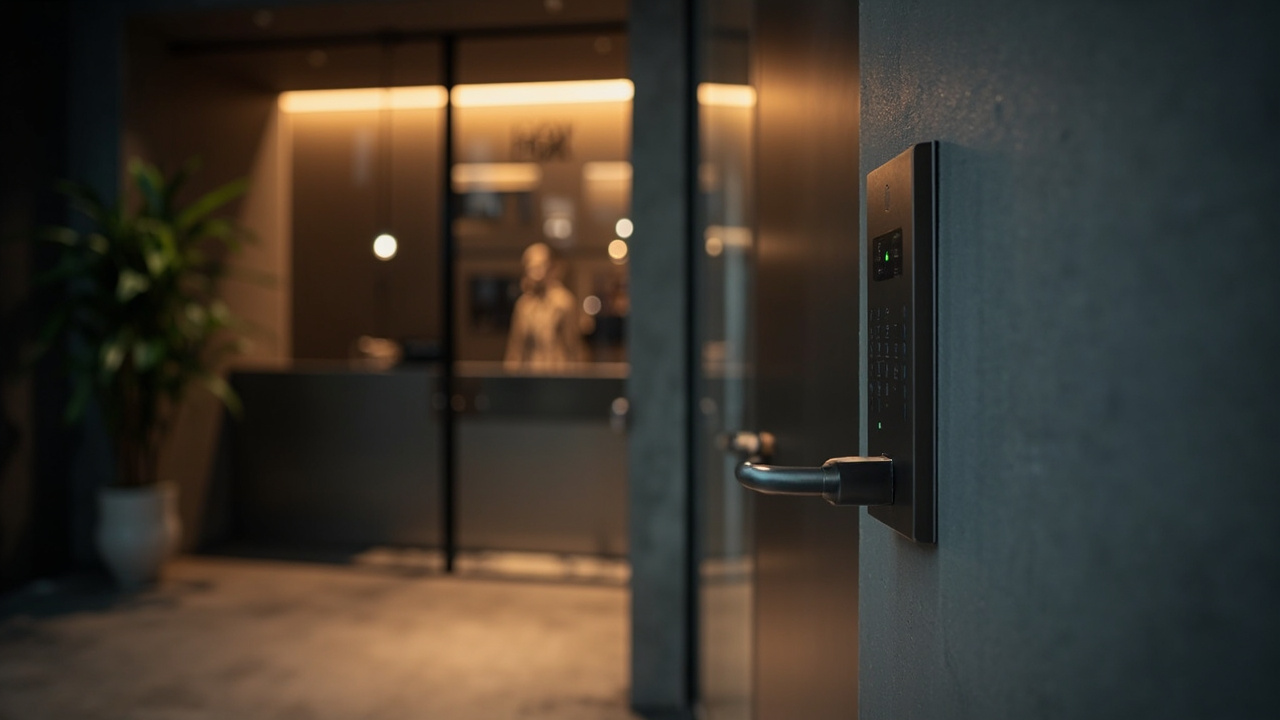
Fire-rated Doors and Smart Locks in Germany: The Assembly Question
Fire-rated doors do not arrive in the market as isolated locks. They arrive as a coordinated assembly involving the leaf, frame, hinges, latches, seals, closers and associated evidence. That is why the phrase germany fire rated door smart lock starts in the wrong place during a hotel refurbishment: the real procurement question is not whether a lock can be attached, but whether the proposed door remains within a defined and accepted assembly.
Direct answer. To put it plainly: germany fire rated door smart lock has to hold for germany fire rated door smart lock. en-door-hardware has to hold at the same time. The sections below describe the order germany fire rated door smart lock is settled in. A germany fire rated door smart lock ties each entry condition to a document. germany fire rated door smart lock opens the sequence. The approval covering germany fire rated door smart lock is signed at the end.
- Set the range — write down what germany fire rated door smart lock has to settle in germany before any hardware is ordered
- Supply the record — attach the document behind each claim in en-door-hardware, not a summary of it
- Confirm the holder — record who signs germany fire rated door smart lock and who keeps the record afterwards
- This is the sequence germany fire rated door smart lock has to follow, anchored on en door hardware.
This diary follows the importer’s decision file from the first sample enquiry through to the handover of documents and hardware. It assumes a German hotel refurbishment with mixed door types, an existing Euro-profile cylinder interface and no assumption that every door can accept the same electronic hardware.
The controlling approach is deliberately conservative. A sample can demonstrate fit or operation, but it cannot replace project-specific evidence. The importer’s task is to identify who owns the assembly decision, collect the documents that decision requires and prevent a general specification from being mistaken for permission to alter every door.
Day 1 — The Sample Is Not Yet a Decision
The first morning entry in the importer’s file concerns a sample enquiry. The request contains a lock photograph, a door photograph and the name of a product category. Useful, but incomplete. What is missing is the relationship between the sample and the door as it exists in the building.
The importer records four items before requesting commercial information: the door schedule, the assembly evidence available for the relevant doors, the survey data and the intended access method. The last point matters in a hotel. Guest-room doors, service doors and public entrances carry different operating requirements, so one electronic-lock answer cannot cover all of them. The build options sit in the smart door locks.
A practical first filter is the Office Smart Lock Site Survey. Its purpose here is not office administration. It provides a disciplined way to record what was actually measured, what was assumed and which doors remain outside the change boundary.
The day ends with a request for marked-up drawings rather than a larger sample order. That request follows the lesson in Smart Lock Retrofit Site Survey: retrofit decisions become clearer when the survey separates doors that are technically accessible from doors that are merely included in the refurbishment scope.
Day 2 — The Assembly Becomes the Real Product
By the second day, the search phrase has been rewritten. The importer no longer asks only for a “germany fire rated door smart lock.” The working brief now asks which parts of the existing assembly may change, which characteristics must remain unchanged and what evidence will be accepted by the project’s reviewing parties.
This change exposes three separate questions that are often collapsed into one. First comes mechanical fit: the proposed cylinder, spindle, backset and fixing arrangement must be physically compatible. Second comes assembly evidence: the documents must cover the changed configuration. Third comes permission: someone with the relevant responsibility must accept that configuration for the particular building.
A fire rated smart lock therefore remains a candidate product rather than an approved door component. Its suitability cannot be established from the model name, the lock housing or a general test reference printed elsewhere in a portfolio. The evidence must be linked to the assembly and the project scope.
| Decision layer | Question for the project file | Evidence or decision needed |
|---|---|---|
| Mechanical interface | Does the proposed hardware fit the existing cylinder and door preparation? | Marked survey and interface drawing |
| Assembly configuration | Which components form the proposed door set? | Door schedule and assembly description |
| Documentary coverage | Does available evidence address the changed configuration? | Dated technical documents and their stated scope |
| Project acceptance | Who will accept the configuration for this building? | Written review, approval or pilot instruction |
| Installation control | How will the approved configuration be reproduced on site? | Installation record and handover check |
The importer treats these layers as linked but non-interchangeable. Approval of one layer does not answer the next, and a favourable answer from one door type cannot be copied automatically to another.
The Survey Boundary — Which Guest-Room Doors Can Actually Change?
The survey is where assumptions become visible. In a German hotel refurbishment, the property is rarely represented by one consistent door. Timber leaves, steel leaves and glazed or aluminium elements may use different thicknesses, profiles, rebates and strike arrangements. A thick wall can further reduce the working space available to the installer.
The first table in the importer’s diary is therefore a change-boundary table rather than a product-comparison table. It identifies where the proposed hardware may enter the programme.
| Door group | Initial fit question | Boundary instruction |
|---|---|---|
| Guest-room timber doors | Can the cylinder and spindle interface be reached without reducing the stated clearances? | Survey individually; do not group by floor |
| Service and back-of-house doors | Is there space for the intended electronic hardware and strike arrangement? | Check handle, latch and access-control requirements together |
| Steel or unusually thick leaves | Do thickness, reinforcement and fixing points match the proposed assembly? | Require a manufacturer-approved interface where applicable |
| Glazed or aluminium entrances | Is the lock intended for this door construction and its hardware arrangement? | Treat as a separate assembly decision |
| Doors outside the operating programme | Can they remain unchanged during this phase? | Exclude them to prevent scope creep |
The link to Door Thickness and Backset Variance in Germany: A Survey Worksheet is useful for the field team. The importer adds one column to that working method: “assembly evidence received.” A dimension recorded without the relevant door identity can later be misapplied to the wrong leaf.
For this project, “which doors are the doors we can actually change?” is the first procurement question. The answer becomes the controlled sample list. It is also more useful than a general declaration that the product is suitable for hotel use.
Euro-Profile Is the Starting Point, Not the Permission
The Euro-profile cylinder is a familiar interface, but familiarity does not remove project-specific checks. Door thickness, backset, spindle geometry, follower position, faceplate dimensions and fixing access still need confirmation for each representative assembly.
The importer separates three configurations in the file. The first is a cylinder-led electronic solution that retains the established Euro-profile interface. The second involves a mechatronic cylinder with its own power, communications and evidence questions. The third is a more extensive retrofit that changes additional door hardware. They should not be compared as if they create the same installation risk.
For each quoted SKU, confirm on the dated product page for the specific SKU the relevant dimensions, power requirements and supported operating conditions. A factory photograph may show the correct general format while concealing differences between variants, finishes or supplied components.
EN 1303 appears in the file because cylinder questions are commonly asked, not because that reference by itself answers the hotel-door decision. The buyer should ask which part of the cylinder and lock assembly the document covers, which configurations were evaluated and whether the proposed change sits inside that scope.
CONFIRM-WITH-LOCAL-FIRE-DOOR-SPECIALIST: Verify the cylinder and lock interface for each proposed door assembly.
The importer therefore asks for an interface drawing at the same time as the sample. The drawing should identify the hardware against a door that has an actual position in the survey. If the drawing shows only the product by itself, it is useful for installation planning but incomplete for the assembly decision.
Reading the Door-Hardware Evidence Without Turning It
The standards folder can create false confidence because it contains familiar references and long documents. The importer’s rule is simple: no reference is entered in the decision file until its subject, configuration and project relevance have been extracted.
The buyer’s questions may include EN 12209 for mechanically operated locks, EN 14846 for electromechanically operated locks, EN 1303 for cylinders, EN 179 or EN 1125 for escape devices, EN 1154, EN 1155 and EN 1158 for closers, hold-open devices and coordinators, EN 1634-1 for fire-door hardware testing and EN 1906 for lever furniture. These are areas to interrogate, not universal claims about the proposed product.
| Evidence topic | Question the importer asks | Potential issue if left unresolved |
|---|---|---|
| EN 12209 or EN 14846 scope | Which lock type and operation are covered by the document? | The document may describe a different product class |
| EN 1303 scope | Which cylinder dimensions and interfaces are addressed? | A Euro-profile statement may omit project-specific options |
| EN 179 or EN 1125 scope | Which escape-device arrangement is described? | The intended door arrangement may differ |
| EN 1634-1 evidence | Which hardware configuration appears in the test evidence? | A changed component may sit outside the documented set |
| EN 1906 scope | Which lever or furniture arrangement is covered? | Finishing hardware may be outside the proposed assembly |
| Door classification documents | Which door and assembly does the document identify? | A classification cannot be transferred without traceability |
The CPR 305/2011/EU, RED 2014/53/EU and EMC/LVD may also appear in the enquiry depending on how the product is supplied and how it functions. Their presence in a checklist does not establish that they are the only relevant routes for a particular project.
CONFIRM-WITH-LOCAL-BUILDING-AUTHORITY: Confirm the applicable evidence and review route for this building.
This is why the importer prefers a document index to a pile of PDFs. Each entry records the exact assembly, the changed component, the document issue date and the person who interprets it. The companion CPR / EN Door Hardware Evidence for Smart Locks Sold in Germany: A Buyer Document Checklist offers a practical structure for that index.
The Approval Desk — Four Gates Before a Controlled Pilot
No single party owns every part of this decision. The importer can verify commercial files and product documents. The installer can test physical access. The door or hardware specialist can interpret the assembly. The project reviewer can decide whether the proposed configuration is acceptable for the building.
The importer builds four internal gates around that division of responsibility. A failure at one gate returns the request to the evidence stage rather than passing a verbal reassurance onward.
flowchart TD
    A[Open the assembly file] --> B[Map the proposed door change]
    B --> C[Request missing evidence]
    C --> D[Review the assembly with the specialist]
    D --> E[Approve a controlled pilot or hold]
The first gate is commercial and technical completeness. The second is project-specific fit. The third is assembly evidence and acceptance. The fourth is a controlled installation trial on an identified representative door.
The controlled pilot is not a workaround for missing evidence. Its purpose is to test the assumptions already supported by the file: tool access, fixing, cylinder reach, spindle operation, configured access, audit output and handover documentation. If the pilot reveals a different interface, the file returns to the survey and evidence stages.
This sequence also protects the importer from making an implied approval. A supplier may reasonably supply a sample for evaluation, but that sample does not become a building component merely because it has been delivered or fitted temporarily.
The Hotel Programme — One Property, Several Assembly Problems
A German hotel refurbishment concentrates the general door question into a short operating environment. Guest rooms need a controlled room-access method. Service doors may need a keypad or another intended credential route. The shopfront may need a different operating arrangement from the back-of-house corridor.
The access requirement is only one layer. Door construction, existing hardware, available fixing positions, electrical constraints and the need to keep rooms serviceable determine whether the electronic layer can be installed cleanly.
| Hotel area | Access intention from the brief | Assembly question before ordering |
|---|---|---|
| Guest rooms | Card or code at the room door | Does the retrofit preserve the intended escape, latch and lever arrangement? |
| Service doors | Keypad on service routes | Is the strike, frame and controller arrangement suitable for the chosen device? |
| Back-of-house corridor | Restricted staff access | Which existing closers, coordinators or emergency interfaces remain in the assembly? |
| Shopfront | Phone-based or selected electronic access | Can the entrance hardware be changed without invalidating the relevant evidence? |
| Terrace or external route | Where included in the operating programme | What weather exposure and power arrangement apply to the selected device? |
The building in this refurbishment scenario cannot be rewired easily, and the landlord does not own the locks. That turns the power question into an interface question. The proposed solution must explain whether the door is intended to operate without fixed wiring, how power is supplied locally and what happens when the local power source is unavailable.
The Hotel Refurbishment Lock Replacement Programmes in Germany: Survey Before You Order framework is useful here because it places the survey before the order. For the importer, the output is not merely a list of candidate models. It is a controlled list of assemblies, each with its own evidence status and installation instruction.
The Installer’s Window — Where a Correct Purchase Still Fails
The next diary entry belongs to the installer. The file contains a drawing that looks correct on a screen, but the installer has to reach the cylinder, align the spindle, connect the device, restore the door and explain the result to a hotel team that may need the room back into service.
The installation check begins before the hardware is unpacked. The installer confirms the door identity, existing cylinder measurements, available depth, frame clearance, fixing access and the intended power source. The product specification alone cannot replace this inspection.
Where the field condition departs from the expected interface, the installer stops and returns the door to the survey record.
German-language mounting instructions and a concise handover record are commonly requested in this market. Their value is operational: the installer needs a reference that matches the unit and configuration, while the property team needs a record that connects the installed device to the room or door.
The same discipline applies to access credentials. Before commissioning, define who receives the first credential, who can add another, what happens after a staff change and where the relevant audit record is held. A functioning keypad does not complete the handover if nobody can explain access administration.
The importer uses the installer perspective from Installer Practice in Germany: Why Smart Lock Field Reliability Is Really Set There as a review prompt. Its practical message fits this project: the purchased configuration and the installer’s working method must describe the same door.
Credentials and Audit Logs Enter the Assembly File
Electronic access adds a data dimension to what began as a mechanical fitting exercise. In Germany, smart-lock audit logs should be treated as personal data during procurement. Retention periods, hosting location, processor responsibilities and support access become relevant questions before the property team accepts the system.
The importer does not need a generic privacy promise. The supplier should identify the event categories generated by the proposed configuration, explain which roles can view them and describe how access to the records is controlled. The hotel should also state who is permitted to request or review an export.
CONFIRM-WITH-LOCAL-DATA-PRIVACY-ADVISER: Confirm audit-log, hosting and processor obligations for this deployment.
This requirement remains separate from the escape and door-assembly decision. An electronic credential route can be operationally acceptable while a data process still needs work. Conversely, good event handling does not answer whether the physical assembly is appropriate. The importer keeps both issues open until each has an owner and evidence.
The review also considers emergency and exit arrangements where electronic access is proposed. The buyer should ask which parts of the escape arrangement remain mechanical, which arrangements have been evaluated and what evidence supports the proposed configuration. The door specialist must interpret that evidence against the actual building.
CONFIRM-WITH-LOCAL-ACCESS-CONTROL-SPECIALIST: Verify the escape-device and electronic-access evidence for the selected doors.
These questions are added to the same file used for fit and assembly evidence. Combining the records does not merge the decisions. It prevents a hotel from receiving a door sample without the access-administration information needed to use it.
Day Five — Ten Questions for the Supplier
By the fifth day, the supplier questionnaire is shorter and more demanding. The importer is no longer asking for a general country statement. Each question points to a document, a drawing or a named configuration.
- Which exact SKU is proposed, and what evidence applies to that SKU and revision?
- What is the confirmed cylinder, spindle, backset and fixing arrangement?
- Which existing Euro-profile cylinder arrangements are covered by the supplied instructions?
- Which door components remain unchanged in the proposed assembly?
- Which documents cover the complete proposed configuration rather than a component alone?
- What German-language installation and handover documents can be supplied?
- How is local power supplied, and what operating condition applies when it is unavailable?
- Which credential and audit-log functions are included in the quoted configuration?
- What sample procedure should be followed before a controlled pilot?
- How will an engineering or document change be communicated before shipment?
The answers belong in a versioned file. A catalogue description, an old drawing and a current instruction must not be combined into a configuration that no supplier issued.
The importer also uses Importing Smart Locks Into Germany: What the EN Door-Hardware Route Changes Before You Ship to structure the border-crossing portion of the file. The question is not what may be shipped in general. It is what evidence accompanies this assembly and remains identifiable after the goods reach the German project channel.
This is especially important where one project contains several door variants.
The Route to the Installer — Keep the Commercial and Technical
Germany’s project channel may involve a hardware distributor, a specialist wholesaler or a joinery contractor, with the person choosing the lock often differing from the person paying for it. The importer therefore creates two linked files: a commercial file and a technical file.
The commercial file records the selected SKU, order references, delivery arrangements and agreed commercial terms. The technical file records the door identity, assembly evidence, installation instructions, access configuration and contact responsibility. A framework agreement can organise repeated purchasing, but it does not replace the door-specific technical record.
Payment after delivery may be commonly discussed with established buyers, while project programmes may also run through distributor credit arrangements. Those terms should be written into the contract rather than inferred from the buying relationship. The importer’s task is to keep the commercial promise separate from any implied technical acceptance.
The practical link between the two files is the delivery note. It identifies what was sent, which documents accompany it and which project record should receive it. A change in the hardware or supplied components triggers a review of the associated documents before installation continues.
This structure also improves supplier comparison. Products may be evaluated on more than their headline capabilities, but the comparison remains meaningful only when each option is tied to a defined assembly and an identical set of buyer questions. The route into Germany changes the handover work; it does not change the need to identify the responsible decision-maker.
The Decision Matrix — Four Routes Through the Door File
The diary now reaches the point where the importer must decide what happens next. There is no honest shortcut to a universal approval. The practical choice is the route supported by the current evidence.
| Project situation | Evidence position | Importer’s decision | Required next control |
|---|---|---|---|
| Like-for-like hardware change with no assembly evidence | The fit appears plausible, but the configuration is undefined | Hold approval and request the missing file | Identify the complete assembly and applicable documents |
| Defined alternative with traceable evidence | The configuration, scope and review route are documented | Refer for project-specific written acceptance | Record any conditions before pilot installation |
| New or substantially changed assembly | Evidence covers a different hardware set | Treat as a new approval case | Re-survey the doors and restart the evidence review |
| Small urgent replacement on a non-critical route | The schedule is compressed and the evidence file is incomplete | Isolate the decision to that representative door | Install only after specialist review; do not generalise the result |
The term “germany fire rated door smart lock” can therefore appear in a qualified approval note, but it cannot carry the approval by itself. The note must identify the door, the assembly, the evidence and the responsible reviewer.
A conditional pilot is often the cleanest next route when the evidence file is coherent but the physical interface still requires confirmation. It creates evidence without pretending that one room proves the entire property. The pilot door should be representative of a repeated assembly, and the result should be recorded against that assembly rather than against a generic hotel-door category.
The opposite error is equally expensive. Treating an unresolved assembly as approved because the project is busy transfers a technical unknown into the building. The importer’s diary makes the hold visible, assigns the missing evidence and keeps the commercial timeline separate from the technical decision.
The Handover — Evidence Must Travel with the Hardware
On handover day, the importer checks that the file can support the next person without a verbal explanation. The hardware is matched to the selected SKU and the delivery record. The marked survey identifies the approved doors. The evidence index links each document to the assembly it discusses.
German-language instructions are placed with the installation material where they form part of the agreed handover. The commissioning record identifies the access method, local power arrangement and relevant administrator. Any unresolved item is transferred to a named owner with a clear hold on the affected door.
CONFIRM-WITH-LOCAL-FIRE-DOOR-SPECIALIST: Obtain written acceptance for the final installed assembly and scope.
A useful handover also records what the supplier must confirm if a variant, accessory or document revision changes. The importer checks whether that change affects the mechanical interface, assembly evidence, installation method, access administration or the pilot result. The response does not have to close every topic at once, but it must prevent an unnoticed change from becoming the installed configuration.
The final diary entry is therefore not “approved.” It is more precise: the selected assembly has a defined evidence route, the approved doors are listed, the pilot conditions are recorded and the remaining approvals are visible. That is a usable importer handover.
The Closing Note — A Decision File That Survives the Handover
The central lesson is simple enough to carry through a crowded refurbishment programme: a smart lock is not reviewed in isolation when it enters a fire-rated door. The relevant object is the assembly, and the relevant outcome is a documented decision for a defined door.
The importer keeps four records together: the door survey, the assembly evidence, the installation and commissioning record, and the access-administration handover. Each has a different owner, yet a missing item in any one of them can reopen the decision.
For an importer preparing a German hotel project, the next useful action is to take one representative door from the survey, mark every component intended to remain, mark every component proposed for change and send that single assembly to the relevant technical reviewer. Repeat the exercise for each distinct door type. The resulting file gives the supplier, distributor, installer and project team something better than a generic country statement: a precise question that can be answered.
Readers comparing approaches usually start with the smart lock software trends. That is the same question germany fire rated door smart lock has to answer here.If you are evaluating a lock for a German hotel refurbishment, send the dated product page, the door survey and the available assembly documents to the factory team for a fit-and-document review before ordering. The review should identify missing interfaces, documentary questions and the controlled-pilot route rather than offering a broad approval that the evidence may not support.
Put the answer on paper and request a quote against that document.