
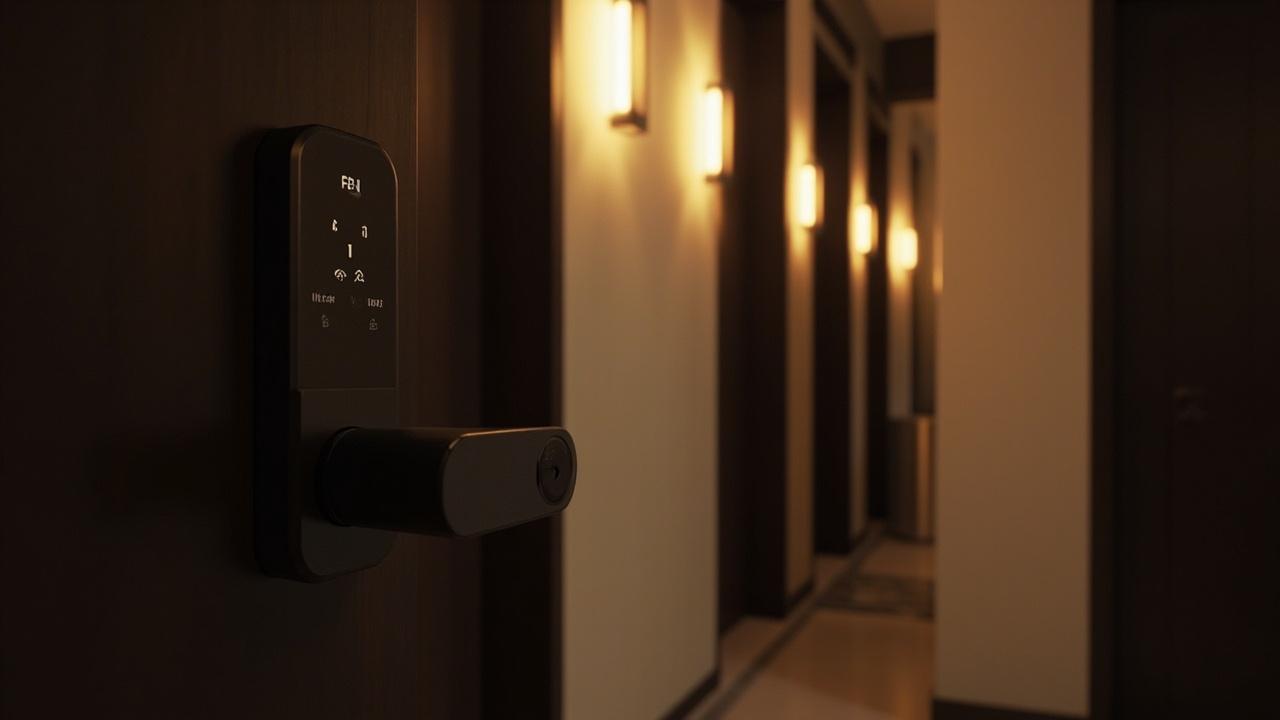
What Smart Lock Should a Hotel Renovation Project Use?
The Short Answer, Before the Arena Opens
A hotel renovation project should use the lock that its binding constraint picks — not the richest lock the datasheet offers. In a new build, the lock is specified first and the door is built around it. In a renovation, the door already exists, the power routing already exists (or doesn't), the guests are still checking in, and the old keycards are still in circulation. The renovation answer therefore routes through four execution strategies, each of which effectively selects a different class of lock:
- Contender A — reuse the cylinder, swap the handles: keep the existing mechanical lock body in the door; fit electronics and lever sets over it.
- Contender B — full lock replacement on the existing doors: pull the old body, drop in a purpose-built hotel smart lock without touching the door slab.
- Contender C — phased floor-by-floor migration: one credential platform eventually, but rolled out floor by floor while the hotel trades.
- Contender D — hybrid split: guest rooms move to new smart locks, public areas and back-of-house keep proven legacy hardware for now.
This article runs those four contenders through five head-to-head rounds — door condition, wiring-free operation, guest-disruption windows, credential continuity mid-renovation, aesthetic consistency — then hands down verdicts for three recognizable renovation archetypes: a 1990s concrete-frame hotel, a seaside resort refit, and a city townhouse conversion. If you came looking for a general hotel lock feature comparison, the what smart lock should a hotel buy guide covers that lane; this one is strictly about what renovation does to the answer.
Renovation Flips the Question
New construction asks: which lock suits this hotel? Renovation asks a narrower, uglier set of questions: which lock suits these doors, this schedule, this live occupancy, and this pile of half-issued keycards? Three flips decide the arena.
The door is a fact, not a choice. Roughly thirty years of prior decisions are drilled into every slab: bore positions, backset depths, mortise routings, original hinge wear, paint built up over trim work. A lock that fits the sample door in the showroom can fight door number 61.
The hotel keeps earning. Renovations are staged around occupancy, not around the installer's convenience. That means room-down windows measured in hours per room, corridors that stay passable, and a front desk that cannot pause mid-migration.
Two credential systems overlap. From the moment the first new lock goes on until the last old lock comes off, the property runs a split key universe. Every strategy in this arena handles that split differently, and it is where renovation budgets quietly leak.
Spec discipline for this article: the only hotel-line model whose numbers are quoted from a verified first-party product page here is the SLK-9936S — door thickness 36–100 mm, RFID Mifare 1 @ 13.56 MHz, read distance 0–5 cm, read time under 0.25 s, 4 × AA power, battery operating cycles above 15,000, audit/event records up to 1,000, 5-pin cylinder, 3-point latch, stainless steel and alloy body with multiple finish options, mechanical emergency access, multilingual management software, standalone or centralized database modes, positioned for 1–5 star hotels. For every other model named below — SLK-9936G, SLK-9905A, SLK-G200, SLK-8831, SLK-1104 and the RFTC/RF legacy series — treat any dimension, power scheme or credential detail as Check the model’s published specification, including whether Wi-Fi is offered.
The Four Contenders, Precisely
Contender A: keep the old cylinder, swap the handle set. The mechanical body and strike stay; the outside lever gets replaced by an electronics-carrying escutcheon and the inside by a matching lever. Some hotels run this with keypad or card-reader front plates that drive the existing latch. Work per room is small; the door is untouched apart from removing the old lever hardware.
Contender B: full lock replacement. The old body comes out, a dedicated hotel electronic lock goes into the same prep (or a cleaned-up prep), and the door slab stays. The SLK-9936S block is a useful yardstick for what a modern hotel-line lock expects from a door: it accepts 36–100 mm thickness — a deliberately wide envelope that exists precisely because retrofit doors vary — and reuses a standard 5-pin cylinder and 3-point latch. Full replacement buys you the lock's own mechanics, audit records, and emergency access design instead of inheriting 1990s hardware decisions.
Contender C: phased floor-by-floor migration. Not a hardware strategy so much as a schedule strategy layered on A or B: rooms go dark one floor at a time, each floor closes its own credential cut-over, the front desk encodes for two worlds during the overlap.
Contender D: hybrid split. Guest-room doors get B (or A); public-area doors — gym, spa, banqueting, staff corridors, mechanical rooms — keep their existing RFTC/RF-lineage or mechanical hardware until a later capex round. One platform for revenue space, tolerance for legacy elsewhere.
Round 1 — Door Condition Constraints
Renovations inherit whatever the doors are. A door survey in a renovation has four verdict categories, and each one pushes toward a different contender.
| Door survey finding | Typical renovation cause | Natural fit | Poor fit |
|---|---|---|---|
| Sound slab, standard bore, lever loose but intact | Original 1990s installation, maintained | A — handle swap preserves everything | B (unnecessary downtime) |
| Worn latch, sagging body, painted-over strike, swollen edge | Age + humid housekeeping | B — new body resets the mechanics | A (inherits failing hardware) |
| Non-standard or double-bored prep from earlier swaps | Multiple prior lock generations | B with prep cleanup, per-door verification | A (old geometry constrains electronics) |
| Narrow stiles, aluminum frames, glass leaves | Conversions, resort cottages, storefront-style public areas | B or category-matched units — SLK-1104-class narrow-edge designs, SLK-G200 for glass; all specs to verify in writing | Anything sized for a 44 mm solid timber slab |
Scoring this round: A wins on doors that are already good and loses everywhere the hardware itself is the renovation liability. B wins wherever the body is tired, because the whole point of a modern hotel lock — the 9936S-style integration of reader, latch control and event recording — is wasted if the underlying mechanics are on borrowed time. C takes door condition as it finds it, floor by floor, which is either a strength (flexibility) or a dodge (nobody owns the survey results). D sidesteps the worst doors entirely by not renovating them yet.
Edge case that decides many projects: heritage or façade-restricted buildings where the door cannot be re-drilled at all. There, A is not the cheap option — it is the only option, and the electronics must live around the existing hardware.
Round 1 verdict: B leads on tired door stock, A on sound stock; D scores well by deferral; C is neutral by design.
Round 2 — Wiring-Free Constraints
New builds pull power to the door during construction. Renovations of standing buildings mostly cannot: chasing walls in an occupied hotel is a bigger project than the locks. So the practical renovation question is battery-operated standalone or near-standalone operation, or nothing — and any claim that a specific catalog model runs on mains power or over Wi-Fi should be checked against that model's product page rather than assumed.
This is where reading a renovation-grade spec block differently from a new-build buyer pays off. On the SLK-9936S, the PDP-cited figures — 4 × AA power, battery operating cycles above 15,000, and management software that runs in standalone or centralized database modes — describe exactly the architecture a no-wiring retrofit needs: each lock carries its own decisions, and the software reconciles records rather than requiring live door-side networking. Read distance 0–5 cm with a sub-0.25 s read means a card touch that housekeeping staff and guests do not have to learn.
| Contender | Wiring exposure | What to verify per model (no documented value) |
|---|---|---|
| A — handle swap | Lowest: no new routing, reuses existing door | Battery compartment size on existing-thickness door; credential tech of the retrofit plate |
| B — full replacement | Low, if the lock is battery-native | Power source, battery cycle rating, whether management is standalone-capable — the 9936S block shows the pattern to demand |
| C — phased | Same as A or B per floor, plus a longer dual-software window | Whether the mid-migration state (some floors online-managed, some standalone) is actually supported by the management software you pick |
| D — hybrid | Zero in retained legacy areas; same as B in guest rooms | That the new platform's event records and the legacy hardware's non-records can coexist in one operational review |
Avoid the renovation trap here: a buyer choosing an online hotel architecture because it reads as premium, then discovering the wiring to 87 doors costs more than the locks and the fire strategy won't approve it anyway. Check the model’s published specification whether Wi-Fi is offered for any specific model before it enters the shortlist; do not carry a residential assumption ("smart means connected means powered") into a hotel door schedule.
Round 2 verdict: A and B on battery-native locks tie at the top; C loses points for stretching the awkward mixed-management state; D is safe but leaves public-area event visibility dark.
Round 3 — Guest Disruption Windows
Renovations are scheduled around occupancy calendars, so per-room work time is the currency. Contenders convert that currency very differently.
An illustrative planning frame: a 74-room floors-and-phases project (say four phases of 18–20 rooms) run by a two-person install crew, with the convention of clearing rooms in morning gaps between checkout and check-in. These are planning assumptions, not promises — every property renegotiates them.
| Strategy | Assumed room-down window | Guest-visible disruption | Crew logistics |
|---|---|---|---|
| A — handle swap | Shortest: sub-hour to ~1 hour per room in most preps | Almost none beyond a delayed cleaning turn | Light kit, no door-off work |
| B — full replacement | 1–3 hours per room depending on prep cleanup | Noticeable if the room is re-sold same day | Requires old-body removal and waste handling |
| C — phased floor-by-floor | One floor blocked in a defined window; rooms otherwise normal | Floor signage, lift restrictions, housekeeping rerouting for the phase week | Predictable, repeatable, easiest to staff |
| D — hybrid split | B-level work in guest rooms only; zero in retained areas | Confined to guest corridors | Public-area hardware stays off the critical path |
The subtlety nobody budgets for: disruption includes the front desk, not just the door. A guest whose old-format card works on floor 3 and fails on floor 4 after a morning migration is a disruption event with no hardware at fault. That lands in Round 4.
A second subtlety: phased work (C) lowers peak disruption and raises total calendar disruption. Two busy seasons of light annoyance versus one quiet-season heavy lift is a real trade, and brand-sensitive properties sometimes choose the quiet-season compression — which pushes them toward B across all floors at once and demands the crew depth to match.
Round 3 verdict: A minimizes per-room time; C minimizes peak concurrency; D minimizes total scope; B is the most disruptive per room but the cleanest single exit.
Round 4 — Card and Credential Continuity Mid-Renovation
The defining renovation risk. On day one every door speaks the legacy system; on the last day every door speaks the new one; in between, the property runs a split credential universe, and the contenders handle the split as follows.
Mifare-class credentials (the SLK-9936S reads Mifare 1 @ 13.56 MHz, PDP-cited) and older magnetic-stripe-era or plain mechanical keys are not interchangeable at the encoder, and guests do not care about your migration diagram when their card fails at the room door.
| Continuity decision | A — handle swap | B — full replacement | C — phased | D — hybrid |
|---|---|---|---|---|
| Re-encode at cut-over? | Depends on retrofit plate's credential tech — to verify in writing | Yes, per room going over | Yes, per floor | Yes, per guest room only |
| Guest re-issuance events | Lowest if legacy cards survive | 1 per renovated room-stay | Spread across the whole migration calendar | Concentrated in guest rooms; public areas unchanged |
| Lost/deactivated card enforcement | Deferred on retained legacy doors | Immediate per renovated door | Weak zone: old floors honor old blacklists only partially | Split by area |
| Audit continuity | Legacy doors generate no new-format events | Event records up to 1,000 per renovated door (9936S figure) | Two record systems reconciled for months | Two record systems by design |
Three operating rules salvage mid-renovation continuity, whichever contender wins:
- One credential format, chosen before the first order. If the target platform is Mifare-1 card plus emergency access per the 9936S pattern, every cut-over wave issues only that format, even in retained legacy areas where cards must still pass a legacy reader — which means dual-media cards or parallel card stock, decided at encoder purchase time.
- Front-desk SOP rewrite is a deliverable, not a memo. During C or D, a shift supervisor must be able to answer "does this guest's card work on floors 2, 5 and 7?" from one table. Build that room-status/credential matrix as part of the rollout packet.
- Blacklist discipline beats hardware discipline. The genuinely dangerous window is the one where a checkout card from a renovated floor meets a still-legacy floor. If your legacy locks accept revalidated old cards, plan card-stock expiry around the migration calendar, not the other way round.
Where the transition is from a fully mechanical key system, the continuity question changes shape — keys are recalled physically, guests lose them constantly, and the upgrade path from traditional hotel locks to smart locks covers that variant's workflow.
Round 4 verdict: D and B score highest (shortest split windows per area), C scores lowest (longest split), A sits wherever its retrofit plate's credential tech lands.
Round 5 — Aesthetic Consistency
Renovations are photographed; guest reviews mention finishes. Two aesthetic failure modes exist.
The mixed-generation corridor. Under C or D, a hallway where renovated rooms wear a contemporary low-profile electronic lock and unrenovated rooms wear a bulbous 1990s box. Guests read inconsistency as "this hotel is being cut up," even when the mechanical work is exemplary.
The mismatched hardware family. Under A, the retrofit electronics sit on the door alongside retained original furniture — hinges, stays, viewers — that were matched to the old lever. A handle-swap can look added on unless escutcheon geometry and finish actually pair with the surviving hardware.
What real consistency requires, per contender:
| Requirement | A | B | C | D |
|---|---|---|---|---|
| Single finish family across all changed doors | Only if retrofit plates exist in the needed finish — to verify in writing off any non-9936S pick | Lock-line finish choice per model; SLK-9936S PDP cites multiple finish options — match to lever/bath hardware spec | Same SKU for every wave or drift appears between phases | Guest rooms consistent, public areas visibly a different era — accept it as phase 2 scope |
| Profile/silhouette consistency | Hardest: electronics must hide behind existing door geometry | Choose low-profile reader designs; hidden-reader concepts such as SLK-9905A exist for doors where the reader shouldn't shout — dimensions to verify in writing | Same as B, twice, months apart | Lowest overall consistency |
| Heritage/facade constraints | Often the enabling strategy | May require per-door approval | Same as B per floor | Same as B in guest rooms |
A manufacturer's note worth stating plainly: ordering finishes in waves is how consistency dies. If a phased or hybrid strategy wins, order all changed doors' hardware against one finish decision made at the start, with the survey sheet recording the finish code per room group. Whether a specific model offers a specific finish is a product-page question — to verify in writing beyond the 9936S block.
Round 5 verdict: B wins on a single-swoop finish decision; A wins where preserving original furniture is the aesthetic; C and D concede ground and must manage it with one locked finish spec.
The Scoreboard and the Routing Map
Cumulative round scoring (2 = led the round, 1 = acceptable, 0 = structurally weak):
| Round | A: cylinder reuse + handle swap | B: full replacement | C: phased migration | D: hybrid split |
|---|---|---|---|---|
| R1 Door condition | 1 (wins only sound-door stock) | 2 | 1 | 1 |
| R2 Wiring-free | 2 | 2 | 1 | 2 |
| R3 Disruption window | 2 | 1 | 2 | 2 |
| R4 Credential continuity | 1 | 2 | 0 | 2 |
| R5 Aesthetic consistency | 1 | 2 | 0 | 0 |
| Total | 7 | 9 | 4 | 7 |
B — full lock replacement on existing doors — is the arena's default winner when the survey says the doors survive a body swap, which is exactly the compatibility question settled in the dedicated treatment of replacing hotel locks without replacing doors. A and D are not worse strategies, they are constraint answers: A when doors are sound or untouchable, D when capex phasing is the real driver. C is almost never a strategy in its own right — it is a schedule imposed on B, and it should only be chosen when occupancy patterns force it, because it buys calendar flexibility at the cost of the two hardest rounds.
flowchart TD
    S[Door-by-door survey completed?] -->|no| S0[Survey before any shortlist:\nbore, thickness, wear, frame material]
    S0 --> S
    S -->|sound doors, good hardware| A[Contender A\ncylinder reuse + handle swap]
    S -->|tired bodies, standard preps| B{Full-property closure\nwindow available?}
    S -->|heritage / narrow / glass / aluminum doors| D2[Category-matched models,\nspecs to verify]
    B -->|yes| B1[Contender B in one wave\n— pick this over C when you can]
    B -->|no, occupancy blocks it| C[Contender B scheduled\nas C: phased floors]
    C --> C1[Cap credential split:\none format, one finish,\none front-desk matrix]
    B1 --> G[Guest-room scope]
    A --> G
    D2 --> G
    G -->|public areas cannot fund\nnew locks this round| D[Contender D overlay:\nrooms new, public areas retained]
    G -->|public areas in scope| W[Single-platform handover]
    D --> W
    C1 --> W
    W --> Q[Quote packet: per-door schedule,\ncredential plan, finish codes]
Verdict — The 1990s Concrete-Frame Hotel
Illustrative property: 87 rooms built 1994, concrete frame, original solid timber doors on a standardized bore, 1990s box-style magnetic or early electronic locks long since out of parts support, single annual low-season closure window per wing, front desk running one encoding station.
This is Contender B territory, executed in two compressed waves rather than an eight-floor crawl. The doors are the lucky kind — one standard prep across 87 rooms, thickness comfortably inside the retrofit envelope a modern hotel lock expects (the 9936S's 36–100 mm range is the pattern to verify against your actual slabs). The bodies are the unlucky kind — three decades of latch wear mean a handle swap would preserve decay. Because the preps repeat, per-door verification is a sample of a few per floor type, not 87 surveys, and the crew rate climbs as the pattern sets in. Credential continuity argues for one format from wave one; the old locks' cards simply stop being issued on the day each wing cuts over. Phasing across the whole year (pure C) would drag a split-card front desk through three seasonal peaks for no capex benefit — the wings are natural wave boundaries the property already has. Finish discipline is easy here: one SKU family, one finish, 87 doors, one decision meeting.
Verdict — The Seaside Resort Refit
Illustrative property: 63 guest units in detached cottages and a main lodge, built and re-clad across 2008–2019, mix of timber, aluminum-frame and glass doors, salt air within a few hundred metres, heavy summer occupancy that makes any closure during season impossible.
Salt and mixed door stock rewrite the answer. Aluminum-frame and glass leaves reject timber-slab-sized bodies outright, so Contender B fragments into category-matched units — narrow-edge or outdoor/aluminum-door series candidates, glass-specific locks like SLK-G200 — and every dimension for those models is verified in writing on its product page; the resort's survey drives selection, not the brochure. The winter-only work window makes this the rare property where C genuinely earns its keep: cottage clusters close as one travel package, the lodge floor-by-floor in its own window, and the credential split is survivable because resort stays are longer and check-in is staffed rather than self-serve — re-issue cards at arrival for the whole stay regardless of unit status. A handle-swap strategy loses badly here: coastal corrosion eats the 1990s cylinders too, and inherited hardware is exactly what salt shouldn't be trusted to. The one non-negotiable: battery access. Winter-storm-season means no technician wants to fight a dead lock in unit 41; favor models whose battery compartment and cycle endurance you can verify — the 9936S block again as the yardstick (4 × AA, >15,000 cycles), with equivalents confirmed per model.
Verdict — The City Townhouse Conversion
Illustrative property: 41 rooms across a row of 1920s townhouses under façade protection, converted for boutique-hotel operation; doors are original or early-replacement, stiles narrow at the edges, ironmongery is period-matched and cannot be visibly altered; work proceeds unit-by-unit as each townhouse is released by the landlord group.
Contender A for the front doors, Contender B wherever a door can take it, hybrid (D) for the service areas — and the schedule takes care of itself because C was forced by the landlords. The façade rule means visible exterior hardware changes need approval; electronics that drive the existing cylinder, with the lever profile matched to the surviving period furniture, is often the only permitted path — every retrofit plate's credential technology, battery fit and finish is verified in writing unless it's the model whose page you can cite. Interior room doors away from the street, which are frequently re-hung during conversion anyway, should get full replacements so the guest-facing bedroom experience is modern while the street-facing threshold stays historic. Credential continuity is a boutique desk's strength — low volume, high-touch check-in, every card issued by hand each arrival — which lets the unit-by-unit drift of D stay invisible to guests. Aesthetic consistency here has a twist: the goal isn't one uniform product across 41 rooms; it's per-door invisibility and per-room coherence, so lock silhouettes must be judged door-by-door, not on a single hero photo.
What the Factory Floor Tells You About Renovation Orders
Ten-plus years of shipping hotel lines into retrofit programs surfaces the same three requests from buyers whose projects went smoothly.
First: survey photos before quotes, per door group. A renovation RFQ that includes measured photographs of the worst door in each family — the swollen one, the narrow one, the painted-shut one — gets a compatibility-checked answer instead of a catalogue recital. Thickness, backset region, existing bore layout, frame condition: the SLK-9936S's published envelope is generous precisely because these inputs scatter.
Second: one pilot room, honestly tested. Put the shortlisted lock on the property's most troublesome door, run real cards, real housekeeping, real battery checks through a stay or two before the bulk decision. Sample-first evaluation is a normal program — the order-samples route exists for exactly this — and it converts a datasheet argument into a witnessed one.
Third: schedule the credential cut-over with the manufacturer's software in the loop, not after it. Standalone-versus-centralized management choices (both modes exist on the 9936S line) change what a mid-renovation front desk can actually do on a Tuesday night. Buyers who treat software as the last checkbox routinely discover it in week six of phase two.
If the legacy estate being replaced is itself a multi-generation hotel-lock system — old encoders, orphaned controllers, mixed RFTC/RF-lineage hardware — the decommissioning and data questions sit in the companion treatment of legacy hotel lock system replacement, which handles teardown; this arena handled selection.
Handing the Decision to Procurement
The arena result in one sentence for a procurement file: a hotel renovation should use the smart lock that its survey picks — default full replacement on reusable doors (B), handle-swap electronics where doors or façades forbid body changes (A), phasing (C) only when occupancy forces the calendar, and hybrid scope (D) when capex, not hardware, is the limiter — all ordered against one credential format and one finish decision made before wave one.
Turn that into a packet: the per-door-group survey sheet, the credential cut-over matrix, the pilot-room finding, and the shortlist with model-level compatibility confirmed on each product page. Send the packet to the quote desk at Request a quote — renovation projects quote per door schedule, not per brochure page — and browse the wider hotel lock line while the survey is finishing, so alternatives are on the table before the first cut-over wave locks in.