
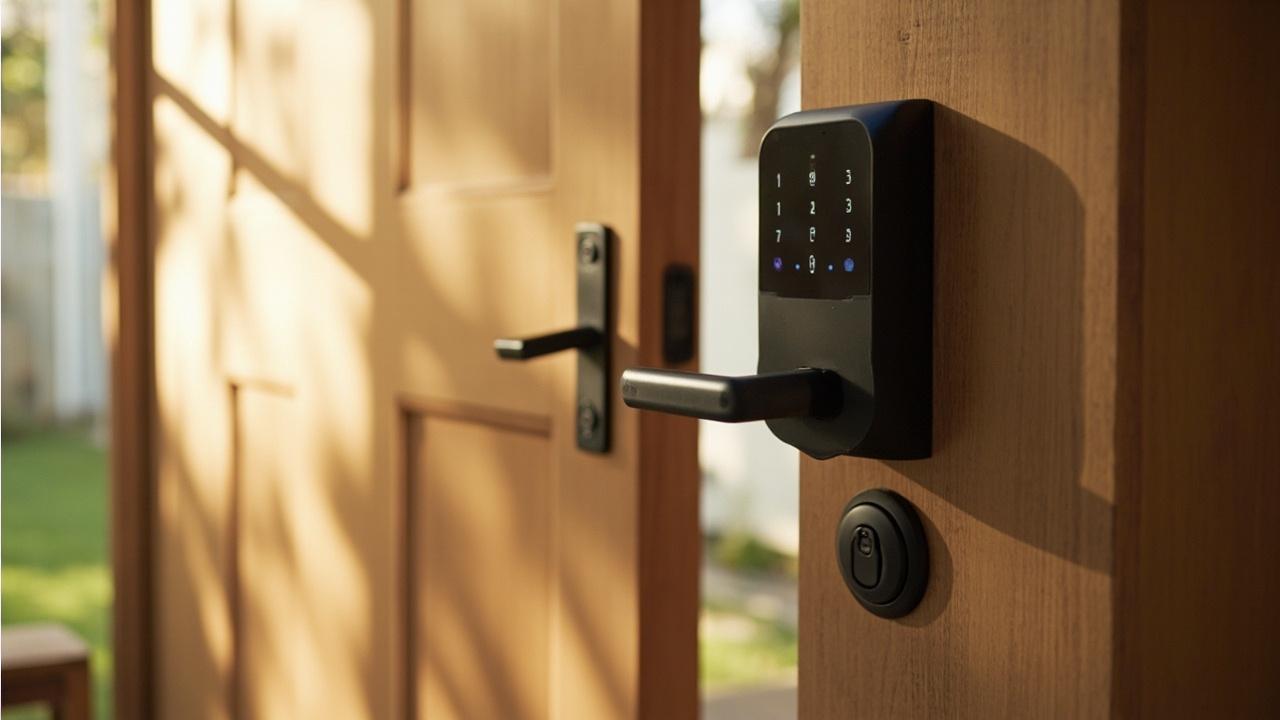
Smart Locks for Multi-Family Housing
Smart locks for multi-family housing mean one door-hardware platform deployed across an estate where the residents do not share a tenure: rented flats, privately owned condominiums, and sometimes an assisted or supported-living block, all behind the same boundary wall. The governing argument is not which lock to buy. It is where uniformity should stop. Standardise the platform — the lock series, the credential family, the audit model, the spares shelf. Differentiate the permission layer — who enrols, how long a credential lives, and how it dies. That split is the only doctrine that survives contact with tenant move-outs, owner committees, and duty-of-care obligations under one roof.
This article takes that position and defends it. The per-door-type buying checklists for apartment buildings live elsewhere; if you want the lock-by-lock selection pass, read the apartment buildings buyer guide. If you are specifying an entire new scheme as a developer, the developer procurement angle covers the schedule side. This piece is about governance: what happens when three populations share one estate and one door standard.
One Roof, Three Constitutions
A single-family homeowner is a government of one. They pick the lock, they hold the keys, they fire the contractor. An exclusively rented apartment block is a government of one too — the landlord, or the operator the landlord pays. Everything about locking flows from a single centre of decision-making, and a clean buying guide can be written for it.
Mixed-tenure housing is different, and the difference is constitutional, not technical. Behind one estate boundary you have three sources of legitimate authority. The rental block answers to an owner-operator who can impose a standard by fiat. The condominium association answers to a committee that must vote, and whose members rotate. The assisted-living block answers to a duty of care that does not belong to the resident alone — staff must be able to enter, families must be able to visit, and the resident's own autonomy still has to mean something. Three tenures, three decision-makers, three definitions of what "good access" means.
Here is what nobody tells you from a brochure: door hardware takes sides. A lock whose whole logic says "the property manager is the only administrator" quietly overrules the condo committee. A lock whose logic says "each household self-manages everything" quietly strands the assisted-living resident who cannot manage anything on a bad day. A platform that cannot express all three constitutions will be worked around within a year — by shared codes taped inside utility cupboards, by mechanical keys "just in case," by whichever ghost system the maintenance contractor brings in the first winter. Shadow access is not a culture problem. It is what happens when the hardware contradicts the governance.
Standardisation Is a Procurement Reflex, Not a Strategy
Ask an estate's procurement lead why every front door carries the same lock, and you will get one of three answers: it was cheaper as a single line, it was easier to install, or it is easier to maintain. All three are real. None of them is a strategy, and the difference matters the day the standard meets reality.
The procurement reflex runs like this. One SKU across the estate feels disciplined: the purchase order is clean, the spares shelf is small, the installer gets fast, and the supplier cannot say "that model was discontinued." So the standard is written at platform level and then, because nobody stops at platform level, it slides downward: one credential model, one enrolment channel, one permission topology for everybody. That slide is where mixed-tenure estates break.
The hardware half of standardisation is genuinely worth defending. The permission half is where uniformity becomes negligence. A rental unit needs a credential that dies on the day the tenancy ends, because a code that outlives a tenancy is a liability with a number on it. An owned unit needs a model where the owner — not the manager — is the household administrator, because autonomy is the thing ownership buys. A care room needs simultaneous logic: rapid staff access, visitor access that respects the resident's dignity, and a record that satisfies whoever is accountable when something goes wrong. A single permission topology cannot perform all three jobs at once.
What should stay uniform across all three tenures is the platform: the lock series, the credential family, the firmware line it runs on, and the shape of the audit trail it produces. What should differ is the policy layer sitting on top of that platform. Say it once, plainly: standardise the machine, differentiate the law.
Per-Audience Locking Feels Right and Corrodes Anyway
The opposite reflex exists too, and it is more seductive because it flatters each audience. Give the rentals the operator's lock with central management. Give the condos the self-managed model the committee approves. Give the care block the lock with the fastest staff entry. Each population gets exactly what was argued for at its consultation meeting. Everyone is heard.
Then the cost arrives, quietly, over three years.
Four lock families on one estate means four spares inventories, because a latch spring for one series does not become a latch spring for another. It means four installer skill sets that fade between the last unit of phase two and the first unit of phase three. It means audit trails in different shapes, so a single incident spanning the rental lobby and the common corridor becomes a data-reconciliation project instead of a lookup. It means the estate's credential story fragments, and nobody can answer "what opens doors here, and who holds them?" without consulting three systems.
And it means obsolescence multiplied. Every product line has its own arc; with four families you have four unsynchronised refresh decisions arriving at awkward moments, and the lock you can no longer get is the one you fitted to one building in phase one.
None of this says the per-audience instinct is wrong. It says the instinct belongs at the permission layer. Audiences genuinely need different rules. They do not need different machines. The estate that buys four locks to express three policies has confused governance depth with hardware variety, and will pay hardware variety's price without ever receiving governance depth.
The Line Where Uniformity Should Stop
So the doctrine, stated properly. Picture the locking estate as two layers with a hard seam between them.
The lower layer is the platform. It covers the door hardware itself — latch and cylinder architecture, the range of door thickness the series physically fits, the credential family or families the lock accepts, the event log it keeps, the emergency mechanical fallback it offers, and the power model it runs on. This layer should be identical across every unit in the estate, phase after phase. Not because sameness is virtuous, but because the spares shelf, the installer's competence, the audit consistency, and the ten-year continuity of the standard all live here.
The upper layer is the policy. It covers who can enrol a credential, who can revoke one, how long a credential lives, what an administrator can see, and what happens at the boundaries of a tenancy, a committee term, or a care plan. This layer should differ by tenure, per door group, and the differences should be written down before the first purchase order — not discovered during the first incident.
| Layer | Uniform across the estate | Differentiated by audience |
|---|---|---|
| Lock series and door fit | Yes — one hardware family on the door schedule | No |
| Credential family accepted | Yes — same cards/codes/biometrics/app route on the same boards | Only the issued subset |
| Firmware line | Yes | No |
| Audit record shape | Yes — one log format estate-wide | Access rights to the log |
| Enrolment authority | Structure uniform | Who holds it: operator, owner, or care lead |
| Credential lifespan rules | Mechanism uniform | Tenure, ownership, care plan |
| Emergency access route | Mechanism uniform | Escalation contacts |
The firewall inside that table is the one most specs miss: uniformity at the credential-family level does not force uniformity at the credential level. If the estate's locks accept RFID, passcode, fingerprint, mechanical key and an app route — the multi-method spread that exists across this catalog, with a single-board five-method model like SLK-8831 as one published example — then a rental tenant, a condo owner and a care resident can all live on the same hardware while holding entirely different credential sets and entirely different lifespans. The machine is one thing. The law on top of it is three.
One rule to enforce at the seam: never let a policy difference be satisfied by a hardware difference if the platform can express the policy. If a door group needs something the platform genuinely cannot do — a weather-rated outdoor class on a side gate, a glass-specific fitting on a terrace screen — that is a hardware exception, documented as such. Everything else is a settings decision wearing a procurement disguise.
Three Lifecycles Every Platform Must Express
Test any candidate standard against three clock cycles. The estate lives or dies by how the platform handles them.
The turnover cycle. Rented flats change hands on a calendar, and inventory units change hands twice per tenancy — once at move-out, once at move-in. The lock's obligation here is a credential death that is complete, dated, and provable. Every code, card, finger and app pairing issued to the departing household must be revocable in one act, with a record saying when. Whatever the platform's actual per-model revocation mechanics are, confirm them on the product page before you write the standard — but write the requirement first. A turnover that leaves a working code behind is a future incident with your estate's name on it.
The ownership cycle. Condo units change hands rarely, and the household's own composition changes at human speed — children, partners, elderly parents, tradespeople let in for an afternoon. The lock's obligation here is the opposite shape: the owner is the administrator of their own unit, enrolling and removing household credentials without filing a request with anybody, and without the operator quietly holding a god-mode override the owner never agreed to. Committees will care about this more than residents do individually; that is normal, and it is still not a reason to give property management an owner unit's admin rights by default.
The care cycle. Assisted and supported-living rooms run on a third clock: the staff rota, the family visit, and the emergency response. Credentials here are role-shaped, not household-shaped. A care worker's access should be alive only while their shift relationship is alive; a family visitor's access should expire on its own, not rot into a permanent key. And the resident's own door still has to feel like theirs. Duty of care is what makes this cycle non-negotiable: someone is accountable for every entry and non-entry, which means the event log is not a nice-to-have feature but the estate's evidence base.
A platform that serves one or two of these cycles is a partial answer. Mixed tenure fails at whichever cycle it cannot express.
What a Homogeneous Fleet Actually Buys
Return the favour to the standardisers, because the case for one machine is stronger than most essays admit — once the seam is drawn correctly.
One door schedule means one installer briefing. On a multi-phase estate, the crew that fits building four is not the crew that fit building one, and the training memory of a heterogeneous fleet dies between them. One series means fitting tolerances, door-thickness handling and the commissioning ritual stay in working memory rather than living in a binder nobody opens.
One spares logic means one shelf. The estate that runs three families keeps three of everything and still gets caught out, because critical spares are always the one from the family you forgot. This is the boring arithmetic that decides whether a broken lock in the rental block is a Tuesday nuisance or a weekend escalation.
One audit topology means one truth. When something happens on an estate — a dispute, an insurance question, a police question — whoever asks first wants the entry record for a door, and then the record for the door next to it. If those two logs speak different languages because they came from different product families, you have built a reconciliation tax into your worst day.
One continuity promise means future phases match. A standard written against a catalog that still carries the series is worth more than a cheaper first purchase of something the same supplier cannot ship again. Breadth matters here: a 79-model catalog covering 77 smart door locks, 18 keypad, 37 fingerprint and 9 RFID classes, plus dedicated outdoor and glass ranges, gives one supplier room to cover the whole door schedule without per-building supplier-hopping — but the continuity of any specific series is a written confirmation to obtain, not a brochure assumption.
Match the Credential to the Door, Not the Brochure
The honest question is not "which unlock method is best" — it is which method fits which door group's lifecycle, given that the platform underneath stays the same. Different door groups answer differently, and a mixed estate should look less like one lock repeated and more like one family, expressed per doorway.
| Door group | Credential logic that fits the lifecycle | What to demand, confirmed on the product page |
|---|---|---|
| Rental flat front door | Operator-controlled; fast full-wipe revocation at move-out; code + card as everyday credentials | Credential per-device capacity, revocation mechanics, offline event log depth |
| Condo front door | Owner-as-administrator household enrolment; visitor codes the household issues itself | Admin/user role structure, self-enrolment path, mechanical override custody |
| Assisted-living room | Role-shaped staff access, expiring visitor access, emergency entry route that never depends on a battery | Event record availability during network loss, backup power behaviour, response-time read mechanics |
| Common corridor and amenity doors | Staff and contractor roles on schedules; resident access that matches the tenure of the amenity | Role and schedule capability of the management software, audit access rights |
| Side, garden and bin-store gates | Weather-rated hardware, often shared credentials; contractor access time-boxed | Outdoor/gate series fit, door material compatibility, operating-environment limits |
| Unit-under-refit and vacant stock | Temporary builder credentials with guaranteed expiry; nothing that outlives the works | Temporary-credential mechanics, default-code behaviour, commissioning reset process |
A few positions from this catalog's spread, as illustration rather than prescription. Keypad series carry the everyday-code logic for turnover-heavy door groups. RFID families suit card-culture estates where credential issuance is already an operational ritual. App and Bluetooth models — the catalog runs TTLock, Tuya and Doodle variants across different boards — change the enrolment question from "who holds a spare card" to "who holds the phone," which matters in owner tenures and worries committees. The five-in-one class, with fingerprint, password, card, key and app on a single lock, is the most literal proof that credential variety can live inside platform uniformity. None of these families is "the answer"; the answer is that your door schedule, tenure by tenure, picks which subset of one platform's capabilities each doorway actually uses.
An Illustrative Scenario: 180 Units, Three Tenures, One Road
Hold the abstract long enough to walk one estate. Consider a development of 180 homes: 60 rented flats under a single institutional owner, 90 privately owned condominiums with an elected management committee, and a 30-room supported-living block run by a care operator. One boundary, one maintenance team serving all three, one physical design with broadly similar doors. Phase one specified nothing; doors got whatever a contractor had in stock. Now the estate faces its first estate-wide re-spec.
The reflex split is instant. The institutional owner wants one operator-controlled model on cost grounds. The condo committee has read its own minutes and will not accept a landlord's god-key on owner doors — and, being a committee, it changes composition every year, so it wants a standard that survives its own turnover. The care operator's duty of care requires staff access that works at 3 a.m. on a dead battery and an event record it can defend. Three audiences, three non-negotiables.
Under the two-layer doctrine, the estate standard reads like this. One lock family across all 180 doors, selected on door-fit, credential family support, event-record depth and emergency fallback — every one of those attributes verified against published product-page data before the standard is signed, not after. The rental blocks are commissioned with operator-controlled administration and move-out credential wipe-down as the governing workflow. The condo blocks are commissioned with each household as its own administrator, and the operator holding nothing on owner doors by default except what the committee explicitly and in-writing grants. The care block is commissioned with role-based staff credentials, auto-expiring visitor access, and the log configured for the operator's audit obligations. Same machines, same spares shelf, same installer briefing, three different permission regimes.
The failure mode to watch for in this scenario is the quiet one: a platform that technically supports all three regimes but whose default commissioning habit pushes everything toward the loudest buyer. The institutional owner pays for the bulk of units, and bulk-money gravity pulls every door toward operator control. The committee notices eighteen months later, when it discovers owner doors that property management can open and its own residents cannot enrol a babysitter. A good standard states the permission defaults per door group, so the installer's commissioning ritual cannot drift.
And one more thing the scenario proves: the 30-room care block is not a rounding error in a 180-unit purchase order. The smallest population on an estate often has the least reversible requirement — duty of care cannot be delegated to a committee vote — which is precisely why the permission layer must be written tenure-first and hardware-second.
What the Factory Can Fix and What the Constitution Must Fix
Speaking from the manufacturing side of the table, with more than a decade behind this catalog and sales into more than eighty countries: there is a line, and buyers cross it in both directions at their peril.
A factory can genuinely fix hardware consistency. It can put the same boards, the same latch architecture and the same credential readers across your whole door schedule. It can carry your series forward into your phase-two order. It can publish the spec depth your permission layer needs — capacities, roles, log behaviour, fallback mechanics — so your committee can decide with evidence rather than vibes. It can ship samples of the exact series you will buy, so your pilot door is a real door and not a proxy.
A factory cannot fix governance. It cannot decide whether the condo committee or the operator holds the administrator role on an owner's front door. It cannot write your move-out wipe-down protocol, your visitor-access etiquette in the care block, or the escalation ladder when a credential fails at midnight. It cannot make your estate's bylaws compatible with its software's assumptions; if those conflict, the bylaws are the thing you change with more pain than the firmware.
The uncomfortable service a manufacturer actually provides, when it is honest, is pushback. Mixed-tenure buyers routinely ask for "one admin for everything because reporting is easier." Easier reporting is not a policy; it is a convenience purchased with someone's autonomy, and on a mixed estate someone's autonomy is the product. The questions a good supplier should ask you back are constitutional ones: who is the administrator of an owner's door; does a departing tenant's revocation reach every method; who signs for the care block's log. If your supplier answers only the ones about quantities, the seam between platform and policy will not be drawn well, no matter how uniform your hardware is.
The Spec-Page Granularity Mixed-Tenure Buying Demands
Mixed-tenure standards fail most often at an unglamorous place: a specification that was too shallow to enforce. If your estate rule says "credentials must be fully revocable at move-out" and the product page says "supports multiple unlock methods," the rule is untestable, so it is unfunded, so it is false.
Compare that shallowness with the granularity a serious product page can carry. The hotel-lock spec block for SLK-9936S on this site's own catalog is a useful yardstick — deliberately a hotel model, and nothing in it transfers to a residential lock: it names a door-thickness band (36–100 mm), the exact RFID standard and read distance and read time, the power type, a battery-cycle figure, an event-record capacity, cylinder and latch architecture, the software's multilingual and standalone-or-centralised options, and an explicit mechanical emergency-access provision. Hotel block, yardstick only — do not port those numbers to anything else.
Now run that granularity list through the mixed-tenure door schedule. For each residential model you shortlist, the product page should let you confirm, without asking: the door-thickness and door-type fit; every credential family the lock accepts and per-device capacities for codes, cards, fingers and app pairings; the administrator-versus-user structure — how many admins a household can have and whether an estate-level role can exist above it; the event-record depth and how records are read when the door is offline; the mechanical override and who physically holds that key; the power supply and what the lock does when it fails. Anything the page does not answer becomes a written question, and the written answer becomes part of your standard. Granularity is not pedantry. It is the only way three constitutions can trust one machine.
Handover, Phases, and the Committee That Never Votes Twice
Mixed-tenure estates are built and re-built on political time, not procurement time. The condo committee that approved a standard will not be the committee that inherits it in year four. The institutional owner will refinance. The care operator will change its management company. The developer who wrote the schedule, if this is a new scheme, will sell out and leave. Every one of those events is a handover, and handovers are where undocumented standards die.
So write the standard as if you will not be there. That means the permission layer — who holds admin rights per door group, what a move-out wipe-down includes, what a visitor credential in the care block expires into — documented per door group, in the estate's own paper, not inside a product manual. It means phase-to-phase continuity made explicit: the series, the commissioning defaults per tenure, and the configuration ritual written down so the installer in phase three reproduces phase one without archaeology. It means the estate keeps the audit keys to its own logs regardless of which admin persona holds them — because a duty-of-care record that only one software vendor can read is evidence held hostage.
Developers hand this problem forward earlier than anyone: the scheme's locking standard is written at design stage, sold through a warranty period nobody in this article controls, and detonated on day one of live mixed tenure. The developer-side decisions that create or prevent that detonation are properly a different article's job — see the apartment developer procurement guide. And once the estate is live, the running of the standard becomes operational work with its own discipline, which is where the property management company guide picks it up. This essay's claim ends where all mixed-tenure claims should: a standard that survives its authors is the only standard worth writing.
Put the Estate Map on the Table First
The practical next step for any mixed-tenure estate considering a lock re-spec is not a catalog. It is a door schedule with tenure labels: every door group, its population, its lifecycle clock, its administrator, and the three or four product-page attributes that must be confirmed for that group before the standard can be signed. Build that map, and the platform-versus-policy seam stops being an argument and starts being a shopping list.
Bring the map to the factory rather than a wish. The quote process is where door-by-door hardware, sample plans and series-availability confirmations turn into real answers — start at request a quote, and browse the estate-scale possibilities on the applications page first if you want to see how mixed door schedules have been approached elsewhere in this catalog. One platform. Three laws. Write the seam down.