
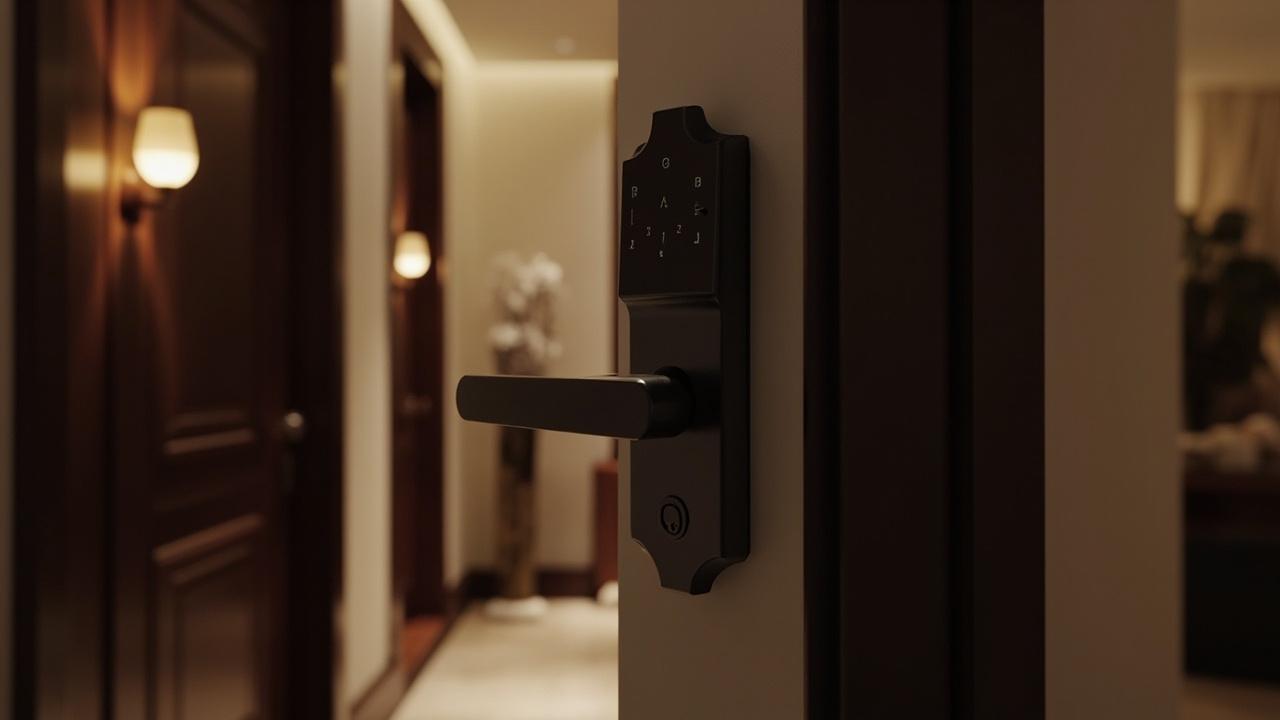
Hotel Smart Lock for 5-Star Hotels
Ask ten hotel suppliers what makes a lock "five-star" and you will get ten different feature lists. Ask a general manager of a real five-star property and the answer is shorter, and stranger: the best lock in the building is the one nobody notices. That is the uncomfortable starting point for this article. The fifth star is not bought by adding features to the door. It is defended by removing everything from the door that reminds a guest the door is a computer.
A five-star-grade hotel smart lock is selected on three properties rather than a longer feature list: it disappears into the door's design through finish matching and low-profile readers; it produces verifiable evidence — audit and event records with a defined privacy posture; and it can be governed as a brand standard across suites, floors and sister properties without drift. At SmartLockFactory, SLK-9936S is positioned for 1–5 star hotels, with a stainless steel and alloy body, multiple finish options, audit and event records of up to 1,000 entries, and a hidden-reader sibling platform in the SLK-9905A.
One sentence of honesty before the argument: star ratings are awarded by evaluators and guides, not by lock manufacturers, and no lock confers a star. What a lock specification can do is survive the standards a five-star property already has to meet — design review, housekeeping cadence, security governance, guest discretion — without becoming the weak link. That is the game. Here is how to play it.
Unfolded, the three standards branch into the specific demands a designer, a security director, and a brand office each put on the same door:
mindmap
  root((Five-star lock standard))
    Design integration
      Finish matched to joinery
      Hidden reader presentation
      Door survey picks the model
    Evidence posture
      Audit depth per lock
      Retrieval cadence owned
      Privacy policy before go-live
    Brand governance
      Configuration string per room type
      Change control with a veto
      One platform across tiers
The fifth star changes tolerances, not technology
The unlocking technology can be identical at every star tier — RFID card at 13.56 MHz, mechanical emergency key, battery-powered operation all appear across hotel locks regardless of grade; what changes at five-star is tolerance. Tolerance for visible hardware, for finish mismatch, for inconsistent behavior between a suite and a standard room, and for access events nobody can reconstruct afterward. The lock class that absorbs tighter tolerance without changing platform is exactly why our hotel line is positioned from 1 to 5 star rather than as separate grade-specific products.
A budget hotel buys a lock to replace a key. A five-star hotel buys a lock that has to pass three audits no budget property runs: the interior designer's, the security director's, and the brand standard's. The hardware survives all three by being boring in the right places — a proven read mechanism, a conservative power design, a cylinder you can re-key — and ambitious in the places guests actually touch: how the front of the door looks, how fast the latch answers, how quiet the whole transaction is.
In our catalog there are 24 hotel locks among 79 published models. That breadth exists precisely because hotel projects at the top of the market are not one product. A heritage corridor with 45 mm historic doors, a new-build tower with 50 mm fire doors, and a spa wing with narrow stiles are three different mechanical problems wearing the same carpet. The five-star label does not pick the model. The doors and the standards pick the model.
What "positioned for 1–5 star hotels" actually commits a supplier to
When the SLK-9936S product page says the model is positioned for 1–5 star hotels, that line is doing more work than marketing. Read it as a supplier commitment with three obligations, and hold every manufacturer to them.
Obligation one: one platform must carry both ends of the stack. A group that runs a flagship tower and a conversion property down the road does not want two access ecosystems. The 9936S line is specified with multilingual management software and standalone or centralized database modes — the same software story can govern 90 keys at one tier and 400 at another. What the spec block does not settle is the detailed feature ceiling of the centralized mode; that is a confirm-per-model, confirm-per-software-build question, and it deserves a written answer before an order, not a demo-day assurance.
Obligation two: the front of the door is a design surface. The PDP-cited facts list multiple finish options on a stainless steel and alloy body. At the five-star tier "multiple finishes" is the whole point: the lock must be able to disappear into walnut joinery, brass-trimmed paneling or a stone-look suite entry. Which finishes exist for which model, and whether a specified finish holds across lock, strike and any ancillary hardware for a single project — confirm per model, in writing, against a physical sample.
Obligation three: grade-agnostic evidence. Audit and event records of up to 1,000 entries appear on the flagship spec regardless of which star tier the door sits in. A five-star property is not more secure because its buffer is deeper; it is more defensible because the same record discipline can be demanded in a palace and in an airport Lodge under one brand standard.
| Spec line (PDP-cited, SLK-9936S) | What a five-star buyer should read into it | What it does NOT settle — confirm per model |
|---|---|---|
| Door thickness 36–100 mm | Fits the heavy solid-core and decorative doors five-star properties actually hang | Whether a specific door's stiles, rails and existing boring allow clean install |
| RFID Mifare 1 @ 13.56 MHz, read distance 0–5 cm, read time <0.25 s | A deliberate touch, near-instant response — no fumbling at a designer door | Card fleet security tier (memory IC vs keyed sectors vs CPU cards) and encryption posture |
| Audit/event records up to 1,000 | Meaningful evidence depth per lock between downloads | Which fields each record contains, and export/retrieval workflow |
| 4 × AA, battery operating cycles >15,000 | Guest never experiences power as a feature; housekeeping can run a cadence | Runtime per cycle under real door-weight and usage load |
| 5-pin cylinder, 3-point latch, mechanical emergency access | Conservative mechanical backbone behind the electronics | Keying structure, emergency-key custody policy, latch throw geometry |
| Stainless steel + alloy body, multiple finish options | The lock can be treated as millwork | Exact finish library and color-match tolerance for the project's joinery |
| Multilingual software; standalone or centralized modes | One platform spans boutique to flagship portfolio | Feature parity between modes; hosting and integration interfaces |
That last column is where five-star specifications are won or lost. Anyone can quote the left column. The right column is the RFQ.
Invisibility is an engineering decision, not a aesthetic wish
Every designer will tell you the same thing about door hardware at the luxury tier: the guest should experience the door as architecture, and the unlocking as a small magic trick. The moment the hardware announces itself — a reader plate larger than the signage, a bolt pattern that fights the panel lines, a black plastic rectangle on a €2,000 door — the property has installed a computer on a guest's door instead of solving the guest's door.
This is where the hotel line's variety earns its keep. The SLK-9905A hidden-reader hotel lock exists exactly for the corridor where the reader must not be seen: the sensing point sits discreetly while the card transaction happens at a defined touch location, with the PDP citing fitment for doors in the region of roughly 38–100 mm thickness. The SLK-9936S presents a different proposition: a refined but present face, made design-compatible through multiple finish options on a stainless steel and alloy body. Neither is "better." One hides the technology; the other dresses it. A flagship frequently needs both — hidden presentation in heritage and public corridors, a finished face in the new-build wing where the hardware was drawn into the elevation.
Two engineering truths hide inside the aesthetics argument:
Hiding the reader does not hide the constraints. A hidden-reader platform still needs the door thickness range, the latch mechanism and the battery compartment to land correctly. "Invisible" is about the guest's eye, not the installer's tape measure. Survey every door before you assign a presentation style, floor by floor, door by door — the planning worksheet in our Hotel Smart Lock Project Planning Guide: A Fill-In Project Canvas is written for exactly this pass.
The quiet part is the power architecture. 4 × AA cells and a battery cycle rating above 15,000 operations are, on paper, unglamorous. That is the compliment. A five-star guest should never meet the lock's power system: no charging ceremony, no pairing prompt, no dead-battery lockout discovered at 2 a.m. because maintenance skipped a floor. What AA-plus-cycle-count buys is a battery program that housekeeping engineering can run as a scheduled, boring cadence, plus a mechanical emergency path that never needs a USB cable. Details of low-battery warning behavior and mechanical key override logging: confirm per model, then put the agreed answers into the brand standard.
The door is the specification the brochure skips
Five-star properties are frequently the best-dressed doors in their city, which makes them the worst-behaved doors in your project. Solid cores that weigh more than a residential door. Heritage leaves 60 mm or thicker with decorative routing. Modern fire-rated assemblies with rigid tolerances. Bronze trim sourced to match a chandelier. The lock's door-thickness window — 36–100 mm on 9936S, roughly 38–100 mm on 9905A per their PDPs — is the first filter, but it is not the survey.
A manufacturer being blunt with you: most "five-star lock failures" on real projects are door failures that the lock inherited. A 3-point latch fighting a sagging heritage frame reads to the guest as a broken computer. Heavy doors eaten by daily cycling read as a lock that "drains batteries." So the five-star RFQ should demand what ordinary RFQs skip:
- Fitting ranges, per model, in writing — minimum and maximum door thickness and the fixing method between them.
- Behavior under load — for flagship corridors, ask the supplier what they recommend for heavier-than-standard doors and have the answer recorded against the model, not the brochure.
- A pilot floor, not a pilot room. One room flatters everyone. Twenty rooms across the property's distinct door types — original, replaced, fire-rated, suite double-leaf where applicable — is evidence. Installation sequence and hand-off discipline run through our Hotel Smart Lock Installation Guide; the five-star twist is that your designer signs the pilot floor's appearance before volume ordering, and that sign-off is a document, not a compliment.
Evidence and discretion: the audit posture nobody puts on the guest-facing sheet
Five-star hotels sell two things no rating guide scores directly: safety and privacy. A room lock sits exactly on the seam between them, because it is the one device on every guest door that can prove who opened that door and when — and therefore the one device whose records must be governed like the guest register it effectively is.
The PDP-cited anchor is a real depth: audit and event records up to 1,000 per lock. Treat that number as logistics, not luxury. A standalone lock is a small evidence vault with a retrieval window; how often records must be pulled — and what happens at rollover — depends on the property's incident cadence, and the mechanics of buffer, fields and export are dissected properly in RFID Hotel Lock Audit Trail and Event Records. What the five-star tier adds is the question budget properties get away with not asking: what is our privacy posture toward these records?
Which means writing down, before ordering, answers to questions like: who at the property may pull a lock's history, and for what logged reason; which events are retained centrally and for how long; whether staff master usage on a VIP floor is visible to anyone beyond security; and how the system behaves during a police or insurer inquiry. The record-depth figure is a fact; the field contents, export formats, retention tooling and role permissions are confirm-per-model-and-per-software-build items. Ask, receive in writing, adopt into policy.
The architecture choice underneath — per-door standalone logging versus a centralized database mode, and what each implies for evidence continuity — is mapped in Standalone vs Centralized Hotel Lock Systems: Which Architecture Fits Your Property. The five-star default, frankly, is to centralize where the brand's security function exists to read it, and to keep standalone operation where it will not be read, because records nobody retrieves are inventory, not assurance.
Hotel electronic locks on platforms such as SLK-9936S store audit and event records of up to 1,000 entries per lock (PDP-cited depth), and management software in standalone or centralized database modes is what turns that buffer into an evidence record. What each entry contains, how it is exported, and who may see it are implementation details to verify in writing per model and software build, then fix into the property's written access-log privacy policy before go-live.
Governance: a five-star brand is a configuration string, not a purchase order
Here is the manufacturer's-eye view that most buying guides miss: five-star groups do not have a lock problem, they have a consistency problem stretched across buildings, cities and renovation cycles. The flagship opens in 2026 on model A with finish X. A sister property renovates in 2029 and needs the same touch, the same software behavior, the same records — ideally the same model, realistically the same platform, certainly the same written standard.
This is what "brand standard governance" means for door hardware, concretely:
- A configuration string. Model, finish, cylinder keying structure, card fleet type, software mode, record-pull cadence, battery program — one controlled line per room type, held by the group, quoted verbatim in every future order. The lock that drifts is the lock nobody wrote down.
- Change control with a veto. If a supplier revises firmware, reader behavior or a finish source mid-program, the group's standard says what gets notified, what gets re-approved, and what a pilot floor must prove before the change ships to a flagship. Our piece on Smart Lock Mass Production After Sample Approval covers the sample-side discipline; at five-star this clause belongs in the framework agreement, not in an email chain.
- Tier logic inside one catalog. The 1–5 star positioning line is governance language: the group can write "SLK-9936S family, presentation per zone" as a standard and let properties below the flagship buy from the same family with the same card fleet and software. Customization of the hotel line — what a designer can legitimately change versus what stays fixed for consistency — is worked through department by department in the Hotel Smart Lock Customization Guide: Reading the Datasheet Against the Property.
| Five-star expectation | Governance artifact | Acceptable evidence from a supplier | Bluff flag |
|---|---|---|---|
| Same guest touch across sister properties | Controlled configuration string per room type | Quote lines that resolve to specific model + finish + software mode, revisable only via change notice | "We can supply similar models" without a named platform |
| Renovations years later match the original | Finish and model continuity commitment | Written statement of current variants and their substitution path, confirmed per model | Finish names that exist only in a rendering |
| One security function reads every building | Software mode + role model definition | Documented standalone vs centralized behavior, seat/role concepts, export capability — per build | Feature claims live in a slide, absent from any specification sheet |
| Incidents reconstructable from evidence | Record-pull cadence written into SOP | Statement of record depth (up to 1,000), and a demonstration of retrieving and exporting from a returned sample lock | Refusing to discuss record contents at all |
| Emergency access is policy, not improvisation | Key and override custody register | Mechanical emergency path confirmed per model, with logging visibility stated in writing | Treating emergency keying as "standard on all locks" |
Ten-plus years making locks and deliveries into 80-plus countries is the context in which we can speak plainly about continuity: catalogs evolve. The five-star protection is never a promise that a model lives forever; it is a written change-control path and a group that owns its configuration strings.
Consider a flagship: an illustrative 210-room scenario
Picture — explicitly as a hypothetical, not a client — a 210-room flagship: 140 standard keys in a 2010 tower, 52 suites in the same building, and 18 heritage rooms in the converted original at corridor-end. Designer's brief reads "hardware should read as part of the paneling." Security director wants every entry reconstructable. GM wants zero guest-visible failure during peak season.
The survey splits the project into three door populations before a single model is named. Tower doors are uniform at 45 mm solid core — comfortably inside the 36–100 mm window of the 9936S family, presented as a finished face in a brass-tone finish drawn from the supplier's option list, matched on a physical sample the designer countersigns. Suite doors are 55 mm with decorative routing — same family, same finish, one cylinder length conversation to settle in writing. Heritage doors are the negotiation: 60 mm thick, one pair beyond the fitted range, salvaged and non-reborable — that room keeps its existing hardware plan and joins the card fleet only through encoding policy, an exception documented on the as-built register rather than forced.
The pilot floor is fourteen rooms: six tower, four suite, four heritage-edge. It fails twice before it passes — once on a finish under artificial corridor light reading cheaper than the sample binder promised (the reason samples are approved in the actual lighting), and once on a reader whose touch point sat where guests naturally brace the door instead of presenting the card — repositioned per the install register before volume release. Software lands in centralized mode for the tower and suites; the heritage annex, with two doors outside the standard plan and a low events-per-day floor, runs the same family in standalone mode with a monthly pull folded into the existing inspection walk. Record contents, export shape and role permissions are pinned to the written software specification the security director demanded at RFQ, not to whatever the demo showed.
Two hundred and ten doors, one configuration string per population, one evidence policy across all of them, and — the part that matters at this tier — a guest who experiences the door as a door.
What five-star should refuse to assume
Fair warnings, in the voice of the factory rather than the brochure. Not in our catalog, and therefore not something a five-star specification should silently assume from any supplier either: native Matter or Zigbee room ecosystems, Apple Home Key, palm-vein recognition — these do not appear in the 79-model hotel-and-door-lock range, and mobile-key behavior on specific hotel models is a confirm-per-model question, not a category feature. If a group's digital strategy leans on a particular credential future, write the credential roadmap into the supplier agreement now; do not discover the platform ceiling during a brand refresh.
Similarly, no certification language should be accepted on a spec sheet without the certificate itself in the buyer's hands — the discipline of buyer self-verification runs through Hotel Smart Lock Supplier Due Diligence: A Decade-Horizon Briefing Memo. The fifth star is not going to be won by whichever datasheet asserts the most.
The verdict, stated as sentences a designer and a security director can both sign
A five-star hotel smart lock is not a more expensive lock. It is a lock whose technology is invisible where guests look, whose mechanics are documented where doors are difficult, whose evidence is retrievable where incidents happen, and whose configuration is owned as a brand standard where properties multiply. Mifare touch at 0–5 cm responding in under a quarter of a second is fast enough to feel like magic and quiet enough to feel like architecture — and that, more than any single feature, is what the top tier is actually buying.
If this is how you need your flagship specified, the right next step is the one that keeps the argument concrete: send your door populations and your configuration-string draft to request a quote so the answers land against named models and written finishes, and put a pilot floor in your hands through order samples before anything reaches a brand standard. The catalog's 24 hotel locks exist for exactly this spread of doors and presentations — the five-star work is deciding, floor by floor, which of them gets to disappear.