
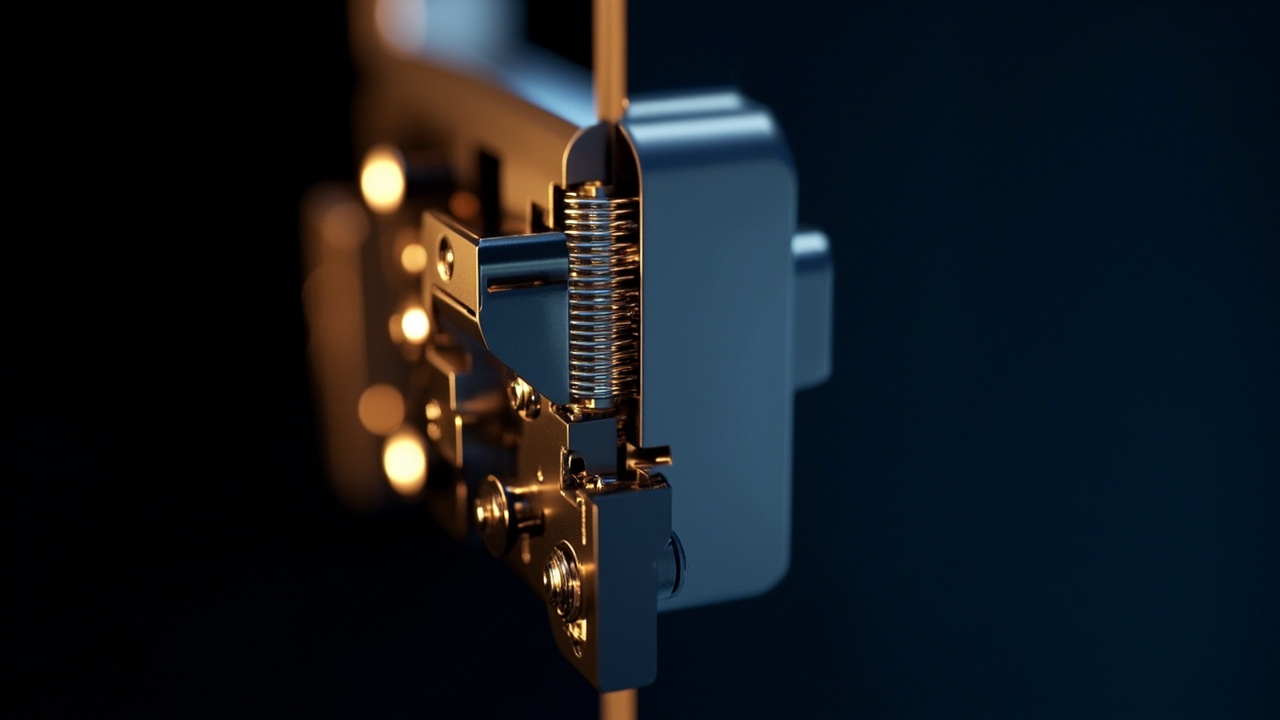
Latch and Bolt Geometry Trade-Offs: Cost, Durability and Service
Latch and bolt geometry tradeoffs is what this piece examines at component level. I remember the first job I was handed as a systems integrator that involved arguing about a lock for three weeks. The client was in a different country from the factory, and the factory was in a third. The dispute was not about radios, credentials or app platforms. It was about a piece of steel roughly the size of a thumb and a half: the latch and bolt assembly that sits inside the mortise case and decides whether the door closes on the first pull or needs a shoulder against it.
Direct answer. In short, latch and bolt geometry tradeoffs is the subject of this piece. latch and bolt geometry tradeoffs is where the work on latch and bolt geometry tradeoffs sits. latch-and-bolt-geometry is what has to be evidenced before anyone signs. A latch and bolt geometry tradeoffs is the engineering view of one component. latch and bolt geometry tradeoffs is the behaviour that has to be reproduced. Then latch and bolt geometry tradeoffs can be signed off.
Three weeks sounds dramatic for what is fundamentally a dimensional question. It was dramatic because nobody at either end owned the measurement. The integrator could see the door. The factory could see the drawing. The drawing was four years old and described a variant that had been superseded twice. What nobody had was a shared language for the geometry itself.
Where the week actually went The next step is to [request
The sequence was mundane and therefore reproducible. The baseline reading is Hotel Smart Lock System Integrator Guide.
- Day one: door schedule review. The doors were not one type. There were steel security doors, timber fire doors, and aluminium storefronts with narrow stiles.
- Day two: measurements on site with a steel rule and a depth gauge, photographing the door edge, the frame rebate and the strike box.
- Day three: request for dimension drawings from two suppliers, in two formats, with two different conventions for naming the same dimension.
- Day four: the drawings arrived. Each was internally complete and mutually incomprehensible.
- Day five to nine: the argument, conducted over email, about backset, backset-to-centre spacing, and whether the "70 mm" on the door schedule meant the same thing on both sides.
- Day ten: a physical sample of the mortise case arrived by courier, taped to a piece of door.
- Day eleven: the sample went into the frame. It did not latch. The latch bolt would not clear the strike plate hole.
- Day twelve onward: the fix, the cost, and the argument about who paid for it.
The three dimensions that decide the week
When I teach this to a junior integrator, I give them three numbers and ask them to explain what breaks if each is wrong.
| Dimension | What it governs | What fails when it is wrong | Who feels the cost |
|---|---|---|---|
| Latch bolt projection and faceplate height | Whether the door closes from a small push or needs a pull | Door hangs open, does not latch, or the bolt cannot be extended | Building owner, day-to-day |
| Backset and door-edge offset | Whether the case body can sit in the door leaf | Case will not fit the door; lipping and rebating required | Installer, factory |
| Deadbolt throw and follower geometry | Whether the lock secures and whether the door can be re-latched from outside | Door cannot be pulled shut from outside; bolt does not fully engage | End user, security reviewer |
| Strike plate and keeper mouth shape | Whether the bolt enters the frame cleanly | Bolt rubs, binds, or leaves the door unlatched | Maintenance |
| Spindle and follower hole spacing | Whether the handles or levers align | Handle turns without moving the latch; rose does not cover holes | Installer |
flowchart TD
  A[Door survey: leaf, edge, frame rebate, strike] --> B{Does mortise case fit the leaf?}
  B -->|No| C[Rabbet, lip or channel rework decides cost]
  B -->|Yes| D{Does latch bolt clear the strike plate?}
  D -->|No| E[Faceplate height or bolt projection is wrong]
  D -->|Yes| F{Does deadbolt fully extend and retract?}
  F -->|No| G[Throw length or follower geometry is wrong]
  F -->|Yes| H[Geometry accepted: price service and durability can be compared]
  C --> H
  E --> H
  G --> H
The naming problem is the first cost
Suppliers disagree, and they disagree in ways that look like trivialities until a container of hardware arrives and the doors do not close. The first lesson is to insist on dimension drawings rather than a marketing table. A dimension drawing can be wrong; a marketing table can only ever be vague. The catalogue glossary for this factory lists documentation: dimension drawings, installation guide, datasheet on request as a normal offer, which means the drawings exist as a category of document. Whether a given SKU ships with an accurate one is a per-product question to settle before the order, not after.
Second lesson: fix the reference points. A backset is measured from the edge of the door to the centre of the spindle or cylinder. A lock case length is a different number. A faceplate height is a different number again. When a supplier says "70 mm backset" and the door schedule says "70 mm backset", they may be measuring from the same datum or from opposite sides of the door, and nobody will find out until a technician is standing in a stairwell at the end of a working day.
Third lesson: ask for the drawing revision and the date. Not to police paperwork, but because a drawing that predates a hardware revision is worse than no drawing. You will argue from it confidently and lose.
For readers who want a fuller treatment of the terminology, the companion piece on door compatibility is worth reading alongside this one: Latch and Bolt Geometry and Door Compatibility: The Fit Envelope. I will not repeat its argument here; my subject is what the geometry costs and how it behaves.
Cost is not one number, it is four
Line one: unit cost of the hardware. This is the number a quote gives you, and it is the least interesting of the four, though it is the only one most quotes will lead with. When a supplier prices a mortise case with a stainless steel faceplate and a heavier deadbolt, the unit cost moves. The published-79-model catalogue does not carry price, MOQ or lead-time figures for any SKU, so any comparison here must be obtained through the quotation route rather than from a page.
Line two: conversion cost at installation. A case that does not fit the leaf forces a rebate, a lip, a channel or a different door entirely. That is a carpenter's time, a closure, a return visit, or all three. In the project I am describing, the geometry mismatch on one door type cost more in labour than the entire hardware price difference between the two candidate mortise cases.
Line three: rework and return logistics. This is the one that crosses borders. A pallet of hardware that does not fit a door is not merely a local problem; it is a return authorisation, a customs question, a re-manufacture or a disposal decision. We were saved by having one sample door made locally and shipped to the factory for trial fitting before the production run. A sample is cheap. A re-order across a border is not.
Line four: lifetime service cost. This is the largest line and the hardest to see. It is the labour of aligning a strike that has dropped, replacing a follower that has worn, or dealing with doors that will not latch reliably in cold weather.
| Cost line | Who carries it | When it appears | Visibility at quote stage |
|---|---|---|---|
| Hardware unit cost | Procurement | At order | High |
| Site conversion cost | Installer | At install | Medium — depends on survey quality |
| Rework and return logistics | Procurement and logistics | After delivery | Low — needs a trial fit |
| Lifetime service cost | Facility or maintenance | Months to years | Very low — needs a service model |
Cost-Build Teardown: what actually moves the number
The first driver is material of the faceplate and bolt. A stainless steel faceplate is a different cost from a plated steel one, and the difference is not only price: it changes corrosion behaviour and therefore the service conversation. The catalogue records panel/body material and lock body/mortise as fields, and for some models stainless steel appears as a body option across ranges, so the question is which specific SKU you are actually buying.
The second driver is the mechanism count. A single latch, a latch plus deadbolt, a latch plus deadbolt plus an auxiliary latch, and a three-point latch are four mechanisms with four different machining costs and four different failure surfaces. The SLK-9936S hotel lock, for example, is described in the first-party spec block with a three-point latch — confirm on the dated product page for the specific SKU if the three-point behaviour is a procurement driver, and confirm what is mechanically linked, since that governs the cost and the service path.
The third driver is machining precision. Tolerances on the bolt-to-follower relationship, on the case-to-faceplate screw positions, and on the case body outline are what make a lock feel solid and what make it expensive. Tolerance stack is where cheap locks are cheap.
The fourth driver is the finish and packaging scope. OEM and ODM work can cover logo, finish, packaging, manuals and configuration, and each of those is a separate line in a quote. Treat them as separate: a buyer who bundles them hides the cost of the one that matters.
quadrantChart
  title Geometry decision: cost weight versus service burden
  x-axis "Hardware cost weighted" --> "Service and fit weighted"
  y-axis "Low field intervention" --> "High field intervention"
  quadrant-1 "Tight tolerance, heavy steel"
  quadrant-2 "Serviceable, forgiving"
  quadrant-3 "Low cost, high risk"
  quadrant-4 "Dated but predictable"
  "Standard steel latch, loose tolerance": [0.25, 0.7]
  "Stainless faceplate, tighter bolt": [0.55, 0.35]
  "Spring-loaded self-aligning follower": [0.7, 0.2]
  "Heavy three-point, machined case": [0.6, 0.55]
Durability: what geometry does to the door, not just to the lock
A latch that enters the frame cleanly produces a small wear pattern at the strike plate. A latch that binds produces a bright, torn contact at the bolt shoulder and a strike plate that deforms. Over a few thousand closures that deformed strike plate changes the geometry: the bolt no longer drops cleanly, so the door needs a pull, so more people lean on it, so the frame rebate and hinge line take more load. You can watch a door's history in its strike plate.
This is why faceplate height, bolt projection and the mouth geometry of the strike plate form one system rather than three features. Change the bolt projection without changing the faceplate height, and you have moved the bolt's contact point in a way the frame was not designed to absorb.
For outdoor and aluminium-door applications in particular, the aluminium side frame is the soft member in the pair. A steel bolt entering an aluminium strike needs the strike to carry the load, and a case with a heavier follower and a better-supported bolt is doing more than adding weight.
Service: the geometry nobody specifies is the geometry you
Service cost on a smart lock has three parts: diagnosis, access, and parts. Geometry hits all three.
Diagnosis depends on whether the lock's failure is self-explanatory. If the latch will not drop because the bolt is binding against a deformed strike, that is a maintenance issue. If the latch will not drop because the case was installed with the wrong faceplate or the wrong backset, that is an installation defect that will present as a maintenance issue for the rest of the lock's life. The second kind costs far more to diagnose, because the technician arrives expecting a worn part and finds a wrong part.
Access is where smart locks differ from ordinary ones in a way integrators often underestimate. A credential-based lock on a battery can be opened by mechanical override — the catalogue records mechanical override key presence on 63 of the 79 models, with RFID/IC card across 72, passcode/keypad across 55, mobile app across 41 and fingerprint across 38. The relevant point for this diary is narrower: if the door will not latch, the override key is what keeps the building running, and its availability and duplication policy are service decisions, not credential decisions. If a key cylinder is not present on a given SKU, that is an absence to write as an absence, and it changes your service plan.
Parts is where geometry bites hardest. A deadbolt that binds because of a follower tolerance is a part replacement; a deadbolt that binds because the case was fitted to a door that was never within its fit envelope is a replacement that will bind again next week. The catalogue offers models across hotel, fingerprint, keypad, RFID, face recognition, glass, outdoor, video and cabinet categories, and a glass door patch fitting is a different answer again to a timber leaf. Geometry decides which service kit your technician is carrying.
The component teardown on maintenance implications takes the same subject further; if you want the arguments rather than my diary, read Maintenance Implications of Latch and Bolt Geometry Choices.
A survey worksheet that prevents the third week
| # | Measurement | How to take it | Record | Tolerance question to ask |
|---|---|---|---|---|
| 1 | Door leaf thickness | Steel rule, at three heights | mm | Does the case have a stated leaf range? |
| 2 | Door edge width (rebate depth) | Depth gauge, from face to rebate | mm | Does the case body enter the rebate? |
| 3 | Backset | Rule from edge to cylinder centre | mm | Which datum does the drawing use? |
| 4 | Faceplate height | Rule on the door edge | mm | Can the faceplate be trimmed, and to what? |
| 5 | Faceplate width | Rule | mm | Will a wider plate still clear the lipping? |
| 6 | Strike plate dimensions | Measure the installed strike | mm | Is a replacement strike supplied? |
| 7 | Frame rebate depth | Depth gauge | mm | Does the case need a surface-mounted fix? |
| 8 | Door swing and frame thickness | Observation | mm | Which side does the case land on? |
| 9 | Handle or lever set | Measure spindle centre | mm | Does the follower match the spindle? |
| 10 | Existing hardware to be replaced | Photograph and measure | mm | Is there a legacy case in the door? |
Rules I attach to the sheet:
- Measure every door type separately. A project with three door types has three geometry answers, and a catalogue that quotes one case for all of them has not answered the question.
- Photograph the door edge, not the face. A photograph of the face tells you nothing about the geometry.
- State the drawing revision and date against every measurement.
- Ask for the fit range of the case in writing, with the units and the datum.
The companion checklist on failure modes is the natural next document once the survey is back: Latch and Bolt Geometry Failure Modes Seen on Smart Lock Projects. And if the buyer's internal team wants to know what evidence to demand from a supplier before ordering, Latch and Bolt Geometry Test Evidence a Buyer Can Actually Request is the right procedural companion.
Cross-border diary: three shipments, three lessons
Shipment one: the mortise case sample. A single case, sent by courier with a scrap of door and a scrap of frame, each cut to the survey dimensions. Cost: a courier ticket and two offcuts. Value: it replaced an argument with a demonstration. When the sample was fitted, the latch bolt sat low against the strike plate hole and the door would not latch. A photograph of that, sent to the factory with the tape measure in frame, ended two weeks of email in a single afternoon.
Shipment two: the corrected faceplate. A revised faceplate, taller by several millimetres, with the strike hole re-placed to match. The lesson: a faceplate change is usually the cheapest way to correct a bolt-to-strike relationship, but only if the case body already fits the leaf. If the body does not fit, a faceplate change only moves the problem.
Shipment three: the strike plates. A batch of strikes shipped separately from the cases, because the strike lives with the frame, and the frame is installed by a different trade on a different programme. The lesson: strikes are the easiest line in the whole geometry package to leave out of the order, and the most expensive to add later when a door is already hung.
Reading a supplier's dimensional claims
Four questions, in order:
- What is the fit range, and against what datum? A leaf thickness range with no statement of whether the measurement is over the door or over the finished door is half an answer.
- Is the case body dimensioned to the rebate, the leaf, or both? A case that is dimensioned to the leaf will not work on a door with a shallow rebate without surface mounting.
- What does the drawing say about the bolt, and what does the physical sample do? Drawings and samples should agree. When they disagree, the sample is right and the drawing is a sales artefact.
- What is the revision history? A superseded drawing is worse than no drawing.
For how to interrogate those claims specifically in a datasheet, Reading Latch and Bolt Geometry Claims in a Supplier Datasheet covers the document-level reading. My diary adds the cross-border wrinkle: the answer to question three may be on the other side of an ocean.
A comparison table you can fill
| Criterion | Package A | Package B | Weight (1–5) |
|---|---|---|---|
| Unit hardware cost | |||
| Fit range covers all door types | |||
| Conversion labour avoided | |||
| Faceplate adjustability on site | |||
| Strike plates included in supply | |||
| Latch reliability from a standing start | |||
| Deadbolt throw and follower quality | |||
| Mechanical override availability | |||
| Spares kit cover for the installed base | |||
| Documentation supplied with the order | |||
| Estimated service calls in year one |
For the wider decision tree that connects geometry to reliability outcomes, see How Latch and Bolt Geometry Drives Smart Lock Reliability. For the component-level questions that get an engineer to answer properly, Specifying Latch and Bolt Geometry: Questions that Get Real Engineering Answers is the document to hand across.
Where cost, durability and service collide
Cost usually fails first at the drawing stage: a case that does not fit the leaf is a build-time problem, and it is expensive because it sits upstream of everything.
Durability fails at the closure stage: it is a wear problem, and it compounds quietly over thousands of cycles.
Service fails at the failure stage: it is a diagnosis problem, and it is expensive because the technician's time is billed at the point of least information.
A geometry that is correct but undocumented produces a service cost. A geometry that is documented but loose produces a durability cost. A geometry that is tight but expensive produces a cost objection at the quote, which is the one problem you can still solve in the room.
The same question is worked through in more detail in smart lock multi site management. That is the same question latch and bolt geometry tradeoffs has to answer here.
What I would put in the RFQ this week
- A dimensioned door schedule: leaf type, thickness, rebate depth, backset, faceplate aperture dimensions, handle set.
- A statement of the fit range each proposed case supports, with the datum stated.
- Dimension drawings per proposed SKU, with revision and date, and a commitment to supply the same drawing with the shipment.
- Confirmation of what is included in the supply: cases, faceplates, strike plates, strikes, followers, cylinders, escutcheons or panels, and the fixings.
- A statement of the mechanical override configuration, and whether a service-level override key exists.
- Spares availability: which parts can be supplied separately, and in what quantities.
- A sample opportunity: one case, one faceplate and one strike for trial fitting before the bulk run.
The qualification-stage question
- Can the proposed case be fitted to the thinnest door in the schedule, in the door with the shallowest rebate, without cutting the leaf?
- Does the faceplate offer a usable adjustment range, or is the bolt-to-strike relationship fixed by the casting?
- Is the strike plate supplied, and is it a replaceable part rather than a welded-in frame element?
- Can the case be serviced by replacing a follower without replacing the whole case?
- Does the mechanical override remain usable when the lock's normal credential path is unavailable?
- If the geometry is wrong at delivery, what is the return route, and does it cross a customs border?
The companion workbook that sits alongside this diary is Latch and Bolt Geometry in a Smart Lock: What a Buyer Should Understand. If you are building the internal brief rather than reading one, that is where the unfilled version of most of the tables above lives.
For the measurement side of this, see the smart lock centralized management. That is the same question latch and bolt geometry tradeoffs has to answer here.
Confirm before you order
Every number that drives a procurement decision in this diary came from a specific source, and you should go back to that source rather than to a paragraph in an article. Treat the 79-model catalogue as a map of what exists, not as a specification sheet.
CONFIRM-WITH-LOCAL-SUPPLIER: dimension drawings, revision dates, fit ranges and included strike plates for every SKU in the quotation.
CONFIRM-WITH-LOCAL-INSTALLER: the conversion labour allowance per door type, including any rebate, lip or surface-mount work implied by the proposed case.
CONFIRM-WITH-LOCAL-FACILITY-OWNER: the service response expectation and the spares stocking policy that the geometry choice has to live inside.
Where this leaves the trade-off
If you take one thing from this record, take the trial fit. Cut a piece of door, cut a piece of frame, send the case, and let the hardware settle the argument. It converts a multi-week exchange into a single courier ticket, and it is the only step in the whole chain that reliably tells you which of the four cost lines you are actually about to pay. The measurement is the part that travels; the geometry conversation is much easier once it has.
This diary records one cross-border qualification project. All project details are illustrative and no client, site or outcome is named. Model-level specifications must be confirmed on the dated product page for the specific SKU.
Put the answer on paper and request a quote against that document.