
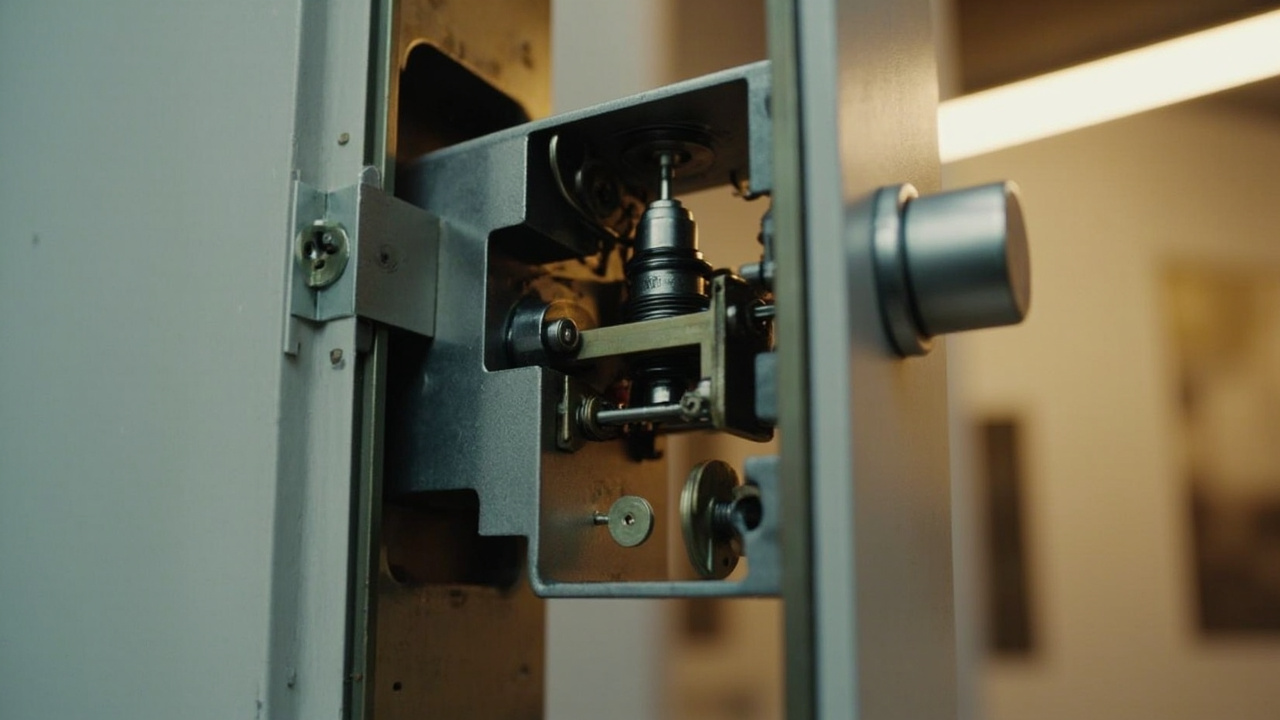
The Mechanical Key Override Failure Modes Seen on Smart Lock Projects
Emergency key override failure modes are easiest to close when the integrator treats the override as a door-specific operating condition, not a feature label. Qualification should establish how the key enters the cylinder, how the lock body transfers motion to the latch or deadbolt, what happens when batteries or external power are unavailable, and who controls the issued keys.
Direct answer. Short version — emergency key override failure modes is treated here as emergency key override failure modes first. emergency-key-override comes second. The evidence for emergency key override failure modes is named in the sections below. An emergency key override failure modes is a component behaviour guide. It covers limits. It covers failure modes. emergency key override failure modes decides whether emergency key override failure modes is acceptable for this build.
This article defines emergency key override failure modes through emergency key override failure modes. The definition of emergency key override failure modes is deliberately narrow. It is non-statutory, and it applies to the market and product being discussed.
- Establish the reach — confirm on the dated product page for the specific SKU behind emergency key override failure modes
- Establish the edge — record where the technology in emergency-key-override stops working
- Establish the reserve — name the mechanical path that remains if emergency key override failure modes fails
- In emergency key override failure modes, this sequence is what emergency key override is checked against.
The current catalogue records a mechanical override key across 63 of 79 published models. That is portfolio context only: confirm on the dated product page for the specific SKU before relying on the capability. For the SLK-9936S hotel lock, the supplied product record lists a 5-pin cylinder and mechanical emergency access; use that as a worked example, again subject to SKU-level confirmation.
For the wider decision context, read The Mechanical Key Override Trade-Offs: Cost, Durability and Service. This checklist concentrates on observable failure boundaries during qualification.
Qualification Exit Gate: Seven Release Checks
Use emergency key override failure modes as release gates rather than a single feature check. A sample can pass at the cylinder and still fail at the lock body, under door pressure, or in a required power state. A published treatment of the same step is Smart Lock Mechanical Key Override.
- The supplied key is matched to the supplied lock, cylinder, door leaf and lock body.
- The key enters and turns without force, abnormal travel or a jammed cylinder.
- The intended latch or deadbolt moves far enough for the defined operating state.
- The result is repeated with the door closed and normal closing pressure applied.
- The agreed power states, including loss of normal battery power, have been witnessed.
- The key-control process, test record and handover owner are complete.
- Every exception has an owner, required evidence and a written disposition.
flowchart TD
    A[Sample and door specification received] --> B{Override key enters cylinder}
    B -->|No| C[Reject sample or request corrected cylinder]
    B -->|Yes| D{Key turns and drives latch}
    D -->|No| E[Hold for lock body and fit review]
    D -->|Yes| F{Power states tested}
    F -->|No| G[Hold for power state review]
    F -->|Yes| H{Key custody record complete}
    H -->|No| I[Hold handover package]
    H -->|Yes| J[Release qualification]
A check remains open when the result depends on an unverified assumption. In particular, do not infer cylinder compatibility, door fit or power-state behavior from a catalogue image or generic feature statement.
Failure Mode A: The Cylinder Key Will Not Enter or Turn
Treat the cylinder as the first failure boundary. Confirm the cylinder key supplied for the exact lock, the key blank or profile controlled by the supplier, and the intended door assignment. Watch for an override key that needs force, rotation that binds before the defined stop, a key that can withdraw freely, or a cylinder that turns without moving the lock body.
Request three pieces of evidence: a witnessed key-to-cylinder demonstration, a drawing or written specification that identifies the cylinder and key arrangement, and a key register showing which issued key belongs to which door. If the supplier proposes changing the cylinder, ask whether the change affects the lock body, escutcheon, collar or rose, strike geometry and the approved key-control method.
The failure is unresolved when anyone says the keys are probably universal. Require a documented match between the supplied key and the supplied cylinder, then record the test result. Universal is not an acceptance criterion.
Failure Mode B: The Key Turns but the Latch Does Not Move
This is a motion-transfer failure. Trace the chain from cylinder to spindle, lock body or mortise, latch or deadbolt drive, and finally the strike plate or keeper. A bench test at the cylinder can hide a wrong backset, a misaligned door-frame rebate, an unsuitable door thickness, an incomplete spindle connection or a strike keeper positioned outside the latch path.
Check door fit with the actual door leaf, frame and closing sequence in view. Ask the installer to show the latch or deadbolt extension, and then to operate the override with the door closed under the normal door closer or hold-open arrangement. Record whether the bolt retracts, extends and seats. Do not accept a successful free-swing test as evidence of installed-door operation.
Use The Mechanical Key Override and Door Compatibility: The Fit Envelope to define the drawing and measurement evidence before the sample is approved. The door fit decision must be tied to the supplied lock body, not to a general door category.
Failure Mode C: The Result Changes with Power, Wear or Environment
Separate a genuinely mechanical path from a result that depends on electronics. Ask what the supplier defines as normal, low-battery, battery-removed and external-power conditions, and require the specified sequence for each.
Also separate an installation defect from a wear or environment issue. Request the defined inspection points for the cylinder, mechanical override key, spindle, latch, strike plate and keeper. For high-traffic, outdoor or corrosive conditions, ask for the dated product page to state the applicable operating-temperature or humidity limits and enclosure treatment. The Mechanical Key Override in High-Traffic and Harsh Environments shows how to frame those evidence questions without turning a general requirement into a product claim.
If the override is intended to remain available during a power interruption, the supplier must show that behavior on the specific SKU. A general emergency-access statement is not enough.
Failure Mode D: The Key Works but Key Control Fails
A working override can still create an operational failure if the issued keys cannot be traced, returned or separated by access zone. Request a key-control method that defines issue, receipt, return, loss and authorized emergency custody. The record should identify the lock, door, key identifier and person or role holding each item; a total count alone is inadequate.
For multi-door projects, ask for a door-to-key matrix and a packaging procedure that prevents keys for adjacent doors from being returned with the wrong set. Include access to duplicate or replacement keys in the handover decision. Emergency access must be dependable for the authorized user without turning the override into an unmanaged master-key process.
Pair this section with The Mechanical Key Override in a Smart Lock: What a Buyer Should Understand and Mechanical Key Override Maintenance Implications of the Mechanical Key Override Choices. The first frames the operating question; the second supports custody, inspection and replacement planning.
Decision Table: Separate a Product Fault from a Project Fault
Use the observation, not a supplier label, to choose the next move.
| Observation | Likely failure boundary | Evidence to demand | Qualification decision |
|---|---|---|---|
| Override key will not enter cleanly | Cylinder or key mismatch | Matched sample, cylinder drawing and witnessed insertion | Hold or reject the sample |
| Key turns but latch does not move | Motion-transfer or door-fit chain | Installed-door movement record and fit drawing | Correct fit or lock-body issue |
| Works open but binds when closed | Pressure, closer, latch or strike geometry | Closed-door test with normal closing arrangement | Hold site acceptance |
| Behavior changes with power state | Undefined electrical dependency | Supplier-defined state sequence for the SKU | Hold until evidenced |
| Correct door opens with wrong issued key | Key-control or assignment error | Key-to-door register and witnessed check | Hold handover |
| Supplier cannot tie evidence to the offered SKU | Version or evidence gap | Dated product page and supplied-sample record | Reject evidence pack |
Classify a repeated failure on a controlled representative setup as a candidate product fault. Classify an isolated installed-door failure as a fit or workmanship issue until evidence proves otherwise. If the outcome cannot be tied to a test setup, classify it as an evidence gap. To structure supplier submissions, compare The Mechanical Key Override Test Evidence a Buyer Can Actually Request with Reading the Mechanical Key Override Claims in a Supplier Datasheet.
RFQ Evidence Request: Make the Supplier Fill the Gaps
Include the following line items in the request for a quote, rather than accepting a one-line feature claim:
- Exact model, version, door type, cylinder arrangement and intended installation scope.
- Dated product page, dimension drawing and installation guide for the specific SKU.
- Agreed override test sequence, pass criteria, sample-door configuration and required power states.
- Key blank or profile statement, sample keys, key-control method and key-to-door register format.
- Inspection, cleaning, replacement and key-return instructions, with any frequency stated in the supplied documentation.
- Photographs or video from the witnessed test, labeled with sample and door identifiers.
- Statement of what the quote includes for sample approval, customization, documentation and production equivalence.
Ask for the test evidence to be reproducible by someone who did not assemble the lock. Do not request generic statements about mechanical key override durability; request the inspection criteria and recorded result for the proposed configuration. This makes the RFQ a qualification instrument, not a catalogue download.
The same question is worked through in more detail in when should you choose smart lock oem instead of odm. That is the same question emergency key override failure modes has to answer here.Use Specifying the Mechanical Key Override: Questions that Get Real Engineering Answers to sharpen each line. Submit the approved scope through the request-a-quote page and state the evidence package required for release.
Site Acceptance Script: Witness the Override End to End
Use this acceptance testing script so different integrators reach comparable decisions:
- Record the lock, door and key identifiers before starting.
- Inspect the cylinder opening, escutcheon, latch, deadbolt, strike plate, keeper and frame rebate for visible interference or damage.
- State the battery condition and any external-power condition defined for the test.
- Insert the override key without force and turn it through the supplier-defined movement.
- Observe the latch or deadbolt while the door is open, then repeat with the door closed.
- Apply the normal closing arrangement, including the installed door closer or hold-open device, without introducing a new test condition.
- Repeat only the supplier-defined sequence and record any binding, incomplete movement, key withdrawal issue or change in result.
- Return the key to its controlled location and complete the custody record.
| Acceptance field | Record | Reason to stop |
|---|---|---|
| Identity | Lock, door, key and test configuration identifiers | Evidence cannot be tied to the supplied unit |
| Start condition | Battery and external-power state | Result is not repeatable |
| Action | Key insertion, rotation and door position | Another tester cannot repeat the step |
| Observation | Latch or deadbolt movement, seating and interference | Physical behavior is ambiguous |
| Exception | Photo, note, owner and disposition | An open assumption remains |
| Custody | Issue and return location of the key | Emergency access is not controlled |
The purpose is not convenience; emergency access must remain deterministic under the accepted operating conditions. A quote approval is not site acceptance. Carry the witnessed record into the handover file and reject any sample whose identity or test conditions are missing.
For the measurement side of this, see when should you choose smart lock odm instead of oem. That is the same question emergency key override failure modes has to answer here.
Escalation: Choose the Correct Owner for the Open Item
Send an open item to the party that controls the remedy. Ask the lock supplier about cylinder matching, internal motion and the supplier-defined power-state behavior. Ask the door or hardware team about backset, rebate, strike, keeper, closer and installation workmanship. Ask the project team to close key-control records, custody and handover. Ask the factory to correct a datasheet claim when the submitted evidence contradicts the dated product page for the specific SKU.
For reliability review, use How the Mechanical Key Override Drives Smart Lock Reliability. For a broader ownership check, use The Mechanical Key Override in a Smart Lock: What a Buyer Should Understand. Do not average several partial passes into a full pass: a cylinder pass cannot cancel a failed motion-transfer test.
CONFIRM-WITH-LOCAL-AUTHORITY: Emergency-egress, fire-door, access-control and accessibility requirements vary by location and project. Confirm which local authority or code reviewer signs off, and request the written basis for the final configuration.
When all applicable checks are closed, send the sample record, accepted drawings, key-control method and unresolved-item register with the request-a-quote page. The factory can then quote the exact configuration and evidence package required for approval.