
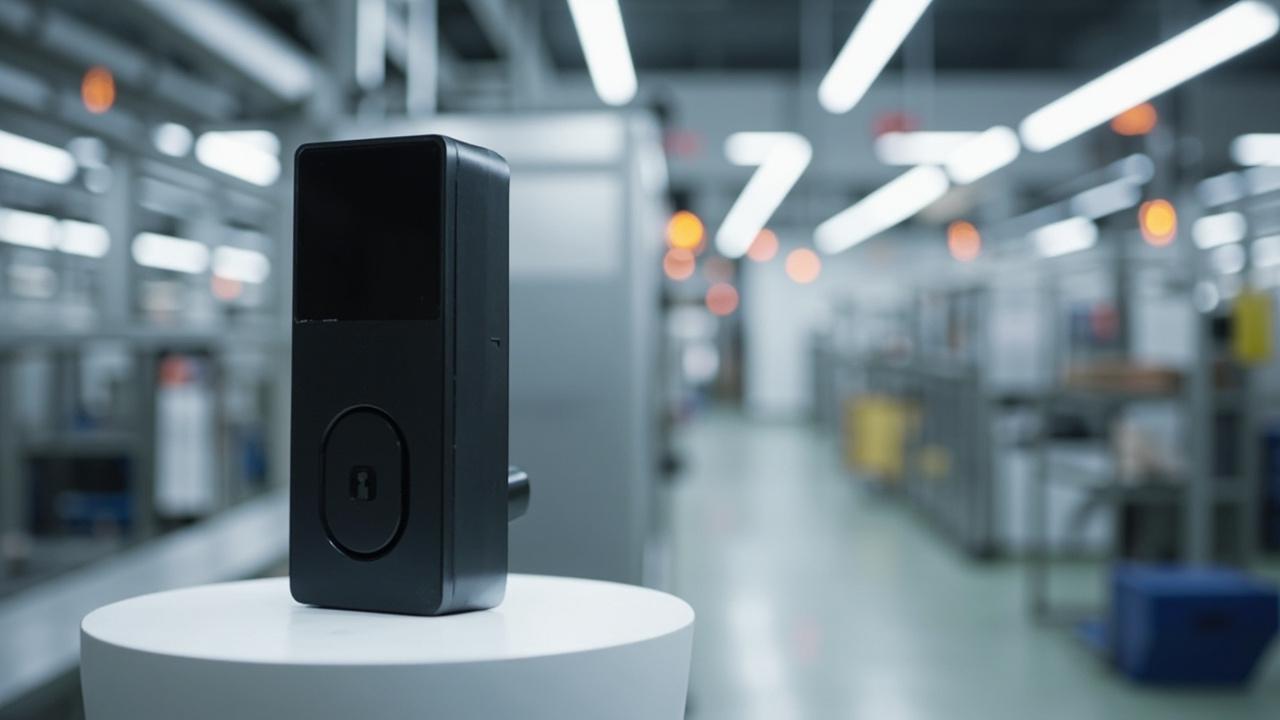
Smart Lock ODM China Guide
MEMO — Briefing for a brand owner, importer or private-label operator before the first serious conversation with a Chinese ODM partner. Read this once, then read it again with your own program in mind.
TO: Brand owner / product lead evaluating a Chinese smart-lock ODM partnershipFROM: SmartLockFactory commercial deskRE: Pre-engagement memo — what ODM actually means here, what to verify in writing in writing, what to refuse to discuss until it is on paperDATE: 2026-10-12STATUS: Pre-RFQ briefing — no commitments, no quotes, no specs inherited from this document
Executive summary
A Chinese ODM (Original Design Manufacturer) for smart locks is a factory that owns the mechanical reference design, the firmware platform, and the production line — and sells you the right to put your brand on top of that reference, with documented customization windows. That is the entire job description. It is not an OEM contract (you supply design, they manufacture), and it is not a private-label deal (no engineering, just sticker-and-box rebranding of an off-the-shelf SKU). ODM is the middle lane, and the middle lane is where most successful first-time smart-lock programs actually sit.
Direct answer: A smart lock ODM in China gives you a ready mechanical platform, a managed firmware lane (TTLock / Tuya / Doodle / hotel PC software — check the model’s published specification which lane the model you choose sits in), a documented customization ceiling, and a single throat to choke for warranty support. What it does not give you is free rein to invent a new product, free access to the firmware source code, or freedom from the reference design's engineering constraints.
The rest of this memo is the discipline you walk in with so the first conversation ends with a written framework instead of a verbal handshake. The factory publishes a 79-model catalog covering Smart Door Locks, Fingerprint, Hotel, Keypad, Outdoor, RFID, Face Recognition, Cabinet, Video Camera and Glass categories. ODM programs are anchored on specific SKUs in that catalog; you do not pick "ODM" in the abstract, you pick a model class to build on — and then you negotiate the customization scope inside that class's published envelope.
Five things this memo insists you put in writing before any commitment:
- Which reference SKU is the program built on, named by model code, not by category.
- Which firmware platform lane the model sits in (TTLock, Tuya, Doodle or hotel PC software) and whether the lane is revocable.
- What the customization ceiling looks like — finish, branding, packaging, language tree, firmware feature toggles — and what is locked above the ceiling.
- Who owns the IP of the customized artefacts (your brand artwork, your locale pack, your custom packaging) versus what stays factory-owned (the mechanical reference, the radio firmware, the cloud tenant).
- What happens at end-of-life — who revokes cloud credentials, who wipes local credentials, and what the installed-base transition path looks like.
If any of these five answers is verbal-only or "we'll figure it out in engineering," you do not yet have an ODM conversation — you have a sales call.
§1 — Why "ODM" is the lane most first-time smart-lock programs actually want
A first-time brand entering the smart-lock market has three realistic collaboration models on the table:
- OEM (you design, they build): You bring a complete industrial design, mechanical drawing and firmware specification. The factory is a contract manufacturer. This is the most expensive model and the slowest. Most first-time programs underestimate the engineering depth required — radio certifications, mechanical cycle testing, firmware security review, supply chain for fingerprint sensors, motors and battery holders all stack up.
- Private label (you rebrand, they ship): You take an existing factory SKU, put your logo on the box, and resell. Cheapest and fastest. The ceiling is low — you cannot change firmware, you cannot change finish beyond what the factory already offers, you cannot ship a region-specific language pack. You are a reseller, not a brand.
- ODM (their design, your customization, their production): The factory owns the reference design. You sit on top with documented customization rights inside a published envelope. You get brand differentiation without inventing the platform. You get production scale without standing up a line.
The reason first-time programs gravitate to ODM is straightforward: the engineering surface of a modern connected smart lock is large (radio firmware, app-platform binding, mechanical override cylinder, motor driver, audit trail, multilingual management software), and most brand owners do not have the in-house team to own it from scratch. ODM lets you pay the factory to own the engineering floor while you own the brand surface, the customer relationship, and the marketing story.
Decision rule:If you can describe your program in terms of "what we put on the lock and what we say about it" rather than "what the lock does mechanically," you are an ODM candidate. If you can describe it as "what the lock does mechanically," you are an OEM candidate — and the OEM brief is a different article.
That fork — plus the private-label rung below ODM — is the whole routing question of this memo, and it is worth seeing in one picture before the rest of the sections argue their way onto the page.
flowchart TD
    P["First-time smart-lock program on the table"] --> M{"Can you describe it as what the lock does mechanically?"}
    M -- "yes · you bring the design" --> OEM["OEM lane · factory builds to your spec"]
    M -- "no · it is a brand-surface story" --> C{"Any change beyond logo and box?"}
    C -- "no · sticker-and-box rebrand only" --> PL["Private label · resell an existing factory SKU"]
    C -- "yes · inside a published envelope" --> ODM["ODM lane · their reference design · your customization windows"]
    ODM --> FIVE["Five written answers before any commitment"]
    PL --> CEIL["Accept the ceiling · pay the private-label price"]
§2 — What a Chinese smart-lock ODM actually delivers
The catalogue of ODM deliverable surfaces is short and stable. Memorize it before the first call, because every "yes" in the conversation maps to one of these surfaces.
- Mechanical reference design — the lock body, mortise, latch, cylinder, handle, electronics bay. The factory owns this. You do not get to redesign it without paying an engineering-change fee.
- Firmware platform — one of TTLock, Tuya, Doodle, or the hotel PC software lane used by the hotel-lock SKUs. The factory has a managed branch on one of these platforms. You do not get the source code; you get a customization window inside the platform's SDK.
- App lane — tied to the firmware platform. If the model you base the program on uses TTLock, your end users download a branded version of the TTLock app (white-label) or use the standard TTLock app with your brand credentials. Same shape for Tuya and Doodle. For hotel-class SKUs, the app lane is the hotel PC software.
- Brand surface — front-panel logo, packaging artwork, manual artwork, language pack. Your artwork, your ownership.
- Customization ceiling — what the factory has already engineered as a variation of the reference. Common ceilings: finish options, keyway options, cylinder pin counts, packaging variants, language additions to the existing language pack. Anything above the ceiling is a new-engineering discussion.
- Production capacity — the line that builds the reference design builds yours too. Throughput, change-over cadence, and capacity reservation are quote-time conversations.
- Compliance posture — the certifications the reference design carries, the certificates that transfer to your brand, and the certificates you must obtain in your own name. Specific certificate numbers, test reports, certificate bodies, certificate expiry dates and approval jurisdictions are not carried in this memo — those resolve to the dated product page and the ODM desk.
Decision rule:If the supplier starts describing your program before these seven surfaces are all on the table, you are being sold rather than briefed. Stop the conversation and ask for the written ODM customization envelope for the named reference SKU.
§3 — The four signals that you are talking to a real ODM, not a re-labeller
A factory that cannot answer the four questions below is selling you private label at ODM prices. Ask these in the first thirty minutes of the conversation and write the answers down verbatim — with date and the name of the person who gave them.
- "Which firmware platform branch is this SKU on, and which version is the current production branch?" A real ODM has a version string. A re-labeller has a brochure.
- "Show me the customization envelope for this SKU — what is in scope and what is locked above the ceiling?" A real ODM has a one-page envelope. A re-labeller has a smile and a vague "yes, we can do that."
- "What is the IP allocation between your reference design and my brand artwork?" A real ODM has a clause. A re-labeller will not.
- "What is the end-of-life path for my installed base when you discontinue this reference SKU?" A real ODM has a decommission command and a transition SKU. A re-labeller shrugs.
If the supplier cannot answer two of the four in writing inside a week, you are not negotiating an ODM contract — you are buying a sticker. The pricing will look attractive because the engineering content is missing.
Decision rule:Three out of four written answers = real ODM conversation. Two or fewer = private label wearing an ODM jacket. Walk away or downscope the program to a private-label brief.
§4 — The customization envelope, decoded
The customization envelope is the one document that separates a serious ODM conversation from brochure talk. It is a short table — typically one page — listing what you may change on the reference SKU and what stays factory-locked. Below is the surface map; specific per-model numbers and per-model option codes all live on the dated product page, not in this memo.
| Surface | Customizable in ODM (typical) | Locked above ceiling (typical) |
|---|---|---|
| Front-panel logo and marking artwork | Yes — your artwork, your ownership | Logo depth, marking method, marking location |
| Finish / colour | Within the factory's published finish options for that SKU | New finish = new paint line, new coating run |
| Packaging artwork | Yes — outer carton, inner box, manual, insert card | Carton structural design, protective inserts |
| Language pack | Languages the firmware branch already supports | New language = new translation + new string freeze |
| Cylinder / keyway | Within the factory's published cylinder options | New cylinder = new tooling, new keying system |
| Cylinder pin count | Within published options | Higher pin count = new pin sets, new key profile |
| Handle / lever style | Within published handle options for the SKU class | New handle = new industrial design |
| Reader module identity | Confirm per model on the product page | New reader = new FCC/CE-RED cycle |
| Firmware feature toggles | Within the platform's SDK capability | Features outside the SDK = new branch |
| Cloud tenant model | ODM-operated or brand-operated per agreement | New cloud = new agreement |
| App skin | Within the platform's white-label window | New app store entry = new developer account |
| Accessories | Within the factory's accessory menu | New accessory = new SKU on the BOM |
| Compliance certificates | Transfer of existing certificates is per agreement | New jurisdiction = new test cycle |
The table is not a price list and it is not a capability list — it is a ceiling map. Anything above the ceiling is a paid engineering change order, not an ODM discussion.
Decision rule:If your brand story requires a customization that sits above the ceiling, the conversation stops being ODM and starts being OEM. Budget for it accordingly.
§5 — The five questions the ODM must answer in writing before you commit
These five questions close the ODM brief. None of them are answered by the brochure, the catalogue, the price list, or the sales call. All five must be answered in writing, on the supplier's letterhead or in a dated email, before you sign anything.
- Which reference SKU is the program built on? Named by model code. "A hotel lock in the SLK-99xx class" is not an answer.
- Which firmware platform branch and which version is the current production branch? A version string, not a category name.
- What is the customization envelope? The one-page table from §4, populated for the named SKU, not for the category.
- What is the IP allocation for the customized artefacts? Your brand artwork, your locale pack, your custom packaging — named as your IP in writing.
- What is the end-of-life path for the installed base? Decommission command, credential wipe path, transition SKU identifier, last-ship and last-support dates.
These five answers are the only deliverables you should accept from the pre-engagement phase. Everything else — pricing, MOQ, lead-time windows, warranty years, certificate numbers — resolves to /request-a-quote once the five are on paper.
Decision rule:Verbal answers, "we'll get back to you" answers, and "engineering will confirm" answers are not answers. Ask for the dated written reply. If the supplier cannot produce one inside two weeks, the supplier is not yet ODM-ready.
§6 — An illustrative scenario: a 200-room serviced-apartment ODM rollout
The scenario below is an illustrative composite, not a customer story. It exists to make the pre-engagement memo concrete. Substitute your own program.
A regional serviced-apartment operator plans a 200-room rollout across two adjacent properties. They want brand differentiation on the front panel and the app, a regional language pack (English + the local language), a centralized audit trail for the operations team, and a mechanical override path the on-site engineering team is comfortable with. They do not want to invent a new lock. The honest answer is ODM, built on a hotel-class reference SKU in the published hotel-lock range — a class that includes the SLK-9936S, SLK-9936G, SLK-9951TH and SLK-9962S family as first-party references for door-thickness envelope and credential architecture, with every per-model numeric spec confirmed on the product page for the named SKU.
Pre-engagement conversation (what the brand owner walks in with):
- Named reference SKU class, not a category.
- A short list of customization surfaces (front-panel artwork, packaging artwork, language additions, app skin).
- A short list of locked surfaces (mechanical envelope, cylinder profile, firmware platform, cloud tenant model).
- A written request for the customization envelope for the named SKU.
- A written request for the five answers from §5.
Mid-engagement conversation (after the envelope is on paper):
- A scoping conversation about which ceiling items move into paid engineering change orders and which stay locked.
- A scoping conversation about app-platform identity (which lane — TTLock / Tuya / Doodle / hotel PC software — the reference SKU sits on, and what the white-label window looks like).
- A scoping conversation about end-of-life and decommission path.
Post-engagement conversation (only after §5 is on paper):
- Pricing, MOQ, lead-time windows, warranty posture, certificate transfer — all routed to /request-a-quote.
- Sample request routed to /order-samples.
The scenario lands cleanly because the brand owner walked in with a brief, not a blank page. A blank-page brief in an ODM conversation is what produces brochure-priced, private-labelled programs.
Decision rule:If your pre-engagement brief looks like a brochure (logo, colour, packaging), the conversation will produce a private-label price. If it looks like a memo (named SKU, envelope, IP, EOL), the conversation will produce an ODM price.
§7 — The three traps first-time ODM buyers fall into
The traps are not new, but they are common. Each one is a verbal-only conversation that turns into a written obligation later, or a written conversation that is missing one of the five answers from §5.
Trap 1 — "ODM" used as a synonym for "OEM" by the supplier.The supplier's contract template treats customization as an open engineering request, with no reference to the published envelope. You end up paying for engineering changes that were never in the ODM scope.
Trap 2 — Customization above the ceiling accepted verbally.The factory agrees to a finish or a feature that is not in the published envelope. Six months later, the engineering change order arrives and the program economics collapse. The fix is to refuse any customization discussion until the envelope is on paper.
Trap 3 — End-of-life path left for "later."The factory discontinues the reference SKU. Your installed base has no decommission path, no transition SKU, no credential wipe. The fix is to insist on the EOL path in the pre-engagement memo, before commitment.
Decision rule:Every trap collapses if the five answers in §5 are on paper before commitment. No written answers = no commitment, from your side.
§8 — How to read the ODM programme alongside OEM and private label
ODM is one of three collaboration lanes. The other two are covered in sibling guides in this cluster:
- Private label — fastest, cheapest, lowest ceiling. You take an existing factory SKU and rebrand it. Right for: a first market test, a price-led play, a category-extension play where the lock is a small part of a larger portfolio. See the Smart Lock Private Label China Guide for the buying discipline.
- OEM — slowest, most expensive, highest ceiling. You bring the design. The factory manufactures. Right for: a brand owner with an in-house industrial design team, a programme that needs a unique form factor, a market where the existing catalogue looks like every other catalogue. See the Smart Lock OEM China Guide for the engineering brief.
- ODM — middle lane. You sit on top of a documented reference design with a documented customization window. Right for: most first-time programmes, most regional brand plays, most category-extension plays where the brand surface matters more than the lock surface.
The reading order across the cluster: start with the sourcing pillar for the macro view of the China market, then read this ODM brief, then read the OEM and private-label guides to know when to switch lanes. Each guide ends with the same five-answer discipline so the conversation does not lose shape when the lane changes.
Decision rule:The three lanes are not interchangeable. Picking the wrong one costs you either a ceiling you cannot break (private label) or an engineering bill you did not budget for (OEM). ODM is the default for first-time programmes; the other two are deliberate upgrades.
§9 — The pre-engagement checklist you actually carry into the room
A printable, single-page checklist for the first meeting. Tick every line before the meeting; an empty tick box is a reason to defer the meeting.
| # | Pre-meeting item | Owner | Status |
|---|---|---|---|
| 1 | Named reference SKU class (model code, not category) | Brand owner | ☐ |
| 2 | Firmware platform lane confirmed on the product page | Brand owner | ☐ |
| 3 | Customization ceiling understood for the named SKU | Brand owner | ☐ |
| 4 | Brand artwork scope drafted (logo, packaging, manual, app) | Brand owner | ☐ |
| 5 | Language pack scope drafted (which languages, where the strings live) | Brand owner | ☐ |
| 6 | App-platform lane understood (white-label vs standard app) | Brand owner | ☐ |
| 7 | Cylinder / keyway / pin-count decisions drafted (if mechanical override matters) | Brand owner | ☐ |
| 8 | Finish / colour decisions drafted within the published envelope | Brand owner | ☐ |
| 9 | EOL expectations drafted (decommission command, transition SKU, last-support horizon) | Brand owner | ☐ |
| 10 | Written request for the five §5 answers prepared | Brand owner | ☐ |
| 11 | Five-question ask sent in writing with date stamp | Brand owner | ☐ |
| 12 | Two-week reply window agreed and recorded | Both parties | ☐ |
A meeting held with empty boxes on lines 1–6 is a brochure meeting. A meeting held with all twelve ticked is an ODM meeting.
Decision rule:If you cannot tick the first six lines before the first meeting, you do not yet have an ODM brief — you have a sales-call list. Defer the meeting until the brief is built.
§10 — What happens after the memo: handing off to quote and to samples
The ODM pre-engagement memo ends where the ODM contract begins. Two hand-offs close the loop:
- Quote hand-off: Once the five §5 answers are on paper, pricing, MOQ, lead-time windows, warranty posture and certificate transfer are scoped in writing. None of those answers live in this memo; they all resolve to a single document — the supplier's quote reply, which lives at /request-a-quote.
- Sample hand-off: Once the quote reply is in your hand, a physical sample of the named reference SKU (with your artwork mocked up if the factory offers mock-up service) is the next decision artefact. The sample lives at /order-samples.
The two hand-offs are not interchangeable. The quote without the five answers is a price for an undefined programme. The sample without the quote is a piece of hardware with no commercial envelope. Both are useful; neither is enough on its own.
Decision rule:The pre-engagement memo is complete when the five §5 answers are on paper and the quote / sample hand-offs have been scheduled in writing. Anything before that is preparation; anything after that is execution.
§11 — A short pre-engagement reading list
The articles linked below cover the lanes that surround the ODM brief. Read them in the order given if you are new to the cluster.
- The cluster pillar: How to Source Smart Locks From China — the macro view of the China market, with the Smart Lock Supplier China Guide carrying the supplier-evaluation discipline that sits above the ODM lane.
- The OEM sibling guide: Smart Lock OEM China Guide — when you need to bring your own design and treat the factory as a contract manufacturer.
- The private-label sibling guide: Smart Lock Private Label China Guide — when the fastest path is to rebrand an existing factory SKU without engineering scope.
- The factory-anchor page: who you are talking to when you talk to the factory — published capabilities, the catalogue, and the supplier-side framing.
- The OEM/ODM process page: the engagement map between brand owner and factory — common to both ODM and OEM, distinct from private label.
The reading order is intentional: macro first, then the ODM brief (this article), then the sibling-lane briefs to know when to switch. None of the sibling guides replaces this one; each one is a different lane.
Decision rule:The reading list is short because the cluster is short. Five articles, three lanes, one memo form. If you have read all five, you have the cluster-level brief.
§12 — Where to go from here
The pre-engagement memo ends with two actions, not one. The first action is internal: build the brief. The second action is external: send the five-question ask to the supplier.
- Internal: Fill in the §9 checklist. Name the reference SKU class. Draft the brand artwork, language pack, app-skin and EOL expectations. Confirm the firmware platform lane on the product page. This is your homework; the supplier cannot do it for you.
- External: Send the five §5 questions in writing. Use a dated email. Request a written reply inside two weeks. If the reply is verbal, ask for it again in writing. If the reply is partial, ask for the missing answers in writing. If the reply does not arrive, the supplier is not yet ODM-ready.
When both actions are complete, the next document is the supplier's quote reply, which lives at /request-a-quote, with a physical sample request routed to /order-samples in parallel. The ODM conversation proper — engineering scope, customization ceiling, IP allocation, EOL path — happens with those documents in your hand.
Closing note. The discipline of an ODM conversation is the discipline of a memo: short punchy paragraphs, bullet stacks, decision rules in bold, three tables instead of ten, no FAQ section — because the questions are answered inline in the section where they matter. Walk into the first meeting with the §9 checklist ticked and the §5 ask drafted. Walk out with five written answers or with the meeting rescheduled. Anything between those two endpoints is a sales call, and a sales call is not an ODM programme.