
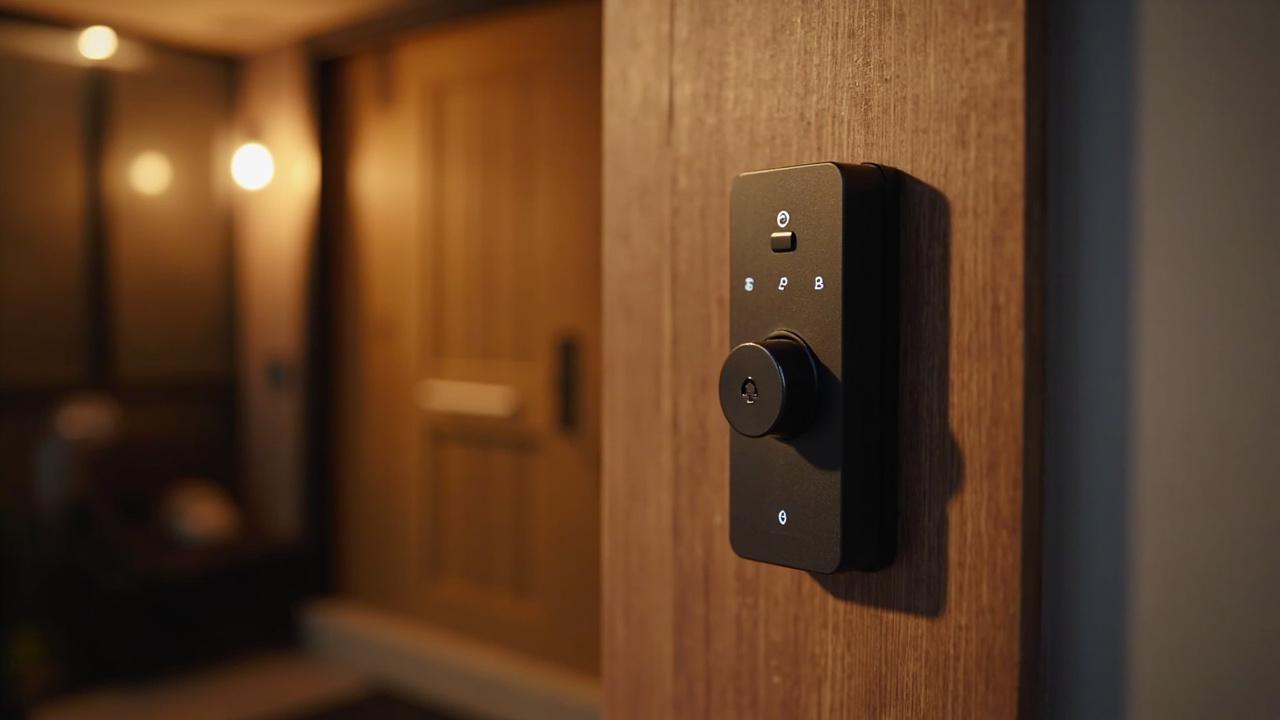
Smart Locks for Property Management Companies
TO: The managing principal, a property management company operating dozens of doors across a handful of buildings under multiple ownership clientsFROM: SmartLockFactory applications desk — we manufacture and supply these locks; that bias is stated up front, and the downsides in this memo are not hiddenDATE: October 2026RE: Consolidating your lock standard across client portfolios without overreaching your mandate
Executive summary
Your lock problem is not a hardware problem. It is a governance problem wearing a hardware costume. A property management company with dozens of doors across several buildings usually runs a quiet patchwork: whatever lock each previous manager, each owner, or each contractor happened to install, plus one or two brands your maintenance team learned to service. Consolidating that patchwork into a written lock standard is the single highest-leverage procurement move available to you — but you buy on behalf of other people's assets, which means the move has two halves. The easy half is technical. The hard half is proving, per owner, that you hold the specification authority to standardize at all.
In plain terms: smart locks for a property management company are door locks with electronic credentials — keypad codes, RFID cards, fingerprint, or app lanes on platforms such as TTLock, Tuya or Doodle — purchased as a standard program across multiple managed buildings rather than per door, with the management company acting as the spec-authority and buyer on each owner's behalf.
This memo covers three things and only three things: a mandate audit you must complete before any consolidation conversation, a decision matrix for what "one standard" should actually cover, and a vendor-consolidation risk register written for the fiduciary position rather than the technical one. The per-building hardware selection craft lives in the sibling apartment buyer guide and the operator playbook linked at the end; this document decides whether and how to standardize, not which lock goes on which individual door.
The situation as we understand it
You are not the typical buyer we write for, and this memo is shaped for the difference. The facts on your side of the table, as they usually present themselves:
- Dozens of doors under management — not thousands. A 74-door, five-building book of business is the scale this memo assumes, and every recommendation survives or dies at exactly that scale.
- Multiple owners, not one. Each building answers to a different client, possibly with a different management agreement vintage and a different tolerance for change.
- A inherited hardware mix. Keys from one era, a keypad brand your maintenance lead trusts, one building with cards from a previous manager's pet project.
- Staff as the real daily users. Turnover crews, maintenance, showings, supervisors. Residents often keep their own access arrangement.
- A churn risk you carry but residents never see: buildings join your portfolio and leave it. Your lock program must survive losing a client.
Read this memo as a fiduciary, not a shopper. A landlord buying locks for their own eight units can make mistakes on their own metal. You make decisions on someone else's asset, at a moment when they are not looking closely. That asymmetry is the entire subject.
What "one lock standard" actually means — and where it stops
Most managers I talk to collapse "standardization" into "buy one model." That is the wrong unit. A lock standard has three layers, and they consolidate on different timetables:
- Credential family. What kinds of access the portfolio issues: codes, cards, fingers, phone-app credentials, physical key. This layer carries your operating cost, because credentials are what staff juggle and what turnover eats.
- Hardware tier. Which two or three models satisfy that credential family across your door types. This layer carries your spares and training cost.
- Operations stack. Who enrolls, who deletes, who holds admin rights, what the fallback is when a credential or a battery fails at 2 a.m. This layer carries your liability story.
The decision rule I would stake my own portfolio on:
Standardize layers 1 and 3 across the whole company, hard. Standardize layer 2 per door class, not per company — and never claim more SKU uniformity than your door geometry allows.
Old stock and new stock diverge. Door thickness, edge width and bore history vary by decade of construction, and a lock that fits one building's risers will fight another's narrow-stile units. Our own catalog reflects that reality rather than pretending it away: 79 published models, with 37 fingerprint, 24 hotel-style, 18 keypad and 9 RFID models spanning different door situations. A standard that forces one model onto incompatible doors is not a standard; it is a backlog of exceptions that your maintenance team will silently route around within six months.
The mandate audit: no consolidation without documented authority
Before you shortlist anything, answer this per building, on paper: what does my management agreement actually permit me to change? Not what the relationship feels like. What the contract says. Three bands show up in practice, and the tactics differ completely between them:
- Full spec authority. The agreement delegates door hardware decisions to you up to a per-door or per-project approval ceiling. You consolidate directly; owners receive the standard as a notification with a rationale.
- Recommend-and-approve. You specify, the owner signs. Consolidation works, but you are really pitching the same memo five times with five different financial attachments.
- Custodial only. Hardware changes are owner decisions you facilitate. Do not standardize for these owners; offer them your standard as an opt-in template, and keep those buildings clearly marked as out-of-standard in your records.
Two flags on this, stated plainly because they cost money to discover late. First, this memo is not legal advice and does not read your contracts for you: have counsel confirm what counts as a capital improvement versus a maintenance substitution under each agreement before you place a fleet order. Second, and this one is purely operational: a lock program is only as revocable as your credential records. When a building leaves your portfolio, someone still holds admin rights on those doors, and residents still hold credentials. Decide in advance what transfers, what gets reset, and what you keep — because the polite version of that decision is far cheaper than the disputed one.
If you cannot produce, per building, a written statement of who authorized the lock program and who takes it over when the contract ends, you are not consolidating yet — you are improvising with owner money.
The consolidation decision, as a matrix
Four defensible end-states exist at your scale. Pick deliberately; drifting into one is how companies end up with four partial standards and no owner of any of them.
| End-state | What it fixes | What it costs | Owner-approval friction | Failure exposure | Pick it when |
|---|---|---|---|---|---|
| A. One SKU, every door | Spares, training, quote simplicity | Doors it does not fit; silent workarounds | Low (easy to explain) | High — one bad model decision multiplies portfolio-wide | Rarely. Only near-identical new-build stock |
| B. Credential family + 2–3 model tiers | The cost that actually matters (credentials, staff time) | Slightly bigger spares kit | Medium — needs a clean one-pager per owner | Medium — errors stay scoped to a tier | The default answer for a mixed-vintage, multi-owner book |
| C. Per-owner standards, shared operations | Everything owner-facing; keeps mandates clean | Keeps the patchwork you were trying to kill | Lowest — each owner chose | Low and diffuse | When mandate bands are mostly "recommend-and-approve" or "custodial" |
| D. Status quo, documented | Nothing, honestly | Compounding maintenance debt | None | Every door is its own incident report | Never as a destination; once, as a baseline snapshot |
The sequence I recommend: run Option D first as a documentation exercise — every door, current lock, who pays for its failures — then move to Option B for buildings where the mandate audit clears you, and Option C where it does not.
Translating the standard for owners who do not care about locks
Your owners will not read a spec sheet. They will read one question: why should I authorize a change to my building? The effective brief for each owner is half a page and four bullets, and the order matters more than the content:
- Service level, not hardware. "Same-day maintenance entry without chasing a keyholder" is a benefit. "Mifare 13.56 MHz readers" is noise.
- The risk you are retiring. Unaccounted key copies and departed contractors with access are the exposure; credential deletion is the antidote. Say which doors you can currently neither audit nor revoke.
- The money framing you are actually asking for. Whether the change is funded from the maintenance budget or a capital line depends on your agreement — present your own case, not ours; exact figures come from a quote, and owners should see that too.
- The exit clause. What happens to the locks and credentials if you stop managing the building. Owners relax measurably when this bullet exists before they ask.
Vendor consolidation: the risk register, not the cheerleading
Buying from one supplier rather than four is genuinely cheaper — in spares, in training, in the sanity of your capture sheet. It is also how single points of failure get purchased with good intentions. Because you hold other people's assets, the register below is written for exposure, not convenience.
| # | Risk | Failure mode at your scale | Early signal | Mitigation to have in writing before the fleet order |
|---|---|---|---|---|
| R1 | Single-supplier dependency | One discontinuation or quality lapse re-opens the whole standard | Quote replies slow; catalog page churn | Two approved model tiers per door class; never one |
| R2 | Platform/ecosystem lock-in | App-lane credentials stranded if a platform or supplier relationship ends | Admin functions only reachable via one vendor's app | Export/deletion paths tested on a sample door before fleet purchase |
| R3 | Mandate overreach | An owner disputes charges for a "standard" they never approved | Any owner asks "why is my building…" | Signed mandate per building; custodial buildings visibly out-of-scope |
| R4 | Program dies with the contract | Building leaves; admin rights, credentials and spares become a dispute | No exit section in the management agreement | Written transition rule: reset, handover, or retention — decided in advance |
| R5 | Mixed-generation fleet drift | Mid-standard model change splits spares and training | Two "equivalent" SKUs in recent orders | A change-control line item on the standard itself |
| R6 | Spec-sheet inflation | Supplier claims outlive their documentation; your fiduciary file inherits them | Answers that improve every time you ask | Capture sheet with documentation discipline (below) |
| R7 | Silent fallback gap | One door type with no working path at 2 a.m. becomes the emergency story | Maintenance tickets with unusual escalation | Fallback sentence per door class, drilled on a sample lock |
The rule underneath the register: consolidate your standard first, consolidate your vendors second, and never let a discount decide the order.
What a finished specification looks like — and what to refuse to accept
Most of the pain in R6 comes from accepting promises that were never written as specifications. Here is one genuine, completed spec block from our own hotel-line product (SLK-9936S), reproduced once, because this is the granularity you should demand for every line you rely on:
- Door thickness: 36–100 mm
- RFID: Mifare 1 at 13.56 MHz; read distance 0–5 cm; read time under 0.25 s
- Power: 4 × AA; battery operating cycles over 15,000
- Audit/event records: up to 1,000
- 5-pin cylinder, 3-point latch; stainless steel and alloy body; multiple finishes
- Mechanical emergency access; multilingual management software; standalone or centralized database modes; positioned for 1–5 star hotels
Read the firewall clearly: this is a hotel lock's data and nothing in it transfers to any apartment, keypad or fingerprint model you are considering. Its only job in this memo is to show the difference between a specification and a slogan. For the models you actually standardize on, every one of these lines is a blank you fill from the product page — user capacity per credential lane, admin-role behavior, event-record capability, door thickness and edge fit range, battery format and low-power behavior, fallback lanes, and what replacement or re-enrollment does to existing credentials. If a supplier answer cannot be pointed at a product page or a written document, it is not a spec; it is a rumor with your liability attached.
When an owner asks "what will this cost": the fiduciary's answer
You will be asked, and the asking is where unprepared programs lose owner trust. Because our commerce is quote-based — figures depend on the portfolio, not a published table — your job is to control the factors and promise the numbers only from an actual quote. The factor list you can defend to any owner, in the order owners care about:
- Door count by class, not total doors. Fifty compatible surface-mount doors and twenty awkward steel stiles are two different programs hiding inside one number. Bring the door survey, not the unit register.
- Credential lanes requested per tier. A code-and-key tier and a code-card-fingerprint-app tier are different products at different price points; the lane decision is yours from the credential family layer, and it should be stated before any figure is discussed.
- Card, credential and consumable volume. Ongoing cards, batteries and spares are a re-order stream, not a rounding error; owners who forget this line later read it as a surprise.
- Tier count, honestly. Three tiers cost more to hold than one and less than eight. Show the R5 drift risk you accepted alongside the saving.
- Sample and drill spend first. Frame the order samples stage as the cheap insurance policy that shrinks every later number above.
Then say the sentence that separates fiduciaries from salespeople: "the exact figures will come from a written quote against this door data, and you will see that quote before I sign anything." That single commitment neutralizes most of the mandate friction in the approval band, because the approver sees a paper trail instead of a invoice surprise.
Consider a 74-door portfolio: one worked consolidation
Illustrative scenario — a composite, not a customer story. Five buildings: two new-ish walk-ups with identical doors, one 1970s block with narrow steel stiles, one converted warehouse with thick timber entries, and one serviced-exposure building your firm runs like semi-hotel stock. Three owners: one hands-off with full spec delegation, one who approves everything, one who treats all hardware as his personal domain.
A defensible outcome for this book, applying the layers above:
- Mandate audit first. Building five (custodial owner) drops out of the consolidation entirely; it keeps its own arrangement, documented as out-of-standard. Trying to convert it is where companies burn two years and one relationship.
- Credential family set company-wide: codes plus app lane for residents, cards or fingerprints for staff, physical key as the insured fallback on every door class. One fallback sentence per class, written down.
- Hardware tiers, not one SKU: a surface-mounted class for the two identical walk-ups; a narrow-edge class for the 1970s steel stiles; a heavy-door-compatible tier for the warehouse block. That is three tiers against four door realities, accepted as a living document with its own change-control rule (R5).
- Sample doors before fleet money: one unit of each tier installed on the ugliest door in its class, battery-down and 2 a.m. fallback drills run by actual staff, deletion tested after the simulated mover leaves.
- Owner briefs: the hands-off owner receives a notification; the approver receives the half-page four-bullet brief; nothing at all goes to owner three.
- Exit rule negotiated into the two renewals that were due anyway: who holds admin rights if the management contract ends.
The honest downside of this shape: three tiers is twice the spares kit of a one-SKU dream, and the portfolio still contains one building you cannot standardize. That is not a flaw in the plan. That is what a 74-door, three-owner fiduciary reality looks like from inside, and pretending otherwise is how the failed single-standard rollouts we have watched started.
Decision asks
This memo exists to produce signatures, not agreement. Five asks, with owners and defaults:
| # | Ask | Decision maker | Evidence needed | If deferred, the default is… |
|---|---|---|---|---|
| 1 | Complete the per-building mandate audit, counsel-reviewed | Managing principal | Management agreements | No consolidation proceeds; improvisation continues |
| 2 | Adopt credential family + operations stack company-wide | Principal + ops lead | This memo, door inventory | Status quo, undocumented |
| 3 | Approve three-tier hardware structure and change-control rule | Principal | Door-survey data per building | Silent one-SKU drift with workarounds |
| 4 | Fund sample doors and the fallback drills | Principal (small budget line) | Sample route on the site | Fleet purchase untested on your worst doors |
| 5 | Write the contract-exit transition rule for locks and credentials | Principal + counsel | Renewal calendar | R4 becomes someone else's problem, later |
What this memo deliberately hands off
Three sibling documents pick up where fiduciary scope ends. For per-building hardware selection and door-by-door buying questions, the apartment buildings buyer guide (Smart Locks for Apartment Buildings: Buyer Guide) owns the unit-level craft. For running a fleet you have already committed to — rosters, turnover cadence, maintenance discipline — the operator playbook (Smart Locks for Apartment Operators) is the operations manual this memo assumes you will write next. For system-level architecture, platform choice and how centralized control compares with standalone locks across a portfolio, see Smart Lock Systems for Property Managers, and for the credential-family segmentation this memo generalizes, the fingerprint-specific portfolio view at Fingerprint Smart Locks for Property Managers. Category pages — starting with Electronic Keypad Entry Door Lock for the most consolidation-friendly family — show what a completed product page looks like against the granularity standard above.
The route out of paper and into metal is the same for a 74-door book as for a 700-door one: order samples through order samples to run the tier-versus-worst-door tests described here, then put your confirmed door data in front of us at request a quote — where the transaction terms an owner will actually ask about, including quantities and timing, are answered per portfolio rather than published per product. A standard you can defend to every owner, line by line, is worth more than a catalog you have to apologize for. That is the whole fiduciary case, and it is the one decision in this memo that no supplier can make for you.