
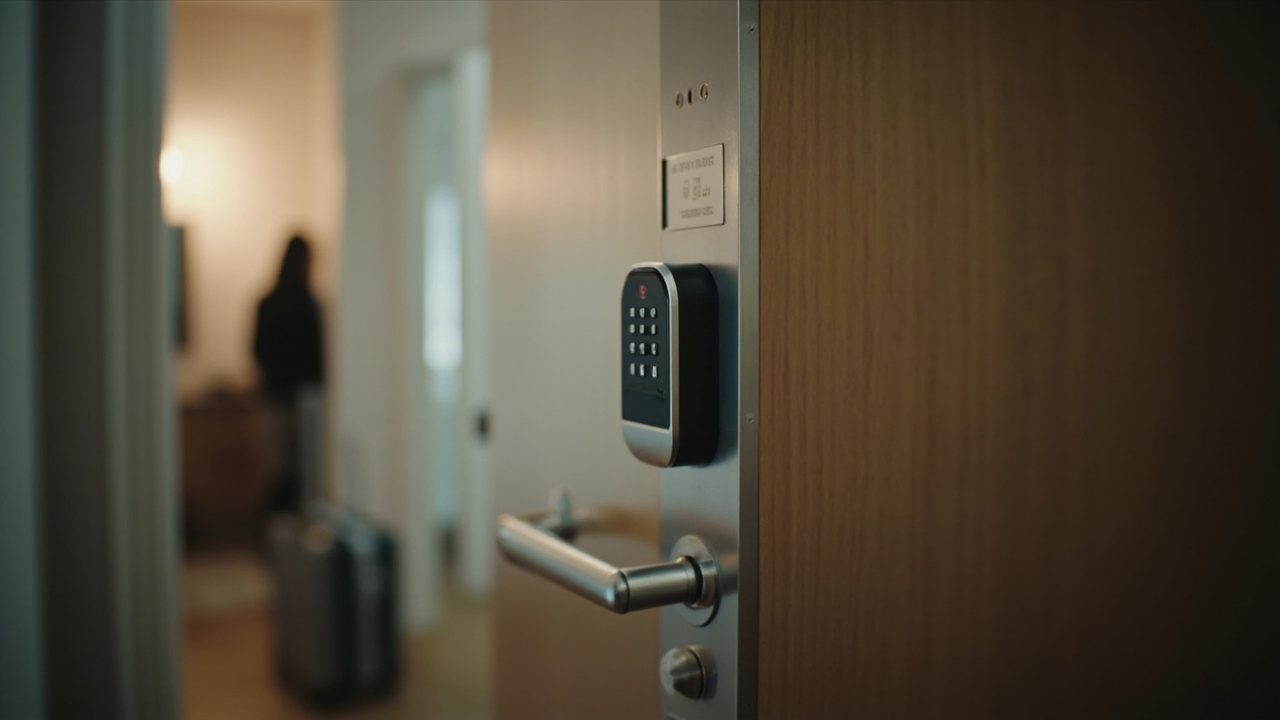
Smart Locks for Hostels and Budget Lodging: Door Survey and Fit Reality
A hostel is not a small hotel with cheaper rooms. It is a different building with different arithmetic, and the arithmetic reaches the door. One leaf may serve a shared room of four to twelve beds; another serves a single guest who stays three nights; a third is the door behind the reception counter; a fourth is the luggage store, where a suitcase and a trolley have a route of their own. The price of a lock in a hostel is multiplied by the number of beds behind it, so a decision taken at one door is a decision taken hundreds of times. A hostels door survey is therefore not paperwork about hardware. It is the document that stops one bad assumption being repeated across every dorm in the building.
- Split the door types — sort the door population into classes that behave alike, starting from hostels door survey
- Match each type to a class — state what sorting building needs before anything is quoted
- Evidence the fit — record the measurement that closes hostels door survey
- For hostels door survey, hostels is what each step has to answer to.
Each leaf has to produce three answers.Can a lock physically live on this door, given its thickness, its rebate, the ironmongery already fitted to it and the way it swings?Who may pass through it, and how is that permission withdrawn when the bed, the booking or the staff member ends?And what happens at this door when the cells run down — who is expected to change them, and can the person who hears the alert actually reach them?
The failure mode that follows is worth stating plainly, because it scales with beds: a battery change modelled as a technician visit when the guest could have done it. Each such visit is a call-out, a travel time and an entry into a room somebody is sleeping in. Multiply by the number of dorms and by the number of times a set of cells reaches the end in a year, and the number stops being a maintenance line and becomes the size of the programme.
Direct answer. A hostels door survey is a per-door decision record that ends as a door schedule, not a measurement sheet. It runs in seven stages: frame the access model on paper, classify the door population and count the beds behind each door, capture the per-leaf fit fields, record the handle, latch and deadbolt arrangement, run the battery-change reachability test at every leaf, work the reception and luggage-store routes, and verify the escape-route and interface posture. Each stage has a gate, and a leaf that fails the fit test is recorded as a failure with an alternative route rather than a lock that will not fit.
This document is written for the property manager who has to return a survey to a supplier and defend it afterwards. It works for a thirty-bed budget hotel, a hostel group running several properties from one office, and a guesthouse whose owner does the walk round alone on a Tuesday morning. Where a property already runs card locks in part of the building, the published Hotel Smart Lock Site Survey sets out the general method and Smart Lock Retrofit Site Survey covers the retrofit framing; the field references start at the Smart Lock Door Measurement Guide.
Sorting the building into four door classes
The hostel door population is small enough to write on one sheet and mixed enough to punish a single specification. Four classes recur: shared-room doors, private-room doors, the reception counter with the door behind it, and the luggage store with its service route. Everything else in the building — a corridor door, a stairwell door, a terrace door — is a variant of one of these four, and the survey records it against the class it belongs to rather than inventing a fifth.
Table 1 — the hostels door survey door-class record.
| Door class | Who uses it | Rhythm | Fit driver that decides it | Access route that fits | What failure looks like |
|---|---|---|---|---|---|
| Shared room door | Guests sharing the room, staff on rounds | Opened all day by every occupant and by staff | Leaf thickness, existing chain or occupancy indicator, latch and deadbolt pattern | Code or card with per-bed withdrawal, plus a staff master | The door propped because the code was passed on; a bed revoked by a walk to the door |
| Private room door | One guest per stay | A few openings a day, then a change of guest weekly | Leaf thickness, rebate, hinge side, strike keeper | Code issued at check-in and cancelled at check-out | The previous guest's code still working; a guest locked out with a bag |
| Reception counter and the door behind it | Staff, guests, couriers, cleaners | Continuous through the check-in and check-out peaks | Counter screen or gate build-up, street door pull or push plate, back door leaf and closer | Staff credential; a visitor credential issued and collected at the counter | A visitor left inside; the back door propped during a delivery |
| Luggage store and service route | Guests storing bags, staff moving them, anyone with a trolley | Bursts: check-out morning, check-in afternoon | Leaf thickness, lever and spindle wear, strike keeper, semi-outdoor exposure | Staff-held credential, with a short-life guest credential for bag drop | A trolley strike bending the spindle; a store found unlocked at night |
Only the private room door behaves the way a hotel room door behaves. The other three carry the hostel-specific risk: a door opened by people who are not the people who pay for it, a door where a credential is issued and cancelled inside the same hour, and a door that takes a trolley. The fit-driver column matters for a different reason from the access-route column. Fit is settled with a tape measure; access is settled in a conversation about the operating model. A survey that confuses the two produces a door list with a reader on it and no answer about who is allowed through.
Recording the access model before anyone measures a door
In a hostel the shared-key problem arrives before the lock problem. One shared-room door serves four to twelve beds, so the credential has to be revocable for a single bed without anyone walking to that door, and a staff master has to survive a season of staff turnover without being re-issued from a factory.
The survey does not design the credential model; that is separate work, set out in Smart Locks for Hostels and Budget Lodging: Credential Model that Survives Constant Credential Turnover. What the survey must do is record the access model against each door class, because the fit consequences differ sharply between routes. A code-only route needs a keypad with a surface a wet or cold hand can use and a body that suits the leaf. A card route needs a reader on the leaf or frame and a way for cards to reach the desk at two in the morning. A per-bed withdrawal without a visit to the door means the credential store must be reachable by somebody on duty.
| Door class | Credential route that fits | Who holds it | How it is withdrawn | The field that must not be left blank |
|---|---|---|---|---|
| Shared room door | Per-bed code or card, with a staff master that opens the same leaf | The guest for their bed; duty staff hold the master | At check-out, from the desk, without a walk to the door | Who cancels a single bed when a guest leaves early |
| Private room door | One guest code or card with a validity window | The guest | At check-out, and again at the next check-in | Who cancels a booking that was never taken up |
| Reception counter and back door | Staff credential; visitor credential issued at the counter | Staff; visitors hold it for the length of a visit | When the visitor leaves the building | Whether a visitor credential can be issued and collected by one person |
| Luggage store | Staff credential, with a short-life guest credential for bag drop | Staff; the guest holds it briefly | On leaving the store | Whether the guest credential opens anything else |
The last column is the survey's real output here. A door class whose withdrawal route is blank is a door class that will be handled in person by somebody walking to the door, and that person is the call-out the programme was meant to avoid. The master-key decisions behind these doors are covered in Smart Lock Key Control and Master Key Decisions for Hostels and Budget Lodging; the survey only has to record which leaf each credential opens.
Counting beds behind the shared-room doors
Nothing in the building tells you how many beds sit behind a door unless somebody counts them. The floor plan shows a room; the booking system shows bed numbers against a date range. Neither shows that a shared-room door serves six beds on one floor and ten on another, or that a corridor door serves a room that empties and refills three times a week.
So the first stage has an output that is not a measurement at all: a bed count per door. The count turns a door list into a programme. A survey presented as a number of leaves invites a quotation priced by the leaf; a survey presented as leaves, beds behind them and shared-room doors with per-bed credential churn invites a conversation about labour, and the labour is usually the larger part of the whole.
| What the bed count changes | What the bed count does not change |
|---|---|
| The number of credentials issued, cancelled and audited each week | The number of leaves to survey, measure and hand over |
| How many cell changes a year the building carries in total | Whether a particular door needs a reader at all |
| How urgently a shared-room credential has to be revocable | The physical fit decision on any single leaf |
The count is cheap to obtain and expensive to omit. It is the one number a supplier cannot derive from a drawing, and it decides whether the programme is a hardware purchase or an operating commitment. The institutional comparison is in Smart Locks for College Dormitories; the budget-lodging case differs in who holds the credential and who pays for the labour.
The nine fields every leaf has to carry
The per-leaf sheet is deliberately narrow. Nine fields are enough to decide fit, and everything else changes less often and belongs in a separate schedule. The fields that a general survey skips and a hostel cannot afford to skip are the existing ironmongery on the leaf, the handle and spindle, and the position of the cell compartment.
mindmap
  root((Per leaf record))
    Leaf
      Thickness at three heights
      Material and construction
      Existing ironmongery
      Swing and handing
    Frame
      Rebate depth
      Jamb condition
      Strike keeper condition
    Lock
      Mortise case pattern
      Backset
      Cylinder profile
      Spindle and handle
    Power and reader
      Cell compartment position
      Tool needed to open it
      Panel zone on leaf or frame
      Cable route
| Field | What you record | Why it decides something | What invalidates the record |
|---|---|---|---|
| Leaf thickness | Millimetres, taken at three heights and at the lock position | Sets the lock family, the body length and the spindle length | A single reading taken on the hinge side |
| Leaf material and construction | Timber, hollow-core, steel, composite | Decides the fixings, the load the spindle takes and the escutcheon finish | Assumed from the room type |
| Existing ironmongery | Lever or knob, surface bolt or chain, occupancy indicator, peephole, closer | A shared-room door often carries a bolt and an indicator that a new panel must live beside | Ignored because the door was treated as a plain door |
| Swing, handing and hinge side | Direction of swing and which side the lock sits on | Decides strike position, handle side and reader placement | Read off the floor plan |
| Rebate depth and frame condition | Distance from the leaf edge to the rebate stop, and whether the frame is sound | Decides whether a mortise case sits without routing | Assumed standard across the building |
| Mortise case pattern | Existing case profile, latch only or latch and deadbolt, cylinder position | Decides whether the existing case is reusable, replaceable or a source of failure | Not opened and looked at |
| Backset and strike keeper | Distance from the leaf edge to the cylinder centre; keeper type and frame fixings | Decides whether the case fits and whether the leaf resists a kick | Measured to the wrong edge, or the keeper judged from an open leaf |
| Handle and spindle | Lever shape, spindle length and section, whether the handle returns | Decides the load the door takes from a trolley or a shoulder | Eyeballed rather than measured |
| Panel zone and cell compartment | Clear space on the leaf, frame or stile; compartment position and access | Decides whether a reader is reachable and whether cells can be changed at all | Deferred until a model is proposed |
The field-by-field references behind that table are the Smart Lock Door Thickness Measurement, Smart Lock Backset Measurement, Smart Lock Strike Plate Measurement, Smart Lock Door Gap Measurement and Smart Lock Handle Measurement pages, and the Smart Lock Replacement Measurement Checklist is the compact sheet to hand to an installer working from somebody else's survey. The pattern and profile side sits in the Smart Lock Mortise Compatibility Guide.
A survey that captures these nine fields per leaf can be priced. A survey that captures "forty doors, mostly timber" cannot, and the difference between the two shows up as a site variation in the week the hardware arrives.
Why the handle and the latch decide more than the credential
The misuse pattern in a hostel is the door leaf, not the number. A lever handle and a shared code invite two behaviours: the door gets propped with a wedge or a suitcase, and the code gets passed on to somebody who was never issued it. A better number fixes neither. The conversation is therefore about the handle, the latch and the deadbolt, and the survey records what is already there rather than assuming an empty leaf.
| Survey finding on the ironmongery | What it changes in the schedule |
|---|---|
| Lever handle with a projecting return | Handle projection into the corridor, and the door most likely to find a trolley |
| Lever handle with no return, or a knob on the leaf | Nothing by itself, but it fixes the panel geometry on the door |
| Surface bolt or chain already fitted | A second locking element the guest operates before the door will open |
| Occupancy indicator or peephole already fitted | Panel geometry on the leaf |
| Latch-only mortise with a light keeper | The leaf is held by the latch alone under impact |
| Deadbolt present but unused by staff | A locking element nobody maintains |
The survey does not specify an anti-propping device, because that decision has an escape-route consequence and belongs to the property and the authority that governs it. What the survey does is record that the door can be propped, whether the property has a rule about it, and who enforces it. A propped door and a propped door with nobody owning the answer are two different doors, and only the second justifies spending money on a device.
The battery-change reachability test, door by door
This is where the survey answers the vertical's own first question — what is the cost of the battery change and who does it — in a form that can be answered on a walk round. It guards against a specific failure: a battery change modelled as a technician visit when the guest can do it. Five questions are asked at every leaf, and the answers go on the schedule.
- Can the cell compartment be opened with the leaf closed, or only with the door open from inside?
- Does it need a tool, and does the tool belong to the building or to the guest?
- Does the low-battery warning reach whoever can act, or only the person standing at the keypad?
- What is the fallback when the cells are dead — an emergency power port, a mechanical override key, or a cylinder?
- On a shared-room door, can the guest who hears the alert reach the cells without asking staff to open a room they do not occupy?
| Door class | Who changes the cells | The reachability that has to exist | What happens if the survey leaves it blank |
|---|---|---|---|
| Shared room door | The guest, if the compartment allows it; otherwise duty staff | Compartment reachable without unlocking the dorm, tool-free | A call-out per dorm per cell cycle, at the door a guest is trying to get out of |
| Private room door | Duty staff on a round, or the guest if the door is open | Compartment reachable with the door open, tool-free, and reachable from the corridor | A technician visit with a guest inside and a refused entry |
| Reception counter and back door | Reception staff | Compartment reachable from the staff side of the counter | A counter that stops working in the middle of a check-in queue |
| Luggage store | Whoever is on shift | Compartment reachable from the corridor side, and a stated fallback for when the store is locked | A store that cannot be opened because the way in is the door with the dead cells |
The third question is where most specifications are silent, and it decides whether the warning is aimed at the right person. A low-battery indicator that appears only on a keypad in front of the guest is a warning for somebody who is still in the building; a guest who has left never sees it, and the door fails empty. The catalogue records a low-battery alert as standard on some models and leaves the power group of others without one, so the alert behaviour is a per-model question. Confirm on the dated product page for the specific SKU.
The published SLK-9936S Battery and Power Guide and RFID Hotel Lock Battery Life cover the power side of a card lock in detail, and the programme-wide version of the same question is in Battery and Power Programme for Smart Locks in Hostels and Budget Lodging.
The survey's output here is a labour answer written into the schedule as a column: cells changed by the guest, by duty staff, by a technician, and the fallback route for each. Four values per leaf — enough for the programme to be judged on labour rather than on a unit price.
The reception counter, where a credential is issued
The reception counter is the busiest door in the building and the least like a guest room. Three things happen there: a credential is issued, a credential is cancelled, and a record is made of who is inside the building. The survey's work at the counter is fit and process; the record question belongs to the property's adviser and is flagged, not answered.
The counter itself may not be a door. It may be a half-height gate with a swing panel, a glazed screen with a staff door behind it, or a solid counter with the room door in the wall. Each has a different fit answer, and the survey has to say which it found before anything is specified.
| Reception-side element | What the survey records | Why it decides something |
|---|---|---|
| The street or entrance door | Pull bar, push plate or lever, and whether the opening is single or double | A street door held open by a trolley is a door that never reaches its closer |
| The counter or screen | Glazing, the build-up of the panel, and whether it is a door or a fixed panel | A screen is a fitting question before it is a lock question |
| The door behind the counter | Leaf type, closer condition, and whether people need to leave by it | The back door is the one most likely to sit on an escape route |
| The card issue point | Where the issuing device sits and who can reach it | A card route only the night manager can operate fails at two in the morning |
| The records made at the counter | What is written down about who is inside, and by whom | A record of guest presence is a personal record, and its retention is a decision |
The fit point that catches most reception counters is the door behind them, because it is usually the door nobody wants to touch. If it is a fire-rated leaf, the survey should not propose to change its locking arrangement at all without a decision from the authority that owns that question; the survey's job is to record the existing hardware, the closer and the signage, and to flag it. The escape-route version of that question is taken up in the next section.
The luggage store, the trolley and the service route
The luggage store is where the hostel door population gets rough. Guests carry bags to it, staff move bags out of it, and a trolley goes in and out of it through the same door as everything else. It may open onto a yard, a ramp or a back corridor, and if it opens onto anything outdoors, the environment question arrives with it.
Survey the route rather than the door. Stand where the trolley stands and look at the leaf at trolley height, because the damage that matters is at the height the trolley hits and at the width of the door it has to turn through.
| Service-door finding | What the survey records | What it changes in the schedule |
|---|---|---|
| Lever or spindle showing wear at the return | Wear at the handle return and along the spindle | Whether the lock's own handle replaces the existing furniture instead of sitting behind it |
| Strike keeper loose or elongated around the fixing holes | Keeper condition and the frame fixings | Whether the frame is reinforced before a new lock is fitted |
| Door propped with a wedge during the morning rush | The propping arrangement and who uses it | A hold-open device or a closing rule, agreed with the property |
| The route continues outdoors | The exposure of the leaf and the power source available at that door | Whether this door belongs to the same product family as the room doors |
| Cleaners use the store as their only way in and out | Which credential the cleaning staff hold | Whether a separate code is needed or the staff master covers it |
The outdoor point is the one that cannot be fixed later. If the service route runs outdoors, the room-door range is the wrong reference point.
The abuse and load pattern on these doors is treated separately in Vandalism, Misuse and Environmental Load on Locks in Hostels and Budget Lodging. The survey's interest is narrower and plainer: it records the leaf as found, so that the specification is written for the door that exists rather than for the door in a catalogue photograph.
The questions only an authority can answer
A survey has a short list of things it cannot resolve, and the ones that matter most are never technical: which leaves are escape routes, whether a leaf may be interfaced with the fire panel, what local rules require of a property issuing credentials to people who are not its tenants, and what may be recorded about who is inside the building. Each is put to the authority that owns it, and each answer is dated and filed with the schedule.
CONFIRM-WITH-LOCAL-EGRESS — The building owner and the fire authority decide which leaves are escape routes and what locking arrangement each one may have. Ask for that decision in writing for every shared-room door and every reception-side door before a reader is specified, and ask what the manual release has to do when the door is powered down. Confirm the scope of the answer locally rather than assuming a national rule covers it.
CONFIRM-WITH-LOCAL-FIRE-AUTHORITY — The fire authority, or the building owner's fire engineer, decides whether a leaf may be interfaced with the fire panel, how it releases, and what the manual override does when the system is isolated. Ask per interfaced door, keep the answer with the door schedule, and confirm the scope locally rather than assuming the requirement follows the product.
CONFIRM-WITH-LOCAL-HOSTEL-LICENSOR — The licensing or registration authority for the property decides what local rules apply to guest registration, to self check-in with a credential, and to the records kept about who is in the building. Ask what the property must hold and for how long, and confirm the scope of the answer locally.
CONFIRM-WITH-LOCAL-DATA-PROTECTION-REVIEW — The data-protection reviewer decides what may be recorded about guest presence at the counter, who may read it, how long it is kept and where it is held. Ask per door class before an audit trail is specified on any leaf, and take the answer from the reviewing authority rather than from the equipment supplier.
| Question the buyer is asked | Who actually answers it | What the survey records |
|---|---|---|
| Is this leaf on an escape route | The building owner and the fire authority | Whether the answer is in hand, and the date it was given |
| May this leaf be interfaced with the fire panel | The fire authority or the owner's engineer | The interface decision and its date |
| What must the property record about who is inside | The licensing authority and the data-protection reviewer | The retention position per door class |
| Will a reader work with a wet or cold hand | A site trial on a real leaf | The trial result, or an explicit note that it was not proven |
| Who changes the cells at this leaf | The property's own decision, recorded during the survey | The named role and the fallback route |
Stage gates, and the order the work actually happens
A survey run in the wrong order produces a schedule with holes in it. The order below is the one that survives a supplier call, because each stage has an output that the next stage needs.
flowchart TD
    A[Stage 1 Access model written down] --> B[Stage 2 Door classes and bed counts]
    B --> C[Stage 3 Per leaf fit fields captured]
    C --> D[Stage 4 Handle latch and deadbolt recorded]
    D --> E[Stage 5 Cell reachability tested at every leaf]
    E --> F[Stage 6 Reception and luggage store routes]
    F --> G[Stage 7 Escape route and interface posture]
    G --> H[Door schedule issued]
    C --> I[Leaf fails the fit test]
    I --> B
    E --> J[Cells need a technician to change]
    J --> E
| Stage | What it produces | What blocks the next stage | Who signs it |
|---|---|---|---|
| 1 Access model on paper | Credential route, holder and withdrawal route per door class | No survey visit is booked until the model is written down | The property manager |
| 2 Classes and bed counts | Four classes and a bed count behind every shared-room door | A programme sized on leaves rather than on beds | The property manager |
| 3 Per-leaf fit fields | Nine fields on every leaf in scope | A leaf with no thickness reading cannot be specified | The surveyor |
| 4 Ironmongery record | Handle, latch and deadbolt arrangement, and the propping risk | A leaf with unknown ironmongery cannot be specified | The surveyor |
| 5 Cell reachability test | Cells-changed-by column and a fallback route per leaf | A leaf with no fallback is a leaf that stops working in public | The property manager |
| 6 Reception and service routes | Counter, back door and luggage-store findings | A service door nobody has walked with a trolley | The surveyor |
| 7 Escape route and interface posture | Written answers, or named open items per leaf | Any interfaced leaf without a decision in hand | The building owner |
The calendar below is the same sequence with the field work separated from the paperwork. The order matters more than the duration, because two things are usually planned in the wrong sequence: the credential model gets discussed after the hardware has been chosen, and the escape-route question gets asked at installation. Both are stage gates rather than tasks. Moving either one earlier costs a conversation; moving it later costs a change to fitted doors.
timeline
    title Hostel door survey stages
    Section Framing
        Access model written down per door class
        Labour question answered in principle
    Section Classification
        Door classes sorted from the floor plan
        Beds counted behind each shared room door
    Section Field work
        Nine fit fields taken on every leaf
        Ironmongery recorded handle latch and deadbolt
        Cell compartment reachability tested at each leaf
        Reception counter and service routes walked
    Section Verification
        Escape route questions put in writing
        Interface questions put in writing
    Section Output
        Door schedule issued one line per leaf
        Open questions listed with an owner
Treat the duration of this work as the buyer's own planning assumption rather than a supplier commitment. It is normally planned as one walk round with a short follow-up visit for the leaves that failed a fit test, and the number of failing leaves depends entirely on the door population — which is why the classification stage comes before the measurement stage.
What the product catalogue settles, and what it leaves open
The catalogue for this manufacturer runs to 79 published models across smart door lock, fingerprint, hotel, keypad, RFID, face recognition, cabinet and glass families, so the survey's real work is narrowing rather than choosing. Narrowing starts from the door class, never from a model.
| Door class | The family that fits the job | The catalogue field that decides it | What to confirm before naming a model |
|---|---|---|---|
| Shared room door | Card or code lock in the hotel or keypad family, with a staff override | Door thickness range, mortise case pattern, cylinder | The thickness range, the case profile, and whether the existing case can be reused |
| Private room door | Card lock or code lock with guest validity windows | Guest card issuance, check-in validity windows, unlock records | How a validity window ends and who cancels it |
| Reception counter and back door | Card lock with a staff credential, or a keypad lock for a back-of-house door | Access methods, mechanical override, power supply | Whether the override is reachable from the corridor and who holds it |
| Luggage store | Keypad or card lock with a mechanical override | Door thickness, latch pattern, panel dimensions | Whether the thickness and the case pattern suit a service door |
| Lockers or cabinets in the store | Cabinet lock body | Access method, and whether it accepts the same credential | Whether the cabinet lock shares the door's credential |
| Glazed screen at the counter | Glass door lock | Glazing thickness, patch fitting range, panel dimensions | Whether the fitting suits the glass and the swing direction |
Three catalogue records show that one job has more than one answer. The SLK-9936S hotel lock in a satin finish records card access with a mechanical override, a stainless steel and alloy body, a five-pin high-security profile cylinder and a stated door thickness range of 36 to 100 mm for hotel wooden or metal doors, driven by a PC-linked card encoder that needs no in-room network, with guest card issuance, floor and room permissions and unlock records among its functions. The SLK-9936G is the same lock in a gold brushed finish. The SLK-9905A, with a hidden card reader and a seven-pin cylinder, records a thickness range of 38 to 100 mm and a low-battery alert.
Two observations follow. First, the thickness ranges in the catalogue are not interchangeable: a leaf measured at 40 mm sits inside one family's range and may fall below another family's lower figure, so a thickness has to be checked against the dated page for the specific SKU rather than against a family name. Second, an absent field differs in kind from a value, and the difference has to be resolved on the product page rather than guessed at. The SLK-9905A access field lists card access alone, so the mechanical override is an open item on the schedule for that model.
Other families fill the remaining classes. A five-in-one fingerprint keypad lock records card, passcode, fingerprint and a mechanical override, with a zinc-alloy faceplate of 227 by 66 by 20 mm and a thickness range of 38 to 100 mm. An electronic keypad entry lock records a panel of 300 by 75 by 15 mm and four AA cells. A guesthouse keypad lock records card, passcode, app and a mechanical override, with hotel lock management software on its card-model versions.
For a glazed screen at the counter, the frameless glass lock in the range records card and fingerprint access with local programming on the lock, and its door fit group is left empty in the catalogue — so the glazing thickness and the fitting range must come from the dated product page for the specific SKU before the screen is accepted. A screen that cannot be fitted has to be reframed, and that is a joinery decision the survey should surface while it is still on site.
Turning the survey into a schedule and a request for options
The schedule is what leaves the building. It carries one line per leaf: a reference; the door class and the room or service it serves; the bed count where the class is shared; the measured fit fields; the fit verdict; the access route and credential type; the existing ironmongery arrangement; the cells-changed-by answer and the fallback route; and the open questions with an owner.
| Item in the supplier pack | Why the hostel needs it specifically | Where it is checked |
|---|---|---|
| Dimension drawing per candidate model | Resolves thickness, body length and panel footprint | Against each leaf's measured fields |
| Stated door thickness range | The first filter applied to every leaf | Against the thickness column |
| Mortise case and cylinder profile | Shared-room doors often carry a case that may be reusable | Against the case pattern field |
| Panel dimensions | Decides whether the panel coexists with a chain already on the leaf | Against the panel zone field |
| Mechanical override arrangement | The manual route when the cells are dead at a shared-room door | Against the fallback column |
| Low-battery alert behaviour | The labour answer depends on who is told, and when | Against the cells-changed-by column |
| Configuration and version list | One model name can cover several versions | On the quotation, in writing |
The supplier side of that conversation has its own preparation: the Smart Lock Factory Audit Checklist for International Buyers and How to Verify a Smart Lock Manufacturer Before Placing an Order set out what to look for, and the Smart Lock RFQ Guide for International Buyers covers the commercial format. The hostel-specific version, with the door classes and the labour answers filled in, is the RFQ Template for Smart Locks for Hostels and Budget Lodging. Three questions from the survey travel into it unchanged: the battery change method, the credential reset method at a season boundary, and the door-handle arrangement.
Questions a property manager asks before signing
What happens when a leaf fails the fit test? That is a legitimate survey outcome, not a failed survey. The schedule records the failure, the reason and the alternative route, and the alternative is often a different handle arrangement, keeper and frame reinforcement, or lock family rather than an electronic lock at all.
Can the guest change the cells? Sometimes, and the survey answers it per leaf rather than as a policy. Where the answer is yes, the schedule says so and names the fallback. Where the answer is no, the schedule names who does it instead, and that is the figure that decides the programme.
What do we do about a door that gets propped? The survey records the propping, the rule and the owner of the rule. A device is one answer among several, and the one with an escape-route consequence is not the survey's to choose.
Who signs the schedule, and when is it no longer a survey? The property manager owns the fit verdict and the labour answers, the building owner owns the escape-route and interface answers, and the survey stops being a survey when it becomes a door schedule with a signature against it.
Where the survey hands over to the next decision
The next decision is whether the locks run standalone or networked, and it follows from the survey rather than preceding it: a small guesthouse running one code per room and a ninety-bed hostel revoking individual beds inside shared rooms will answer it differently. That question is taken up in Choosing Between Standalone and Networked Smart Locks for Hostels and Budget Lodging.
The door population itself, including the dorm lockers and the shared-room leaves, is covered in Door Types in Hostels and Budget Lodging: Dorm Lockers and Shared-Room Doors Compatibility Notes. The order in which the surveyed doors are actually replaced sits in Rollout Sequencing for a Hostels and Budget Lodging Smart Lock Programme, a scoped programme at two building sizes is in Illustrative 60-200 Beds Smart Lock Programme for Hostels and Budget Lodging: Scope Notes, and the point at which the doors stop being the surveyor's and become the property's is in Installer Handover and Commissioning for Hostels and Budget Lodging.
The commercial request follows the schedule rather than a count: send the per-leaf schedule so that every class can be priced against what was measured, and ask for samples drawn from the leaf classes that failed the fit test rather than from the whole door total. Samples of that kind are handled through order samples and priced through request a quote.