
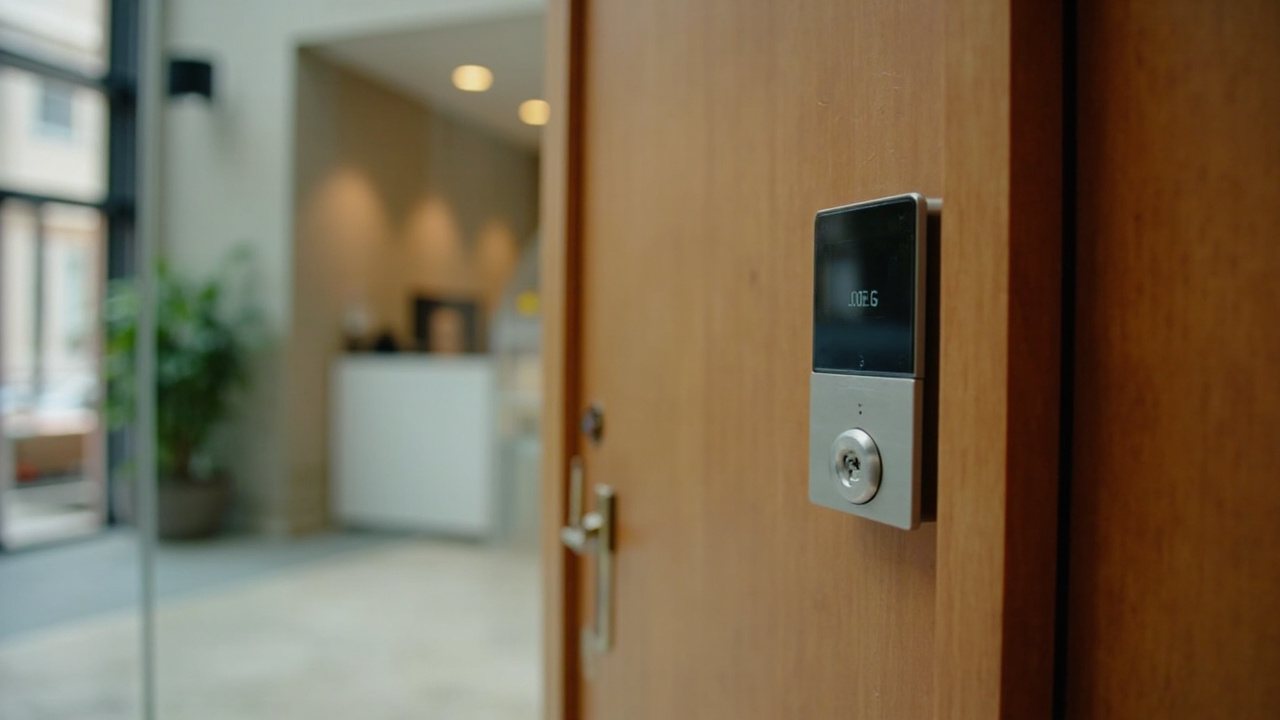
Smart Lock Data and Privacy Practice in Southeast Asia: Event Logs and Hosting
An IT security reviewer evaluating hostel or budget-hotel locks needs more than a promise that data is secure. A southeast asia smart lock data privacy practice should define what each event records, where it is held, who can view it, and when it is deleted. Tag the review southeast-asia, then apply the clauses below to dorm doors, reception, luggage rooms, and staff access. Keep the lock, gateway, hosting platform, and property system as separate parts of the data boundary.
Direct answer. Short version — southeast asia smart lock data privacy practice is treated here as southeast asia smart lock data privacy practice first. radio-approval comes second. The evidence for southeast asia smart lock data privacy practice is named in the sections below. A southeast asia smart lock data privacy practice defines entry conditions for one market. southeast asia smart lock data privacy practice starts the approval conversation. Every southeast asia smart lock data privacy practice condition names its evidence.
This article defines southeast asia smart lock data privacy practice through southeast asia smart lock data privacy practice. The definition of southeast asia smart lock data privacy practice is deliberately narrow. It is non-statutory, and it applies to the market and product being discussed.
Fix the review boundary The commercial step that follows
Use the Smart Lock Retrofit Site Survey to identify legacy controllers, guest systems, and credentials that may enter scope, and pair it with the Office Smart Lock Site Survey. Physical fit does not establish who can see access history. Name an owner for each flow: lock, gateway, management platform, hosting provider, support desk, and property system. The commercial end of this decision is the smart door locks.
Event-log field schedule
A smart lock event logging schedule should support investigations without becoming a guest dossier. Require enough context to distinguish a denied attempt, successful opening, credential change, and maintenance event. Record UTC time with the property time zone, door and lock identifiers, and the responsible system. Exclude fields whose operational purpose is not yet clear.
| Field set | Required content | Reviewer test |
|---|---|---|
| Event | Type, door and lock ID, result, UTC time, property time zone, device ID | Reconcile one guest event against the physical access record. |
| Credential | Opaque token, bed, room, or dorm reference, issue and revoke state | Prove that the exported log does not reveal a guest name. |
| Administration | Operator ID, action, result, reason, software version | Trace one credential change to an accountable person. |
| Security | Source, authentication result, privileged access, export and deletion actions | Compare privileged activity with the named administrator list. |
Include a retention owner and deletion route for every field set.
Hosting route and administrator reach
For an IT reviewer, a southeast asia smart lock data privacy practice is useful only when it follows the data route, not the label “cloud.” Compare the smart lock hosting model with documented locations, purposes, and access routes. Ask where hosting, backups, administrator access, support access, and exports are processed. Require the hosting jurisdiction, backup location, support-access approval method, named subprocessors, and advance notice of material service changes. Use the Language, Culture and Technical Support for Smart Locks in Southeast Asia link to align the field dictionary with the administrator’s working language.
CONFIRM-WITH-LOCAL-DATA-PRIVACY: Confirm applicable hosting-location, remote-access, transfer, retention, breach-notification, and contract duties with qualified counsel in each operating country.
flowchart TD
    A[Door event] --> B[Gateway]
    B --> C{Operating model}
    C -->|Local| D[Property store]
    C -->|Hosted| E[Named host]
    D --> F[Reviewer]
    E --> F
    F --> G[Export and deletion]
Draft clause
Use these as negotiation drafts, then have local counsel adapt them:
- C-01 — Event inventory: Document each event category, field, purpose, owner, retention period, and access role. Accept with a signed data inventory and redacted export.
- C-02 — Credential separation: Keep guest identity separate from revocable bed, room, and dorm references, with approved lookup controls. Accept with a revocation demonstration and sample record.
- C-03 — Hosting transparency: Disclose hosting jurisdiction, backup location, support-access locations, subprocessors, and material service changes. Accept with contract schedules and provider evidence.
- C-04 — Controlled administration: Make access individually attributable, role-limited, logged, and tied to documented need. Accept with named-account and privileged-access samples.
- C-05 — Retention and exit: At season or contract close, export required records, revoke outstanding credentials, and confirm deletion or return of controlled copies. Accept with a witnessed exit test.
- C-06 — Incident pack: Provide a scoped timeline, affected log categories, access evidence, containment steps, and preserved records. Accept with a tabletop-exercise result.
CONFIRM-WITH-LOCAL-DATA-PRIVACY: Have qualified local counsel adapt party roles, remedies, transfer wording, retention periods, and incident obligations before contract signature.
Season-close credential controls
At the season boundary, dorm access data and credential data retention should follow the guest lifecycle rather than an indefinite default. Require per-bed revocation without a door visit, controlled reassignment of staff credentials, and an export showing the last change to each shared credential. Ask the provider to distinguish a low-battery alert from an access denial, so a maintenance event is not misread as misuse. The Specifying Smart Locks for Hostel and Budget Hotel Stock Projects in Southeast Asia workbook remains the companion for door-handle and battery-change decisions.
Country radio-approval evidence
Keep radio approval evidence on a separate acceptance track. For any radio-bearing SKU, ask which country-specific record applies in Singapore, Malaysia, Thailand, Indonesia, the Philippines, or Vietnam, and which model and radio configuration it covers. The regional evidence points to IMDA, SIRIM, NBTC, SDPPI/Postel, NTC, and Vietnam type approval as routes to verify. Contract wording should prevent a CE mark or approval from another country from being presented as cover for every destination. The How Southeast Asia Buyers Weight Country-by-Country Radio Approval Evidence When Comparing Smart Lock Suppliers link explains how to compare that evidence.
Readers comparing approaches usually start with keyless lock vs smart lock. That is the same question southeast asia smart lock data privacy practice has to answer here.CONFIRM-WITH-LOCAL-RADIO-APPROVAL: Confirm the current scope, SKU-specific status, and acceptable evidence with the competent authority for each destination country.
Hosting decision comparison
Before approval, the IT security reviewer checklist should compare evidence for each hosting option:
| Test | Self-managed or local option | Hosted service option |
|---|---|---|
| Administrator access | Named property admins, local accounts, support path | Customer and provider roles, access regions, approvals |
| Log movement | Local storage, export, backup handling | Data flow, backup, provider access, subprocessors |
| Season close | Credential revoke plus export and deletion | The same checks plus contract exit and deletion confirmation |
| Radio evidence | Dated country record for a radio-bearing SKU | The same SKU and configuration check before service launch |
Ask the supplier to complete the clause set for the exact lock, gateway, hosting option, and destination countries. Require a redacted log, named data owners, radio-approval evidence, a credential-revocation demonstration, and a season-close export/deletion test. Use the Smart Lock Security Questions Southeast Asia IT Teams Actually Ask link as the final interview sheet. Approval should wait until unresolved legal and radio items have the relevant local confirmations.
Ask for the offer against the same requirement: request a quote.