
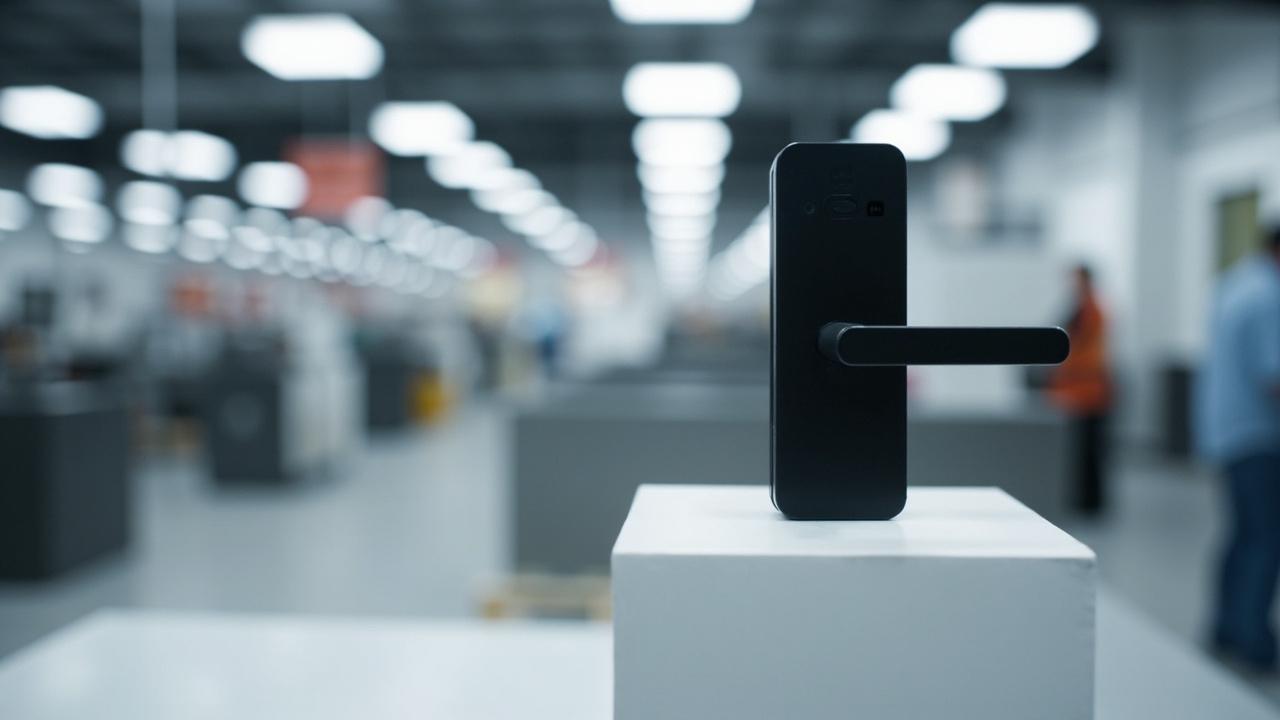
Smart Lock High-Security Cylinder
A high-security cylinder is the mechanical heart of every smart lock that still keeps a keyed fallback. Buying the wrong cylinder is the most common way a smart-lock project quietly loses security: the keypad and the fingerprint reader get all the attention in the brochure, then the door gets opened with a $15 bump key in twelve seconds. This article is a decision-pillar explainer for B2B buyers — importers, distributors, hotel groups, property managers, and brand owners — who must decide what "high-security cylinder" actually means on their procurement worksheet before they send an RFQ to a manufacturer. The five pillars below are the technical attributes that move a cylinder from "commodity" to "high-security." Each pillar carries its own decision question, its own evidence request, and its own hand-off to the product page for model-specific confirmation. Per-model cylinder detail — exact pin count, exact grade label, exact security tier — is intentionally not asserted here. The factory publishes that on the per-model product page, and your procurement worksheet should pull from there, not from a generic catalogue line.
The five pillars are pick resistance, drill resistance, bump/impact resistance, key control profile, and cylinder architecture & attack-time-to-defeat. A smart lock that has only two of these five is a standard cylinder in disguise. The job of this article is to give you a structured way to tell the difference, to write the questions that surface the difference on an RFQ, and to refuse the marketing language that lets it slide.
Why the cylinder is the missing variable in most smart-lock RFQs
A smart lock is a credential stack on top of a door, and the door still has a cylinder. Electronic credentials (RFID card, PIN, fingerprint, mobile key, face, palm) do the work ninety-nine percent of the time, and the cylinder answer gets conditioned as the marginal one percent — the mechanical override that "nobody really uses." That framing is wrong on three counts.
First, mechanical override is what you reach for when the electronics fail. A dead battery, a misconfigured admin, a software migration in mid-2026, a firmware bug after a vendor update, a card-encoding mismatch on a PMS integration — any one of these forces the door back to the key. If the cylinder cannot hold, the lock fails. Second, mechanical override is the route that any attacker who has spent ten minutes watching the lobby will try first. The credential stack is auditable; the cylinder is silent. Third, in a hotel or property context the cylinder also runs the master keying system: housekeeping, engineering, management, emergency override. The cylinder is the entire mechanical control plane of the property, and its security posture determines whether the property still has one when the network goes down.
The five-pillar decision framework below reframes "high-security cylinder" from a marketing line into five distinct testable attributes. The article uses the language of cylinder engineering that an importer can copy into an RFQ and a factory's engineering team can answer in a cell-side or a product page.
Pillar 1 — Pick resistance
Pick resistance is the ability of the cylinder to defeat manipulation with hand tools. A standard five-pin tumbler cylinder can be picked by an experienced amateur inside ten seconds with a basic pick set. Pick resistance adds the variance that makes the work tractable, and the variance comes from pin design, driver geometry, sidebar presence, and the cylinder's tolerance for mis-pinning.
Decision questions for the RFQ row on pick resistance:
- How many effective locking elements are in the cylinder (pin count, plus any side pins or sidebar elements)?
- Are there security pins in the pin stack — spool, mushroom, serrated, or patented anti-pick geometries?
- Is there a secondary locking mechanism (a sidebar actuated by a slider on the key, or a movable element that engages only when the correct key is inserted)?
- What is the cylinder's stated or implied time-to-defeat against a skilled operator with hand tools (the manufacturer states this internally; the buyer asks for the figure they have on file, and verifies it against independent test-house reports when available)?
Pick resistance is also the pillar where the smart-lock industry has the most vocabulary to copy and the least to verify. Brochure lines will say "anti-pick," "pick-resistant," "security pins," and "patented pin design." None of those phrases carries a number. A B2B buyer should ask the factory to enumerate the security elements and to name the engagement principle. The factory's answer is the basis for the worksheet row; the brochure is decoration.
The smart-lock-specific wrinkle on pick resistance is that the cylinder is half of a hybrid. Even if the cylinder itself resists picking, the attack surface expands to the credential reader, the clutch, and the mechanical override path. A cylinder with excellent pick resistance that is paired with a clutch-driven free-spinning outside handle is still a pickable system, because the operator can defeat the clutch from the outside without ever engaging the cylinder. Pick resistance on a smart lock is therefore a system property, not a cylinder property. The RFQ should ask for it as a system property.
| Pick-resistance worksheet column | What to ask the factory | What good evidence looks like | What to refuse |
|---|---|---|---|
| Effective locking elements | Total pin count plus sidebar / side pin count | A labelled pin-stack drawing with security pins marked | A bare pin-count number with no diagram |
| Pin geometry | Names of security pin types used | At least three pin types named (e.g., spool, mushroom, serrated) | A single security pin name with no detail |
| Secondary locking | Sidebar / movable element present? | Yes/no plus one-line description of engagement principle | "Patented design" with no principle named |
| Free-handle override risk | Does the outside handle disengage when the cylinder is in locked state? | Yes/no plus clutch model or anti-panic specification | A brushed-off answer about "indoor/outdoor models" |
| Cylinder-system claim | "Is pick resistance tested at the cylinder level or at the lock level?" | "Tested at the lock level, including clutch and override path" | "Tested at the cylinder level only" |
The worksheet above is intentionally blank for the buyer to populate. The column for "What to refuse" is the firewall: it lists the phrases that allow the factory to claim high-security without committing to a number.
Pillar 2 — Drill resistance
Drill resistance is the ability of the cylinder to defeat a drill attack. A drill attack destroys one or more of the pin stacks and allows the operator to defeat the lock without picking it. Drill resistance is engineered into the cylinder through hardened steel inserts, anti-drill pins (often tungsten-carbide or molybdenum-alloy), and the cylinder's overall body hardness.
Decision questions for the RFQ row on drill resistance:
- Are there anti-drill pins or plates in the cylinder body, and where (top of cylinder, side, bottom, all three)?
- What is the material of the anti-drill pins (tungsten-carbide, molybdenum-alloy, hardened tool steel)?
- How many pin stacks are protected by anti-drill inserts?
- What is the cylinder body material and is it case-hardened or through-hardened?
- What is the expected drill time on the cylinder face before a sufficient number of pins are destroyed for the lock to rotate freely?
Drill resistance is the pillar where physical specifications matter most. "Anti-drill" by itself is a feel-good label. The buyer wants material and location data. Tungsten-carbide inserts in the top and side of the cylinder body defeat most hand-drill attacks; without them a standard cordless drill can defeat a brass-bodied five-pin cylinder in under a minute. A high-security cylinder should have anti-drill coverage on at least two axes (top and side), and the inserts should be a different alloy than the body.
The smart-lock-specific wrinkle on drill resistance is that the cylinder is rarely attacked by drill alone. A determined attacker will combine drill with pick: drill the top pin to clear the spring tension, pick the residual pin stacks, rotate. The cylinder must therefore hold up under a combined attack, and the factory's answer should describe a combined attack resistance, not just "drill time." The RFQ row should also distinguish between anti-drill upper pin (the most common configuration) and anti-drill lower pin (rarer and more resistant). Most catalogues include upper-pin only.
The combined attack runs in a fixed order, and the order is what the worksheet row has to describe. The sequence below restates that attack path through the cylinder and the clutch.
sequenceDiagram
    participant OP as Skilled operator
    participant CY as Cylinder pin stacks
    participant CL as Clutch and outside handle
    OP->>CY: Drill the top pin to clear the spring tension
    OP->>CY: Pick the residual pin stacks
    CY->>CL: Plug rotates
    Note over CL: The latch engages only if the clutch path is intact
| Drill-resistance worksheet column | What to ask the factory | What good evidence looks like | What to refuse |
|---|---|---|---|
| Anti-drill pin count | Number of anti-drill pins or plates | "3 anti-drill inserts: top, side, bottom" | "Anti-drill" with no count |
| Anti-drill material | Alloy name and approximate HRC | "Tungsten-carbide, HRC 80+" | "Hardened steel" with no grade |
| Body hardness | Body material and treatment | "Brass body with case-hardened surface" | "Brass body" with no treatment note |
| Drill axis coverage | Top/side/bottom protection | At least top + side named | "Top only" or "drill-resistant" with no axis named |
| Combined-attack resistance | Drill + pick or drill + impact testing | A statement of combined-attack test method | A statement only of single-attack drill time |
The worksheet's last row is the smart-lock-specific row. Cylinders that are sold as standalone products often have excellent single-attack drill resistance; the same cylinder, integrated into a smart lock with a clutch and a credential reader, may have weaker combined-attack resistance because the cylinder's protected faces are not aligned with the lock's exterior. Always ask for the integrated answer.
Pillar 3 — Bump / impact resistance
Bump resistance is the ability of the cylinder to defeat key-bumping. Key-bumping is the technique where a cut key (a "bump key") is inserted, struck, and rotated; the kinetic impact transfers through the pin stacks and momentarily separates each driver-pin from its pin, allowing the cylinder to rotate. Bumping is faster than picking and requires less training; it is the dominant non-credential attack on residential cylinders.
Decision questions for the RFQ row on bump resistance:
- Is the cylinder designed to resist bump-key attacks, and on what principle (security pins that resist the kinetic transfer, sidebar that requires a second axis of movement, or movable element that prevents rotation under impact)?
- Are the driver pins or security pins shaped to dissipate the kinetic impact?
- Is there a patented or proprietary anti-bump feature, and on what engagement principle does it work?
- Is the bump resistance stated for the cylinder alone or for the cylinder integrated with the smart-lock clutch and handle?
Bump resistance is the pillar that distinguishes a true high-security cylinder from a five-pin tumbler with marketing. A standard five-pin tumbler is trivially defeated by bumping; it takes under a minute for a novice. Anti-bump cylinders either use security pins that require a positive key geometry (mushroom, spool) or use a sidebar / movable element that does not transfer the kinetic impact into a disengagement event. The principle matters more than the label.
The smart-lock-specific issue with bump resistance is that smart locks often have a clutch that disengages the outside handle when the door is locked. If the clutch is disengaged, bumping the cylinder from the outside does not rotate the handle — the cylinder rotates freely without engaging the latch. This means the effective bump resistance of a smart lock is often a product of the clutch, not the cylinder. A buyer should ask the factory whether the cylinder is intended to be the primary resistance or whether the clutch is. If the answer is "both," the buyer should request the integrated test data.
| Bump-resistance worksheet column | What to ask the factory | What good evidence looks like | What to refuse |
|---|---|---|---|
| Anti-bump principle | Pin geometry, sidebar, or movable element | One principle named, plus the engagement mechanism | "Anti-bump" with no principle |
| Pin shape for kinetic dissipation | Names of pin types used in the stack | At least mushroom + spool named | Single pin type with no diagram |
| Clutch integration | Is outside handle engaged when cylinder rotates? | Yes/no plus clutch specification | No answer, or "indoor/outdoor variation" |
| Integrated test data | Bump test on the lock, not the cylinder | A bump-test report naming the integrated lock | Cylinder-only test report |
| Spare-key vulnerability | Can a standard-cut key be bumped on this cylinder? | No, with a brief reason | No clear answer |
The "Spare-key vulnerability" row is the one B2B buyers miss. If the cylinder accepts a standard-cut key that can be filed into a bump key, the property is exposed even if the cylinder is theoretically bump-resistant — because the spare keys for staff and contractors can be filed by anyone with a metal file. The factory's answer should address the key-blank profile, not just the pin stack.
Pillar 4 — Key control profile
Key control is the ability of the property owner to restrict who can duplicate keys. A standard five-pin tumbler accepts a key blank that can be cut at any hardware store; the property owner has no way to control duplication. A high-security cylinder uses a restricted, patented, or registered keyway that requires the property owner (or the manufacturer's authorized agent) to authorize duplication, often through a signed key-duplication card.
Decision questions for the RFQ row on key control:
- Is the keyway restricted, patented, or registered?
- Who can authorize key duplication (the property, the manufacturer, an authorized agent)?
- What is the duplication control mechanism (signed card, online authorization, biometric key-cutting, restricted blank distribution)?
- What happens to the key-control registry when the property changes ownership?
- What is the cost and lead-time for a single key or commercial replacement key?
Key control is the pillar that makes a cylinder "high-security" in a property-management sense. A standard cylinder with excellent pick resistance and drill resistance is still a key-control liability if any staff member can walk into a hardware store and walk out with a copy. The duplication control mechanism is what protects the property over the life of the cylinder, not the lock-in moment.
The smart-lock-specific angle on key control is that the cylinder is usually a secondary credential. The primary credential is the RFID card or fingerprint or mobile key. The cylinder's role in key control is therefore narrower: it protects the mechanical override path and the master keying structure. The buyer should still restrict the keyway, but the cylinder may carry fewer keys than a non-smart lock would — perhaps a master key for engineering, a master key for management, and a single emergency override key held offsite. The total key count in the property is the metric; the keyway restriction is the protection.
| Key-control worksheet column | What to ask the factory | What good evidence looks like | What to refuse |
|---|---|---|---|
| Keyway type | Standard / restricted / patented / registered | A named keyway profile plus its duplication control | "Proprietary" without a profile name |
| Duplication authorization | Who authorizes, and through what mechanism | A signed card, an online portal, or a registered-agent process | "Through our service department" with no further detail |
| Blank distribution | Where can blanks be purchased | Factory-direct only, or licensed locksmiths only | Open hardware stores, or "varies" |
| Key-tracking transition | Whole property key-tracking record ownership stated | "Standard" or "Standard + private agreement" | |
| Cost / MOQ / lead time | Per-key cost and minimum order | Routed to /request-a-quote with an explanation of the factors | A bare number with no context |
The cost/MOQ/lead-time row is a deliberate firewall. Per the site's standing rule, the article does not assert specific cost figures, minimum order quantities, or lead times for any catalog model or service. The article routes the question to the factory's quote request and explains the factors that drive the numbers (blank material, quantity, registered-agent process, geographic shipping).
The key-control decision ties directly to the master keying decision in Pillar 5. If the keyway is not restricted, master keying is not enforceable at the cylinder level; the property is running master keying on trust. A restricted keyway is the prerequisite for a real master keying system.
Pillar 5 — Cylinder architecture & attack-time-to-defeat profile
The fifth pillar is the property-level architecture of the cylinder plus its stated attack-time-to-defeat profile. Attack-time-to-defeat is the laboratory or field estimate of how long the cylinder resists a skilled operator with a defined tool kit. It is the property-level rollup of Pillars 1, 2, and 3 — the integrated time the cylinder buys the property before the operator is in.
Decision questions for the RFQ row on cylinder architecture and attack-time-to-defeat:
- What is the master keying structure available on this cylinder (master key, change key, construction key, emergency key, GMK / sub-master)?
- How many levels of master keying are supported, and what is the maximum cylinder count per level?
- Is the construction key feature available (a key that works only during the construction phase and is then decommissioned)?
- What is the cylinder's stated attack-time-to-defeat profile (factory-handlab-test-internal), and is it integrated or cylinder-only?
- What is the audit trail on the cylinder side — does the cylinder record which key was last used, or does it only report "key override event" to the smart-lock firmware?
Cylinder architecture is the pillar that converts the cylinder from a commodity component into a property-management system. A standard five-pin tumbler has one key per cylinder; a high-security cylinder with master keying can carry a hierarchy — guest key, staff key, supervisor key, master key, grand master key, construction key — and the cylinder enforces the hierarchy mechanically.
Attack-time-to-defeat is the pillar where the buyer should be most skeptical of factory numbers. Stated times vary widely across manufacturers, are often tested under favorable conditions (skilled operator, ideal lighting, no time pressure), and rarely include combined attacks. A buyer who is comparing two factories should ask each one the same question: what is the integrated attack-time-to-defeat on a single-door smart-lock installation, against a combined attack (drill + pick, or bump + torque), performed by a skilled operator? The factory that hedges is the factory that has tested; the factory that names a single number is often guessing.
The smart-lock-specific angle on architecture is the audit trail. A standard cylinder is silent — a key event is a key event, indistinguishable from "the property manager came in at 3 a.m." A high-security cylinder with smart-lock integration can report a key-override event into the lock's firmware, and the firmware can stamp it with a timestamp and a cylinder identifier. This is the bridge between Pillar 5 and the rest of the smart lock: the cylinder becomes a data point in the property's audit trail rather than a silent mechanical fallback.
| Cylinder-architecture worksheet column | What to ask the factory | What good evidence looks like | What to refuse |
|---|---|---|---|
| Master keying levels | Maximum supported levels | "Up to 4 levels (sub-master, master, GMK, EMK)" | "Master keying available" with no level count |
| Construction key | Available and pin-counted | Yes/no plus a description of the decommissioning process | A bare "yes" |
| Attack-time-to-defeat (integrated) | Combined attack estimate on the integrated lock | A range / condition not in raw seconds for the integrated test report | A single number in raw seconds with no method |
| Audit trail integration | Does the lock firmware report a key-override event? | Yes/no plus the firmware field name | No answer |
| Key-rotation policy | How often should the master key be re-cut and re-registered? | A factory-stated interval or a property-defined interval | "As needed" |
The audit-trail row is the smart-lock-specific row. It is also the row that tells the buyer whether the cylinder is being treated as a smart-lock component or as an afterthought. A factory that has integrated the cylinder into the firmware has thought about the property's full credential stack; a factory that says "the cylinder is separate" has not.
How the five pillars combine into a procurement decision
The five pillars do not score the same way on every project. A hotel guest-room cylinder has different requirements than an apartment tenant door, which has different requirements than a back-of-house office, which has different requirements than a warehouse IT room. The buyer should weight them by use case.
Illustrative scenario: a 180-room hotel property
Consider a 180-room hotel property in a coastal city whose three live locations are the lobby, the back-of-house corridor, and the guest-room floors. The buyer is the hotel group, the property is new-build, and the procurement cycle has 14 weeks. The five pillars weight as follows for this property.
Pick resistance: high weight. The property will run guest-room cylinders as mechanical fallback only — guests use RFID cards — yet the property must hold up against a keyed attack because the cylinder is the path that an external attacker will try first. Master keying plus a restricted keyway will absorb the day-to-day keyed risk; pick resistance absorbs the off-pattern risk.
Drill resistance: high weight. The property's insurance profile requires drill resistance on guest-room cylinders because the local underwriting guidance includes cylinder drill-time minimums. The buyer should ask the factory for drill-time data on the guest-room cylinder specification.
Bump resistance: medium-to-high weight. The property is in a market where bump-key attack is a known pattern. The buyer's worksheet should require anti-bump pin geometry and should request the integrated bump test data, not the cylinder-only test.
Key control profile: very high weight. A 180-room hotel with sub-master, master, and grand master keys cannot run on a standard keyway. The keyway must be restricted, the duplication must be authorized, and the property must be able to revoke key-cutting rights at the end of the property-management contract. This is the most important pillar for this scenario.
Cylinder architecture: very high weight. A 180-room property runs a multi-level master keying structure (sub-master for floor supervisors, master for housekeeping, grand master for engineering and management, construction key for the build-out phase, emergency key for the fire-services liaison). The cylinder must support this structure, and the lock firmware must report the key-override event into the property's PMS audit trail so that a "key came in at 3 a.m." event can be reconciled against the master-key custody log.
This scenario is not a customer story — it is an illustrative configuration for the framework. A different property — a 40-unit apartment building, a 12-door office, a single warehouse — would weight the pillars differently. The point is that the five pillars do not have intrinsic weights; the weights come from the property.
| Property type | Pick | Drill | Bump | Key control | Architecture | Dominant pillar |
|---|---|---|---|---|---|---|
| Hotel guest room (large) | High | High | Med-High | Very high | Very high | Key control + architecture |
| Hotel guest room (boutique) | High | Med | Med | Low-Med | Low | Pick + drill |
| Apartment tenant door | Med-High | Med | Med | High | High | Key control |
| Apartment common area | Med-High | High | Med | High | High | Architecture |
| Office back-of-house | Med | Med-High | Med | Med-High | High | Architecture |
| Office executive suite | High | High | Med | Very high | Med-High | Key control |
| Warehouse IT room | High | Very high | High | Very high | High | Drill + key control |
| School staff room | Med-High | Med | Med | High | Med | Pick + key control |
| Clinic consultation room | Med | Med | Med | Med | Med | Balanced |
| Retail stockroom | Med-High | Med | Med | Med-High | Med | Pick + key control |
The matrix is a guidance tool, not a fixed specification. The right weights for a specific property should be set in the procurement worksheet.
A five-pillar scorecard for the RFQ
The scorecard below consolidates the five pillars into a single worksheet the buyer can populate per model. The columns are blank on purpose: the per-model numbers must come from the factory's product page or from a per-model engineering document, and the standing rule for this site is to route per-model cylinder detail to "check the model’s published specification." The scorecard is therefore a per-candidate-comparison worksheet, not an asserted rating.
| Pillar | Question | Weight (0–3) | Candidate A score | Candidate B score | Evidence pointer |
|---|---|---|---|---|---|
| 1. Pick resistance | Effective locking elements / sidebar / system pin count | A | A | B | Product page + integrated test report |
| 2. Drill resistance | Anti-drill insert count / material / body hardness | A | A | B | Product page + integrated test report |
| 3. Bump resistance | Anti-bump principle + clutch integration | A | A | B | Product page + integrated test report |
| 4. Key control | Keyway restriction + duplication authorization | A | A | B | Product page + key-control terms |
| 5. Architecture & attack-time | Master keying levels + audit trail + attack-time | A | A | B | Product page + firmware spec |
The weight column is the buyer's weighting per the property profile. The candidate columns are populated from the factory's product-page data, not from the brochure. The evidence pointer column is what an auditor or QA reviewer would check.
Where to find the per-model cylinder specification
The standing rule for per-model cylinder detail on this site is verified in writing on the product page. Cylinder specification is the most frequently misquoted line in the smart-lock industry: a brochure will say "anti-pick" without saying on what principle, "anti-drill" without saying on which axis, "high-security" without saying against which attack. The factory publishes the per-model data on the per-model product page, and the procurement worksheet should pull from there.
The catalog of 79 models in the published line is organized across the major smart-lock categories (Smart Door Locks 77, Fingerprint 37, Hotel 24, Keypad 18, Outdoor 10, RFID 9, Face Recognition 6, Cabinet 6, Video Camera 3, Glass 3). Each model has a per-model product page that names its cylinder, its credential stack, and its door-thickness range. The hotel anchor — the SLK-9936S — is a useful reference for a five-pin cylinder baseline with mechanical key override; the per-model product page carries the exact pin-count and the cylinder-body specification. The buyer's job is to verify, on the product page, that the candidate model carries the line item the worksheet expects.
For hotel projects, the SLK-9936S is the canonical reference: five-pin cylinder, mechanical emergency access, stainless steel + alloy body, multiple finish options, 36–100 mm door thickness, RFID Mifare 1 at 13.56 MHz with 0–5 cm read distance and under 0.25 s read time. That is the anchor. The article does not extend those specific lines to siblings — SLK-9936G, SLK-9951TH, SLK-9962S, SLK-9905A — or to the cylindrical-latch Tuya model, the 3D-face intercom model, the SLK-G200 glass-door lock, or any other catalog item. Per-model detail goes to the per-model product page.
What to put on the RFQ: five rows, five questions, five refusal phrases
The RFQ row for the cylinder should be five short rows, one per pillar, each carrying the decision question and the evidence requirement. The five refusal phrases are the firewall.
SURE THE RFQ ROW: P1 Pick resistance: total pin count + sidebar + security pin names + free-handle override P2 Drill resistance: anti-drill pin count + alloy + body hardness + axis coverage P3 Bump resistance: anti-bump principle + clutch integration + spare-key vulnerability P4 Key control: keyway type + duplication authorization + blank distribution P5 Architecture & attack-time: master keying levels + construction key + audit trail
The five refusal phrases below are the phrases that allow the factory to claim high-security without committing to a number. The buyer should refuse them and request the underlying specification.
- Refusal 1: "Anti-pick design." The argument is the pin geometry and the sidebar / secondary locking element. A label without a principle is a brochure, not a specification.
- Refusal 2: "Drill-resistant body." The argument is the anti-drill insert material and location. A body without inserts is a body, not a drill-resistant body.
- Refusal 3: "Patented keyway." The argument is the duplication authorization mechanism. A patented keyway without a duplication-control process is a keyway, not a key-control system.
- Refusal 4: "Master keying available." The argument is the maximum level count and the construction-key option. A master-key option without a level count is a label.
- Refusal 5: "Time-to-defeat: X minutes." The argument is the integrated attack-time, the operator skill level, and the tool kit. A single number in raw seconds is a guess.
The buyer should refuse all five on first read and accept only the underlying specification. The factory that can answer all five is the factory that has the engineering depth to be a high-security supplier; the factory that cannot is a candidate for a non-high-security tier.
The relationship to the rest of the smart lock stack
A high-security cylinder is one component in a five-component stack. The other four are the credential reader, the clutch, the firmware, and the audit trail. The cylinder does not score the property; the stack does. A property with a high-security cylinder and a poorly-clutched handle is a property with a cylinder that rotates freely without engaging the latch. A property with a high-security cylinder and a silent firmware is a property whose cylinder events do not appear in the audit trail. A property with a high-security cylinder and an unrotated key policy is a property whose master keys are duplicated without authorization.
The five pillars of cylinder decision must be read alongside the four pillars of the smart-lock decision (credential reader, clutch, firmware, audit trail). The full procurement decision for a smart lock is a 5+4 worksheet, not a 5-row worksheet. The buyer should hold both worksheets and cross-reference the candidate rows.
Internal cross-links
The five pillars connect to the wider cluster of materials and specs articles on this site. The cluster is structured as a series of decisions that the buyer walks through from the body of the lock to the edge of the door. The Smart Lock Materials: Complete Buyer Guide is the cluster root and should be the first stop for a buyer who has not yet fixed the substrate (stainless steel, zinc alloy, aluminum alloy, brass). The Smart Lock Anti-Picking Design article is the closest sibling and should be read alongside this one — it covers the pick-resistance pillar in greater depth and connects to the pick-test methodology. The Smart Lock Five-Pin Cylinder article is the next-door sibling that discusses the most common cylinder architecture and the way pin count maps to security tier. The Smart Lock ANSI Mortise and Smart Lock Three-Point Latch articles cover the cylinder's mechanical environment. The cylinder measurement article covers the physical dimensions and tolerance bands the buyer needs to specify the cutout. The engineering procurement checklist pulls all of the above into the worksheet the buyer carries into the RFQ. The smart-lock-manufacturer page is the factory-side context for OEM / ODM / private-label cylinders.
Closing CTA
The five pillars — pick resistance, drill resistance, bump resistance, key control, and architecture & attack-time-to-defeat — give the buyer a decision framework, not a specification. The specification comes from the per-model product page and from the factory's engineering document. The buyer's job is to populate the five-pillar scorecard with the candidate's per-model data, weigh the pillars by the property profile, and ask the five refusal phrases on first read.
Start with the anti-picking design article (smart-lock-anti-picking-design) for the deeper pick-resistance context, then the materials buyer guide for the substrate decision, then return to the per-model product page to populate the scorecard. For factory-side questions on cylinder specification, master keying, and OEM / ODM keyway customization, the smart-lock-manufacturer page carries the engineering contact and the project intake form. Per-model cylinder detail, exact pin count, and exact keyway profile are confirmed on the product page for each catalog model; per-model numbers should not be carried across models, and the RFQ should pull them from the per-model product page or from the factory's engineering document on request.