
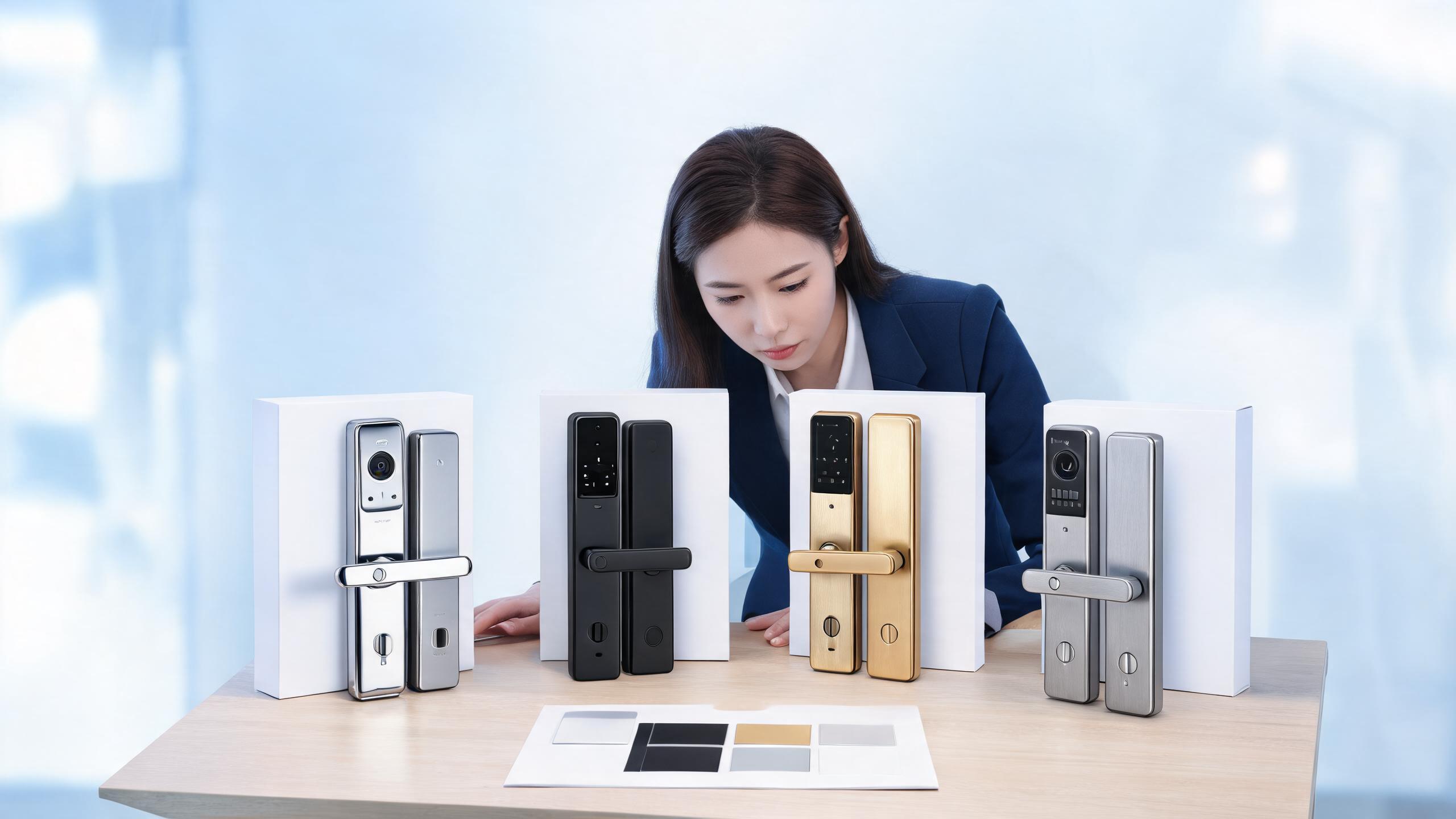
For brand owners
Smart locks for brand owners: your brand, proven platforms
Brand-controlled identity on validated production — logo, packaging, credentials, firmware defaults and app branding, with clear IP terms and a staged path from private label to ODM.
Brand owners do not buy a product — they buy a controlled customer experience: consistent finish and packaging, an app that looks and behaves like the brand, quality that protects reviews, and IP terms that survive growth. The brand-owner program starts on proven in-production platforms (so reliability is inherited, not beta-tested) and layers brand control in stages: identity and packaging first, firmware and app branding next, regional lock-body and finish variants after volume, and ODM only when a genuine market gap justifies tooling. Who owns what — artwork, tooling, firmware configuration, accounts, data — is written down before production, not negotiated afterward.
Brand-owner program at a glance
| Platform strategy | Validated in-production models carry the brand first; new development is added only against documented market demand |
| Brand layers | Laser logo, color box and manual, printed credentials, firmware defaults, branded app on supported ecosystems, finish and body variants |
| App route | Branded ecosystem apps (Tuya/TTLOCK-type) as the standard path; standalone app development scoped separately |
| IP clarity | Your artwork and trademarks remain yours; platform IP is licensed; tooling ownership or use rights are contractual — see ODM |
| Quality protection | End-of-line testing per unit, batch records, golden-sample approval and optional third-party inspection guard review scores — QC |
| Certification | Model-specific files for covered SKUs; electronics changes that affect certification are flagged before commitment |
| Commercial terms | Per-layer thresholds, tier pricing and lead times in writing; exclusivity discussions require volume commitment and a defined market |
Answer unit
What does a brand actually control in each program?
Most disputes between brands and factories come from assuming control that was never agreed. The matrix below shows what the brand controls, what is shared, and what remains factory platform IP at each stage. It should mirror the written agreement.
| Element | Private label | Configured OEM | ODM |
|---|---|---|---|
| Trademark & artwork | Brand controls | Brand controls | Brand controls |
| Packaging design | Brand design, factory print | Brand design, factory print | Brand design, factory print |
| Firmware defaults | Factory standard | Agreed configuration | Project specification |
| App identity | Usually ecosystem standard | Branded on supported platform | Branded or custom build |
| Accounts & data | Platform terms | Brand ownership discussed | Defined in agreement |
| Housing design | Factory platform | Factory platform (variants possible) | Per agreement, possibly brand IP |
| Tooling | None | Rarely | Ownership/use rights contractual |
The staged path successful brands follow
- Platform validationTest 2–4 in-production models on the doors your market sells into; select on reliability and fit, not feature lists.
- Identity layerLaser logo, color box, manual and printed credentials; approve vector proofs and a golden sample.
- App & firmwareProvision the branded app on a supported ecosystem, lock firmware defaults, and define account and data ownership.
- Market complianceConfirm model-specific files for every launch SKU; treat any electronics change as a possible certification event.
- Scaled reordersTier pricing, spares rhythm and running-change notification protect the customer experience as volume grows.
- Selective ODMOnly with sell-through evidence: new finish, body variant or a genuinely new model via turnkey OEM.
What we protect
Brand risks the program is designed around
Review-damaging defects
Per-unit end-of-line checks, golden samples and inspection before shipment keep quality consistent with the brand promise.
IP clarity
Artwork, tooling and platform IP positions documented in the agreement before tooling or production starts.
Compliance surprises
SKU-level certificate review up front; changes that could affect files flagged at specification stage.
App experience
Branded ecosystem provisioning with clear account structure, so the app feels like the brand from first pairing.
Running changes
Notification before production changes affect a branded SKU, with samples where the change is customer-visible.
Warranty control
Planned spares and a documented claim path let the brand own the customer relationship confidently.
Related paths
Where brands go next
Smart locks for brand owners: common questions
Can we sell factory models under our own brand name?
Yes — that is private label: your trademark, packaging and credentials on proven in-production platforms. An agreement defines usage, quality expectations and IP positions before production, and the underlying platform remains factory IP licensed for your branded units.
Who owns the app and the customer data for connected locks?
It depends on the route. Branded apps on Tuya/TTLOCK-type ecosystems operate under that ecosystem's account and data structure with your branding; a standalone custom app is a scoped project where ownership is defined contractually. Always resolve account structure and data flow before launch, especially for EU markets.
Can we get exclusivity for our market or design?
Exclusivity is discussed only with a defined market, channel commitment and volume forecast, and the scope (model, territory, term) is written into the agreement. Ask early so the commercial structure can be designed around it rather than appended later.
Hvordan forhindrer vi, at fabrikken foretager uautoriserede ændringer af vores produkt?
Ved hjælp af en golden sample, en underskrevet specifikation, underretning om ændringer under produktionen og ret til inspektion før levering. Alle ændringer, der er synlige for kunden, kræver bekræftelse og, hvor det er nødvendigt, en ny godkendt prøve. Disse foranstaltninger fremgår af kvalitetsaftalen – se kvalitetskontrol.
Hvornår giver det mening at gå fra private label til ODM?
Når salgsdata viser et markedshul, som ingen katalogplatform dækker – en bestemt formfaktor, overflade eller funktionssæt, hvor det prognosticerede volumen understøtter udvikling af værktøj. Indtil da er tilpasning af dokumenterede platforme hurtigere, billigere og forbundet med lavere risiko; beslutningsrammen findes på siden med tilpassede smart locks.
Byg dit mærke på dokumenterede låse
Send dit målmarked, din短 liste over platforme og dine brandinglag – og modtag IP-tilpassede vilkår, grænseværdier og en lanceringsplan skriftligt.
Planlæg dit mærkesortimentDrøft OEM/ODMSidst opdateret: 31. oktober 2026 · Gennemgået af redaktionen hos Smart Lock Factory