
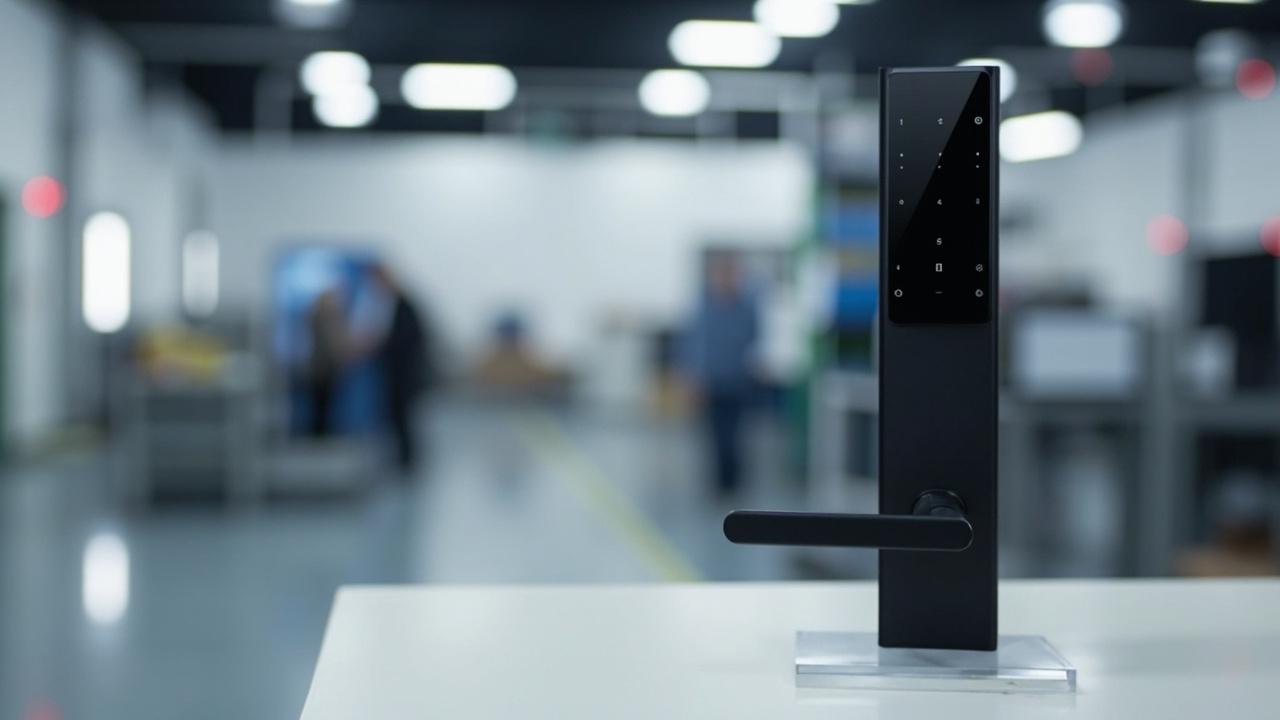
Smart Locks for Cafes
The cafe sits on the ground floor of a three-storey walk-up: ten covers at the bar, six at the window ledge, an espresso machine with two groups, a single grinder, a back room the size of a shipping container, and a toilet door that opens onto a corridor shared with the upstairs tenants. Lena runs it on her own for the first six months. She opens at 6:30 a.m. on weekdays, 8 a.m. on Saturdays, and she is closed on Sundays. There is no host. There is no manager. There is a key on a ring that, until last winter, had been lent to the roastery driver twice a week, copied once for the upstairs tenants to use the toilet, and re-cut once after the cleaner lost hers in a snowbank.
Lena had decided, in the quiet way these decisions get made, that she was done with that ring. She had also decided, less quietly, that the cafe does not have time for a security project. She wants a lock on each door that the cafe actually opens and closes during the day, a routine she can run with one other person at the busiest moment, and a December-in-a-year's-time audit log she can read on a Tuesday morning when the upstairs tenants ask who let themselves in last Tuesday evening. This is what that first year actually looks like when the cafe is small enough that the owner is also the buyer.
The answer in one paragraph
Direct answer: a smart lock for a cafe is an electronic lock with at least one credential lane beyond a plain metal key — passcode, card, fingerprint or app/Bluetooth — that lets one owner-operator open a small set of shop doors on a counter-service cadence without copying keys for the roastery driver, the upstairs tenants or the cleaning contractor; the published category on smartlockfactory.com covers 79 models across keypad, fingerprint, RFID, Bluetooth, hotel, cabinet, face-recognition, glass-door, video-camera and outdoor families, with multiple unlocking methods on most units, so the procurement question for a cafe is not "is there one for a coffee shop" but "which lane set fits the four-to-six doors this particular cafe actually opens during a working day." Every specific capability a buyer relies on — user capacity, time-limited codes, app dependency, mechanical-key fallback, battery life, door-thickness range, weather rating on the back-of-house door, audit-log behaviour on the toilet door — is a product-page question and must be confirmed there before the order goes in.
How the first year is laid out
The story below follows the cafe across its first year. The whole timeline reads as a process, with entry conditions and exit artefacts at each stage: the two weeks before opening, the first morning the lock holds the cafe open, the mid-shift flow at 10 a.m., the quiet-hour stretch between two and four in the afternoon, the late close, the Sunday adjustment, and the three-, six- and twelve-month moments when the lock either fades into routine or comes back to bite. Three siblings sit beside it. Smart locks for restaurants treats the larger kitchen brigade, dining-room turnover and host-station cadence of a 60- to 120-cover dining room — if the question is about a full-service restaurant, start there. Smart locks for retail stores reads a single shop floor through customer-entry front-door and stockroom-back-door discipline. Smart locks for small offices is the studio-offices neighbour with the same single-owner profile but a daytime rather than early-morning cadence. If the question is what the first year actually feels like for the person who opens the cafe, runs it alone through the quiet hour, locks up at close and adjusts the schedule on Sundays, this is the one.
The two weeks before the espresso machine lands
Lena did not start with a brand. She started with a count of the doors the cafe actually uses, taken on a Saturday morning while she was sweeping the back room. The count is the spine of every later decision, because the locks do not cluster — they fan out by traffic pattern, and a single model on every door is rarely the right answer for a small cafe.
| Door | Who passes through | How often | What the door rules in or out |
|---|---|---|---|
| Front cafe door (street-facing) | Customers, baristas, couriers, the postman | Continuous during open hours | A credential the barista can re-issue in minutes when a regular shows up; rules in app and time-limited code, rules out a single biometric template the cafe cannot rotate |
| Back-of-house door (service alley) | Baristas, roastery driver, produce vendor, plumber, landlord | 4 to 12 openings on a weekday, 0 on Sunday | A credential that tolerates weather, a hand-truck bang and a non-staff user the cafe can revoke; rules in outdoor-class hardware, rules out a residential-class lock not specified for back-of-house exposure |
| Upstairs tenants' toilet door (shared corridor) | Upstairs tenants, customers asking to use the toilet, cleaners | 30 to 80 openings per day | A credential that is fast, cheap to issue and easy to revoke; rules in keypad, rules out a fingerprint reader where the upstairs tenants refuse biometric enrolment |
| Produce cupboard (back room) | Lena and one other barista | 2 to 4 openings per service | A credential tied to one or two named people, with an audit trail that survives a roastery-driver misdelivery; rules in app and biometric, rules out a shared code on a post-it |
| Cleaning cupboard (under the bar) | Cleaner, Lena | 1 opening on weekday evenings, 2 on Saturdays | A credential issued and expired on a known window; rules in time-limited code |
Five doors. Three traffic patterns — customer-facing, back-of-house staff-and-vendor, and shared service. Two more — the upstairs-tenants' toilet door and the produce cupboard — that the cafe did not even realise it was locking the day it signed the lease.
The next step is the hard one: deciding which door is the lock project and which door is not yet. Lena put the front door and the back-of-house door on a single order because they share a credential platform. She put the upstairs-tenants' toilet door on a separate order because the tenants are their own admin population. She deferred the produce cupboard and the cleaning cupboard to a second-quarter order, after she had watched the cafe run for sixty days.
Day one at 6:30 a.m.: the box lands and the cafe opens
The locks arrived on a Tuesday. Lena installed the front-door lock between the espresso machine commissioning and the bread delivery. The arrangement was deliberate: she wanted the first customers to walk through a door that already had a code on it, because she did not want to remember the morning she handed a key to a stranger.
The front-door arrangement for a single-owner counter-service cafe is narrower than the same arrangement for an apartment building or a shared office. Three things have to be true on day one:
- The owner can open the door without the phone. Coffee shops open early. Baristas arrive before vendors. The credential that opens the door at 6:30 a.m. cannot be a credential that requires the Wi-Fi to be up, the app to be logged in, or the battery of a phone to be charged. A passcode, a fingerprint template, a card, or a mechanical key acts as the always-on lane; the app is the convenience lane on top.
- A second person can be issued a credential in under five minutes. Lena had a second barista starting on day eight. She had to be able to enrol that barista without calling anyone, without a service ticket, and without serialising the new barista behind herself. The owner-as-only-administrator arrangement breaks the moment a second trusted person appears on the rota.
- The mechanical key still works. Every credential platform documented on the product pages — the app/Bluetooth lanes via TTLock, Tuya or Doodle depending on the model — sits on top of a mechanical keyway. The mechanical key is not a fallback that "almost no one uses." It is the lane the cafe uses on the morning the lock's batteries are dead and the cafe has eighty people outside.
The back-of-house door has the same three rules, plus one more. The weather exposure has to match the catalog's outdoor-class design, not borrowed sideways from a residential SKU. The 10-model outdoor family, plus the narrow-edge SKUs in the 4-in-1 class for aluminium back doors, is the right vocabulary; a residential keypad mounted on a steel back door with rain hitting it directly is not. Confirm the door's thickness range, the gasket spec, and the temperature range on the product page for the exact model that lands on the back door.
Mid-shift at 10 a.m.: the second barista, the first rush
The 10 a.m. rush is the first moment the cafe is not single-operator. It is the first moment Lena has handed a credential to another person and trusts it to work in front of a queue. It is also the first moment the failure mode is visible: a customer is waiting, the barista is mid-pour, and the credential does not behave.
| Mid-shift event | What it tests | What works | What fails |
|---|---|---|---|
| Second barista's first open at 9:45 a.m. | Credential enrolment speed | A passcode written once into the admin app, or a fingerprint enrolled at the door in under a minute | A biometric-only lock with a 30-second enrolment and no admin code |
| Roastery delivery at 10:30 a.m. | Vendor credential expiry | A one-shot code with a four-hour window, issued from the admin app | A permanent code taped to the back door that survives the roastery-driver's tenure change |
| Plumber arriving unannounced at 11 a.m. | Ad-hoc credential issue | An owner who can issue a temporary code from the admin app on the bar in under a minute | An admin-only model where the barista cannot issue a code without the owner present |
| Customer asking to use the toilet at 11:15 a.m. | Toilet-door credential UX | A numeric keypad on the toilet door with a code the upstairs tenants and the customers share, changeable monthly | A biometric reader on a customer-access door where customers refuse to enrol |
The lesson of the first week is that the cafe does not have one lock problem; it has a credential-UX problem across five doors, each with a different admin population. The front door is owner-and-staff. The back-of-house door is owner-staff-and-vendor. The upstairs-tenants' toilet door is owner-tenants-cleaners. The produce cupboard is owner-and-one-barista. The cleaning cupboard is owner-and-cleaner. Five admin populations, each on their own door, with their own credential lifecycle.
Through the quiet hour: the long middle of a cafe day
The quiet hour is the 2-to-4 p.m. stretch every weekday cafe owner recognises. The morning latte rush has ended. The afternoon espresso crowd has not arrived. Lena is alone, the cafe is empty, and the day-to-day noise is the milk steamer cycling and the dish pit. It is the hour when the lock either becomes invisible or becomes a small project of its own.
Three things happen in the quiet hour during the first year:
The lock learns the cafe. The first month, Lena checked the admin app after every opening. By month three, she had not opened the admin app in a week. By month six, she opened it on Tuesdays to download the previous week's audit log for the upstairs-tenants' toilet door — not because the toilet door was a problem, but because the upstairs tenants asked, twice a year, who else had used the toilet on a particular Tuesday evening. Confirm on each model's product page whether the audit log is downloadable in a format the cafe can email the upstairs tenants' representative without a paid plan or a vendor subscription; some models ship with the records on-device, others require the app.
The lock gets small grants from the cafe. Month four, Lena noticed the back-of-house keypad's rubber buttons were wearing down from the produce vendor's rapid punch. She asked the supplier for replacement-gasket pricing rather than replacing the whole lock. The right answer at that point in a small-cafe ownership arc is not to swap the whole lock; it is to ask what the warranty does not cover (which is a written-supplier question, not a catalog paragraph), and to plan a spares budget against what the catalog does not promise.
The lock gets one early failure. Month five, the front-door lock ran out of batteries during the 6:30 a.m. open. Lena had a fresh set of four AAs on the shelf — she had started buying them in month one, on the supplier's recommendation — and the swap took four minutes. The cafe opened at 6:36 a.m. instead of 6:30. The lesson was not the inconvenience; it was the fact that the battery format was the format the product page named. If the lock had taken a battery the local hardware store did not stock, the cafe would not have opened at all that morning. The four-AA format that several models in the catalog share — the same format named on the hotel-class PDP for the SLK-9936S, with battery operating cycles above 15,000 — is a deliberate design choice by the factory, not a coincidence; it is the format a small cafe can stock.
| Quiet-hour routine | Owner task | Lock capability that does it | What to check against the model specification |
|---|---|---|---|
| Monday morning | Download the previous week's toilet-door audit log | App-based log export on the Bluetooth/app lane | Whether log export is on-device, in-app only, or behind a paid plan |
| Tuesday | Check that all five doors still respond on the first try | Mechanical-key fallback and credential health readout | Battery-low warning latency from the lock to the admin app |
| First of the month | Replace batteries on any lock that crossed the 12-month mark | Battery format and operating-cycle rating | Battery count, type, and rated operating cycles per model |
| Quarterly | Re-issue all tenant and cleaner credentials | Time-limited code issuance and revocation | Maximum user count, maximum active codes, time-window granularity (minutes, hours, days) |
| Annually | Re-enrol every staff fingerprint if the lock uses fingerprint | Biometric template update procedure | Re-enrolment time, template capacity, failure-to-enrol behaviour |
The owner operator who treats the quiet hour as the lock's natural review window — five minutes on a Tuesday, once a week — will make better decisions about the lock than the owner who treats the lock as a one-time purchase and only remembers it when it fails.
The late close alone: locking up at 8 or 9 p.m.
The late close is the second point in the day where the cafe is single-operator, and it is the point where the lock either holds the cafe or breaks the rhythm of the owner going home. A cafe that closes alone is a cafe where the lock has to give the owner one thing the day-to-day does not: a verifiable close.
The verifiable close has four components, all of them small:
- A single action that locks every door at once. Some models support a "lock-all" sequence from the admin app; others require each door to be locked independently. For a single-owner cafe, the first option is enough to justify the lock by itself — the owner does not have to walk from the back of the cafe to the front of the cafe to verify in writing the back-of-house door is sealed.
- An audit trail of the close. The audit log records who locked and when. If the cafe has a second barista closing while Lena opens the next morning at 6:30 a.m., the audit log tells both of them who held the keys — literally — for the night.
- A mechanical override the owner is not afraid to use. The mechanical-key override is the lane the owner uses when the lock's batteries die at 9:15 p.m. on a Tuesday and the cafe has to close in twenty minutes. Check the model’s published specification that the mechanical-key override is documented for use-case "battery-dead at close," and that the key itself is the format the owner can take to a local locksmith if she loses it.
- A neighbour-of-record. The upstream tenants, the landlord, the neighbour with the espresso knock box — each of them has a fall-back contact, and the lock's audit log gives the cafe a way to answer the question they ask after the fact.
The late close is also the moment when the first-year cafe owner faces a small decision about what is not yet on the lock. Lena did not, in her first year, install a camera-integrated lock. She did not install a 4G-connected model. She did not install a face-recognition reader on the customer-facing toilet door. Each of those would have solved a problem she did not yet have, and each would have introduced a credential population she would have to administer without a manager. The right answer at the late close is the lock she already has, working as documented, with a one-line verification at the end of the night.
The Sunday adjustment: a different cadence, not a worse one
Sunday is the day the cafe's rhythm changes most. Some independent cafes close on Sundays. Lena's cafe closed on Sundays for the first four months and then, at month five, opened on Sundays from 8 a.m. to 2 p.m. because the upstairs tenants asked. The decision is small but it changes four things on the lock side:
- The Sunday open is single-operator for the entire shift. Lena opens alone, serves alone, and closes alone. The mechanical-key override is the primary credential lane for the Sunday open, because the Wi-Fi is sometimes flaky on a Sunday morning (the cafe's router runs an automatic Saturday-night backup, and the restoration occasionally takes longer than the café's Wi-Fi extender takes to recover). A lock with a non-network-dependent primary lane — passcode, fingerprint, or mechanical key — is the right lock for the Sunday schedule.
- The Sunday schedule demands a different credential rotation. The customers are not regulars. The upstairs tenants are not asking to use the toilet every Sunday. The cleaner is not coming on Sundays. The credential rotation for the Sunday schedule is much narrower than the weekday rotation, and it is easier to administer if the weekday and Sunday credentials are issued from the same admin app with different windows.
- The Sunday close happens earlier, in daylight. The owner locks the cafe in winter-light at 2 p.m. on Sundays and in summer-light at 2 p.m. on Sundays. The photographic conditions of the close are different from the weekday close at 9 p.m., and a lock whose keypad is hard to read in late-afternoon glare is a different lock from one whose keypad has a small backlight. Check the model’s published specification for any model under consideration whether the keypad is backlit and, if so, what the brightness spec is.
- The Sunday open tests the audit log the upstairs tenants ask about. The upstairs tenants' toilet door sees Sunday traffic that is different from weekday traffic. The audit log the cafe pulls on Tuesday morning will have a Sunday block in it. The cafe owner should know — before month six — what format that audit log is in (CSV export, PDF, in-app view), whether it is on-device or in-app only, and whether it survives a battery swap.
The Sunday schedule is not an inconvenience for the lock. It is a different test, in the same way the 10 a.m. rush and the 2 p.m. quiet hour are different tests. A lock that passes the weekday test and the Sunday test has passed the first year.
The first month: vendors, deliveries, and the first angry email
The first month of cafe life is not the time to introduce a new credential. The first month is the time to issue the minimum credential set and watch how the cafe actually uses the doors. Lena ran the first month with three credentials on the front door (Lena, the second barista, the cleaner), two on the back-of-house door (Lena and the second barista), one on the upstairs tenants' toilet door (a code the upstairs tenants agreed on), one on the produce cupboard (Lena), and none on the cleaning cupboard (the original key). The vendor population — the roastery driver, the produce vendor, the bread delivery, the milk delivery — was issued a one-shot time-limited code on the morning of the delivery, not a standing credential.
This is the discipline that survives the first month:
| Vendor | Default credential | When re-issued | When revoked |
|---|---|---|---|
| Roastery driver | One-shot code, weekday 5 a.m.–noon | Each Monday for that week | At the end of the same week |
| Produce vendor | One-shot code, delivery morning only | At the order email, 24 hours before delivery | At the end of the same day |
| Bread delivery | Standing code, weekday 5 a.m.–7 a.m. | Quarterly | At the end of the quarter |
| Milk delivery | Standing code, weekday 5 a.m.–8 a.m. | Quarterly | At the end of the quarter |
| Plumber / electrician | One-shot code, morning of visit | At the booking confirmation, morning of visit | At the end of the visit |
| Landlord's inspector | One-shot code, with 48-hour notice | At the inspection booking | At the end of the inspection |
The first angry email arrived in week three, from a milk-delivery driver who had been given a code on Wednesday morning and arrived on Thursday morning to find the code already revoked. Lena's response — which is the canonical first-year response — was to map every vendor's actual arrival window against the code's validity window, and to lengthen the standing code for the milk-delivery driver to a quarterly reissue because the milk-delivery operation is more stable than the roastery-delivery operation. This is the first lesson: codes are not right or wrong, they are tuned to the cadence of the door they sit on.
The week-one vendor rhythm Lena settles on, drawn as an issuance sequence for the back-of-house door (whether a given model supports one-shot windows and auto-expiry is a product-page confirmation):
sequenceDiagram
    participant O as Cafe owner
    participant A as Admin app
    participant V as Roastery driver
    participant L as Back-of-house lock
    O->>A: issue one-shot code · Monday window
    A-->>O: code active · weekday 5:00-12:00 only
    V->>L: enter code on delivery morning
    L-->>V: door opens · event recorded
    Note over L: code expires at window end
    O->>A: re-issue each Monday · revoke on rotation change
The 3-month mark: the first time the lock stayed in
Three months into the first year is the moment when the lock either fades into the cafe's routine or comes back as a project. Lena's lock faded. Three months in, Lena opened the cafe on a Tuesday, locked it on Tuesday evening, and did not think about the lock at all during the day. The audit log had not been checked for nine days. The batteries were not on Lena's mental list of things to buy that week.
The 3-month mark has three lessons:
- The lock is not the project. The lock is the boundary of the project. The project is the cafe. Owners who remember this treat the lock as something to administer when it needs administrating, not as the centre of a daily ritual.
- The audit log is the answer to questions the cafe gets asked. The upstairs tenants' representative asks, every six weeks, who used the toilet last Tuesday evening. Lena answers from the audit log, not from memory. The audit log is not a security tool — it is a customer-service tool that happens to also be a security tool.
- The batteries are the only physical consumable. Lena now buys four AAs every quarter. The four-AA format, common across several models in the catalog including the hotel-class family that uses them with operating cycles above 15,000, is the cheapest insurance against a 6:30 a.m. lock-out. Confirm on each model's product page whether the lock has a low-battery warning that reaches the admin app, and how many days of warning the lock gives.
The 6-month mark: hiring the second barista
Six months in, Lena hired a second barista for the Sundays and the Saturday shift. The hire changed three things on the lock side:
- Two people, one admin population. The owner-and-one-barista arrangement becomes a three-person admin population — Lena, her first barista, and the new hire. The admin-app permissions are no longer "Lena can do anything" and "the barista can open the door." They are a tiered model: Lena can issue and revoke; the baristas can open the door and view the audit log; the cleaners can open one door only, on a windowed credential.
- One barista hands over to the other. The Saturday shift ends at 6 p.m. The Sunday shift starts at 8 a.m. The interim is fourteen hours during which the cafe is closed but the upstairs tenants' toilet door is shared. The credential populations on the two shifts overlap on the toilet door and on the front door, but the cleaner does not have the front-door credential on Sundays. Administering the overlap is the work the cafe does in week one of the new barista's tenure.
- The lock's user-capacity ceiling approaches. A small cafe runs out of user slots faster than the catalog's residential-class locks anticipate. A four-person household does not stress a credential manager; a cafe with three baristas, two cleaning contractors, four vendors and a rotating group of upstairs tenants does. Confirm the user-capacity figure on the product page for the model under consideration before placing the order. The right answer for the 6-month cafe is not the same lock the cafe opened with at month one.
The 12-month mark: the second winter
Twelve months in, the cafe has run through a winter, a summer, and a second winter. The lock that worked in year one is being asked to do the same job in year two, but the cafe itself has changed: a third barista, a Saturday-night tasting event, a new neighbour who wants to use the espresso knock box, a second landlord inspection. The 12-month mark is the moment to revisit four questions the first year either answered or skipped:
- Has the lock been the bottleneck or the servant? If it has been the bottleneck, the cafe has spent first-year attention on the lock; if it has been the servant, the lock has been invisible. The right answer for year two is to design for invisibility — replace the lock before it becomes the bottleneck, not after.
- Has the audit log earned its keep? If the cafe has used the audit log more than ten times in the year — for the upstairs tenants, for an insurance claim, for a vendor dispute — the lock has paid for itself. If not, the cafe might not need the level of auditability the lock provides, and a simpler lock might be appropriate for year three.
- Has the credential rotation stayed disciplined? If yes, the lock has done its work. If no — if a one-shot code has become a standing code because no one revoked it — the cafe's discipline has slipped, and the lock has not caught it.
- Is the lock still on the right door? Year two might mean a rearrangement of the cafe's internal floor — the produce cupboard becomes the cleaning cupboard, the cleaning cupboard becomes a display shelf, the back-of-house door gets a new gasket. A lock is a fixture, not a permanent installation; the 12-month mark is the moment to decide which fixtures have to move.
What the catalog covers, and what it does not
Honesty about scope is the only thing that makes the lock recommendation credible. The published catalog at smartlockfactory.com holds 79 models across the categories. The categories the cafe conversation reaches into are the small-form single-door ones: 18 keypad models, 37 fingerprint models, 9 RFID models, 6 cabinet-class models for the produce cupboard and the cleaning cupboard, 10 outdoor-class models for the back-of-house door, and the multi-method hardware such as the SLK-8831 5-in-1 (fingerprint, password, card, key, app) on the front door. The narrow-edge 4-in-1 SKUs in the aluminium-door class fit the back-of-house door's profile when the cafe's back door is aluminium-framed rather than timber. The cabinet-class models sit on the produce cupboard, where the lock is closer to a latch than to a deadbolt and the credential population is small.
What the catalog does not do — and a cafe owner who pretends otherwise is buying a scope the cafe cannot deliver — is cross into the building systems above the door. There is no elevator-destination-dispatch credential, no building-management-platform integration, no channel-manager connection, no property-management-system handshake. The credential platforms documented on the product pages are TTLock, Tuya and Doodle, in the app/Bluetooth category; they are consumer-oriented credential platforms with admin apps, and they are right for a single-owner counter-service cafe in the way they are not right for a 60-cover dining room or a 4-tenant small office. Wireless-protocol families beyond those app/Bluetooth lanes — Matter, Zigbee, Apple Home Key, ultra-wideband presence — are not represented in the catalog and should not be listed on a cafe's RFQ. Palm-vein and finger-vein readers are not in the catalog either; the 37 fingerprint models use surface sensing in the optical, capacitive or semiconductor classes, with the exact class stated on each product page, and the appropriateness of fingerprint on a customer-facing toilet door is a separate decision from the appropriateness of fingerprint on the front door.
What the first-year cafe owner should ask the supplier
The right questions to put to a supplier at the end of year one, written into an RFQ email or a quote exchange, are the questions whose answers the product page cannot give. The list below is a starter, not a final form. Each row is a row the cafe owner should be ready to defend in writing, with a named-supplier answer attached.
| Question | Why it matters | Where it lives |
|---|---|---|
| What is the user capacity of the admin app on this exact model? | The 6-month cafe runs out of slots faster than a 4-person household | Product page; quote exchange confirms the figure |
| Does the audit log survive a battery swap? | The cafe loses power to the router during the Saturday-night tasting event | Product page; supplier confirmation in writing |
| What is the mechanical-key override format, and can a local locksmith cut a replacement? | The owner loses the mechanical key in week nine | Product page; local locksmith confirmation |
| Is the keypad backlit, and at what brightness? | The owner locks the cafe at 2 p.m. on Sundays in winter | Product page |
| What is the weather rating on the back-of-house lock? | The back-of-house door sees direct rain for nine months of the year | Product page; site-survey confirmation |
| Does the app issue one-shot and time-limited codes? | The vendor population rotates every week | Product page; app documentation |
| What is the maximum active-code count? | The cafe supports three baristas, four vendors and two cleaning contractors | Product page |
The cafe owner who asks these questions in writing, before the order is placed, is the cafe owner who will not, twelve months later, ask the same question under pressure. Each answer goes back into the cafe's lock folder — a single notebook, a single email thread, a single PDF — and each answer is the answer the upstairs tenants' representative will see if they ask.
Where this process stops, and where it hands off
This article stops at the 12-month mark. It deliberately does not cover the year-two expansion (a second location, a roasting operation, a wholesale channel), because the lock that fits a single cafe does not necessarily fit a two-cafe operation. The hand-off destinations, named so the cafe owner does not have to re-read everything:
- If the cafe becomes a two-cafe operation, the lock story stops being a single-owner management story and becomes a small-chain management story. The right next article is the multi-site counterpart in the operator's manual on this site.
- If the cafe adds a roasting operation behind the cafe, with a separate roastery door on the same back-of-house alley, the lock story adds a second back-of-house door and a higher vendor population. The roastery door is its own procurement.
- If the cafe becomes a 30-cover bistro with table service and a small kitchen brigade, the lock story moves off this article and onto the smart locks for restaurants sibling. The restaurant cadence is different: a 30-cover bistro opens at 11 a.m. for lunch, has a host station, has a small kitchen brigade and has a dishes-and-glassware back-of-house population the cafe does not.
For the cafe owner who, in month thirteen, decides the cafe is the cafe and the lock is the lock, no further reading is required; for the cafe owner who decides the cafe is the beginning of something larger, the right next read is one click away.
The right next move for the day you decide to buy is to request a quote. A quote conversation is the cheapest way to verify in writing the user-capacity, the audit-log behaviour, the weather rating and the credential-window granularity on the exact model you intend to install on each of the five doors this article has named. For independent buyers who want to put a model in their hand before they decide, the order-samples page is the second step — it returns a single unit of the model on the front door or the back-of-house door so the cafe owner can hold the keypad, feel the backlight, and read the product page over the espresso machine before the cafe signs off.