
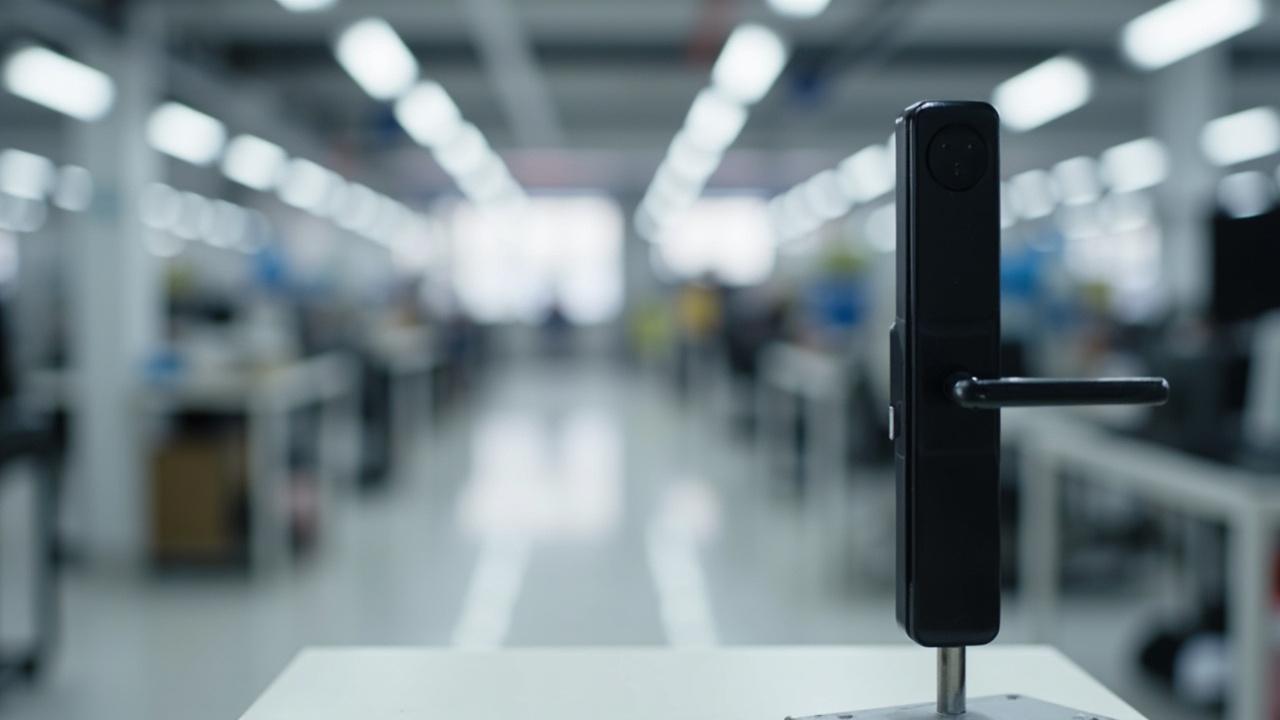
Smart Lock Coffee Black Finish
Smart-lock coffee black finish is a tinted dark-bronze tone — bronze-brown base darkened with a controlled black tint, sitting between true black and warm bronze in the broader finish palette — used on door hardware where buyers want the visual weight of black with the warmth of bronze and where the dark-bronze tonality reads as architectural rather than industrial. The standing rule is that per-model coffee-black availability must be confirmed on the product page; the SLK-9936S hotel-class lock is documented with "multiple finish options" only on its own row, never ported to siblings. Refurbishment is honestly framed: coffee black can be specified for some legacy lock classes and not for others, with the per-lock-class verdict running through a documented decision matrix.
This article reads as an annotated datasheet. It dissects the SLK-9936S "multiple finish options" spec line as documentation-granularity yardstick, situates coffee black in the finish palette alongside black, copper, and gold, names the environmental envelopes where the tone holds and where it does not, and routes refurbishment questions through a per-leg outcome line so the buyer walks into the RFQ with a defensible finish call rather than a colour preference.
What this datasheet does and does not do
This datasheet treats one specific finish tone — coffee black — as a procurement discipline, not as a colour swatch. It teaches by dissecting the real "multiple finish options" spec line item that the SLK-9936S hotel-class product page carries, so the buyer understands what the line item does and does not promise, and so the buyer applies the same discipline to every other SKU they evaluate.
The datasheet does three jobs. It places the tone in the finish palette relative to true black, copper, and gold so the buyer can talk about colour with engineering weight rather than marketing language. It lays out the environmental envelope — interior conditioned space, semi-outdoor covered exposure, marine-adjacent atmospheres, humidity cycles, UV load, traffic class — and names where coffee black holds and where it does not. It frames refurbishment honestly, with a per-legacy-lock-class verdict matrix that distinguishes locks that can be re-finished or replaced in coffee black from locks where the answer is "no, route to a different finish."
This datasheet does not do four jobs, and naming them up front prevents misuse. It does not publish per-SKU coffee-black availability as a list — every per-SKU availability figure routes to the verified product page per the standing rule. It does not assert any specific cycle count, IP class, salt-spray hour figure, or adhesion-pull threshold as a coffee-black numerical lock. It does not assert any held certification, factory stamp, third-party attestation, or factory-floor statistic as a coffee-black credential. It does not name a specific price, MOQ, lead-time window, warranty term, distributor, or end customer as a coffee-black commercial fact. Any of those numbers, where they matter, belong in the quote or the contract, not in the finish datasheet.
The finish spec block dissected — what "multiple finish options" actually carries
The SLK-9936S hotel-class product page carries the spec line "multiple finish options" under the SLK-9936S row. That line item is the only finish-line anchor this datasheet dissects as documentation-granularity yardstick. Every other SKU — SLK-9936G, SLK-9905A, SLK-9951TH, SLK-9962S, SLK-G200, SLK-8831, the SLK-1104-class narrow-edge family, SLK-3108, the cylindrical Tuya round-code lock, the 3D-face family, B09, the outdoor D11/D12/D15/ODS/DQ series, the cabinet 6-model family, the face 9L5-R/Q7/Future 1 group, the camera-intercom 516 / Q7 intercom / 4G set, the RFTC-RF card-and-code legacy family 118 through 760, and the stainless-keypad 019/022/309 group — gets its finish availability by routing to that specific SKU's verified product page. The firewall is strict: "multiple finish options" on SLK-9936S does not extend to siblings; it is documentation granularity, not a universal promise.
The dissection in the table below names what each phrase in the spec block does and does not promise, what to demand in writing, and what would be a bluff to accept at face value.
Spec-block dissection table
| Spec phrase (literal) | What the line means | What to demand in writing | What is a bluff |
|---|---|---|---|
| "multiple finish options" | The SKU ships with a finish menu greater than one, with the actual set living on the verified product page for that specific SKU. | The named finish set as a per-SKU list (coffee black, satin black, copper, gold, etc.) on the PDP, plus the per-finish sample availability on request. | A blanket "available in any finish" claim across the catalog, or a finish colour name applied as a category-wide promise. |
| "stainless steel + alloy body" | The substrate family the finish is applied to — a stainless + alloy body, not a plastic or zinc substrate. | The substrate spec on the PDP plus the finish-application method (PVD, electrophoretic, lacquer-over-brass, powder-over-zinc, anodize-on-aluminium) on request. | "Suitable for any substrate" or "finish carries the substrate" — substrate carries substrate load, finish carries finish load. |
| "mechanical emergency access" | The lock retains a mechanical key path under power-loss conditions; the finish must tolerate key insertion wear at the cylinder escutcheon. | The mechanical-override path geometry plus the finish-wear expectation (handle wear, key-slot wear, thumb-turn wear) per finish tone. | "Mechanical wear does not affect finish" — every finish shows wear at high-traffic bearing points; the datasheet names where coffee black shows it cleanly. |
| "multilingual management software" | A platform-side claim, not a finish claim — included here to underscore that finish and electronics are decoupled and the buyer must verify both. | The platform lane (TTLock / Tuya / Doodle / hotel PC software) on the PDP plus the finish-set list. | Treating a platform lane as a finish-lane document. |
| "standalone or centralized database modes" | A deployment-shape claim about software, not a finish claim — finish is independent of deployment mode. | Per-SKU confirmation that the chosen deployment mode is available, separately from the finish set. | Assuming a centralized deployment constrains or expands finish availability — it does not. |
| "1–5 star hotel positioning" | A market-positioning statement for the SKU, included here only so the buyer understands finish availability on hotel-class SKUs is wider than on residential SKUs in the catalog. | The SKU's per-finish availability list on the verified product page for the specific SKU, not for "hotel locks as a class." | A blanket "hotel-class locks come in any finish" inference — finish is per-SKU, not per-category. |
The discipline that the dissection table teaches is the one the buyer must apply to every finish-related spec line on every SKU: name the literal phrase, name what it promises, demand the per-SKU confirmation on the verified product page, and treat any extension beyond that SKU as a bluff.
Where coffee black sits in the finish palette
Finish tones in the smart-lock catalog sit on a spectrum from cool to warm, from light-reflective to light-absorbing, from neutral to chroma-loaded. Coffee black is a tinted dark-bronze tone — bronze-brown undertone darkened with a controlled black tint — and that places it on the warm-dark side of the spectrum, between true black (cool-dark, near-achromatic) and warm bronze or copper (warm-light, chroma-loaded). The siblings that the C11 Materials/Specs cluster documents — black, gold, copper, and the surface-finishes umbrella — define the surrounding tone families, and coffee black is the warm-cool-dark bridge between them.
The table below positions the four documented tones relative to one another so the buyer can talk about finish with engineering weight rather than colour preference.
Finish-palette position table
| Finish tone | Tonal position | Typical substrate pairing | Best-fit environment envelope | Sibling reference |
|---|---|---|---|---|
| True black (satin black / matte black) | Cool-dark, near-achromatic, low chroma | Stainless + alloy body, anodized aluminium, zinc die-cast under powder coat | Interior conditioned space, semi-outdoor covered, low-UV zones | Smart Lock Black Finish |
| Coffee black (this datasheet) | Warm-dark, tinted dark bronze, low-to-mid chroma, bronze undertone | Stainless + alloy body with bronze-tinted PVD or electrophoretic dark-bronze deposit | Interior conditioned space, hospitality corridors, mid-traffic commercial door | This article |
| Copper | Warm-light, mid-to-high chroma, red-orange undertone | Brass substrate, bronze substrate with clear lacquer, copper-plate over brass | Interior accent doors, hospitality lobby accents, low-wear display hardware | Smart Lock Copper Finish |
| Gold | Warm-light, mid chroma, yellow undertone | Brass substrate with gold-tone finish, anodized aluminium on gold-tone spectra | Interior accent doors, hospitality VIP floors, residential statement doors | Smart Lock Gold Finish |
The table reads as a procurement matrix because each finish tone is mapped to its typical substrate, its environmental envelope, and its sibling reference. The buyer reads the matrix and asks: does my project's tonal direction match the finish tone's typical pairing, and does my project's environment match the finish tone's best-fit envelope?
The coffee-black tone family — composition and tonal position
Coffee black, as a tone family, sits at the intersection of three finish disciplines: the bronze-brown undertone that comes from a bronze-bearing substrate or a bronze-tone interlayer, the darkening tint that absorbs visible light and pushes the apparent reflectance down, and the surface texture that determines how the finished surface scatters the light it does reflect. The interplay of those three determines whether the installed lock reads as architectural bronze, as industrial black, or as the warm-dark hybrid the tone is meant to deliver.
The tonal position table below names each component of the coffee-black tone family, the way it is typically delivered, and the tonal effect it produces.
Coffee-black tone composition table
| Component | What it does | Typical delivery | Tonal effect | What to verify on the PDP |
|---|---|---|---|---|
| Bronze undertone | Carries the warm chromatic signal that distinguishes coffee black from true black. | Bronze-tone interlayer (PVD bronze-tone deposit, bronze-tone electrophoretic deposit) over stainless + alloy body, or bronze-bearing substrate with controlled darkening tint. | Without bronze undertone the tone reads as industrial black; with strong undertone the tone reads as warm bronze. | The substrate spec plus the finish-application method on the verified product page for the SKU. |
| Black tint | Darkens the bronze undertone and pulls apparent reflectance down. | Controlled dark tint applied over the bronze-tone layer, with tint density calibrated to the target tone. | Higher tint density yields a cooler, darker coffee black; lower tint density yields a warmer, lighter coffee black. | The finish-tone description (coffee black / dark bronze / oil-rubbed bronze tone) on the PDP. |
| Surface texture | Determines how the finished surface scatters light and how it shows handling marks over time. | Brushed, satin, matte, or low-gloss clear-coat over the tinted bronze-tone deposit. | Higher gloss reads as "newer" for longer; matte reads as architectural and ages with visible character. | The surface-texture spec on the PDP and the handling-mark expectation on request. |
| Clear-coat or seal | Protects the tint and the bronze undertone from handling wear and from atmospheric exposure. | Clear lacquer over the tinted deposit, or a sealed PVD layer where the chemistry data supports it. | A well-specified seal keeps the tone stable across the wear envelope; a poorly specified seal lets the bronze undertone shift under handling. | The seal spec on request, particularly for semi-outdoor and humidity-exposed environments. |
The discipline the table teaches is that coffee black is a system, not a single colour: the bronze undertone, the darkening tint, the surface texture, and the protective seal each contribute, and any one of them being off-spec shifts the tone away from the architectural warm-dark the finish is meant to deliver.
Read as a build sequence, the coffee-black system assembles layer by layer from substrate to seal, exactly as the composition table above sets out:
flowchart TD
    A["Substrate · stainless + alloy body"] --> B["Bronze undertone · bronze-tone PVD or electrophoretic deposit"]
    B --> C["Black tint · controlled darkening layer pulling reflectance down"]
    C --> D["Surface texture · brushed, satin, matte, or low-gloss clear-coat"]
    D --> E["Protective seal · clear lacquer or sealed PVD layer"]
    E --> F["Installed tone · warm-dark coffee black between true black and warm bronze"]
    E -.->|"seal off-spec"| G["Bronze undertone shifts under handling"]
    C -.->|"tint density off"| H["Tone drifts cooler-dark or warmer-light"]
Environmental fit — interior, semi-outdoor, marine, humidity, UV, traffic class
Coffee black's environmental envelope is narrower than true black's and wider than copper's or gold's. It tolerates interior conditioned space well, holds up under semi-outdoor covered exposure with the right seal specification, ages visibly under UV load at a rate that the buyer can plan for, tolerates humidity cycles within a documented band, and the traffic class it can carry depends on the substrate and the seal rather than on the tone itself. The buyer evaluates environmental fit by reading the per-environment line of the scorecard below and routing any "verify" or "frozen" cell to the verified product page for the SKU.
Per-environment coffee-black fit scorecard
| Environment | Coffee-black fit | What determines the verdict | What to verify on the PDP / with supplier |
|---|---|---|---|
| Interior conditioned space (office, apartment interior, hotel guest-room) | Fits well | Substrate + seal stability under stable humidity and temperature. | Substrate spec, seal spec, finish-tone description on the verified PDP for the SKU. |
| Interior high-traffic (hotel corridor, apartment common area, office lift-lobby) | Fits with traffic planning — coffee black shows handling marks at handle, key-slot, and thumb-turn at a different rate than true black. | Surface texture (matte vs satin) and seal class. | Surface-texture spec, handling-mark expectation on request, seal spec. |
| Semi-outdoor covered (apartment entry canopy, hotel porte-cochère, covered walkway) | Fits with seal discipline — covered exposure reduces direct UV and direct rain but introduces humidity cycling. | Seal class under humidity cycle, bronze undertone stability under humidity. | Seal spec, humidity-cycle expectation on request, substrate spec. |
| Outdoor exposed (perimeter gate, exterior wall, marine-adjacent facade) | Verify per SKU — coffee black's environmental envelope is SKU-dependent, not tone-determined. | The SKU's outdoor-rated posture plus the seal spec. | The SKU's outdoor-rated line on the verified PDP, the IP-class posture on request, the seal spec. |
| Marine-adjacent atmosphere (coastal property, salt-air exposure) | Verify per SKU — atmospheric chemistry matters more than tone for marine envelopes. | Substrate class, seal class, salt-spray posture if any. | Substrate spec, seal spec, salt-spray posture on request — note that no salt-spray hours, no IP-class numbers, no held attestations are asserted in this datasheet. |
| High-UV interior (atrium glass wall, conservatory, skylit lobby) | Fits with UV planning — coffee black's bronze undertone can shift under sustained UV at a rate that the buyer can plan for. | Seal class against UV, surface-texture spec. | Seal spec, UV-stability expectation on request. |
| High-humidity interior (pool-area corridor, spa entry, wet-change room) | Verify per SKU — humidity cycling interacts with the seal and with the bronze undertone. | Substrate class, seal class, humidity-cycle expectation. | Substrate spec, seal spec, humidity-cycle expectation on request. |
The scorecard reads as a per-environment decision tool: each environment maps to a fit verdict, a determining factor, and a verification path. The buyer reads the row for their project's environment and routes any "verify" cell to the verified product page for the SKU under evaluation.
Refurbishment of older locks — when coffee black can and cannot be specified
Refurbishment of older locks with coffee black is honestly framed: some legacy lock classes can be re-finished in coffee black, some can be replaced lock-for-lock in coffee black, and some cannot be specified in coffee black at all. The verdict depends on the legacy lock class, the substrate, the mechanical envelope, and the door population. The buyer evaluates refurbishment by reading the per-legacy-lock-class verdict line and applying the standing per-SKU rule to the specific lock they intend to refurbish.
The refurbishment verdict matrix below covers the four legacy lock classes that most often come up in refurbishment conversations.
Refurbishment verdict matrix
| Legacy lock class | Coffee-black verdict | Why | What to verify on the PDP / with supplier |
|---|---|---|---|
| Stainless-keypad legacy (019 / 022 / 309 and related stainless-keypad roster) | Re-finishable with verification | Stainless substrate accepts bronze-tone interlayer and darkening tint under the right finish process; seal class determines long-term stability. | The refurbishment-route availability on the verified PDP, the substrate spec, the seal spec, the finish-process compatibility. |
| RFTC-RF card-and-code legacy (118, 118E, 228, 230, 232, 238, 239, 253, 305, 306, 308, 309, 502, 620, 621, 911, 002, 019, 022, 2020, 760 — with stainless 019/022/309 noted) | Replace lock-for-lock in coffee black with verification | Card-and-code legacy locks typically have mechanical envelopes that the current catalog covers; the finish-tone decision is independent of the card-and-code posture. | The replacement-SKU availability in coffee black on the verified PDP for the specific SKU, the mechanical envelope fit, the platform-lane transition path. |
| Cylindrical mechanical legacy (residential and light-commercial cylindrical locks being upgraded to smart locks) | Replace lock-for-lock in coffee black with verification | Cylindrical mechanical locks typically re-fit to current cylindrical smart-lock families; the finish-tone decision is independent of the cylindrical-to-smart transition. | The replacement-SKU availability in coffee black on the verified PDP, the backset envelope fit, the bore pattern fit. |
| Mortise mechanical legacy (commercial mortise locks being upgraded to hotel-class smart locks) | Replace lock-for-lock in coffee black with verification — multiple-finish posture applies to SLK-9936S only | Mortise-mechanical legacy locks typically re-fit to the SLK-9936S-class hotel locks; the multiple-finish posture from the SLK-9936S spec block applies only to the SLK-9936S, and every other mortise-class SKU routes to its own verified PDP. | The replacement-SKU availability on the verified PDP for the specific SKU, the mortise pocket fit, the multi-point latch posture, the platform-lane compatibility. |
The matrix reads as a per-legacy-class procurement tool: each legacy class maps to a coffee-black verdict, a reason, and a verification path. The buyer reads the row for their legacy class and routes the verification path to the verified product page for the specific SKU under evaluation.
Decision matrix — when coffee black is the right finish call
The decision matrix below condenses the environmental-fit and refurbishment-verdict material into a single per-scenario tool. Each scenario combines a project class and a finish-direction call, and each row produces a verdict, a reason, and a verification path.
Coffee-black decision matrix
| Scenario | Coffee-black verdict | Why | Verification path |
|---|---|---|---|
| New-build hospitality (hotel guest-room, corridor, back-of-house) with warm-dark interior design direction | Coffee black is a defensible finish call | Warm-dark hospitality interiors read coffee black as architectural; the bronze undertone ties to bronze-tone hardware on lobby doors and signage. | Verify per-SKU finish set on the verified PDP for the specific hotel-class SKU under evaluation; SLK-9936S multiple-finish posture applies only to SLK-9936S. |
| New-build hospitality with cool-light interior design direction (white, glass, neutral tones) | Coffee black is a tone-break call — verify the design intent before specifying | Cool-light interiors read coffee black as visual weight; the buyer should confirm the design intent before specifying. | Verify design intent with interior designer; verify per-SKU finish set on the PDP. |
| Residential interior (apartment entry, villa entry, residential interior door) | Coffee black is a defensible finish call where warm-dark hardware direction is established | Residential interior doors with warm-dark hardware direction (bronze-tone lever handles, dark-bronze hinges) tie to coffee black. | Verify per-SKU finish set on the verified PDP for the specific residential-class SKU. |
| Residential interior with cool-light hardware direction | Coffee black is a tone-break call — verify the design intent before specifying | Cool-light hardware direction reads coffee black as visual weight; the buyer should confirm the design intent. | Verify design intent; verify per-SKU finish set on the PDP. |
| Office interior (private office, executive suite, boardroom) | Coffee black is a defensible finish call for warm-dark hardware direction | Executive offices with warm-dark hardware direction read coffee black as architectural statement. | Verify per-SKU finish set on the verified PDP. |
| Office interior cool-light direction | Coffee black is a tone-break call | Cool-light office interiors read coffee black as visual weight. | Verify design intent; verify per-SKU finish set on the PDP. |
| Semi-outdoor covered entry (apartment canopy, hotel porte-cochère) | Coffee black is a defensible finish call with seal discipline | Semi-outdoor covered exposure with the right seal spec reads coffee black as warm-dark architectural hardware. | Verify per-SKU finish set, verify seal spec, verify humidity-cycle expectation on the PDP and on request. |
| Outdoor exposed or marine-adjacent | Verify per SKU — coffee black's environmental envelope is SKU-dependent | Atmospheric chemistry and substrate class matter more than tone for outdoor and marine envelopes. | Verify per-SKU finish set, verify outdoor-rated posture on the PDP, verify seal spec on request. |
| Refurbishment of stainless-keypad legacy (019 / 022 / 309) | Coffee black is a defensible refurbishment call with verification | Stainless substrate accepts bronze-tone interlayer and darkening tint; seal spec determines long-term stability. | Verify refurbishment-route availability, substrate spec, finish-process compatibility on the PDP. |
| Refurbishment of cylindrical mechanical legacy | Coffee black is a defensible refurbishment call with verification | Cylindrical-to-smart transition is independent of the finish-tone decision. | Verify replacement-SKU availability in coffee black, bore pattern fit, backset envelope fit on the PDP. |
| Refurbishment of mortise mechanical legacy to hotel-class smart locks | Coffee black is a defensible refurbishment call with verification | Mortise-to-SLK-9936S-class transition is independent of the finish-tone decision; the SLK-9936S multiple-finish posture applies only to SLK-9936S. | Verify replacement-SKU availability on the PDP for the specific SKU, mortise pocket fit, multi-point latch posture. |
The matrix reads as a per-scenario procurement tool: each scenario maps to a verdict, a reason, and a verification path. The buyer reads the row for their scenario, applies the verdict, and routes the verification path to the verified product page for the specific SKU.
Per-model coffee-black availability — the standing rule
The standing rule is simple and load-bearing: per-model coffee-black availability must be confirmed on the verified product page for the specific SKU. The rule exists because the catalog spans 79 published models across 10 categories — smart door locks, fingerprint, hotel, keypad, outdoor, RFID, face recognition, cabinet, video camera, glass — and finish availability varies by SKU, by substrate, by platform lane, by deployment mode, and by the supplier's per-SKU finish menu. A blanket "coffee black is available across the catalog" claim would be a bluff; a per-SKU claim routed to the PDP is the procurement-grade discipline.
The per-model evidence firewall table below applies the standing rule to the SKU families that most often come up in coffee-black finish conversations.
Per-model evidence firewall
| SKU family | Per-SKU coffee-black rule | Source | Firewall rule |
|---|---|---|---|
| SLK-9936S (hotel smart door lock, product-page-documented) | Check the model’s published specification — the "multiple finish options" spec line on SLK-9936S applies to SLK-9936S only. | product-page-documented SLK-9936S spec block. | Never extended to siblings. |
| SLK-9936G (hotel smart door lock) | Check the model’s published specification — independent of SLK-9936S. | Verified PDP for SLK-9936G. | Never ported from SLK-9936S. |
| SLK-9905A (hidden-reader hotel lock) | Check the model’s published specification — independent of SLK-9936S. | Verified PDP for SLK-9905A. | Never ported from SLK-9936S. |
| SLK-9951TH (hotel electronic lock) | Check the model’s published specification — independent of SLK-9936S. | Verified PDP for SLK-9951TH. | Never ported from SLK-9936S. |
| SLK-9962S (hotel electronic lock) | Check the model’s published specification — independent of SLK-9936S. | Verified PDP for SLK-9962S. | Never ported from SLK-9936S. |
| SLK-G200 (glass door smart lock) | Check the model’s published specification — independent of SLK-9936S. | Verified PDP for SLK-G200. | Never ported from SLK-9936S. |
| SLK-8831 (5-in-1 fingerprint/password/card/key/app) | Check the model’s published specification — independent of SLK-9936S. | Verified PDP for SLK-8831. | Never ported from SLK-9936S. |
| SLK-1104-class narrow-edge family | Check the model’s published specification — independent of SLK-9936S. | Verified PDP for the SLK-1104-class narrow-edge family. | Never ported from SLK-9936S. |
| SLK-3108 (cylindrical password lock) | Check the model’s published specification — independent of SLK-9936S. | Verified PDP for SLK-3108. | Never ported from SLK-9936S. |
| Cylindrical Tuya round-code lock | Check the model’s published specification — independent of SLK-9936S. | Verified PDP for the cylindrical Tuya round-code lock. | Never ported from SLK-9936S. |
| 3D-face-recognition family | Check the model’s published specification — independent of SLK-9936S. | Verified PDP for the 3D-face-recognition family. | Never ported from SLK-9936S. |
| B09 (glass double-opening face recognition) | Check the model’s published specification — independent of SLK-9936S. | Verified PDP for B09. | Never ported from SLK-9936S. |
| Outdoor D11 / D12 / D15 / ODS / DQ series | Check the model’s published specification — independent of SLK-9936S. | Verified PDP for the outdoor series. | Never ported from SLK-9936S. |
| Cabinet 6-model family | Check the model’s published specification — independent of SLK-9936S. | Verified PDP for the cabinet family. | Never ported from SLK-9936S. |
| Face 9L5-R / Q7 / Future 1 | Check the model’s published specification — independent of SLK-9936S. | Verified PDP for the face-recognition family. | Never ported from SLK-9936S. |
| Camera / intercom / 4G (516 cat-eye / Q7 intercom / 4G) | Check the model’s published specification — independent of SLK-9936S. | Verified PDP for the camera-intercom-4G set. | Never ported from SLK-9936S. |
| RFTC-RF card-and-code legacy family (118 / 118E / 228 / 230 / 232 / 238 / 239 / 253 / 305 / 306 / 308 / 309 / 502 / 620 / 621 / 911 / 002 / 019 / 022 / 2020 / 760 — with stainless 019/022/309) | Check the model’s published specification — independent of SLK-9936S. | Verified PDP for each RFTC-RF legacy SKU. | Never ported from SLK-9936S. |
| Stainless-keypad 019 / 022 / 309 | Check the model’s published specification — independent of SLK-9936S. | Verified PDP for the stainless-keypad set. | Never ported from SLK-9936S. |
The firewall table reads as the buyer's per-SKU evidence register: every SKU family names its coffee-black availability as a per-SKU question routed to the verified PDP, with the firewall rule making explicit that the SLK-9936S multiple-finish posture never extends beyond SLK-9936S.
Cross-link map — how coffee black sits inside the materials and finishes cluster
Coffee black sits inside the C11 Materials/Specs cluster alongside black, gold, copper, the surface-finishes umbrella, and the broader materials guide. The cluster documents the substrate-and-finish decisions the buyer makes across the catalog, and coffee black is one specific finish tone within that cluster. The cross-link map below names the sibling articles and the relationship each one carries to coffee black.
Cross-link map
| Sibling | Relationship to coffee black | What the sibling owns that this datasheet does not duplicate |
|---|---|---|
| Smart Lock Materials: Complete Buyer Guide | Substrate umbrella | The full substrate decision (stainless / alloy / zinc / aluminium / brass) that coffee black sits on top of; coffee black is a finish tone, the materials guide is the substrate library. |
| Smart Lock Surface Finishes | Finish-family umbrella | The full finish-family decision (PVD / electrophoretic / lacquer / anodize / powder) and the application methods coffee black is delivered through; coffee black is one tone within the surface-finishes family. |
| Smart Lock Black Finish | Sibling tone (true black) | The cool-dark, near-achromatic black tone; coffee black is the warm-dark tinted-dark-bronze sibling. |
| Smart Lock Gold Finish | Sibling tone (gold) | The warm-light yellow-undertone finish tone; coffee black is the warm-dark sibling that complements gold-tone hardware rather than competing with it. |
| Smart Lock Copper Finish | Sibling tone (copper) | The warm-light red-orange-undertone finish tone; coffee black is the warm-dark sibling that complements copper-tone hardware on adjacent doors. |
| /smart-lock-manufacturer | Site anchor | The manufacturer-overview page that introduces the OEM/ODM factory, the 10+ years posture, the 80+ countries posture, and the 79-model catalog scale; coffee black is one finish tone within that catalog. |
| /hotel-lock | Category anchor | The hotel-class category landing page that introduces the 24 hotel locks and the hotel-class SKU families; coffee black is one finish tone within the hotel-lock category. |
| /request-a-quote | Commercial-terms routing | The quote route for commercial terms (cost / MOQ / lead time / warranty) — none of which this datasheet asserts. |
The cross-link map is the routing tool for what coffee black is and what it is not: it is a finish tone within a finish family within a substrate library within a manufacturer catalog, and each of those levels carries its own sibling reference.
Illustrative scenario — a 64-door mixed-class project with a coffee-black finish call
Consider a 64-door mixed-class property — illustrative, not a customer story — combining a 36-room boutique hotel wing, a 16-unit serviced-apartment wing, and a 12-office small commercial wing — with the project architect specifying a warm-dark interior hardware direction across all three wings and the project procurement lead asking whether coffee black is a defensible finish call for the entire 64-door population.
The procurement lead walks the verdict matrix line by line. New-build hospitality with warm-dark interior design direction: coffee black is a defensible finish call, verify per-SKU finish set on the verified PDP for the specific hotel-class SKU. Residential interior with warm-dark hardware direction: coffee black is a defensible finish call, verify per-SKU finish set on the verified PDP for the specific residential-class SKU. Office interior with warm-dark hardware direction: coffee black is a defensible finish call, verify per-SKU finish set on the verified PDP for the specific office-class SKU.
The procurement lead routes the verification path. For the 36 hotel-line doors, the lead pulls the verified PDP for SLK-9936S (the hotel-class SKU under shortlist), confirms the coffee-black finish set on the SLK-9936S row, and notes that the multiple-finish posture applies only to SLK-9936S. For the 16 serviced-apartment doors, the lead pulls the verified PDP for the residential-class SKU under shortlist, confirms the coffee-black finish set on that SKU's row, and applies the per-SKU firewall. For the 12 office doors, the lead pulls the verified PDP for the office-class SKU under shortlist, confirms the coffee-black finish set on that SKU's row, and applies the per-SKU firewall.
The procurement lead then walks the per-environment coffee-black fit scorecard for each wing. The hotel guest-room and corridor interiors are interior conditioned space plus interior high-traffic: coffee black fits well, coffee black fits with traffic planning. The serviced-apartment interiors are interior conditioned space: coffee black fits well. The office interiors are interior conditioned space: coffee black fits well. The hotel lobby entrance under a porte-cochère is semi-outdoor covered: coffee black fits with seal discipline. There is no outdoor-exposed or marine-adjacent door in this illustrative property.
The procurement lead then walks the refurbishment verdict matrix. The 64-door property is new-build, not refurbishment — the refurbishment matrix does not apply to this scenario. The lead files the refurbishment matrix for the property's next phase, where the older back-of-house locks will be considered for refurbishment.
The lead's deliverable is a per-SKU finish set routed to the verified PDP for each SKU under shortlist, a per-environment fit verdict with the verification path for the lobby entrance seal, and a commercial-terms routing to /request-a-quote for the quote on the specific SKUs in coffee black. The lead's discipline is the standing rule: per-SKU coffee-black availability must be confirmed on the verified product page for the specific SKU.
The scenario is illustrative — the property name, the SKU shortlist, the design class, and the per-door count are all illustrative — and the discipline the protocol produces is the discipline the buyer carries into every coffee-black finish call across the catalog.
Out-of-scope and what this datasheet does not cover by design
This datasheet covers coffee black as a finish tone — its tonal position, its composition, its environmental envelope, its refurbishment framing, and its per-SKU availability rule. It does not cover four adjacent topics by design, and naming them up front prevents misuse.
It does not cover per-SKU finish availability as a list. Per-SKU coffee-black availability is per-SKU, and the per-SKU answer lives on the verified product page for the SKU. Any "coffee black is available on these SKUs" list in this article would be a bluff.
It does not cover specific cycle-count, IP-class, salt-spray-hour, or adhesion-pull-threshold figures as coffee-black numerical locks. Coffee black is a finish tone, not a test profile, and the buyer evaluates test figures by reading the SKU's verified test posture on the PDP and on request, not by reading a tone datasheet.
It does not cover held certifications, factory stamps, third-party attestations, or factory-floor statistics as coffee-black credentials. Coffee black is a finish tone, and any held credential belongs to the SKU's documentation chain, not to the tone datasheet.
It does not cover prices, MOQs, lead-time windows, warranty terms, distributor names, or end-customer names as coffee-black commercial facts. Coffee black is a finish tone, and commercial terms belong in /request-a-quote, where the per-SKU quote confirmation handles them properly.
The out-of-scope list is the discipline the datasheet enforces: coffee black is a finish tone, and every adjacent question routes to its own per-SKU or per-topic instrument rather than being absorbed into the tone datasheet.
Closing — what to do with this datasheet
The buyer walks into a coffee-black finish call with three artefacts from this datasheet: the per-SKU confirmation discipline routed to the verified product page, the environmental-fit verdict from the per-environment scorecard, and the refurbishment verdict from the per-legacy-class matrix. The buyer reads the verdict, names the per-SKU verification path, and pulls the per-SKU finish set on the verified PDP for the SKU under evaluation.
The buyer then routes any commercial-term question (cost, MOQ, lead time, warranty, distributor name, end-customer reference) to /request-a-quote, where the per-SKU quote confirmation handles the commercial side properly. The buyer does not ask for commercial terms on a tone datasheet, and the datasheet does not assert commercial terms as tone facts.
The buyer routes any substrate question to Smart Lock Materials: Complete Buyer Guide, any finish-family or application-method question to Smart Lock Surface Finishes, and any sibling-tone question to Smart Lock Black Finish (true black), Smart Lock Gold Finish (warm-light yellow), or Smart Lock Copper Finish (warm-light red-orange). The coffee-black datasheet is the warm-dark tinted-dark-bronze datasheet, and the buyer reads it alongside its siblings rather than in isolation.
The final user prompt for the buyer is straightforward: pull the verified PDP for each SKU under shortlist, confirm coffee-black availability on that SKU's row, apply the per-environment verdict from the scorecard to the door population, apply the per-legacy-class refurbishment verdict to the refurbishment scope (if any), route commercial terms to /request-a-quote, and walk into the RFQ with a defensible finish call rather than a colour preference.
For a quote on the specific SKUs under shortlist in coffee black, the buyer routes to /request-a-quote with the per-SKU list, the per-environment verdict, the per-legacy-class refurbishment verdict (where relevant), and the design-intent confirmation. The supplier confirms the per-SKU finish set on the verified PDP, names the substrate and seal spec, and routes the commercial terms back through the quote channel.
Distinct from Smart Lock Black Finish (true black is the cool-dark, near-achromatic sibling; coffee black is the warm-dark, tinted-dark-bronze sibling), Smart Lock Gold Finish (gold is the warm-light, yellow-undertone sibling; coffee black is the warm-dark, tinted-dark-bronze sibling), Smart Lock Copper Finish (copper is the warm-light, red-orange-undertone sibling; coffee black is the warm-dark, tinted-dark-bronze sibling), Smart Lock Surface Finishes (surface-finishes is the finish-family umbrella covering PVD / electrophoretic / lacquer / anodize / powder; coffee black is one tone within that family), and Smart Lock Materials: Complete Buyer Guide (materials is the substrate library covering stainless / alloy / zinc / aluminium / brass; coffee black is one finish tone applied on top of a substrate choice).