
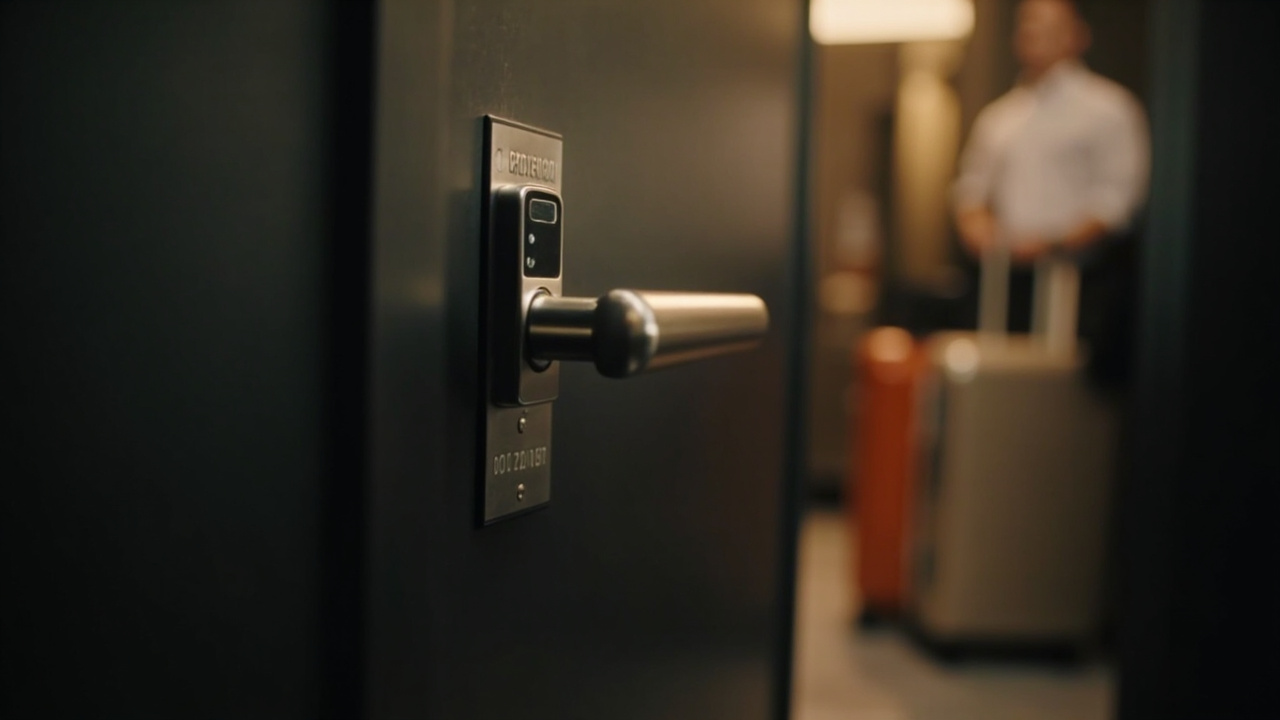
Guest, Resident and Staff Experience of Smart Locks in Resorts and Villa Rentals
Memo purpose and decision requested — resort villas user experience
This memo evaluates the resort villas user experience for a property manager deciding whether smart locks should enter a pilot. It treats the lock as part of a service journey, not as the subject of a feature comparison. The question is whether guests, residents and staff can complete expected access tasks with fewer avoidable handoffs while the property retains a controlled fallback. What the specification covers is in the hotel door locks.
Direct answer. The short answer is that resort villas user experience is not one decision. It is a sequence. This article takes resort villas user experience from resort villas user experience through resort-villas to the record you keep. A resort villas user experience is a building-level specification record. Door classes come in order. resort villas user experience is the first one closed for resort villas user experience.
The term resort villas user experience carries one meaning throughout this article. It is the one given in resort villas user experience. That is a working definition of resort villas user experience, and the buyer still has to check it against the dated product page.
Decision requested: approve the journey set, evidence owners and pilot gates below. The memo should be returned with observations from each persona rather than a catalogue comparison.
- Approve the persona-to-door journey map for the pilot.
- Assign an evidence owner for every observed access task.
- Require the failure and recovery states to be tested.
- Decide which door-level experience patterns qualify for wider rollout.
Scope covers the villa entrance, pool gate, service door, beach cabana and safe. It treats code access at the villa and app-based staff or service access as workflow inputs, not as guaranteed product capabilities. Where a candidate SKU’s fit, override arrangement, exposure suitability or other model-level detail affects the decision, confirm on the dated product page for the specific SKU.
The experience object is a journey, not a door
The smart lock guest experience begins before the guest reaches the lock. It includes how the credential arrives, whether the guest knows where to use it and whether the property can help without creating a queue or a security concern. For residents, the experience continues across repeated entries and credential changes. For staff, it depends on whether the assigned route matches the service task.
| Persona | Expected result | Critical door moments | Evidence to capture |
|---|---|---|---|
| Guest | Enter, use and leave without depending on the front desk | Villa entrance and safe | Arrival instructions, first-entry attempts and departure handover |
| Resident | Move in, enter repeatedly and change access without ambiguity | Unit entrance and pool gate | Repeated-entry experience and credential-change result |
| Service team | Enter when the job requires it without waking or walking through the villa | Service door and beach cabana | Request route, arrival at the door and exception handling |
| Security and maintenance | Manage a controlled exception without bypassing the operating process | All pilot doors | Recovery route, handover evidence and unresolved cases |
Resident access experience should be recorded separately from a guest stay. A resident may expect self-service after initial onboarding, while a guest may need guided arrival. Staff service access needs a different test because the property is evaluating whether service can enter quietly, on request and within the guest’s stated permission.
This approach also prevents the pilot from rewarding a convenient staff route that creates guest disruption. The score is not attached to a single door or persona; it is attached to the complete journey at each named door.
Four journey moments that decide acceptance
The villa access journey should be observed through four moments. Each moment needs a task, an owner and a record of what the person did without receiving coaching.
- Credential handover. Record how the guest or resident receives the credential, which person explains it and whether the handover introduces an additional visit or dependency. The guest credential handover is complete only when the intended user can identify the correct door and method of use.
- First entry. Observe the first attempt without prompting the user. Record uncertainty, use of the wrong credential and requests for help. A successful manual retry should be recorded as an intervention, not erased from the result.
- Service request. Test the operating question from the brief: how can service enter without waking the guest or requiring the guest to walk through the house? Observe both the request and the resulting door event.
- Departure or change. Confirm that the departing guest loses access when intended and that a resident or new guest receives the correct replacement. Record any manual cleanup at reception or the service desk.
Keep the original task stable between the current process and the candidate. If the test uses a different message, a different door or a staff member who knows the candidate procedure, the result cannot support a fair comparison.
Before judging staff performance, review the Training Estate Maintenance Team to Run Smart Locks in Resorts and Villa Rentals. Training is part of the experience because an untrained exception path can make a technically successful lock feel unreliable.
The scorecard compares observable work
The resort villas user experience scorecard should compare the current handover method with the candidate method at the same named door. The smart lock evaluation is incomplete until the exceptions have been observed alongside the normal path.
| Experience measure | Current-process record | Candidate-process record | Decision implication |
|---|---|---|---|
| Entry effort | Assistance requests, retries and staff involvement before entry | Same measures under the candidate task | Retain the candidate only if avoidable handoffs fall |
| Instruction clarity | Whether the user knows which door and credential to use | Whether the same user can act without coaching | Simplify the handover before adding lock features |
| Service disruption | Woken guests, missed service windows and door-side waits | Guest-authorised entry and exceptions | Protect the guest’s rest while retaining service access |
| Recovery confidence | Whether staff know what to do when access fails | Whether the fallback is identified and used | Require a rehearsed route, not an improvised workaround |
| Access lifecycle | Time and effort needed to close or replace access | Closure result and residual manual steps | Assign ownership of every credential change |
| Support ownership | Which team receives confused-access reports | Whether ownership and escalation are visible | Make the route understandable to guests and staff |
Use counts from the observation session as planning evidence, not as claims about the wider property. Record the door, scenario, role, observed result and corrective action. Keep guest-identifying information separate from the test record unless it is required to explain the observed event.
CONFIRM-WITH-LOCAL-DATA-PROTECTION-REVIEWER
Failure states are part of the everyday journey
A lock that works only when every credential is present has not completed the guest journey. Test expired access, a denied request, a lost credential, an unavailable staff device and the fallback opening. The recovery action should be observable, but it should not depend on improvisation at the door.
flowchart TD
    A[Access requested] --> B{Identity and right confirmed}
    B -->|Granted| C[Door opens]
    B -->|Rejected| D[Exception route]
    C --> E[Guest or resident proceeds]
    D --> F[Staff recovery]
    E --> G[Credential changed or expires]
    F --> H[Evidence recorded]
    G --> I[Next access request]
Resort pool gate access needs a separate test because the pool gate is both an everyday route and a recovery route. The brief identifies a mechanical override at this gate, but the operating direction, escape implications and who may operate it require a site decision.
CONFIRM-WITH-LOCAL-FIRE-AUTHORITY
Use the Smart Lock Failure Triage for Resorts and Villa Rentals to classify what failed. Use the Smart Lock Retrofit Site Survey to check whether the proposed lock arrangement fits the actual door. The experience score should show whether the user received a clear next action, not merely whether the door eventually opened.
Comparing the service models
The property can evaluate several service models without changing its lock architecture. A staff-mediated handover may fit a staffed arrival desk, while a self-service credential may suit a guest who prefers autonomy. A guest-authorised service window gives the service team a defined opportunity to enter without adopting the assumption that staff carry keys.
| Decision point | Staff-mediated handover | Self-service villa credential | Guest-authorised service window |
|---|---|---|---|
| Arrival | Staff explain and issue access at the desk | Guest receives access before arrival and enters independently | Guest authorises the relevant visit within an agreed window |
| Service entry | Staff attend the door using the property route | Resident manages access to the villa | Service team receives permission without entering the living space |
| Exception | Front desk or security resolves the issue | Contact path depends on the arrival instructions | The request, authorisation and failed attempt remain linked to the service job |
| Best evidence | Staff time and queue observations | Unassisted entry and handover records | Service arrival, guest disturbance and authorisation records |
Do not apply one service model to every door. A self-service approach at the villa entrance may be appropriate, while the safe, pool gate and service door may need different controls. The decision should reflect the exception workload and the recovery evidence from each door.
The Office Smart Lock Site Survey offers a useful comparison method because it links the access experience to the physical door and the people using it. The same principle applies here: observe the real task before deciding which operating pattern belongs on the door schedule.
Field-test sequence for the pilot
Run the evaluation as a controlled sequence of observations. Use the Smart Locks for Resorts and Villa Rentals: Door Survey and Fit Reality to connect each journey task to the door being tested.
- Record the baseline. Observe the current process for arrival, service entry and departure. Note every staff handoff, guest interruption and manual recovery.
- Assign test roles. Identify a guest or resident participant, the staff member receiving the service request and the person responsible for recovery. Keep their roles separate during the task.
- Run the same scenarios. Test normal entry, a changed credential, a denied request and a fallback event. Do not coach participants unless the task has ended.
- Capture the experience evidence. Record what was understood before the door, what happened at the door, who was called and whether the journey closed without a residual manual task.
- Issue the memo update. Compare the records, assign corrective actions and state whether the candidate should proceed, change or stop at that door.
The pilot should retain the baseline record. Without it, the property can report that the new arrangement felt easier but cannot show which operational step changed. For the resort-villas programme, this comparison is the bridge between an access demonstration and an operating decision.
Readers comparing approaches usually start with hotel smart lock replacement card management. That is the same question resort villas user experience has to answer here.
Decision record and next action villas
Approve a wider rollout only when the evidence supports four conclusions:
- The arrival path is understood by the intended guest or resident.
- Service entry follows an agreed request route without waking the guest or requiring an unplanned walkthrough.
- A failed access event produces a known recovery action and a recorded owner.
- Credential closure and replacement are assigned to a named team.
Add any corrective action to the door record rather than hiding it in general training notes.
Send the completed journey matrix and door schedule through the RFQ Template for Smart Locks for Resorts and Villa Rentals, with the observed exceptions attached. The request for quotation should describe the experience the property intends to protect, not simply ask for a lock that can operate a given door.
Put the answer on paper and request a quote against that document.