
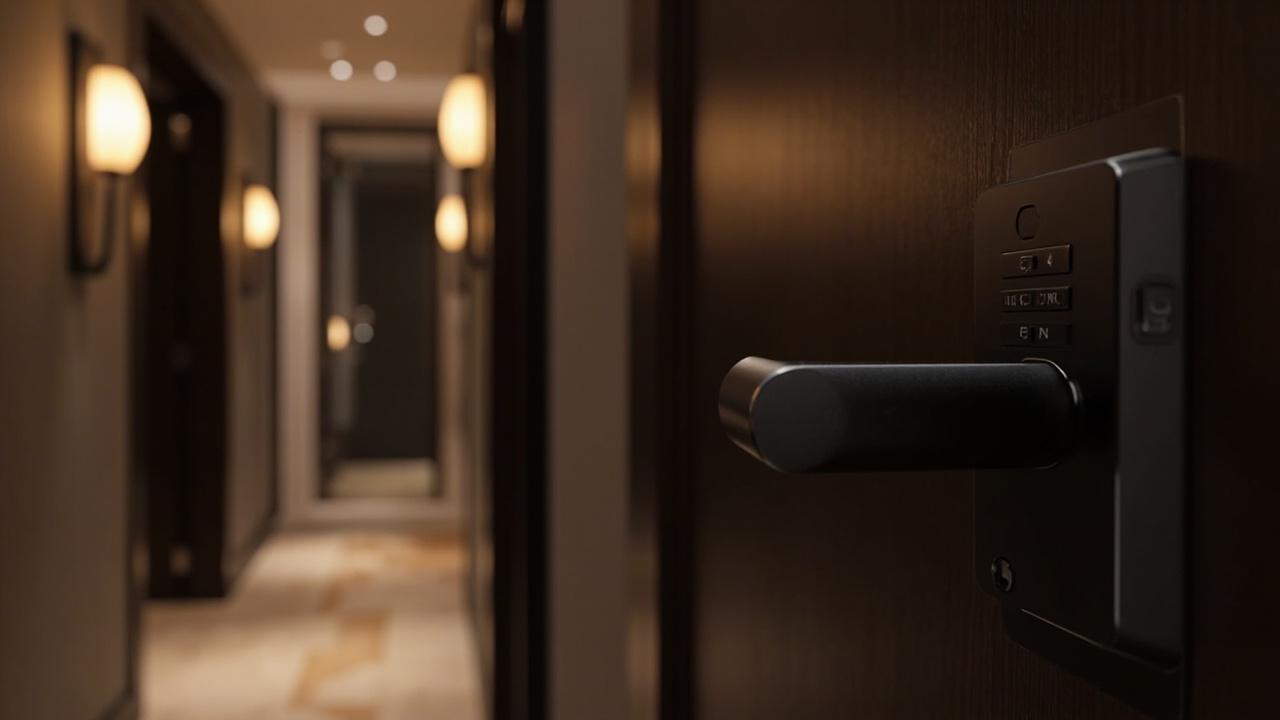
What Smart Lock Is Best for Hotel Rooms?
Forget the phrase "smart lock" for a moment and look at the actual job. A guest-room door has to accept a stranger twice a day, expire that stranger's access at a predictable minute, let housekeeping in at 9:00 on the hour, let maintenance in at 14:30 on a Tuesday, refuse the previous guest's card, refuse the neighboring room's card, keep a record of who opened it, and do all of this on batteries, on a wooden door, with nobody carrying a laptop to the corridor. Residential smart locks are designed around one family and one calendar. Hotel-room locks are designed around churn.
Direct answer: For the overwhelming majority of hotel rooms, the best smart lock in this catalog is an RFID card hotel lock from the dedicated hotel line — a proximity-card lock paired with front-desk hotel management software — because it is the only lane engineered around reception-desk credential issuance, staff/master card hierarchies, per-door standalone battery operation, and an audit trail you can actually pull for an incident. Fingerprint models from the 37-model fingerprint category are a credible guest-room alternative only when the property has no traditional front desk or wants zero plastic credentials. Keypad models are rarely the right primary lock for a guest room; they win at staff-gate and back-of-house doors. The six rounds below score each lane on the workflow realities, and the verdict section maps the result to four property archetypes.
This piece is the in-room technology head-to-head. If you are still routing the wider purchase — room count, retrofit versus new build, platform choice — that decision tree lives in what smart lock a hotel should buy overall; this arena assumes the hotel-room door and argues the credential.
Three Lanes Enter the Arena
The catalog splits into lanes by what the lock is built to do, not by what it looks like.
| Lane | Catalog footing | Primary credential | Built-for |
|---|---|---|---|
| Hotel line (RFID card) | 24 hotel-category SKUs, RFID card based, paired with hotel PC software (e.g., SLK-9936S, SLK-9951TH, SLK-9962S; SLK-9905A as a hidden-reader variant) | Proximity card at the door, encoded at reception | Turnover rooms with a staffed front desk |
| Fingerprint lane | 37 fingerprint-category models; multi-function examples such as the 5-in-1 SLK-8831 (fingerprint / password / card / key / app) | Enrolled finger, plus fallback credentials | Long-stay and self-access doors |
| Keypad lane | 18 keypad-category models, e.g., the SLK-3108 password lock | Memorized code | Staff areas, utilities, low-churn entries |
Two ground rules for the fight. First, one credential is not one lock: within the hotel line, buyers choose models by door and finish, but the workflow — card encoded at reception, hierarchy tiers, logging — is category-wide. Second, older properties sometimes ask whether their magnetic stripe keycards from a previous vendor's system matter here. They don't: this catalog's hotel lane is contactless RFID (proximity) based, not stripe-based, so stripe-wear comparisons from legacy other-vendor systems are not a constraint on these locks.
Scoring is out of 10 per round, judged on hotel-room duty specifically. A fingerprint lock can be a magnificent product and still lose the check-in round, because the check-in round asks about a queue in a lobby at 23:40.
Round 1 — The 11 p.m. Check-In Test: Card Encoding at Reception
Picture the moment every hotel purchase decision gets punished or vindicated: three coaches just discharged, twelve guests want keys now, and one of them is annoyed about the sea view that isn't.
The hotel line's answer is a station, not a lock. The front desk runs hotel PC software with an encoder on the counter. A reservation becomes a card: room number, arrival window, departure window, card tier. The guest takes plastic, the door validates it on its own processor, and the card dies at the encoded checkout minute without anyone touching the lock. Report a card lost, and the next encoded replacement makes the old one inert at that room on the next attempted tap — the standard hotel-lock revocation story that never requires a technician in the corridor.
flowchart TD
    A[Reservation confirmed] --> B[Front desk: hotel PC software + card encoder]
    B --> C[Card written: room number, stay window, card tier]
    C --> D[Guest taps card at room door]
    D --> E{Door lock validates offline}
    E -->|In-window, right room| F[Latch releases, event logged in lock]
    E -->|Expired or wrong-room card| G[Access denied, attempt logged]
    H[Card reported lost] --> I[Reception encodes replacement]
    I --> J[Old credential rejected at next tap at that room]
Now run the same twelve guests through the other lanes. Fingerprint lane: whose finger? Pre-enrolling a stranger's biometric at check-in means an enrollment terminal, a privacy conversation per guest, and a delete-at-checkout procedure you must trust staff to run. SLK-8831-style multi-function locks accept cards too, but a residential-lane card workflow has no reception encoder or stay-window expiry logic unless the specific model and platform provide it — verify per product page, because specs for individual multi-function models beyond their credential list are verified in writing territory. Keypad lane: a code. Codes for turnover rooms mean either one code shared across a cohort — which you then change constantly — or per-stay codes delivered remotely, which assumes a connectivity story you must confirm per model before designing any workflow around it.
Score, on hotel-room check-in throughput at a staffed desk:
| Lane | Check-in workflow fit | Score |
|---|---|---|
| Hotel line (RFID) | Encoder at reception, per-stay expiry, instant revocation, zero lock-side setup | 10 |
| Fingerprint | Enrollment burden per stranger; no reception-native issuance | 3 |
| Keypad | Shared or remotely-delivered codes; no front-desk issuance station | 2 |
Round 2 — The Guest Who Reads Signs: Privacy Perception
Guests don't benchmark locks. Guests notice locks — or rather, a growing slice of them notice what a lock remembers about them.
The proximity card is the least invasive credential a door can demand. It says "holder of this plastic, this window, this room." Nothing about the guest's body is stored in the door. Some guests hate carrying the card; almost none feel surveilled by it. That neutrality is why card systems still dominate hospitality: perception risk near zero.
Fingerprint is the opposite polarity. A biometric at the room door reads intimate to a meaningful minority of travelers — enrollment at check-in asks them to hand over a body part to a property they'll never see again, and delete-at-checkout policies are promises, not evidence. Some boutique and extended-stay buyers deliberately monetize that friction as a novelty or a convenience ("your finger is your key"); plenty of others find it creepy, and a single viral complaint travels further than a hundred unremarkable taps. In this catalog's hotel-room framing, the fingerprint lane's honest score is mixed: genuinely welcomed by some archetypes, actively rejected by others, and neutral for neither.
Keypad perception has its own leak: the code is observed. Shoulder-surfing, wear patterns on buttons, and the guest who texts the room code to friends are all ways a memorized secret quietly stops being secret. Hotel staff areas manage this with code rotation; guest rooms with high churn make rotation a daily chore.
| Lane | What the guest perceives | Failure mode | Score |
|---|---|---|---|
| Hotel line (RFID) | Neutral plastic token; nothing bodily stored | Card loss, pocket-bend (solved by re-encode) | 8 |
| Fingerprint | "The door is memorizing my body" | Biometric-averse guests, delete-policy distrust | 5 |
| Keypad | "Someone can watch me type this" | Code sharing, wear patterns, rotation fatigue | 4 |
Round 3 — Who Holds the Master: Staff and Hierarchy Support
A guest-room lock spends most of its life serving non-guests: room attendants, linen porters, maintenance, supervisors, the night GM with the emergency override. The question for this round is whether the lock knows the difference.
The hotel line was invented for exactly this. Card-based hotel systems are tiered by design — guest cards bound to one room and one stay; floor-tier cards for attendants limited to their assigned floors; master and emergency tiers above them; and the hotel PC software that issued those tiers records which tier was used. This tiering plus multilingual management software is the structural reason a 24-SKU hotel category exists separately from the residential categories at all.
The fingerprint and keypad lanes organize around a different social unit: one admin plus several users. An SLK-8831-class lock can hold many fingerprints and codes, and multi-function lanes may support administrator versus ordinary-user distinction — but a "floor attendant who can open floors 3 and 4 only, during a shift window, with every open logged to their name" is a hotel-software concept, not a standalone-lock concept. For a residential product used in a hotel, that gap shows up as: every staff member whose finger is enrolled can open every enrolled door until someone remembers to remove them after they resign. Staff churn is precisely what hotel hierarchy exists to absorb.
Score: hotel line 9, fingerprint lane 5, keypad lane 4 — both non-hotel lanes graded down not for capability deficits as residential products, but for missing the tier-and-scope model guest-floor operations require.
Round 4 — The Paper Trail: Audit Records, and What SLK-9936S Actually Documents
Every hotel buyer eventually asks for the paper trail: a guest swears their room was entered, an item goes missing from a suite, an insurer wants proof of who was at the door and when. Audit capability is where "which lane" becomes "which sheet," and it is worth isolating the one model in this catalog whose numbers are published enough to quote directly.
The SLK-9936S Evidence Block
The following is quoted from the product page for SLK-9936S, and these figures belong to that model's published specification — not to every hotel lock, and not to the other two lanes:
| Spec line (PDP-cited) | Value | Why a hotel buyer should care |
|---|---|---|
| RFID standard | Mifare 1 @ 13.56 MHz | Proximity card family; sets the encoder/card ecosystem at reception |
| Read distance / read time | 0–5 cm / <0.25 s | Tap-and-go at the door with no dwell in the corridor |
| Battery operating cycles | >15,000 | Endurance yardstick against room-traffic math |
| Audit / event records | up to 1,000 | On-lock event depth for incident reconstruction |
| Power | 4 × AA | Ordinary cells; floor-level maintenance can service it |
| Cylinder / latch | 5-pin cylinder, 3-point latch | Mechanical backbone behind the electronics |
| Body / finishes | Stainless steel + alloy, multiple finish options | Corridor aesthetics without changing the platform |
| Door thickness envelope | 36–100 mm | Retrofit reach across typical guest-room doors |
| Emergency access | Mechanical | The fallback when batteries die or software stalls |
| Management modes | Standalone or centralized database; multilingual software | Runs per-door or property-networked |
| Positioning | 1–5 star hotels | Catalog's own star-tier framing for this line |
15,000+ battery cycles and up to 1,000 stored events are the numbers this catalog actually publishes for SLK-9936S, and they set the audit round's benchmark.
What does 1,000 records buy you? A guest-room door turning over perhaps 25–60 times a day across guest, staff, and denied attempts stores on the order of 750–1,800 events a month, so an on-lock log of that depth covers roughly two to four weeks of activity — which is almost exactly the lookback an incident claim needs, because claims arrive within days, not quarters. Pull the lock's log via the management software, match timestamps against the front desk's card-issuance records, and you have a reconstruction nobody had to trust. Deeper retention lives in the centralized-database mode of the software, which the spec block documents for this model.
Outside that block, the honest generalization is thinner but still decisive: the hotel lane is designed around event logging with software to extract it, while the fingerprint and keypad lanes vary model by model — some log last-open events, some log little, and none of them inherit a property-level extraction layer. Specs for SLK-9936G, SLK-9905A and other individual models are verified in writing audit capability per product page rather than assuming the 9936S numbers travel across categories.
Score with the evidence block as the anchor: hotel line 8, fingerprint lane 5 (logging exists in the category; extraction and depth unverified per model), keypad lane 4.
Round 5 — When the Server Sleeps: Offline Standalone Operation
Hotel IT fails at the worst times. The reception PC dies, the property network wobbles, a software update is mid-flight when the bus from the airport unloads. A guest-room lock's correct behavior during any of that is: open the door for credentials that were already valid.
This is where the hotel line quietly earns its architecture. Each lock is a standalone, battery-powered computer on the door; the reception software writes credentials to cards, and the door checks them locally. A dead encoder stops new check-ins from being carded, but it does not lock out every guest already in the building — their cards carry their own validity windows. That blast-radius control is the difference between an IT incident and a lobby riot.
The fingerprint lane is arguably more offline-native: enrollment and validation both happen at the device with no reception dependency at all, which is genuinely useful for properties with no staffed desk at all hours — an eight-unit guesthouse whose owner holds the only administrator fingerprint, or a long-stay floor where one enrollment serves a ninety-day tenancy. Keypad is the same story in code form: the lock needs nothing upstream to evaluate an entered number.
The asymmetry is revocation. A standalone lock can't be told "deactivate room 402's last guest" without someone walking to door 402 or the lock supporting remote instruction — and remote instruction is a connectivity claim you must confirm per model, never assume. Hotel line cards expire themselves on schedule and go inert on re-issue at reception, so its offline posture and its revocation story reinforce each other.
One connectivity footnote applies to all three lanes and to this whole catalog: do not build any workflow on assumed radios. For any model under consideration, check the model’s published specification whether Wi-Fi is offered, and treat Bluetooth-app control as a per-model feature where the page says it is — the catalog includes app/Bluetooth unlocking on some models, and platform families such as TTLock, Tuya, or Doodle appear across it, but which lock carries which radio is product-page information, not category information.
Score: hotel line 8 (standalone doors + self-expiring credentials), fingerprint 9 (zero upstream dependency), keypad 9 (same, minus everything else this arena cares about).
Round 6 — Star Fit, 1 to 5
The catalog itself positions the hotel line across 1–5 star properties, and that framing survives contact with reality because the card workflow scales sideways: a one-star transit property and a five-star full-service property run the same credential choreography — encode at reception, tap, expire — and differentiate through model choice (readers hidden or prominent, finishes, cylinder class) rather than through a different physics of check-in. Higher star counts don't demand a different credential so much as a quieter, better-dressed one.
The fingerprint lane's star story is a boutique story, not a ladder story: at small design-led properties, "no plastic, your finger opens everything" is a guest experience talking point, and the front desk may be a host with a tablet rather than an encoder station. The keypad lane at star-tier properties functions as staff-area infrastructure — laundry, stockroom, service corridor — not guest rooms, where code rotation for turnover and code-observation problems never go away.
Score: hotel line 10, fingerprint 6, keypad 4.
The Scoreboard After Six Rounds
| Lane | R1 Check-in | R2 Privacy | R3 Hierarchy | R4 Audit | R5 Offline | R6 Star fit | Total /60 |
|---|---|---|---|---|---|---|---|
| Hotel line (RFID card) | 10 | 8 | 9 | 8 | 8 | 10 | 53 |
| Fingerprint models | 3 | 5 | 5 | 5 | 9 | 6 | 33 |
| Keypad models | 2 | 4 | 4 | 4 | 9 | 4 | 27 |
The spread is not an accident of scoring generosity: the hotel lane wins four rounds outright, ties nothing closely enough to matter, and loses the two offline rounds where standalone simplicity naturally peaks. A lane that dominates the rounds about reception, staff, records and tiers — the four rounds where hotels differ from every other building type — is telling you exactly what it was built for.
An Illustrative Tuesday at an 83-Room City Transit Hotel
Seventy-one rooms sold overnight, a conference block checks out at 11:00, and the front desk runs one encoder and two clerks. Under the arena's logic, the day plays out like this:
- 07:40 — Housekeeping starts. Attendants carry floor-tier cards; rooms on their floor open all shift, rooms on other floors refuse them. Nobody enrolled anybody's finger; nobody changed a code at the service-corridor door (which is a keypad lock, exactly as the keypad lane's verdict intends).
- 11:02 — Thirty-six checkouts in one hour. Returned cards go back to the encoder pool and get re-encoded for arrivals; the departing guests' cards die at their encoded expiry minute regardless, so a card "forgotten" in a jacket stops working at the room within the day.
- 14:15 — A delegate insists room 512 was entered during a two-hour absence. The manager pulls SLK-9936S-class on-lock events through the management software, cross-references the issuance log for 512, and answers with timestamps instead of apologies.
- 23:38 — Coaches arrive, twelve guests, one encoder. Throughput is a card-printing rhythm. In the counterfactual fingerprint workflow, every one of those guests is an enrollment event with a privacy conversation; in the keypad counterfactual, twelve codes to deliver, and a cohort's worth of code changes at checkout.
One more wrinkle worth keeping honest: the encoder PC crashes at 23:30 instead. The already-carded in-house guests still open their doors — validation is per-door and offline. New arrivals wait for a reboot or fall back to the property's emergency procedure. That failure mode — issuance pauses, occupancy access doesn't — is the correct way to grade hotel-line offline behavior, and it beats both standalone lanes on recovery because re-issuing a card is instant once the station returns, while standalone revocation still requires walking to each door.
Verdicts by Property Archetype
| Property archetype | Winning lane | Runner-up | The deciding factor |
|---|---|---|---|
| 83-room city transit hotel, staffed desk | Hotel line (RFID card) | — | Check-in throughput and tiered staff cards; nothing else closes the workflow |
| 164-room full-service conference property | Hotel line, centralized-database software mode | Keypad for service-corridor and back-of-house doors | Audit extraction across 164 doors; hierarchy across three shifts of staff |
| 36-room design boutique, host-desk staffing | Hotel line or fingerprint — genuinely contested | The other one | Decide by guest persona: biometric novelty as hospitality theater vs plastic-free neutrality; the deeper boutique reasoning is in how a small design-led property should weigh the credential |
| 12-room guesthouse, no 24-hour desk | Fingerprint lane | Keypad lane | No reception to encode at; zero-dependency standalone operation is worth its price in staff time |
Cells marked — have no documented value in this article’s sources; obtain the figure from the supplier’s written specification.
The pattern in the verdict table is the honest one: the hotel line wins every archetype that has a front desk doing check-ins, and the fingerprint lane's real claim on a guest room is the absence of that desk — not superiority at what the desk does.
Loose Ends: Four Questions That Surface Mid-Arena
Is a card system obsolete — hasn't everyone moved to phones? Phone-as-key is a live direction across the industry, and some models in this catalog pair with app platforms over Bluetooth; but for hotel rooms specifically, the reception-issued credential and the hierarchy machinery still anchor on the card workflow, and any phone-forward design must be verified model by model on the product page rather than assumed category-wide.
What about guests who lose cards constantly? Re-encode at reception; the lost credential goes inert at the room on its next attempted use. Lost-card volume is an encoder-throughput cost, not a security hole, which is why the hotel lane scored 10 in Round 1.
Can we mix lanes across one property? Yes, and most should: hotel-line locks on guest rooms, keypad locks on the stockroom and service corridor, fingerprint or app-class models wherever long-stay tenants live. Mixing is an operations question — one management software that can see all hotel-side doors keeps the paper trail in one place. For new-build properties deciding lane-by-floor during construction, the sequencing is worked through in what a new hotel should choose before the doors arrive.
Do these locks need wiring to the corridor network? No — the hotel lane's per-door operation is battery-powered and standalone, which is precisely the Round 5 architecture; any networked behavior is the software talking to encoders and gateways, not to each door across a mains line. Confirm the connectivity details of any specific model on its product page before designing anything that presumes remote door access, and check whether Wi-Fi is offered for models in the non-hotel lanes rather than assuming it.
The Shortest Path From This Arena to a Quote
Three sentences to leave with. For hotel rooms with a front desk, the RFID card hotel line is the best smart lock this catalog contains — 53 of 60 on the arena's own axes, and it wins the four rounds that make a hotel a hotel. For properties without staffed reception, the fingerprint lane is the legitimate alternative, bought with eyes open about hierarchy and audit extraction. Keypad models belong on staff doors, and a serious property plan almost always includes one or two of them outside the guest-room schedule.
Browse the 24-model hotel category at RFID Hotel Card Lock, the anchor model's published sheet at SLK-9936S, and when your lane and archetype are settled, send the door schedule and star-tier plan through request-a-quote — the quote conversation is where model-level specs, samples, and software scope get pinned to your property.