
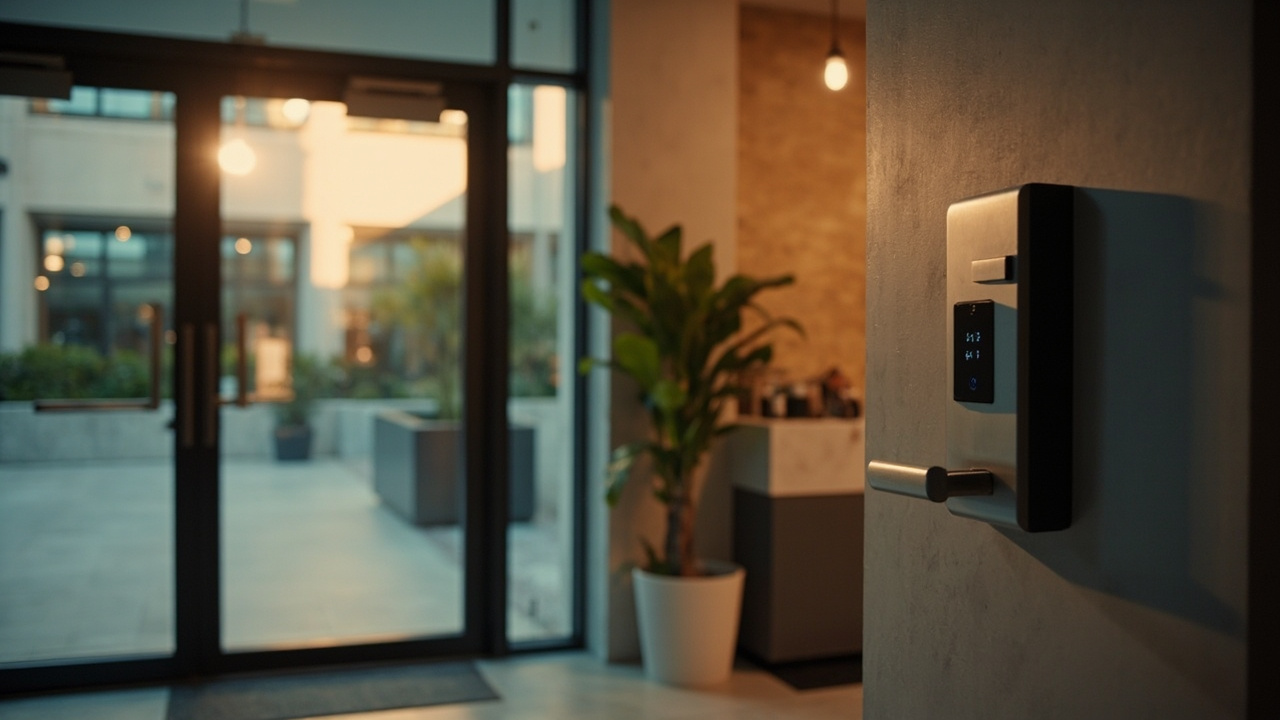
Residential Door Realities for Smart Locks in Japan
A residential door in Japan is rarely a blank opening waiting for hardware. In the apartment stock that urban hotel conversions inherit, the leaf is often narrow, the frame sits in a concrete or lightweight panel wall, the mail slot is cut straight through the leaf, and the hinge side was set by a factory jig long before anyone thought about electronics. The japan residential door realities an importer meets first are geometric, and each one turns into a question that somebody local has to answer before an order can be defended.
Direct answer. In brief, this article covers japan residential door realities from japan residential door realities to giteki. It states what to confirm about japan residential door realities on the dated product page where a figure is involved. A japan residential door realities sets out entry conditions for a single market. japan residential door realities decides which approval exists. The proof behind japan residential door realities is filed once japan residential door realities closes.
- Set the range — write down what japan residential door realities has to settle in japan before any hardware is ordered
- Supply the record — attach the document behind each claim in giteki, not a summary of it
- Confirm the holder — record who signs japan residential door realities and who keeps the record afterwards
- japan residential door realities runs this sequence, and giteki is the record it produces.
This brief treats those realities as a set of regulatory questions rather than as a product-selection exercise. Each section below takes one door condition, states the question it raises, and names the party who answers it, whether that is the owner, the building management association, the fire or building reviewer, the registered conformity holder, the trading house or the installer. Beside each answer sits the evidence an importer should be holding when the answer comes back. It is written for the importer preparing a first urban business hotel or apartment-conversion project, and it assumes only that the building already exists and that most of its doors will not be replaced.
The door conditions that generate the questions
The conditions that recur are few. Entrance leaves are compact and the entryway geometry is tight, so a device that looks generous on the face of the door may not clear the frame return or the corridor wall. The mail slot belongs to the leaf rather than to the hardware, and its position is a fixed point around which any exterior plate has to work. The hinge side follows the frame and the swing, which makes handing a building decision rather than an installation preference. Behind the door there is usually a shared corridor, which turns release behaviour into somebody else's business. In a hotel wing the leaf may belong to a rated assembly. And the lock itself contains a radio, which brings a paperwork route that has nothing to do with doors. What the specification covers is in the smart door locks.
graph LR
    D1[Compact leaf in a tight entryway] --> Q1[Who may authorise the alteration]
    Q1 --> P1[Owner and management association]
    D2[Mail slot cut through the leaf] --> Q2[May the slot be covered or moved]
    Q2 --> P2[Management association and delivery practice]
    D3[Hinge side fixed by the frame] --> Q3[Can the handing be reversed]
    Q3 --> P3[Door supplier and installer]
    D4[Door opening onto a shared corridor] --> Q4[Is the opening an escape route]
    Q4 --> P4[Fire and building reviewer]
    D5[Rated leaf in a hotel wing] --> Q5[Who accepts the assembly after the cut]
    Q5 --> P5[Assembly supplier and accepting reviewer]
    D6[Radio inside the lock body] --> Q6[Whose name is on the conformity file]
    Q6 --> P6[Importer and registration holder]
    D7[Manual label and app strings] --> Q7[Who reads them at approval]
    Q7 --> P7[Trading house and site approver]
Read the diagram as a map rather than a sequence. The questions do not arrive in the order drawn, and one party sometimes answers two of them in a single meeting. What the map fixes is that no question here has a supplier-only answer. Every one of them ends with a named local party and a piece of paper that party is willing to put a name to, which is the difference between a specification that survives an approval meeting and one that is reopened at the first site visit.
| Door condition | Question it raises | Party who answers | Evidence to hold |
|---|---|---|---|
| Narrow leaf, tight entryway | Who may authorise any alteration to this leaf | Owner and building management association | Written consent naming the door and the fixing method |
| Mail slot through the leaf | May the slot be covered, moved or worked around | Management association and delivery practice | Slot position measured from edge and floor, with a photograph |
| Handing fixed by the frame | Can the swing or handing be reversed | Door supplier and installer | Swing diagram and measured clearance to the return |
| Shared corridor behind the door | Is this opening on an evacuation route | Fire and building reviewer | The door's role in the evacuation plan and the release test expected |
| Rated leaf in a hotel wing | Who accepts the assembly after modification | Assembly supplier and accepting reviewer | Leaf marking and the assembly documentation as installed |
| Radio inside the lock | Whose name is on the conformity file | Importer and registration holder | File naming the model and the radio module inside it |
Question one: is this leaf yours to alter, and who holds
A converted apartment building or a small business hotel is a building with several kinds of owner. The entrance door to a dwelling may be common property, the internal partitions may belong to the tenant, and a corridor door may sit with a management association that has strong views about appearance. In the boutique-hotel case the building frequently cannot be rewired and the operator does not own the locks, which makes permission the first constraint in the project rather than the last.
The question to put on paper is short: who may authorise an alteration to this leaf, and what does the authorisation cover? The party who answers is the owner of record together with the building management association, sometimes through a managing agent who speaks for both. The importer rarely meets this party directly, which is precisely why the trading house needs the answer in writing rather than in a meeting summary.
The evidence is a consent that names the door, the alteration, the fixing method and what happens when the premises are vacated. A photograph of the door as found belongs with the consent, because consent to alter a door is consent to alter the door that was described, not whatever a later surveyor decides it was. Where the answer is a refusal, the door moves into an excluded list with the reason stated, and the reason travels with the order.
What this changes in the order is whether the device must be reversible. A door that must be returned to its original state favours a face plate over an existing cutout and a fixing that leaves no new pocket. It may also push the project towards a different door entirely, which is a building decision that no lock specification can make on the owner's behalf. The Hotel Smart Lock Site Survey structure is a workable place to record these answers door by door, provided the consent column is filled in at the time rather than reconstructed afterwards.
Question two: what happens to the mail slot
The slot is cut through the leaf at a height the door maker chose, and the post arrives through it. An exterior plate that covers the opening, or that repositions the flap, changes where mail lands and whether the flap still works at all. This is the geometry problem that catches imported designs most often: a plate can be correct for the door thickness and wrong for the slot, and the error is invisible until the first delivery.
The question is whether the slot may be covered, moved or worked around, and who confirms that delivery still functions. The management association answers for the building, and the delivery practice at that building answers for the practical consequence, which is not always the same thing as the building's formal position. Where a replacement leaf is being contemplated, the door maker or its supplier answers as well, because the slot position is part of the leaf's original drawing.
The evidence to hold is a slot position measured both from the leaf edge and from the floor, the proposed plate footprint drawn over that measurement, and a photograph with a tape in frame. Three numbers and one image settle a question that otherwise runs for weeks. The Door Thickness and Backset Variance in Japan: A Survey Worksheet gives the measuring discipline that makes those numbers comparable between doors, and the Smart Lock Door Thickness Measurement method fixes where the readings are taken on each leaf.
What this changes in the order is plate geometry. A slot-compatible aperture, a smaller escutcheon or a surface-mounted form may be the only options for a whole class of doors, and the class should be defined by the slot position rather than by the leaf thickness alone. If the slot has to remain functional and the plate cannot accommodate it, the honest answer is a different door, and that answer belongs to the building rather than to the lock supplier.
Question three: which side does it close on, and who owns
A Japanese apartment entrance usually swings into a small entry area, and the hinge side is fixed by the frame that was cast or fitted before the corridor was finished. The lock body has to sit on the face that the swing exposes, and a body designed around the other hand will foul the frame return, the adjacent wall or the shoe cupboard that was built in afterwards. Reversing a handing is a joinery change on some leaves and impossible on others.
The question is whether the handing may be reversed, and who decides. The door supplier answers for the leaf and the installer answers for what can actually be hung on it, while the site approver confirms that the resulting swing is acceptable in the corridor. This is a three-way answer, and an importer who collects only one of the three has collected a preference rather than a decision.
The evidence is a swing diagram for each door type, the measured clearance between the closed leaf and the nearest return, and a note of which face is intended to carry the body. Where the doors are compact and the entryway geometry is constrained, the Compact Entryways and Constrained Door Geometry: What It Means for Smart Lock Selection in Japan analysis is the right companion, because it sets out how much of the model choice is already decided by the opening before any credential conversation begins.
What this changes in the order is template and model selection. A handing question resolved at the door is resolved with a drill, and a drill is the least reversible tool on the site. Recorded on the survey and answered before the order, it costs a column on a sheet.
Question four: is the opening on an escape route
Apartment entrance doors open onto shared corridors, and in a hotel the corridor is the escape route. A lock that changes how the door releases under power loss, or that alters what a person inside has to do to get out, is a life-safety question rather than a security preference. The person who cares about the answer is not the buyer, and the person who signs it is not the supplier.
The question is whether this opening sits on an evacuation route and what release behaviour is expected at it. The fire and building reviewer for the property answers, with the local fire authority answering for the occupancy as a whole. Those are two different signatures and a project can need both.
The evidence to hold is the door's role in the evacuation plan, the release test the reviewer expects to see, and the name of the person who will witness it. A test that nobody agreed in advance is a test that gets repeated. The Japan Egress Rules and Electronic Locks: What a Buyer Should Verify teardown sets out the verification sequence, and this brief adds only the party column: the answer comes from the reviewer, and the importer's job is to have asked early enough that the answer can still change the model.
What this changes in the order is whether a mechanical release on the inside face is non-negotiable for that door, and whether the device may be fitted to the corridor side at all. On some doors the answer removes the product from consideration regardless of how well it fits the leaf.
Question five: is this a rated assembly, and who accepts
Hotel corridor doors, and some apartment entrance doors, belong to rated assemblies. Cutting a pocket, a cable route or a fixing hole through such a leaf is an alteration to the assembly rather than to a door, and the assembly is what was accepted, not the leaf on its own. This is the point where a lock order meets a file that the building has kept since construction.
The question is whether the leaf carries a rating and who accepts the assembly after modification. The assembly supplier, usually the door maker, answers for the assembly, and the reviewer who accepted the original installation answers for whether the modification stays inside that acceptance. Neither answer is available from a catalogue.
The evidence is the marking on the leaf and frame, the assembly documentation as installed rather than as designed, and a written position on whether the proposed preparation is inside the accepted scope. Where the documentation has been lost, the marking is the starting point and the reviewer is the route to a replacement record. The Fire-rated Doors and Smart Locks in Japan: The Assembly Question essay examines the assembly logic in full; here the only addition is that the accepting party has to be named before the preparation is drawn.
What this changes in the order is whether the device goes on that leaf at all, and whether the project uses a different door from the start. Both outcomes are cheaper when they are reached before the sample is approved.
Question six: does the device radiate, and who holds
A lock with a radio, a card reader or a phone interface is a radio device in paperwork terms, whatever it is in door terms. The route importers meet in Japan is commonly described as Giteki, a technical conformity mark reached through a registered conformity body, with ARIB-style technical conditions behind it. Whether a particular SKU falls inside that route, and under which variant of it, is a per-product question that the importer has to settle for the exact model being shipped.
The question is whether the model radiates, under what technical conditions, and whose name is on the file. The importer of record answers for the import, and the holder of the registration answers for the technical file, with the trading house carrying documents between the two. In practice these are often three conversations about one document, and the importer should know which of the three can actually produce it.
The evidence is a conformity file that names the exact model and the radio module inside it, together with markings on delivered units that match the file. A file for a sibling variant is not evidence for the variant on the water, and the difference is usually a module change that nobody wrote down. The Reading Giteki for Smart Locks: A Buyer Guide for Japan guide sets out what the file contains and how to read it against a shipping list.
What this changes in the order is whether the SKU can be offered under the importer's own name, what the label must carry, and whether the shipment waits at the port for a document that should have existed before the order. This is the one question on the map where a late answer is measured in weeks rather than in drill bits.
Question seven: who reads the paperwork, and in what language
Approval in this market is specification-grade, and validation cycles run long by the standards of most export destinations. That has a documentation consequence: the person reading the manual, the label and the app at approval reads Japanese, and the installer reads the same documents at the door with the resident standing nearby. A translated manual that arrives after approval has arrived after the decision it was meant to support.
The question is which documents must exist in Japanese for this project, and who signs them off. The trading house and the site approver answer, with the installer as the second reader whose objections surface last and cost most.
The evidence is Japanese manual and label proofs tied to the SKU, a mounting sheet that matches the door conditions recorded on the survey, and the app strings a resident will actually see. The What Documents Should You Request From a Smart Lock Supplier? list covers the commercial set; the language question is narrower and belongs to the project. The Specifying Smart Locks for Urban Business Hotels Projects in Japan piece shows how the specification document itself is read at approval, which is why the manual and the specification have to agree on the door types they describe.
What this changes in the order is timing. Documentation produced before sample approval is part of the validation; documentation produced after it is a second validation.
Question eight: when it fails in service, whose claim is it
Field reliability here is set at installation as much as at the factory. A lock that fails at a door may have been fitted to a leaf that was never surveyed, and the question of who carries the cost turns on records rather than on fault. Buildings rarely accept an argument about fault; they accept a file.
The question is whose claim it is when a device fails, whether importer, trading house, installer or building. The seller of record answers for the product, and whoever holds the maintenance obligation for the property answers for the door. Those two parties can be in the same meeting and still disagree about which of them owns the failure.
The evidence is an installation record per door with photographs of the preparation, serial numbers matched to door positions, and the credential and event record covering the failure. The Installer Practice in Japan: Why Smart Lock Field Reliability Is Really Set There analysis explains why the installation record is the decisive document, and the answer sheet in the next section is designed to make that record possible.
What this changes in the order is what the importer collects at handover, and whether spares are held locally rather than shipped against a claim.
The answer sheet an approval meeting
The map becomes useful when it is turned into a sheet with four columns: the question, what the importer can settle alone, what needs the local party, and the point in the sequence at which it has to be answered. The japan residential door realities do not all arrive at once, and the sequence column is what stops a late radio answer from becoming a late order.
| Question | Settled by the importer alone | Needs the local party | Point in the sequence |
|---|---|---|---|
| May this leaf be altered | Which fixing methods are reversible | Consent from owner and management association | Before any door is specified |
| What the mail slot allows | Plate footprint against slot position | Whether delivery still functions | With the door survey |
| Whether handing may change | Which model variants exist for each hand | Swing and clearance at the frame | Before templates are cut |
| Whether the door is on an escape route | What release options the model offers | Expected release behaviour and test witness | Before the model is fixed |
| Whether the leaf is rated | Nothing | Assembly position from supplier and reviewer | Before preparation is drawn |
| Which conformity file applies | Which model and module are shipping | Registration holder and importer of record | Before the order is placed |
| Which documents must be Japanese | Draft translations and label artwork | Sign-off by trading house and approver | Before sample approval |
| Who owns a later failure | The record the importer keeps | Maintenance obligation for the property | At handover |
Most importers arrive at the first approval meeting with the middle column full and the right-hand column empty. The middle column is the part a supplier can help with, because it is about product options. The right-hand column is the part that decides whether those options were ever available to the project.
What this changes about the order itself
The order of the questions is not the order of the sections. Ownership and rating come first because they can remove doors from the programme, and a door that has been removed does not need a model. Geometry comes second because it decides which models are eligible. Radio and language come third because they decide whether the eligible models can arrive and be approved. An importer who starts with the product and works backwards usually discovers the first two questions after the sample has been signed off, which is the most expensive possible moment.
There is a further consequence for how the door survey is written. A survey that assumes one door thickness across a property is the classic failure in this vertical, and in this stock it is also a regulatory failure, because a door that was never described cannot be shown to have been authorised, rated or released. The survey is not a courtesy to the installer; it is the evidence base for every answer on the sheet.
Put in the request for quotation the things the answers have produced: a photograph and a measurement for each door type, the slot position, the handing and the clearance at the frame, the rating marking where one exists, the party who authorised each door, and the language the documents must be in. A supplier can quote against that. A supplier quoting against a room count is guessing, and the guess is paid for at installation.
The confirmations that stay local
Some of this brief can be settled by measurement, and some of it cannot. The measurements are the importer's to take: slot positions, leaf thicknesses, clearances, handing, markings. The legal and regulatory positions belong to local parties, and no article can settle them from outside. Whether an entrance door is common property, what an evacuation route requires at a particular opening, and which conformity route a specific model falls under are all questions for the people who hold the building file and the registration.
CONFIRM-WITH-LOCAL-LEGAL on ownership, consent and the terms under which a door may be altered or restored. CONFIRM-WITH-LOCAL-FIRE-AUTHORITY on the release behaviour expected at any opening on an escape route. CONFIRM-WITH-LOCAL-CONFORMITY-BODY on the radio route that applies to the exact model and module being shipped. The door readings are yours; the signatures are theirs.
A project that carries all three confirmations into the first approval meeting has done the thing that this market rewards, which is to arrive with the questions already separated and the answering parties already named. The Smart Lock Door Compatibility Matrix is a reasonable cross-check before that meeting, because it tests whether a proposed device is plausible for a door class before anyone is asked to commit to it. When the door classes and the answer sheet are ready, send the project details through the quotation route and let the supplier quote against the building that exists rather than the one on the drawing.