
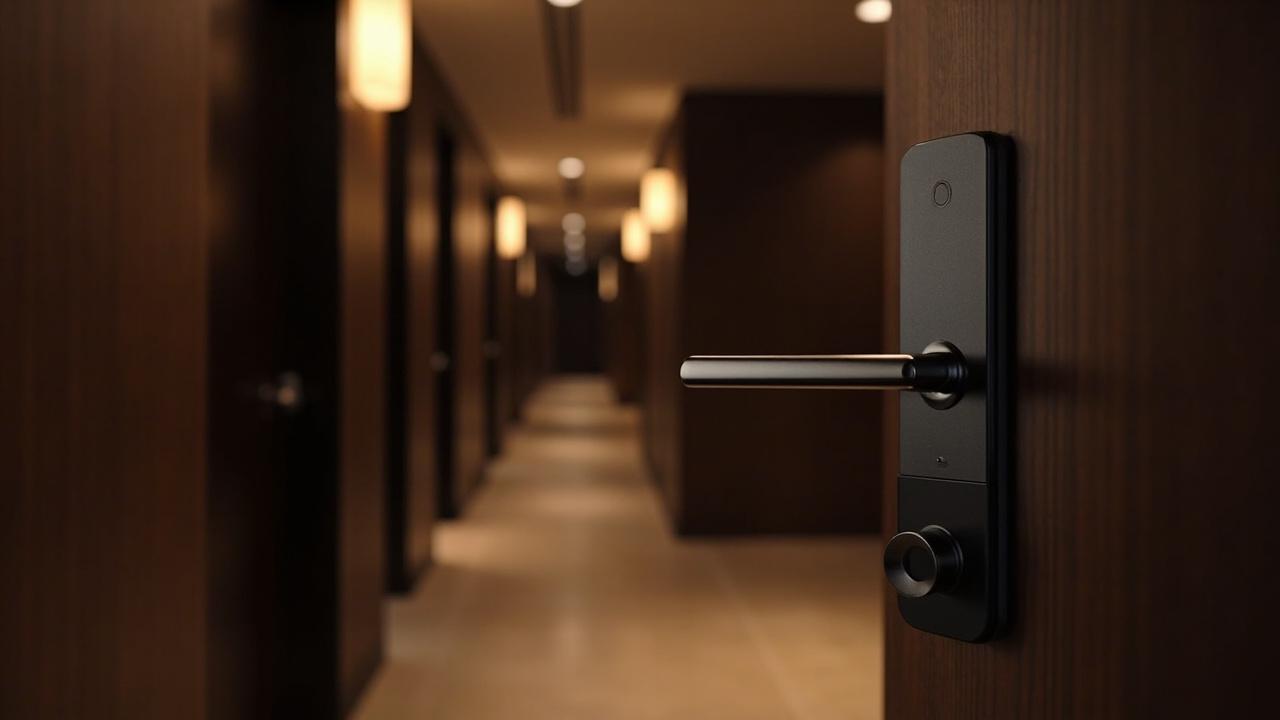
Hotel Smart Lock Digital Key Management
A hotel that "enables mobile check-in" has not enabled mobile check-in. It has grafted a second credential onto the same four-component hotel lock system, and asked that credential to survive every scenario the plastic keycard already survived: a guest who arrives at 23:40 without their phone charged past 6%, a duty manager whose PMS has just lost its WAN link, a security officer who needs to know not just that the door opened at 03:12 but which key opened it, a guest who expects their stay window to end the second the housekeeping report says so.
Hotel smart lock digital key management is the governance program that issues, expires, audits, and integrates phone-based or virtual-card credentials against the same operational contract that the plastic keycard already lives under — written down once, with named owners, named windows, named evidence, and a named PMS handshake — so the property never has to improvise the answer to "who has the right to issue, suspend, extend, revoke, and prove the digital key" on the morning something is already broken. This article is the long-form editorial voice on that program. The architectural pillar the program sits inside lives at Hotel Smart Lock System Architecture. The mobile-key-architecture deep dive that explains how the credential is encoded into the phone lives at Hotel Smart Lock Mobile Key Architecture. The PMS-edge seam the digital key rides across lives at Hotel Smart Lock PMS Integration Guide. This article is the governance ledger that holds the three of them together.
Two disclosures that bound every claim below
Two honest disclosures before the editorial opens in full:
Per-model digital-key capability is a product-page item. Whether a specific hotel lock in our 24-model hotel category reads a phone-based credential as a primary lane or only as a redundancy to its RFID Mifare 1 lineage at 13.56 MHz, holds up to 1,000 audit/event records on the SLK-9936S as a single first-party data point, supports multilingual management software in standalone or centralized database mode, and pairs with a mechanical emergency-access cylinder, is a fact about that model and that model alone. The product-page-documented block quoted once in this article — door thickness 36–100 mm, RFID Mifare 1 at 13.56 MHz, read distance 0–5 cm, read time under 0.25 s, 4 × AA batteries, battery operating cycles above 15,000, audit/event records up to 1,000, 5-pin cylinder plus 3-point latch, stainless steel + alloy body, multiple finishes, mechanical emergency access, multilingual management software, standalone or centralized database modes, positioned for 1–5 star hotels — is the anchor for the documentation discipline a hotel-class datasheet must carry. Every other hotel-line SKU (SLK-9936G, SLK-9905A, SLK-9951TH, SLK-9962S, and the wider 24-model category) is routed to documentation for any digital-key claim.
The plastic keycard is not retired. Adding a digital key is not a replacement of the plastic card; it is the addition of a second credential medium to the same door. A property that buys mobile keys on top of plastic cards without rewriting the SOP for stock, encoding, recovery, audit and destruction is the same property that yesterday had "the plastic card works" and tomorrow has "we do not know whether the door opens." This article presupposes that the card-as-object discipline covered at Hotel Smart Lock Guest Card Management remains in force. The mobile lane runs beside the plastic lane, on the same doors, against the same PMS, into the same audit log.
The Two Words That Carry Different Meanings in This Article
"Digital key" is sold by three different industries at once, and the property will live with whichever the supplier implements.
The mobile phone as a credential. A smartphone — usually the guest's own — carries a digital credential inside the property's mobile app or a wallet-style envelope. The credential is presented to the lock over a short-range radio (typically BLE in hotel deployments), and the lock validates it the way it validates a card: reader window, decision, motor, event, log. This is the dominant 2024–2026 deployment shape in mid-scale and upper-scale hotel brands. The credential lives in an app or a wallet, the lock reads it at the door, and the desk still owns who can issue and revoke.
The virtual card on a guest's existing wallet. Some properties reuse the guest's native wallet — Apple Wallet or Google Wallet — to store a virtual card that the lock reads at the door. The visible artifact looks like a card in the guest's wallet, the underlying medium is radio-driven, and the property's discipline of issuance, expiry, revocation and audit runs the same shape as a mobile-credential deployment, but the credential surface is the wallet's stored-pass UI rather than the property's own app.
A generic label without a defined credential medium. Some "digital key" marketing refers to a PDF sent by email, a paper printout, or a QR code at the door. None of these is a hotel-line lock credential in our catalog — our hotel line is built around the RFID Mifare 1 lineage at 13.56 MHz paired with a mobile-app handover channel where the lock model supports it. Any deployment that proposes a different credential medium than the lock actually reads is a marketing phrase, not a deployed credential, and the rest of this article assumes the mobile-app or virtual-card shape.
This article does not claim the second shape for any catalog SKU without an explicit product-page citation. It does not assume the first shape is universally available; it does assume that whatever shape is deployed, the four pillars below govern it. The thin part of "digital key" is not the radio, the wallet, or the app. The thin part is whether the property has written down who owns issuance, when the credential expires, where the evidence lives, and how the PMS decides the answer.
Pillar 1 — Issuance: Who Has the Right to Hand a Guest a Digital Key
The first governance question is the oldest: who can sign a digital key on behalf of the property, and against what event? Plastic cards issued at the desk with encoder and software produce a paper trail by construction — the software logged the operator, the encoder logged the write, the card was physically handed across a counter. A digital key issued from the back office to a phone in another country has none of those affordances unless the property designs them in.
Authority for issuance sits with the desk, not with the mobile channel. The mobile app is the delivery surface; the desk (or its automation equivalent) is the issuing party. Three rules follow. (i) Every digital key issued against a reservation must have an authorizing event recorded in the hotel PC software or the PMS — the desk selected the room and the stay window; the mobile channel did not. (ii) Every digital key must carry the issuing operator's identity at the moment of issue, the reservation it is bound to, and the timestamp — even when the issue is automated, the rule that names the system as the actor does not let the system act anonymously. (iii) Every digital key must be tied to a handed-to-guest event distinct from a delivered-to-app event: the property cannot treat a push-delivered credential as "received" until the guest has confirmed receipt through the app or the wallet, and a credential that never reaches the guest must be revoked on the property side the same way a card that never reached a guest is treated in the plastic-card discipline.
Issuance happens at the lodging-side system, not on the guest's device. The lock-side firmware does not generate keys. The hotel PC software does, in coordination with the PMS or with the desk's direct input. The mobile app is a delivery wrapper that receives a key the property has already minted. A common architectural mistake is to let "the app" become the issuer — that mistake means the issuance event is not in the property's audit log, the operator is not the desk, and the PMS has no record to revoke against. The architectural lens for this is the four-component system at Hotel Smart Lock System Architecture; this article carries the governance consequence.
Pre-encoded digital keys live or die on the same discipline as pre-encoded cards. Some properties pre-issue digital keys for arriving guests before they land at the property — the desk writes the key during the morning of arrival, the app receives it during the cab ride from the airport, the guest walks straight to the door. The discipline is identical to the plastic-card SOP at Hotel Smart Lock Guest Card Management: a pre-encoded credential that is never claimed at the property boundary is a credential that stays revoked at the property boundary. The mobile channel does not relax this discipline; it makes it harder to enforce because the physical handoff that used to be visible at the desk is now a push notification on a phone in another country. The compensation is not "trust the channel"; the compensation is a written rule that the credential auto-expires on first evening of stay if the guest never reaches the door.
Issuance audits and issuance ladders are the desk's discipline. Role-keyed issuance — front-desk agent can issue a guest key, duty manager can issue a guest key and a one-shot vendor key, security officer can issue an emergency dispatch key — is a property policy that runs in the PC software, not in the lock firmware. The mobile channel inherits the ladder by construction because it is the delivery surface on top of the issuance event, not the source of issuance. This is why the same hotel PC software that runs the card ladder runs the digital-key ladder; nothing about the radio changes the authority stack, and a property that buys a mobile-key product from a vendor who does not also sell or pair with the hotel PC software is a property that will discover this gap within the first week.
Pillar 2 — Expiry: The Credential That Has to End the Stay the Second the Stay Ends
A plastic card has an encoder-driven stay window. A digital key has a software-driven stay window expressed as data on the phone and as a validation event at the door. The expiry discipline is the same shape; the failure modes are different because the credential is harder to recover at the end of life.
Expiry is a contract, not a UX nicety. A guest's digital key has a starting timestamp and an ending timestamp. The starting timestamp matches the reservation check-in time or the property's earliest-arrival window — the property chooses; check the model’s published specification for the deployed lock what the earliest-arrival enforcement behavior is. The ending timestamp is check-out time on the reservation date, extended by the late-checkout flag if the desk authorises one. A digital key that lets the guest open the door past 11:00 on the day of departure is a digital key that has forgotten how hotels charge for late departure.
Expiry must be enforced on the lock side, not only on the app side. Some 2024–2026 mobile-key implementations validate the credential inside the app and trust the lock to accept whatever the app is willing to send. That is a security mistake the lock firmware owner did not make. The lock decides what to accept based on the credential and the local clock, the app does not decide. A digital-key implementation that does not enforce expiry at the lock side is a digital-key implementation with a guest-trust model, not a property-governance model; the lock's clock discipline, its time-window enforcement behavior, and its offline-mode expiry behavior are all to verify in writing questions to verify against the model’s published specification for any shortlisted lock. This is where the SLK-9936S anchor — read time under 0.25 seconds, audit/event records up to 1,000, mechanical emergency access, multilingual management software, standalone or centralized database modes — names the lineage a hotel-class datasheet is supposed to carry; the exact expiry enforcement points of any sibling SKU (SLK-9936G, SLK-9905A, SLK-9951TH, SLK-9962S) are documentation.
Late checkout, extension, early arrival, room change — each is a re-issue event. A guest who arrives four hours early wants their key to start at noon instead of 15:00. A guest who asks for a 14:00 late checkout wants their key to extend by three hours. A guest who is moved from room 412 to room 418 wants the 412-key to expire and the 418-key to issue against the same reservation. None of these is a new credential in the property's accounting — they are re-issues of the same reservation-bound credential with new timestamps or a new room binding. The mobile channel should treat them as re-issues: a single line in the audit log, not two or three; a single operator on the desk, not the guest themselves.
The credential that is not used is not a credential that has to be revoked. A digital key delivered to an app that the guest never installed, a virtual card pushed to a wallet that never received the confirmation tap, a credential issued for a no-show reservation — these are not "active leaked credentials" until the stay window passes. A no-show credential expires at its check-out timestamp the same way every other credential does; a never-confirmed credential expires the same way. The discipline property owners worry about is real, but it is not a "mobile key is dangerous" rule — it is a "credential without a clock is a credential without a guest" rule that the plastic lane has always had too. The compensation is the clock, the audit log, and the rule that a credential past its timestamp is not a credential at all.
Expiry at suite-change, group split, and multi-property transfer. A guest moving between suites in the same stay expects the new door to open and the old door not to. A guest transferring between two hotels in the same group expects the destination door to open from the moment of check-in at the new property. Both events are re-issues, not additions. The hotel PC software supporting both shapes (standalone-mode for one property, centralized-database-mode for groups) and the digital-key channel that rides on top of that software is the system this article is about. Check the model’s published specification for the deployed lock and the deployed software what the specific behavior is at re-issue and at group-transfer events — those behaviors vary by SKU and by software build.
stateDiagram-v2
    [*] --> Issued: desk or PMS event mints the credential
    Issued --> Delivered: push or pull lands in the app or wallet
    Delivered --> Active: guest confirms receipt · stay window open
    Active --> Active: re-issue on room change or late checkout
    Active --> Expired: lock-side clock ends the stay window
    Active --> Revoked: early checkout · lost phone · incident
    Revoked --> Synced: revocation reaches the lock on next sync
    Expired --> AuditClose: trail stitched to the folio at check-out
    Synced --> AuditClose
    AuditClose --> [*]
Pillar 3 — Evidence: What the Audit Log Has to Capture and What Has to Stay Out of It
A digital key has a richer audit footprint than a plastic card by default, and a much easier one to fudge. The governance choice is whether to treat the richer footprint as a property benefit or to let the richer footprint become a privacy surface the property cannot defend. Pillar 3 forces that choice into writing.
Every digital-key event is a property event, not a phone event. The lock logs a "credential presented" event. The hotel PC software logs a "credential validated" event if the lock pulls the audit trail. The PMS logs a "key issued / re-issued / revoked" event. The mobile app on the guest's phone may log its own delivery receipt, but that is the guest's event, not the property's event. The property's audit trail is the union of the first three, not the first one alone, and a program that cannot demonstrate which of the three fires for which event is a program that will lose disputes.
The audit fields are a question to ask, not a list to assume. What event classes does the lock export — credential presented, credential accepted, credential rejected, credential expiry hit, credential revocation hit, low battery, mechanical override, tamper, forced entry? What is the audit-event field list per event? What is the export format (CSV, JSON, raw, signed batch)? What is the receiver endpoint — the hotel PC software only, or also the PMS, or also a long-term archive? What is the retention policy at the lock, at the hotel PC software, at the PMS, and at the archive? What is the signing or hashing discipline on the audit pull — is the trail tamper-evident, or is it a CSV anyone can edit? Every one of these is a fact about the deployment, not a fact about the catalog. The SLK-9936S names "audit/event records up to 1,000" as a single first-party data point; what is exported, in what format, to whom, with what retention, with what signing — all to verify in writing, all documentation for the deployed SKU and the deployed software version.
The audit log is a privacy instrument, not a marketing asset. A digital key at the door records the credential, the door, the timestamp, and an envelope around the credential identity. It does not record the device's MAC address, the geolocation of the phone, the OEM of the phone, the OS version, the battery level, the biometric state, or the user-agent of the app. A logging posture that captures any of those is a logging posture that has crossed from operational evidence into personal-data territory under most 2024–2026 jurisdictional frames (GDPR, UK GDPR, the various state privacy frameworks in the US, the regional privacy laws in APAC and LATAM). The property should write down what fields it captures and what fields it does not capture, who has access to the captured fields, how long the fields are retained, and what deletion process applies when a guest's reservation is closed. If the supplier's default logging is broader than the property's privacy posture, the property has to either constrain the logging at the deployment or accept the supplier's default.
Tamper-evidence is a different question than capture. A property can capture every event at the lock and still have a fully tamper-vulnerable trail if the trail is a CSV on the hotel PC software's desktop. The mobile-key channel makes this question more important, not less, because the digital key opens more doors in some deployments than a card (suite doors, lounge doors, parking gate, elevator call) and the larger attack surface demands a stronger evidence posture. Check the model’s published specification for the deployed software what the audit-export format is and whether the trail is signed or hashed. If the answer is "plain CSV," the property should plan for an external archive step (write-once storage, off-host signing, scheduled hash) before the trail becomes a regulatory exhibit.
Cross-system forensics need a shared event clock. A guest dispute at midnight on a Tuesday requires the property to reconstruct what happened across the lock, the hotel PC software, the PMS, and the mobile-delivery channel. If the four systems' clocks differ by more than a few minutes, the reconstruction is impossible. The clock discipline is named by hotel PC software's "multilingual management software" requirement because that requirement is a hint that the software has a clock convention — but the convention itself is check the model’s published specification for every shortlisted build. NTP, time-zone handling for multi-property deployments, daylight-savings handling, drift behavior in standalone-mode where no central time source exists — all of these are deployment questions the property has to answer in writing.
Pillar 4 — PMS Integration: The Contract That Decides Whether the Digital Key Actually Works at the Door
The PMS is the system the desk actually lives in. The mobile-key channel is a delivery surface on top of the hotel PC software, which is in turn a peer of the PMS (sometimes the same software, more often an adjacent system with a handshake). Pillar 4 is the contract at that handshake, and it is where most digital-key programs fail not because of the lock, not because of the phone, not because of the app, but because the integration was scoped verbally and never put on paper.
The PMS owns the reservation; the hotel PC software owns the key. In the dominant 2024–2026 architecture the PMS holds the room inventory and the guest identity, the hotel PC software holds the lock population and the key inventory, and the two systems exchange events through a connector. The mobile-key channel writes keys as the hotel PC software authorizes them; the PMS does not issue keys directly to phones. A property that has contracted for a PMS-driven mobile-key workflow is a property that has contracted for a PMS-to-PC-software connector with a mobile-delivery leg on top of the PC-software side. The depth of that connector — does it carry room-change events as re-issues, or as additions; does it carry late-checkout as a re-issue or as an extension; does it carry the audit trail back to the PMS or to a separate archive — is a seam question the property has to write down before the desk goes live.
The 13-event contract is the contract property-side questions should walk through. The PMS integration guide at Hotel Smart Lock PMS Integration Guide names thirteen events the integration must support on a properly-scoped deployment: reservation-sync inbound, check-in-triggered key encoding, room-change trigger, extension-of-stay re-key, walk-in same-day re-key, mobile-key handover, check-out de-authorisation turnaround, audit-event outbound, housekeeping-status outbound, master-card role-keyed issuance, two-factor hook, connector-license terms, offline-mode behavior. The mobile-key channel is the "mobile-key handover" leg, but the same thirteen-event contract is what tells the property whether check-in triggers a key delivery, whether late-checkout extends an existing key, whether a room change revokes the old key before issuing the new, whether the audit trail reaches the PMS, and whether the offline-mode behavior at the lock keeps the door disciplined when the WAN drops. Every cell of that contract is confirm-on-the-supplier, confirm-on-the-PMS-vendor, and documentation before the desk writes its first mobile key.
The PMS vendor and the lock vendor do not always integrate natively. Some properties will discover at deployment that the chosen PMS and the chosen lock vendor have no native connector at all, and that the connector they are planning to use is a third-party middleware product with its own license, its own failure modes, and its own maintenance cadence. This is not a surprise the property wants on the morning of go-live. A pre-quote question list that names the PMS product, the PMS version, the lock product, the lock firmware version, the hotel PC software version, and the connector product (if any) is the lever that closes this gap at the RFQ stage. The property that asks these five questions before signing has bought itself a contract; the property that asks them after signing has bought itself a project.
Connector ownership and support contracts. A connector is software. Software needs an owner. A connector that the lock vendor owns is a connector that the PMS vendor cannot update unilaterally; a connector that the PMS vendor owns is a connector that the lock vendor cannot update unilaterally; a connector that a third-party integrator owns is a connector that nobody is contractually bound to update unless the property bought the support contract. The property should name the connector owner, the contract owner, and the maintenance cadence (PMS-version compatibility register, lock-firmware compatibility register, regression-test cadence) in the RFQ, and refuse to sign the RFQ until the three are written down with signatures.
Offline mode and the digital key. A digital key is a credential that lives in the phone; the phone does not require a WAN connection to present it at the door in most 2024–2026 implementations. This is a guest-experience win and a property-governance wrinkle: it means the digital-key handover can happen even when the property is offline, but it also means the lock has to enforce the stay window and the revocation list locally, not against the PMS. The lock's offline-mode behavior — what it caches, what it enforces, how it reconciles when the WAN comes back — is a fact about the deployed lock and the deployed software, not about the catalog. Check the model’s published specification for the deployed SKU and the deployed build. The SLK-9936S anchor names standalone-or-centralized database modes as the architectural handle for this question; the exact offline-mode behavior at the lock side, at the software side, and at the mobile-delivery side is verified in writing.
The Credential Format Conversation the Property Has to Have Before the Quote Is Signed
Digital-key marketing is loud and the underlying credential formats are quiet. The property-side questions are quiet too. They run on paper before the desk writes its first digital key.
| Question the property must write down | What the answer changes | Where it is confirmed |
|---|---|---|
| Which credential format does the lock accept at the door — phone-presented digital credential, wallet-pass virtual card, or both? | Determines whether the property runs one delivery channel or two; determines the app-build and the wallet-build scope | Hotel-line product page for the deployed SKU; documentation per SKU |
| How is the credential delivered — property app, brand app, wallet-push, third-party delivery service? | Determines whether the property builds an app or reuses a brand app; determines the data-sharing posture with the delivery service | Hotel PC software documentation; documentation per software build |
| What is the issuing authority on the credential — desk, duty manager, brand-app account, third-party account? | Determines who can sign a key and against what reservation event | Hotel PC software documentation; PMS integration guide at Hotel Smart Lock PMS Integration Guide |
| What is the stay-window enforcement behavior — clock-driven, event-driven, both? | Determines whether a guest can present at 11:01 and still get in | Documentation for the deployed lock SKU and firmware version |
| What is the offline-mode behavior at the lock — does the door keep accepting credentials when the WAN is down? | Determines whether the property must run the desk at full paper for stays during outages | Documentation for the deployed lock and software build |
| What audit-event classes does the lock export, in what format, to whom? | Determines whether the property has a defensible evidence posture at the desk and at the long-term archive | Documentation for the deployed lock SKU and software build |
| What is the connector owner — lock vendor, PMS vendor, integrator? | Determines who the property calls when a key does not arrive at the door | Confirm with the lock vendor and the PMS vendor before the RFQ is signed |
| Question the property must write down | What the answer changes | Where it is confirmed |
|---|---|---|
| What is the connector maintenance cadence for PMS-version drift and lock-firmware drift? | Determines whether the property is forced to retest every PMS upgrade and every lock firmware roll-out | Confirm with the lock vendor, the PMS vendor, and the connector owner in the RFQ |
Two tables because the question set itself splits: the credential-and-runtime questions above are answered against the deployed lock and the deployed software; the connector-ownership questions are answered against the deployed vendors. Neither side asserts catalog capability beyond what the SLK-9936S product-page-documented anchor names (Mifare 1 at 13.56 MHz, sub-quarter-second read time, 4 × AA batteries, more than 15,000 battery cycles, up to 1,000 audit/event records, 5-pin cylinder, 3-point latch, mechanical emergency access, multilingual management software, standalone or centralized database modes, 36–100 mm door thickness). Every other number is documentation or confirm-with-the-PMS-vendor or confirm-with-the-connector-owner.
Out-of-Catalog Firewalls the Property Should Write Down Once
The catalog publishes 79 models with 24 in the hotel category. Hotel-line locks in our catalog expose RFID Mifare card reading as the primary credential medium, paired on most models with mechanical-key bypass and audit-log retrieval. Mobile-key delivery on top of the hotel-line is an architectural extension the property buys and the lock vendor implements; the credential medium on the lock side remains the catalog's published lineage. The following are not catalog capability for any hotel-line SKU and the property that buys a digital-key pitch anchored on any of them has bought a pitch, not a deployment:
Apple Home Key. Not a catalog capability for any hotel-line SKU in the published lineup. A vendor that pitches "Home Key for hotels" is a vendor with a Home Key strategy, not a vendor with a hotel-line SKU; do not accept the pitch as a hotel-line capability.
Matter, Zigbee, Z-Wave, Thread. Not in the hotel-line catalog. A hotel-line lock that integrates with any of these is integrating through a third-party bridge, not through the lock SKU itself; the property must write the bridge down on paper and ownership it the same way as a PMS connector.
UWB. Not in the hotel-line catalog. Fine-range location for door-open-at-distance is a guest-experience nice-to-have the catalog does not promise.
Wi-Fi as the hotel-line radio. The hotel-line locks in this catalog are not promoted as Wi-Fi-primary locks; networking and connectivity decisions (RFTC/RF, gateway, networked, standalone) live at the architectural decision the property has already made, and the digital-key channel rides on top of that decision.
Palm-vein, vein-recognition, advanced biometric. Not in the hotel-line catalog. A vendor that pitches biometric mobile-key on the hotel-line lock is a vendor that is pitching general-purpose biometric smart-lock capability, not hotel-line hotel capability.
NFC secure-element wallet credentials. Where the catalog does not publish a SKU support level, the property must write down what the lock actually reads in writing.
This is the firewall. The property that writes it down once, at the RFQ stage, never has to chase the marketing brochure through security or compliance review.
The Procurement Posture: What the Property Signs Before Signing
The property-side procurement posture for hotel digital-key management is not the same as the procurement posture for a plastic-card rollout. Five commitments belong in the RFQ before the desk writes a single key.
Commitment 1 — The credential is governed, the delivery surface is configured. The property commits to a desk-driven, PC-software-mediated issuance process with the mobile channel as the delivery surface. The supplier commits to a hotel PC software that runs the issuance, an encoder station that operates for the plastic lane, and a mobile-delivery channel whose behavior is documented per firmware and per software version.
Commitment 2 — The expiry is enforced at the lock. The property commits to a stay-window enforcement at the lock side that does not trust the phone. The supplier commits to documentation that names the lock-side enforcement behavior per firmware, including the offline-mode behavior when the WAN is down.
Commitment 3 — The audit is a union, and the union is signed. The property commits to an audit posture that captures the relevant event classes at the lock, the hotel PC software, and the PMS, and to a signed or hashed archive where the trail is tamper-evident. The supplier commits to the event-class list, the field list, the export format, and the signing posture per build.
Commitment 4 — The PMS connector contract is on paper. The property commits to refusing to sign without a 13-event PMS-to-PC-software connector contract. The supplier commits to a named connector product, a named connector owner, and a named connector maintenance cadence.
Commitment 5 — The privacy posture is written down once. The property commits to a documented data-capture list, a documented retention policy, and a documented deletion process. The supplier commits to a configurable logging posture that does not exceed the property's documented privacy frame.
These five commitments are the closing posture of this article. They are also the procurement instrument at Hotel Smart Lock System Architecture. The mobile-key channel is not a new commitment; it is the same commitments, written tighter, on a new credential.
An Illustrative Walkthrough: A 180-Room Regional Hotel on the SLK-9936S Line
Consider a 180-room regional hotel with a mixed-stay profile — 60% business, 30% leisure, 10% group — operating on the SLK-9936S hotel-line platform documented with the anchor spec block this article has named (36–100 mm door thickness, RFID Mifare 1 at 13.56 MHz, 0–5 cm read distance, read time under 0.25 s, 4 × AA batteries, more than 15,000 battery cycles, audit/event records up to 1,000, 5-pin mechanical cylinder with mechanical emergency access, 3-point latch, stainless steel + alloy body, multilingual management software, standalone-or-centralized-database modes). The property has adopted mobile check-in, meaning digital keys are issued against the existing PMS for every reservation that opts in; the plastic card lane remains in production for every reservation that opts out.
A Tuesday in mid-autumn. A business guest checks in on the mobile channel at 14:20 in a cab from the airport. The desk writes the key — operator Smart Lock Cloud vs Local Management, room 612, stay window 14:00 Tuesday to 11:00 Wednesday. The hotel PC software carries the issuance event into the audit log. The mobile-delivery leg pushes the key into the property's app on the guest's phone; the guest receives the push, the app confirms receipt, the audit log gains a delivery-confirmed entry. The cab rolls up at 15:08; the guest walks to room 612, presents the phone at the reader within the 0–5 centimeter window, the lock validates the credential against the local clock, drives the 3-point latch, appends an event. The audit log now contains three entries on the same reservation: issuance, delivery-confirmed, door-open. All three are visible to the desk the next morning.
At 21:14 the guest calls the desk — a colleague from the office is downstairs for a 15-minute meeting. The desk asks whether the colleague can come up; the property policy is no second-party handover without a desk escort. A second digital key is issued to the colleague's phone as a one-shot guest credential with a 30-minute stay window, the expiry hard-coded at 21:50. The audit log adds the colleague-issuance event with the desk operator ID and a guest-of-guest annotation. At 21:48 the colleague departs, the key expires at 21:50, the door does not open past that timestamp because the lock enforces the window, not the phone.
At 06:40 the next morning the guest extends checkout to 14:00 via the app. The extension is a PMS-to-PC-software re-issue event; the audit log carries the re-issue as a single line, not two. The previously-issued credential is replaced with one whose expiry is 14:00 Wednesday; the phone's local cache updates; the lock is indifferent to the operation because the new credential bears a later stay window. At 14:00 the property's housekeeping report shifts the room to "checked-out inspected" state; the PC software revokes the credential, the audit log carries the revocation, and any subsequent presentation at the door is rejected at the lock. The guest has departed; the credential has reached its agreed ending timestamp. The audit log is contiguous across the stay. This is what the program is supposed to produce. Every fact in this walkthrough is descriptive of how the architecture is documented on the SLK-9936S product page; the property's specific configuration of mobile-delivery vendor, PMS connector, and audit-export format is documentation and confirm-with-the-vendors before the quote is signed.
Closing Posture: The Digital Key Is a Credential, Not a Brand Promise
The hotel industry sells mobile check-in as a guest experience. The property-side governance treats it as a credential. The two should converge on the same paper, written once, before the desk writes its first digital key, and updated at every PMS-version drift and every lock-firmware roll-out. The architecture pillar at Hotel Smart Lock System Architecture, the mobile-deep dive at Hotel Smart Lock Mobile Key Architecture, and the PMS seam at Hotel Smart Lock PMS Integration Guide own the rest of the surface. This article owns the four governance pillars: issuance authority at the desk, expiry discipline at the lock, evidence as a signed union, and the PMS contract as a 13-event document with a named owner. The mobile channel does not change those pillars. It makes them more important to write down, because the credential is harder to recover at the end of life than a card is.
When the desk goes to write a digital key and the property has not written down who issues it, when it expires, where the audit lives, or how the PMS contract delivers the key, the desk will improvise. Improvisation produces credentials that cannot be revoked, stay windows that do not end at noon on the day of departure, audit trails that are CSVs on a desktop, and PMS handshakes that work until the next PMS upgrade. The four pillars exist to make improvisation expensive enough to justify writing things down once.
The hotel-line catalog supports the discipline. The architectural pillar is published. The PMS seam is dissected. What remains is for the property to read those three, write the four pillars, and walk into the RFQ knowing what the desk will do on Tuesday morning when a digital key does not arrive at the door. The rest is paperwork.