
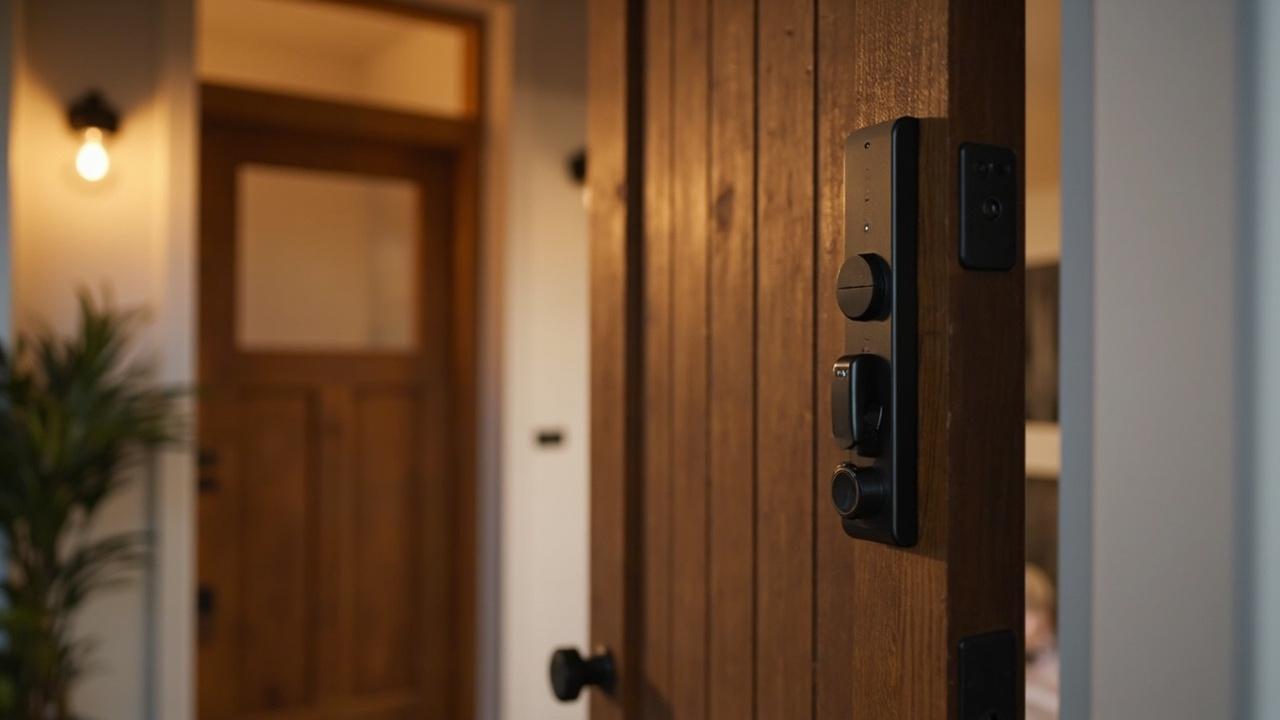
SLK-1104 for Narrow Frame Doors
A narrow frame door defeats a standard smart lock long before anyone thinks about batteries or fingerprint sensors. The lock case simply has nowhere to go: the edge of the door is too slim to receive a mortise pocket, the chambers inside the profile collapse under the cutout, or the fixing screws land in air. The SLK-1104 belongs to the narrow-edge door lock class, and this article is the engineering explanation of why that class exists — what the anatomy of aluminium and uPVC profile doors does to a lock, where conventional mortise cases fail, and which design decisions a narrow-edge case makes differently. If you are comparing the SLK-1104 against door types across a mixed retrofit, that decision arena lives in SLK-1104 narrow edge door compatibility; this piece explains the geometry underneath it.
Direct answer: "Narrow frame door" in lock-fitting language means a door — usually an aluminium or uPVC profile system — whose edge is too slim to house a standard mortise lock case. A narrow-edge lock like the SLK-1104 answers that anatomy with a slim steel case, fastening that reaches structural material instead of hollow chambers, and a bolt line that clears the profile walls. Fit is decided by two numbers you measure at the door (edge width and thickness) and two numbers you transcribe from the product page, never from memory.
Four Words Buyers Mix Up: Frame, Leaf, Face, Edge
Half of the failed narrow-door orders in this category are vocabulary failures before they are measurement failures. Specify a lock by saying "our frames are narrow" and the factory cannot tell which dimension you mean, because a door has at least four distinct "narrow" candidates.
| Term | What it actually is | Which side of the lock problem it decides | The classic misuse |
|---|---|---|---|
| Frame (jamb) | The fixed structure in the wall opening | Strike-side geometry, what the bolt throws into | Called "narrow" when the buyer means the door itself |
| Leaf | The moving panel you open and close | Everything the lock case cares about | Ignored; people survey the frame and order for the leaf |
| Face width | The visible width of the stile when the door is shut | Aesthetics, sight lines, where surface plates sit | Measured with a tape and reported as "edge width" |
| Edge width / door thickness | The slim side of the leaf where the latch exits | The lock pocket, case envelope, fixings, cutout | Never measured at all on profile doors |
The lock does not live on the face. It lives on the edge — that narrow strip of leaf, only a few centimetres wide on profile doors, where the latch bolt emerges and the case buries itself. When someone says "narrow frame door" and a retrofit goes wrong, the narrowing that mattered was almost always the edge.
This distinction has procurement consequences. A survey sheet that records "frame: aluminium, narrow" is unusable for a lock quotation. A survey sheet that records leaf edge width at the lock line, leaf thickness at the lock line, and face width separately is quotable. The hands-on measuring protocols — where to place the calipers, how to avoid the paint flange trap — are written out step by step in SLK-1104 lock case size guide, and this article deliberately does not repeat them; what follows is the anatomy those measurements are probing.
Aluminium Profile Stiles: A Shell Around Air
Architectural aluminium door leaves are extruded from alloys chosen for stiffness-to-weight, not for machinability the way timber is. A typical commercial-grade aluminium door stile in narrow-frame systems presents an outer wall in the region of 1.4–2.0 mm — general industry-typical territory, subject to whatever system your supplier actually built with — wrapped around internal voids: insulation slots, gasket channels, drainage paths, sometimes a thermal break. Two millimetres of aluminium, and then air.
Three anatomical consequences follow for anything you try to bury inside that stile.
First, there is no depth to cut. A timber door lets a mortise chisel descend 60 mm or more into solid material. An aluminium stile that is, say, 38–45 mm thick across the edge (again, a common band for profile doors, verified in writing per project) gives you that whole number minus the walls you must not punch through. Every millimetre of case width spends itself out of a budget measured in low double digits.
Second, there is no holding power in the wall itself. A screw threaded into a 1.5 mm aluminium wall in a hollow chamber does not behave like a screw in timber; under the daily torque of a handle and the recoil of a deadbolt, the threads wear the soft extrusion and the assembly goes loose. Narrow-edge hardware answers this by clamping through to structural material or by through-fixings that sandwich the profile, not by biting into one wall.
Third, the chambers break the cutout plane. A rectangular lock pocket drawn casually across a profile cross-section will intersect vertical webs, gasket runs and drainage slots. Cutting a web removes the stiffness the profile was engineered for. Severing a gasket channel produces a leak path that shows up as a water complaint months later. The pocket has to be planned against the cross-section, not against the visible face.
Cold is the wildcard. Aluminium bridges temperature the way it bridges doorways: the stile runs cold in winter, warm and sweating in humid summers, and any electronics pocket that traps condensation against a battery compartment or a fingerprint module board is a corrosion story waiting for its chapter. This is part of why the narrow-edge class — including the SLK-1104 waterproof narrow-edge lock — is positioned for exposure-prone openings, and why the sealed-construction claims around it deserve auditing against the product page rather than against adjectives.
uPVC Profiles: Plastic Skin, Steel Backbone
uPVC profile doors — the multi-chamber systems familiar from European windows and patio doors, commonly built around nominal 58, 65 or 70 mm frame-depth families with leaf dimensions in the same neighbourhood — are a different animal with the same headline problem. The visible material is unplasticised PVC with typical wall thickness in the 2.5–3 mm band; inside the main chamber sits a galvanized steel reinforcement section, inserted to carry the hardware loads the plastic itself cannot.
That steel insert is the whole story for lock fitting on uPVC.
- The pocket cuts plastic, the screws must find steel. Handle spindles, cylinder fixings and case screws are designed to thread into or clamp against the reinforcement. If a survey never opened the profile to verify in writing the insert is present, continuous and correctly positioned, a lock can be specified for a door whose hardware zone is actually two shells of hollow PVC.
- Cutting the wrong web wrecks the reinforcement. The steel section is often a C or U shape welded or screwed along the profile length. A lock cutout that clips its flange undermines every other fixing on the door, not just the new one.
- Thickness is not the constraint; layout is. A 70 mm uPVC leaf looks generously thick beside a 40 mm aluminium one, but the usable lock zone is a narrow corridor between outer wall, chamber structure and reinforcement. Wide mortise cases that would sink comfortably into timber intersect the geometry here.
Between the two systems, the shared problem statement is identical and it is not about millimetres alone. Both profiles are engineered structures whose cross-sections allocate material where the loads go, and a lock pocket is an intrusion that has to negotiate that allocation. Timber forgives an over-sized pocket; a profile system does not.
Where the Lock Pocket Ends: The Four Walls Problem
Picture the cutout from the installer's side. The case enters through the edge and descends into the leaf interior. Four boundaries constrain it, and on narrow-frame doors each one is live:
- Outboard wall — the weather-facing skin. Break through it and you have created a thermal bridge, a water path and an cosmetic wound on the exterior elevation. Minimum cover must remain.
- Inboard wall — the interior skin. Same logic; on fire- and acoustic-rated assemblies, punching it can void the build-up's intent.
- Top and bottom of the pocket — the profile's transverse webs or the continuation of chambers. Where a rail crosses the stile, the pocket length is capped by the web spacing, and the survey has to record web positions, not just door height.
- The bolt line — the horizontal plane in which the latch and deadbolt travel. Anything in that line inside the frame zone — strikers, mullions, drainage — belongs in the survey too.
A standard timber-mortise template assumes a homogeneous medium in which none of these four walls exist as engineered constraints. That assumption is the seed of every failed profile-door lock order: the template was drawn for a door that has no opinions about where you cut.
Why Standard Mortise Cases Fail on Profile Doors
With the anatomy on the table, the failure sequence of a conventional lock on a narrow-frame door reads almost like a script. Standard mortise cases for timber doors are typically designed around edges and faces measured in centimetres of solid material — a case front often in the region of 60 mm face width with deep pockets — and their entire design language presumes that presumption.
| Failure mode | What happens physically | What the buyer experiences |
|---|---|---|
| Pocket breaks the outboard wall | Cutout depth exceeds available material; outer skin is pierced | Rejected doors, replacement profile sections, project delay |
| Fixings bite nothing | Case screws thread into hollow chamber walls only | Handle rosette loosens within weeks; lock shifts in pocket |
| Case obstructs chambers | Bulky body interrupts drainage or gasket channels | Water ingress, wind whistle, frozen gaskets in winter |
| Bolt line misfires | Throw geometry drawn for timber edges meets rail/striker intrusions | Deadbolt rubs, partial throw, or won't extend at all |
| Steel insert misaligned (uPVC) | Screw points fall short of or across the reinforcement | Cylinder and handle wiggle; torque tests fail on site |
| Condensation on bare metal case | Cold bridging onto an unsealed backbox | Corroded electronics, intermittent keypad/fingerprint faults |
| Thermal bowing around large cutout | Removing a stiffening section of the profile | Door binds in frame seasonally; latch engagement drifts |
Each row is a design brief in negative. The narrow-edge lock class exists because someone answered them one by one.
Note what is not in this list: bad batteries, weak sensors, unreliable fingerprint readers. Those are electronics questions that apply to any smart lock on any door. The mortise-class failure above is purely structural, which is why a project can fall apart before the electronics are even switched on. The cluster's operations guides — SLK-1104 fingerprint enrolment and field operations and its password policy handbook — pick up where the pocket ends; this article stays with the metal and the plastic.
What a Narrow-Edge Case Does Differently
Take the failure table and invert it, and you have a functional description of the narrow-edge lock case. Six design responses define the class, and they are worth naming precisely because a supplier who cannot speak to them is selling you a timber lock with a narrow sticker on it.
A slim envelope. The case body is drawn to a reduced face and pocket footprint so the cutout stays inside the safe zone between profile walls. The SLK-1104's own case outline — the numbers that let you plot that envelope against your stiles' cross-sections — is a transcription from the product page, left as blanks in this article's capture sheet below rather than guessed here.
Fixings that reach structure. Instead of trusting one extrusion wall, narrow-edge hardware clamps the profile: through-bolts that sandwich the stile, or screw points positioned to land in the steel reinforcement of uPVC sections. Load goes to the material engineered to carry it.
A bolt line planned around the profile. Latch and deadbolt geometry is set so the throw clears internal webs and engages the strike without the case needing depth it cannot have. On some systems this means a hook-style or reduced-throw bolt family; on a given product, check the description rather than assuming.
Separation of electronics from pocket. In many narrow-edge smart locks, the smart part — board, battery box, sensor — is designed to sit in surface-mounted plates on the leaf faces or in shallow compartments, keeping the buried steel case as simple as possible. The 4-in-1 credential set of the SLK-1104 class product (fingerprint, password, IC card, mechanical key, per its product listing) lives in those plates; the pocket carries mechanics.
Sealed interfaces. Because profile doors skew exterior — balcony, entrance, shopfront — the class treats the edge cutout as a weather boundary. Gaskets behind the case, sealed plate perimeters, drained battery compartments: the specific construction of the SLK-1104 is a product-page audit, but the design posture is visible in why "waterproof" appears in its listing name at all.
Reversibility awareness. A profile door is a replacement item, not a regrindable one. Narrow-edge fitting favours templated, repeatable cutouts over site-carving, so a damaged leaf goes back to the profile shop rather than into a skip mid-project.
Reading a Profile Cross-Section Before You Cut: A Stage Sequence
Specifying a narrow-edge lock onto a narrow-frame door is not one decision but a gate sequence. Run them out of order and each earlier skip contaminates the later answer.
Survey leaf type → Measure edge at lock line → Open/reveal chamber layout → Confirm reinforcement (uPVC) or webs (alu) → Transcribe case envelope from product page → Plot cutout against cross-section → Verify bolt line and strike → Issue sample on a like-for-like offcut or sacrificial leaf
- Gate 1 — Material identity. Aluminium system or uPVC system, and whether the leaf carries a steel insert. Record it per door type, not per building.
- Gate 2 — The live numbers. Edge width and thickness at the height where the case will sit, at three doors per type minimum; profile doors vary with manufacturer batch.
- Gate 3 — Internal truth. A cross-section drawing from the profile supplier, or a photographed cut on a sample offcut. What the pocket will intersect becomes visible here or becomes a surprise later.
- Gate 4 — Hardware envelope. The lock's own case outline, pocket depth and cutout pattern pulled from the dated SLK-1104 product page — the article SLK-1104 4-in-1 specifications walkthrough shows how to dissect that datasheet line by line without trusting any number you cannot source.
- Gate 5 — Overlay test. Draw the envelope onto the cross-section. If every wall keeps its minimum cover and every fixing lands on structure, the fit is credible. Anything else returns to Gate 1 with a different product class.
- Gate 6 — Physical rehearsal. Fit one sample on a real or like-for-like leaf before fleet money moves. The cluster buyer guide frames the sample-first purchasing logic; the engineering reason is that no survey captures cutting feel, screw engagement, or how the gasket sits under load.
The SLK-1104 Fitment Capture Sheet: Blanks on Purpose
Here is where discipline matters. This article is sanctioned to tell you what the SLK-1104 is — a narrow-edge 4-in-1 electronic smart door lock with waterproof positioning in the catalogue — and where its numbers must come from. It is not sanctioned to tell you the numbers. Every value below belongs in a dated transcription from the live product page or factory datasheet; the blanks are the point.
| Capture field | Value (transcribe + date source) | Why this field decides the fit |
|---|---|---|
| Minimum door edge width | ___ (to verify in writing — check the product page) | The class-defining number; your narrowest stile must meet or beat it |
| Door thickness band (min–max) | ___ (to verify in writing — check the product page) | Pocket depth budget for aluminium leaves and uPVC sections |
| Lock case outline (face × depth) | ___ (to verify in writing — check the product page) | Overlay onto the cross-section; touches the four-walls test |
| Cutout pattern / template size | ___ (to verify in writing — check the product page) | Determines which webs and chambers get intersected |
| Backset and bolt line height | ___ (to verify in writing — check the product page) | Strike engagement and clearance to rails and mullions |
| Fixing method (through-bolt / insert screw points) | ___ (to verify in writing — check the product page) | Whether the case can actually reach structure on your profile |
| Surface plate footprint | ___ (to verify in writing — check the product page) | Face width needed on the inboard/outboard sides |
| Credential lanes shipped per variant | ___ (confirm against listing: 4-in-1 = fingerprint / password / IC card / mechanical key) | Determines operations stack, not fitment — but variant price bands follow it at quote time |
| Water/protection claim wording | ___ (transcribe the exact name-level claim; ask what standard it answers to) | Exposure-scope audit, not an assumption of rating |
Two habits make this sheet work. First: a blank with a date beats a remembered number. Second: any supplier answer phrased as an adjective — "fits most aluminium doors", "fully waterproof" — converts back into a row on this sheet or it does not count. If the product page cannot fill a row, that is itself a finding: it means the door type should be routed to the compatibility decision process in narrow edge door compatibility instead of being forced onto this SKU.
Direct answer: On narrow-frame doors, the SLK-1104's fit is decided by five transcribed numbers — minimum edge width, thickness band, case outline, cutout pattern and fixing method — plotted against the door's actual profile cross-section. Any specification built without those five lines plotted is a guess priced like a decision.
Face Width, Edge Width: Two Measurements, Two Different Verdicts
Because the vocabulary table flagged the misuse, it deserves its own section. On a shut narrow-frame door, face width is what the building sees; edge width (thickness) is what the lock occupies. They change independently, and they veto different things.
| Dimension | Where measured | Too narrow means | Too wide means |
|---|---|---|---|
| Edge width / leaf thickness | Calipers across the slim side of the leaf, at lock height | Standard mortise case cannot be buried without breaching walls — the narrow-edge class exists for this | Case pocket or through-fixings may exceed profile internal geometry; check chamber layout |
| Face (sight) width of stile | Visible strip of the closed door, across the stile | Surface plates, rosettes or handle escutcheons overhang the edge into the rebate/gasket | Rarely a veto; mostly aesthetics and plate positioning freedom |
A door can be face-generous and edge-starved — a wide-looking aluminium stile with a slim 38–40 mm leaf thickness is a textbook narrow-edge candidate. It can also be the reverse: a slim sightline with a deep thermal leaf that swallows a conventional case. Neither "narrow" nor "wide" describes a door for lock purposes until you say which of the two you measured. And neither verdict transfers between the two profile families: an aluminium pass does not imply a uPVC pass, because the reinforcement question can veto a door with perfect outer dimensions.
Direct answer: Face width decides whether surface hardware sits cleanly on the door; edge width decides whether the lock case fits inside it. Narrow-frame door failures are almost always edge-width failures recorded on a survey sheet that only measured faces.
Illustrative Scenario: A Balcony-Door Refit That Was Two Projects
Consider a 60-unit serviced-apartment block upgrading balcony access doors. Every door looks identical to a resident: grey aluminium, slim sightlines. The initial enquiry treats them as one population, one lock, one order.
The gate sequence splits the population in three. Forty-one leaves measure an edge narrow enough that a conventional case would breach the outboard wall — genuine narrow-edge doors, natural SLK-1104-class candidates pending the capture sheet. Nine are a heavier thermal variant with deeper stiles where the standard class clears the four-walls test. The remaining ten, sampled late, turn out to be the original uPVC build where two doors reveal missing steel reinforcement behind the lock zone — no electronic case, narrow or not, has anything to clamp to until the profile is repaired.
The project that was quoted as one line item becomes three: narrow-edge units, standard-edge units, and a small construction scope before any lock goes on. None of that was visible from the brochure; all of it was visible from edge gauges, a section drawing and ten minutes per door. The fleet still buys from one supplier, still runs one credential system, and the split is written into the quote request as line items rather than discovered on scaffolding in week three. (Illustrative scenario — constructed to show the gate mechanics, not a customer report.)
Where This Problem Sits in the Catalogue
The narrow-frame question is a slice of a wider fitment map, and knowing the slice stops buyers from asking one SKU to cover geometries it was never drawn for. From first-party catalogue data: 79 published models overall, 77 in Smart Door Locks, 37 fingerprint, 18 keypad, 9 RFID, 6 face recognition, 24 hotel, 10 outdoor, and 3 glass-door models. The narrow-edge waterproof 4-in-1 product line this article dissects sits in the slim-edge profile-door lane; the outdoor series and glass locks answer adjacent but structurally different door problems — a glass leaf has no edge to mortise into at all, which is why a dedicated glass-door fingerprint line guide exists beside this cluster rather than inside it.
Category breadth is context, not a promise: the catalogue census tells you the factory speaks these door languages; only the product page tells you whether a given grammar fits your given door. That separation — population facts from the catalogue, fitment facts from the dated listing — is the same discipline the capture sheet above enforces.
Before You Order: The Narrow-Frame Engineering Sign-Off
The resource closes with the check that converts anatomy into a go/no-go. Every line either carries an artifact (photo, drawing, dated transcription) or it fails.
| # | Sign-off line | Evidence required | Status |
|---|---|---|---|
| 1 | Leaf material identified per door type (alu / uPVC / timber) | Survey sheet rows | ☐ |
| 2 | Edge width measured at lock height, ≥3 doors per type | Caliper photos with tape/caliper readable | ☐ |
| 3 | Profile cross-section obtained or cut sample photographed | Drawing or photo file | ☐ |
| 4 | Reinforcement presence confirmed (uPVC doors) | Probe/screw-point check record | ☐ |
| 5 | SLK-1104 case envelope + cutout transcribed with date | Completed capture sheet | ☐ |
| 6 | Envelope overlaid on section: four-walls test passes | Marked-up diagram | ☐ |
| 7 | Bolt line clears webs, rails and strikes | Measured heights both sides | ☐ |
| 8 | Fixing route to structure planned (through-bolt or insert) | Method note per door type | ☐ |
| 9 | Weather-exposure posture audited against listing wording | Transcribed claim + query on scope | ☐ |
| 10 | Sample rehearsed on like-for-like leaf before fleet order | Fitted-sample report | ☐ |
Ten lines, all closable with paper or photographs, none closable with confidence. That is the point of engineering sign-offs: the door population is a fact pattern, and the fit is a computation over it.
Hand the Geometry Back to the Cluster
This article owned the anatomy — why narrow-frame doors defeat standard cases and what the narrow-edge class changes about the metal. The rest of the SLK-1104 decision tree is distributed through the cluster: the complete buyer guide for the fit-veto purchasing frame, lock case size guide for measurement protocols, narrow edge door compatibility for mixed-population decisions, and the specifications walkthrough for datasheet literacy. Fingerprint and keypad lanes across the catalogue sit at Digital Fingerprint Smart Door Lock for the wider method comparison.
The next physical step after a passing sign-off is not a purchase order. It is a sample on your door geometry. Mount one set through Order samples on an offcut or sacrificial leaf of the actual profile, run the four-walls test with a real case in a real pocket, and let the fitted hardware — not the brochure — write the specification. Then take the completed capture sheet to Request a quote so the factory answers line items, not adjectives.