
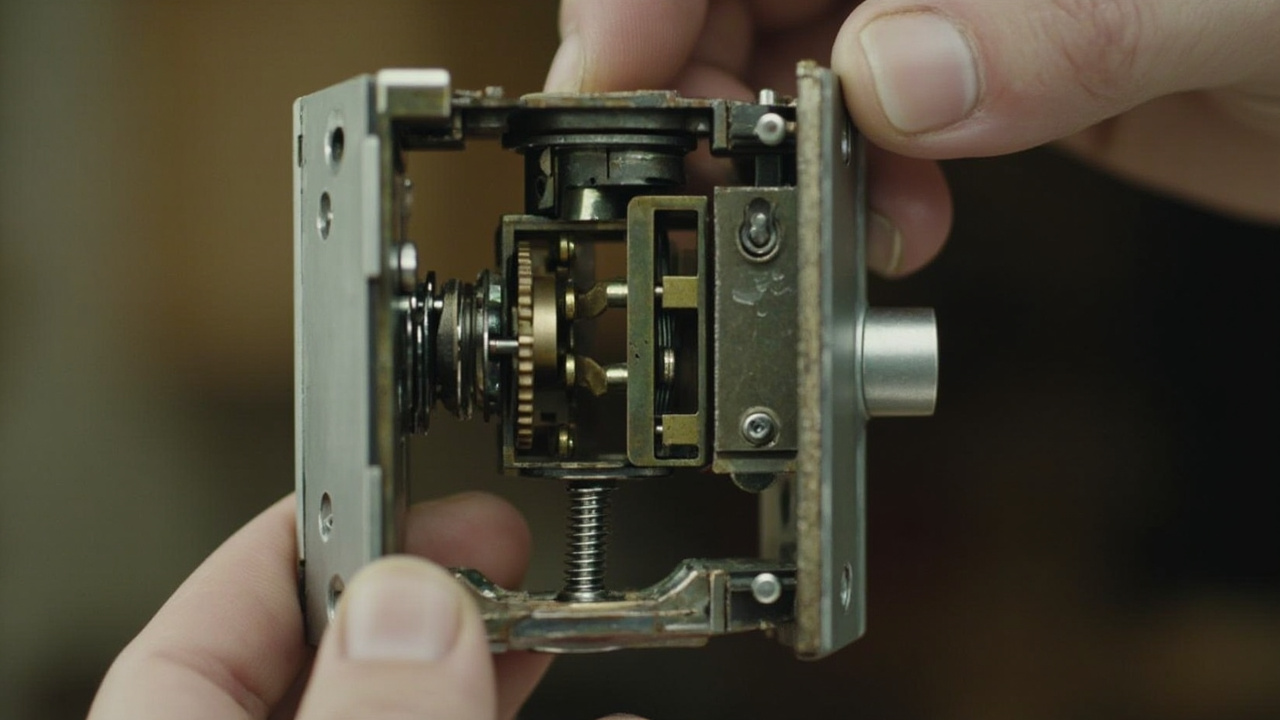
Maintenance Implications of PCB Layout and Protection Choices
System integrators can use pcb layout and protection maintenance implications as a qualification lens for electronic lock subsystems. This fill-in workbook turns layout, power, enclosure, and service assumptions into fields completed before a control PCB is approved. Attach controlled drawings, record evidence, and date every change. The result is a traceable basis for deciding what must be inspected, replaced, or held for engineering review.
Qualification boundary: identify the exact assembly
Direct answer. Start with the exact product, board revision, enclosure, and exposure conditions. The published catalog contains 79 models; the control PCB, RF/wireless module, emergency power port, battery or cell compartment, motor, and gearbox are separate objects a buyer can inspect or specify. For a project based on the SLK-9936S hotel lock, confirm on the dated product page for the specific SKU before using any power, cycle
| Fill-in field | Project entry |
|---|---|
| Application and door type | [enter] |
| Product name and exact SKU | [enter] |
| Control PCB and enclosure revision | [enter] |
| Power source and battery compartment | [enter] |
| Installation and service constraints | [enter] |
| Evidence owner and review date | [enter] |
Treat an unknown revision as an open qualification item, not as equivalent hardware. The same question as pcb layout and protection maintenance implications, read from a different angle, is covered in PCB Layout and Protection in a Smart Lock: What a Buyer Should Understand.
Route qualification evidence through one review
Use one route so the layout review, protection review, and maintenance plan cannot drift apart. Each step must produce a recorded output.
flowchart TD
    A[Record assembly boundary] --> B[Review control PCB layout]
    B --> C[Review protection choices]
    C --> D[Translate findings into maintenance actions]
    D --> E[Qualify or request evidence]
Name the owner of each output and attach the record before the next arrow is closed.
Complete the control PCB layout review sheet
Record what is physically present, not only what the enclosure promises. Add document references and reviewer notes to every answer.
| Review area | Fill-in question | Supplier response and evidence |
|---|---|---|
| Power entry and separation | Where does power enter, and how is it separated from sensitive signal areas? | [schematic/layout reference and reviewer note] |
| Connector and cable entries | Which connectors cross the enclosure boundary, and how are cables retained? | [drawing, part reference, service method] |
| Protection placement | Where are protection components placed, and where does the diverted path terminate? | [placement extract and rationale] |
| Thermal and source proximity | How is the control PCB positioned relative to the motor, gearbox, RF/wireless module, and power source? | [layout extract and design basis] |
| Mechanical mounting and service access | How is the board restrained, and can technicians reach power or test points without destructive disassembly? | [assembly drawing, service procedure, access note] |
Treat any unexplained drawing change as a revision needing review. If the supplier cannot identify a return or reference path, log an open action instead of approving by assumption.
Compare protection choices with their service burden
PCB protection selection should define the protection, its boundary, and the work required after installation. Compare options rather than accepting “protected” or “ruggedized” as evidence.
| Option under review | Maintenance exposure to record | Evidence to request | Service decision |
|---|---|---|---|
| Conformal coating only | Coverage, cleanliness, and inspection visibility | Process record, coverage map, inspection method | [enter] |
| Conformal coating with controlled enclosure | Coating condition at seams and connector entries | Enclosure drawing and coating record | [enter] |
| Potting or encapsulation | Internal condition may resist visual inspection | Process definition, repair limits, replacement route | [enter] |
| Replaceable module | Configuration matching and spare availability | Version map, exchange procedure, service record | [enter] |
The ingress protection inspection should record accessible entry points, enclosure condition, and the observation method; it does not replace product-specific evidence. For conformal coating evidence, ask for process, coverage, inspection criteria, and rework limits. Treat an option as unproven when those fields are blank.
Translate findings into a preventive maintenance worksheet
Record the pcb layout and protection maintenance implications as one observation, one owner, one inspection trigger, and one response. This turns a technical drawing into an actionable maintenance instruction.
| Finding | Trigger | Evidence | Owner and response | Status |
|---|---|---|---|---|
| [enter PCB or enclosure condition] | [enter event or interval] | [photo, reading, or test reference] | [role and action] | [open/closed] |
| [enter protection condition] | [enter event or interval] | [inspection record] | [role and action] | [open/closed] |
| [enter connector or wiring condition] | [enter event or interval] | [service photograph] | [role and action] | [open/closed] |
| [enter revision-related condition] | [enter event or interval] | [drawing reference] | [role and action] | [open/closed] |
Use control PCB failure analysis only after preserving the failed configuration, symptom record, and revision evidence. This keeps smart lock control PCB maintenance focused on the assembly that actually failed.
Build the evidence request and supplier response
Request a controlled evidence pack rather than a general durability statement. For each file, record the applicable PCB and enclosure revision, test configuration, date, and sign-off.
- Controlled schematic and layout revision index tied to the exact PCB and enclosure.
- Protection schedule mapping each treated area to process, boundary, and service method.
- Conformal coating evidence: process, coverage, inspection criteria, and rework limits.
- Dated test report: method, sample configuration, acceptance criteria, result, and limitations.
- Service instructions for battery replacement, external power override, fault indication, and module exchange.
Keep four companion reviews beside this workbook: PCB Layout and Protection Trade-Offs: Cost, Durability and Service, PCB Layout and Protection Failure Modes Seen on Smart Lock Projects, PCB Layout and Protection Test Evidence a Buyer Can Actually Request, and Reading PCB Layout and Protection Claims in a Supplier Datasheet. Record which questions each review closes so the evidence pack does not repeat itself.
Work through an illustrative change scenario
Consider an illustrative project in which the supplier changes the enclosure but says the control PCB is unchanged. Enter both drawing revisions, then compare connector access, cable strain relief, thermal distance, and any coating or encapsulation boundary. Request a revised maintenance worksheet and evidence index if those items changed. The outcome is hold for evidence or approve with defined inspections, not an assumption that electronic parts remain equivalent.
Record the qualification decision
Close the review only after every open action has an owner, due date, and disposition.
| Decision item | Entry |
|---|---|
| Overall decision | [qualify / qualify with actions / hold] |
| Unresolved engineering actions | [owner and due date] |
| Maintenance instructions issued | [revision and document reference] |
| Evidence index | [files, dates, and applicable revisions] |
| Reapproval trigger | [change requiring renewed review] |
When the workbook is complete, send the controlled revision list, open actions, and evidence index with your request for a quote. The technical record should let the supplier and integrator work from the same maintenance assumptions.