
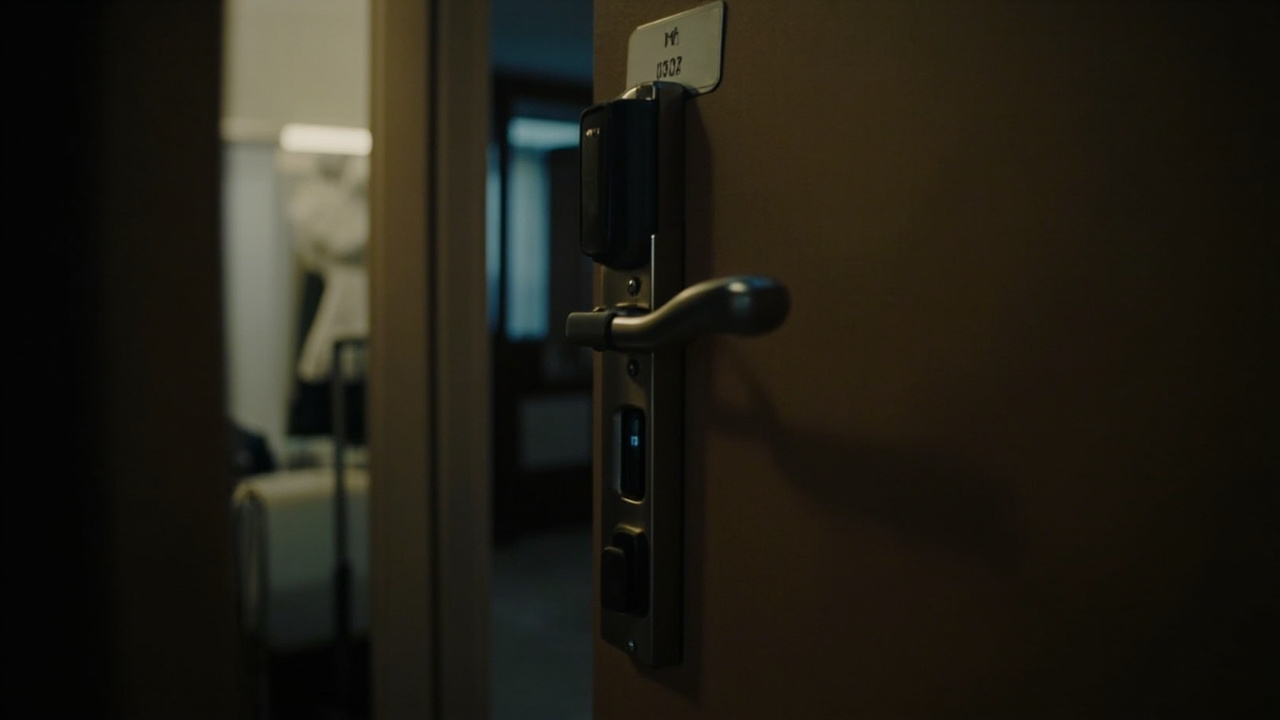
Smart Locks for Independent Boutique Hotels: Door Survey and Fit Reality
A boutique hotels door survey should answer one operational question before any lock family is proposed: “Which doors are the doors we can actually change?” This bid and specification sheet turns that question into a door-by-door evidence schedule for guest rooms, service corridors, shopfronts and terraces. It defines what the bidder must measure, document and qualify so the buyer can distinguish a documented fit from an untested assumption.
Direct answer. Condensed to the essential point, boutique hotels door survey turns a request into a decision record. boutique hotels door survey and boutique-hotels are the two parts of boutique hotels door survey most often skipped. A boutique hotels door survey maps one building type to its door classes. boutique hotels door survey comes first. Each class states what boutique hotels door survey requires and how it is evidenced.
boutique hotels door survey is defined in this article by boutique hotels door survey. It is used as a working definition of boutique hotels door survey only. Any regulatory reading belongs to the authority and the product in the destination market.
- Sort the openings — sort the door population into classes that behave alike, starting from boutique hotels door survey
- Classify each door — state what boutique-hotels needs before anything is quoted
- Show the fit — record the measurement that closes boutique hotels door survey
- In boutique hotels door survey, this sequence is what boutique hotels is checked against.
Tender purpose and survey boundary
This is an evaluation-stage bid sheet, not an instruction to select one lock for every opening. A mixed-door stock survey must capture the differences between a guest-room door, a frequently used service door, a branded shopfront and an exposed terrace door. The resulting smart lock door fit assessment will support the buyer’s access control door schedule without pretending that the property has a uniform door population.
The survey package has five outputs:
| Output | Required content | Boundary |
|---|---|---|
| Door population register | One record for every in-scope opening | It does not prescribe a credential policy |
| Physical evidence pack | Measurements, photographs and existing-hardware observations | It does not certify unmeasured suitability |
| Fit classification | A documented status for each proposed lock position | It does not authorize installation |
| Exception register | Unresolved geometry, ownership, power or access issues | It does not convert assumptions into facts |
| Bidder response | Proposed devices, evidence and exclusions | It does not substitute for site verification |
The bidder shall survey the supplied property records and the physical openings listed by the buyer. Any door not yet accessible, concealed behind finishes or located outside the stated boundary shall be marked as unverified rather than estimated. The buyer will not treat an excluded opening as suitable in a later comparison unless the missing evidence is supplied and the record is formally updated. The first-party record behind this is the SLK-118 RFID Card Lock for Hotels and B&Bs — confirm the SKU on the dated product page.
Instructions for the surveying bidder
The bidder shall follow one record per door. A door identifier shall combine property code, floor or level, zone and opening number. A generic room number is insufficient when refurbishment work can renumber spaces, so each identifier must remain traceable to the survey photograph and the access schedule.
Survey instructions shall require the following discipline:
- Record what exists before proposing a replacement.
- Measure the actual leaf and frame rather than infer dimensions from the drawing.
- Photograph the complete lock area, frame rebate, strike area and adjacent finished surfaces.
- Identify the proposed lock body, reader, handle, spindle or latch arrangement separately.
- State the documented fit condition and the evidence supporting it.
- Record every unresolved condition as an exception with a named owner.
- Keep the proposed device tied to the door identifier through every schedule revision.
A missing measurement shall be entered as “not measured.” It shall not be replaced by a typical value, a value copied from another opening, or a manufacturer drawing that the bidder believes is likely to apply. For a heritage or concealed frame, the bidder shall provide the physical evidence required to establish whether the strike cavity, spindle path and lock body can be used without rebuilding the opening.
The mixed-door stock survey shall also identify doors that are excluded before quotation. Examples include a door the owner has not authorized the bidder to inspect, a service entrance that cannot be opened without a staff escort, and a terrace opening whose threshold condition cannot be established safely. Exclusion is preferable to false precision.
Door population and change-control register
The door register is the control record that connects the survey to the later installation work pack. It shall remain under change control from the first site visit through technical evaluation. A room reassignment, door replacement or frame repair can invalidate the earlier fit status, so the register shall state which event requires remeasurement.
| Door family | Established operating pattern | Survey emphasis | Required bidder decision |
|---|---|---|---|
| Guest-room door | Card or code at the room | Leaf, frame, existing lock, escape arrangement and issue-side clearance | Direct fit, adaptable fit or exception |
| Back-of-house corridor | Keypad on service doors | Traffic, handle arrangement, frame condition and staff-access route | Suitable position and maintained access method |
| Shopfront | Phone-based access is part of the operating pattern | Brand finish, door movement, frame reveal and exterior-side placement | Device position and integration boundary |
| Small terrace | Guest-facing opening in a mixed environment | Threshold, weather exposure, fixings and restricted alteration | Suitable hardware position or exclusion |
The first approval gate is property-owner permission to inspect and potentially alter each opening. The fact pattern for an independent boutique hotel includes a landlord that does not own the locks, so consent to survey does not automatically constitute consent to modify. The bidder shall provide two separate status fields: survey access and alteration authority.
CONFIRM-WITH-LOCAL-PROPERTY-OWNER: Confirm which surveyed doors may be altered, which alterations require written consent, and who holds authority to approve each proposed lock position.
Physical measurement and evidence record
| Field | Evidence to capture | Reason for the field |
|---|---|---|
| Leaf and frame thickness | Minimum, maximum and nominal readings with locations | Identifies whether one value can represent the opening |
| Door width and height | Overall dimensions and usable frame opening | Establishes the physical boundary |
| Stile width | Narrowest usable fixing zone | Shows where a reader or lock body may be placed |
| Door edge and rebate | Lock-pocket depth, edge profile and rebate arrangement | Tests body and casework fit |
| Backset or centres | Existing spindle or latch centres | Supports replacement-mechanism comparison |
| Frame construction | Solid, hollow, timber, metal or unknown where visible | Identifies fixing and adaptation limits |
| Strike and jamb condition | Existing keep, cavity, screws and available space | Tests whether the jamb must change |
| Handle and spindle | Lever, spindle, follower and internal hardware arrangement | Reveals operating conflicts |
| Swing and handing | Opening direction, hinge side and handing | Establishes orientation for the proposed position |
| Surface condition | Timber, metal, glass, coating, corrosion or damage | Separates door preparation from lock capability |
| Power and signal position | Existing supply, cable route and surveyed signal coverage | Places powered components where service is possible |
| Usage condition | Traffic, load, weather exposure and staff or guest contact | Informs maintenance and placement decisions |
Photographs shall include a scale reference and be named with the corresponding door identifier. A close image of the lock cavity shall be accompanied by a wider image showing the relationship to the door edge, hinge and frame. Images that show an attractive finished face but conceal the fixing zone do not constitute fit evidence.
The bidder shall state the measurement tolerance and method. Where repeat readings differ, the schedule shall retain the range rather than selecting the most favourable figure. If a dimension is concealed or cannot be established, the opening receives an Unverified status and remains outside the firm-fit count.
Any proposed device specification that depends on dimensions, power, connectivity, reader placement or environmental suitability must be confirmed on the dated product page for the specific SKU. The buyer will compare the bidder’s schedule with that dated evidence; a catalogue statement or oral assurance does not override a missing site condition.
Fit classification and exception rules
| Fit class | Decision condition | Required evidence | Buyer treatment |
|---|---|---|---|
| A — Documented direct fit | Existing geometry and prepared positions match the dated SKU evidence | Complete measurement set, photographs and product-page cross-reference | May proceed to the next control check |
| B — Adaptable fit | A documented adapter, revised fixing or minor reversible preparation is required | Adaptation detail, affected dimensions and installation sequence | Evaluate as a qualified fit with an explicit condition |
| C — Alternate lock-body route | The current pocket, spindle path, handle or strike arrangement requires a materially different mechanism | Alternative geometry and complete supporting evidence | Treat as a design exception, not a standard retrofit |
| D — Unverified | A measurement, opening view or permission is missing | List of missing evidence and responsible party | Hold from the firm-fit count |
| E — Excluded | Alteration is not permitted, the opening is out of scope or no feasible route is identified | Reason, supporting record and boundary statement | Remove from the proposed scope unless resolved |
Class A is not a claim that every electronic function will work at the door. It means only that the recorded physical evidence matches the proposed device evidence for the positions being assessed. Power, communication, credentials and operating behaviour remain subject to their own checks.
The survey shall contain no inferred Class A position merely because a door appears similar to one already measured. If the evidence supports only a family resemblance, the correct class is D.
Heritage and non-standard door-set assessment
The Door Types in Independent Boutique Hotels: Heritage and Non-Standard Door Sets Compatibility Notes provides the companion technical reference for the door family. This sheet does not repeat that compatibility analysis. It defines the evidence the bidder must place beside each door record.
The survey shall specifically examine:
- The relationship between the visible leaf and the actual frame cavity.
- Whether the nominal door thickness changes around the lock position.
- Whether the strike area is solid, hollow, mortised or obstructed.
- The usable width after accounting for the frame, hinges and adjacent finish.
- Whether a handle, spindle or follower would foul the proposed mechanism.
- Whether the opening is glazed, panelled, fire-recorded or otherwise structurally special.
- Whether a surface-mounted reader can be installed without damaging the listed fabric.
- Whether the electrical route would require chasing, drilling or other building alteration.
The Office Smart Lock Site Survey shows the broader discipline of tying each device position to field evidence rather than a room label. For this hotel survey, each record shall also preserve the operating reason for the opening, since a guest-room requirement and a service-door requirement may lead to different placement decisions.
The Smart Lock Retrofit Site Survey is relevant where existing locks are being replaced. The bidder shall identify whether the existing lock is being retained as an emergency route, removed during guest-room lock retrofit, or replaced only after a new operating method is accepted.
Where a door cannot be altered without a material change to the frame or leaf, the bidder shall offer an exclusion or alternative route. A proposal that depends on concealed reinforcement shall identify the evidence, method and owner of that work. It shall not treat reinforcement as a routine installation detail.
CONFIRM-WITH-LOCAL-BUILDING-AUTHORITY: Confirm any permission, inspection or approval needed for door alteration, frame work, wiring routes or changes to a recorded door set.
Reader, handle and credential placement
| Opening | Access mode to assess | Placement question | Exception to record |
|---|---|---|---|
| Guest room | Card, code or the buyer’s chosen room method | Can the chosen interface operate without changing the handle or reducing usable movement? | Unavailable fixing zone, spindle conflict or power-route issue |
| Service corridor | Keypad | Is the keypad readable and reachable during staff use without damage to the finish? | Restricted wall, exposed position or unsuitable frame |
| Shopfront | Phone-based access | Is the proposed interface compatible with the existing entrance arrangement and service route? | Brand, frame, door movement or power issue |
| Terrace | Guest access subject to the operating rule | Is the device position suitable for the actual opening and its exposure conditions? | Threshold, frame or environment issue |
The Smart Lock Key Control and Master Key Decisions for Independent Boutique Hotels owns the credential and master-key argument. This bid sheet shall not invent a credential hierarchy. It shall identify the physical reader position, the proposed lock-control location and the door-level effect of each access method.
The bidder shall document the internal and external faces of every proposed reader position. Where a room handle, privacy function, latch or deadbolt arrangement exists, the schedule shall show the proposed relationship between them. The survey shall not remove an existing operating feature unless the buyer has approved that change in writing.
Where access events or guest identifiers are part of the proposed system, the bidder shall define the event fields, retention period, export route and role-based viewing question. It shall identify any processor or service dependency without claiming that local rules do or do not apply.
CONFIRM-WITH-LOCAL-DATA-PROTECTION-REVIEWER: Confirm the access-record, guest-identifier, retention, export and viewing requirements that apply to the proposed credential and event-data workflow.
Power, network and management boundary
The property cannot be rewired, so the survey shall establish the available power and signal routes before the bidder proposes a powered component. A blank schedule cell means “not established,” not “not required.” Any proposed operation that depends on a new supply, cable route or remote service shall be shown as a condition.
| Operating scenario | Question for the bidder | Evidence required |
|---|---|---|
| No power at the opening | Can the proposed lock operate without a new supply, and what changes if it cannot? | Dated SKU evidence and an explicit power requirement |
| Nearby power but no usable cable route | Is there an alternative installation position that remains within the door boundary? | Route sketch and affected surface information |
| Intermittent network path | What happens at the door when the management connection is unavailable? | Dated product-page evidence and stated operating boundary |
| Thick-wall or separated service path | What signal behaviour has been documented for the proposed arrangement? | SKU-specific evidence; no generic site inference |
| No local technical support | Can routine tasks be completed by the responsible hotel team? | Named task, tool and access requirement |
| Power interruption | Which functions remain available and which require a defined fallback? | SKU-specific evidence and an operational response |
Every connectivity, power, battery-life or operating-range statement must be confirmed on the dated product page for the specific SKU. The bidder shall not convert a general platform statement into a door-level promise. It shall also avoid protocol names unless the relevant ecosystem question is accompanied by the required product-page qualifier.
The hotel lock specification shall distinguish physical fit from operational fit. A Class A door can still be held if the power route, management method or fallback arrangement is unresolved. Conversely, a simple local arrangement may remain usable when a remote service path is weak, provided the bidder documents what the hotel team can operate.
Outdoor, shopfront and high-contact conditions
Each door record shall state whether the opening is:
- Indoors, outdoors, semi-exposed or in a transition area.
- Subject to rain, sun, salt, moisture, dust or cleaning washdown.
- Reached by guests, staff, luggage equipment, deliveries or maintenance traffic.
- Likely to receive a new surface finish or protective coating.
- Affected by a handle, latch or bolt that takes repeated force.
- Near a wall return, reveal, glazing panel or projecting surface.
The bidder shall photograph the surrounding construction and identify whether weather exposure is direct or sheltered. Any product exposure statement used for the decision must be confirmed on the dated product page for the specific SKU. The survey shall not convert a general indoor suitability statement into an external recommendation.
For the terrace, the threshold and fixing substrate may be more restrictive than the door leaf. The schedule shall record the threshold material, available fixing depth, standing-water exposure and any requirement to preserve the opening’s finish. If a surface-mounted solution is proposed, the bidder shall identify the seal, cable route and service-access implications.
Manual access, failure recovery and service responsibility
The bidder shall provide the dated evidence for:
- The proposed method of emergency or manual opening.
- Any change to the internal thumbturn, handle or spindle arrangement.
- The tool or credential needed to reset the lock after service.
- The door opening required for battery, case or spindle access.
- The named person or role responsible for first-line response.
- The route for escalation when the first-line response cannot restore access.
The Emergency and Out-of-Hours Access for Independent Boutique Hotels covers the wider decision tree for out-of-hours access. This survey captures the door-specific evidence without turning the bidder into the operator of that process.
Where a door forms part of an escape route or is recorded as having a special fire function, the buyer shall obtain the applicable local direction before the lock schedule is approved. The survey shall not infer compliance from the visible hardware.
CONFIRM-WITH-LOCAL-FIRE-AUTHORITY: Confirm the egress, opening arrangement, manual-access and recorded-door requirements for each affected guest-room and service door.
CONFIRM-WITH-LOCAL-HEALTH-AND-SAFETY-ADVISER: Confirm any safety, handling and accessibility requirements affected by the proposed lock, handle, reader or manual-access arrangement.
Bid compliance and evidence matrix
| Requirement | Bidder response | Evidence to attach | Buyer acceptance test |
|---|---|---|---|
| Door-by-door scope | List every included and excluded opening | Door register and signed scope statement | Every included opening has a unique identifier |
| Physical fit | Assign A, B, C, D or E | Measurements, photographs and dated SKU cross-reference | Class matches the supplied evidence |
| Heritage alteration | Identify every change to leaf, frame or finish | Detail drawing, note or explicit exclusion | No alteration remains implied |
| Access placement | Locate reader, lock body and controls | Marked photographs and component schedule | Access pattern remains usable at the recorded position |
| Power and service | Define supply and routine service tasks | Route evidence and task description | No unnamed power or service dependency remains |
| Ownership and permissions | Separate inspection from alteration authority | Consent status and owner column | Survey access and modification authority are distinct |
| Manual access | State opening, reset and escalation route | Dated product evidence and service note | A named operational route is recorded |
| Exceptions | State impact and next evidence required | Exception register | No exception is hidden in a generic note |
A response that marks a field “as required” shall identify who is responsible for proving it. A response that marks a field “not applicable” shall give the property-specific reason. Blanks shall be treated as incomplete.
The bidder may offer a proposed hotel lock specification for a class of doors only after showing the representative measurements and explaining why the class is repeatable. The sample does not override the property record. Each included door remains subject to its own evidence.
Site acceptance and clarification control
flowchart TD
    A[Survey pack issued] --> B[Door records completed]
    B --> C{Evidence complete}
    C -->|Yes| D[Fit class proposed]
    C -->|No| E[Hold as unverified]
    D --> F[Permission and service checks]
    F --> G{Requirements recorded}
    G -->|Yes| H[Approved fit schedule]
    G -->|No| I[Exceptions retained]
    H --> J[Installation work pack]
The clarification log shall identify each question, the affected door, the bidder, the response required and the resulting change to the schedule. A verbal answer may guide the next inspection, but the accepted record shall be written into the relevant door line.
| Clarification type | Example | Required close-out |
|---|---|---|
| Missing measurement | Concealed frame depth | Photograph or remeasure and update the fit class |
| Conflicting evidence | Drawing differs from the physical rebate | State the physical evidence used and record the discrepancy |
| Scope ambiguity | Terrace door omitted from the initial list | Add the door through controlled schedule revision |
| Permission gap | Alteration consent absent | Hold the opening until authority is recorded |
| Service dependency | Battery access requires furniture movement | Add a task and space requirement to the work pack |
| Product evidence gap | Dated page lacks the cited dimension | Withdraw the claim or move the opening to Unverified |
Commercial response and award basis
The response should separate four commercial scopes:
- The surveyed opening and its recorded fit class.
- Any adaptation or alternative mechanism required for that opening.
- The power, reader, case, handle and management components required for the stated use.
- The survey, documentation, configuration, handover and service tasks included by the bidder.
Any exclusion that changes the buyer’s operating scope shall be visible in both the door schedule and the response summary. The bidder shall state who carries each excluded task and what evidence or access is needed before that task can proceed.
Evaluation will consider the completeness and traceability of the survey, the realism of the fit classes, the quality of the product evidence, the clarity of exceptions and the completeness of the service and handover proposal. The buyer may record weighting after receiving responses, but it shall apply the same criteria to every bidder.
The RFQ Template for Smart Locks for Independent Boutique Hotels can carry the commercial response into a broader tender document. This sheet supplies the door survey and fit requirements that should sit inside it.
Submission declaration and required attachments
The final submission shall include a cover response, the completed door register, the physical evidence pack, the fit-class schedule, the exception register, the access-placement schedule and the bidder’s product-evidence index. The index shall link every proposed SKU to its dated product page and identify which door entries depend on it.
The bidder shall declare that:
- Each measurement was taken at the identified opening or obtained through a documented method.
- Missing evidence has not been replaced with an assumed value.
- Each fit class reflects the attached record.
- Every product-specific statement used for a procurement decision has been checked against the dated product page for the specific SKU.
- Every excluded alteration, missing measurement and unresolved permission is visible.
- The proposed access placement has been checked against the door, handle, frame and operating route.
- Any linked material identifies the corresponding door and component rather than presenting a general family statement as door-level evidence.
The submission shall close with a signature from the person accountable for the survey response. That person shall not be identified by title alone if the buyer needs a named operational owner; the name is supplied through the buyer’s procurement channel.
Readers comparing approaches usually start with smart lock manufacturer for hotel projects. That is the same question boutique hotels door survey has to answer here.The response is ready for technical evaluation when every in-scope door has an identifier, a fit class or an explicit exception, and every exception has a named route to resolution. The buyer may then compare the proposed locks against the recorded physical reality rather than against the assumption that an independent boutique hotel has one repeatable door.
Once the requirement is written down, request a quote is the move.