
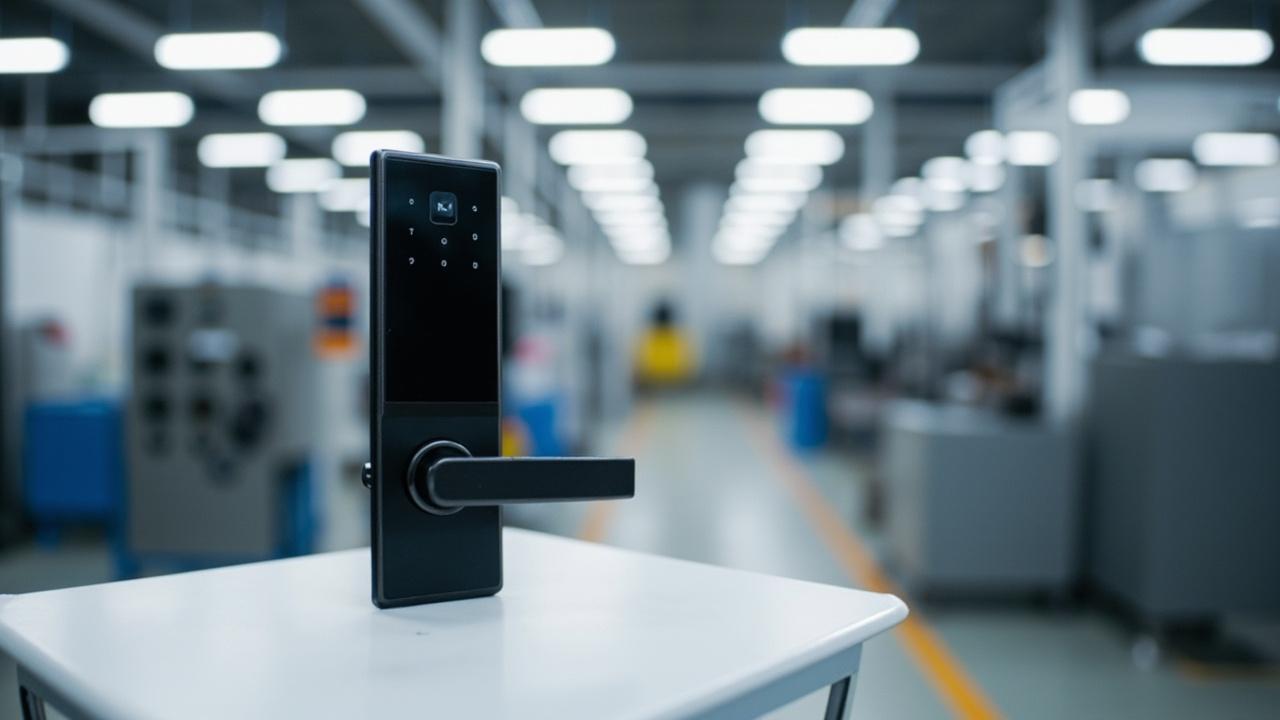
Smart Locks for Factory Tool Rooms
TO: Floor supervisor, Plant, second-shift and third-shift rotationFROM: Tool-crib manager, PlantDATE: Quarter of issueRE: Shift-window credential scheme, missing-tool investigation honestly framed, and contractor access window for the tool roomCC: Maintenance lead, EHS coordinator, plant security officer, supplier liaison, HR shift roster owner
Executive Summary
The tool room is not the same problem as the factory storage room. A storage room gets opened a few times a day by a small number of named people on the HR roster. A tool room gets opened by a larger number of named people across three shifts, by a parade of contractors arriving on named maintenance windows, and — when something is missing — by the same floor supervisor asking the lock manufacturer what the audit log can and cannot prove. This memo is the tool-crib manager's position on those three questions and on the lock purchase that follows from answering them.
Smart locks for factory tool rooms are electronic door locks — keypad, RFID, fingerprint, multi-method, narrow-edge — applied at the door of a tool crib inside a factory, with a per-shift credential window, a per-contractor window, and a per-event audit record that the tool-crib manager can read out when something is missing. They are not the factory's ERP tool-master, they are not asset-tracking RFID portals, they are not the loss-prevention insurance path, and they are not a substitute for the floor supervisor's investigation when a torque wrench or a calibrated micrometer is unaccounted for. They are the door, and the lock's value at the door is the credential window it can issue, the event record it can capture, the mechanical-key fallback it can honour, and the four honest handoffs it cannot.
The rest of this memo is the shift-window credential scheme, the missing-tool investigation read honestly as a per-model audit-log question, the contractor access window, the tool-crib door-class map, the bold decision rules the floor supervisor carries, the position on standalone versus networked operation, and the supplier interview sheet the tool-crib manager sends before any product page is closed. Read it before the next shift change.
Why this memo exists now
The tool room has been on a mechanical-key pin-tumbler cylinder for the eleven years I have run the crib. The key was held by the supervisor on shift, signed out at the start of the day and signed in at the end, with a paper ledger on the inside of the door recording what was taken, by whom, and at what time. That system has done most of what a tool room needs to do for most of the eleven years. Three pressures have arrived in the last quarter that force the position this memo lays out.
- Shift rotation pressure. We are running three shifts on the second and third production cells. The second-shift supervisor does not trust a paper ledger signed by the first-shift supervisor and not countersigned by anyone in the second shift. The third-shift supervisor — alone on the floor between 22:00 and 06:00 — does not trust a paper ledger full stop. Every shift wants a credential it owns and a record it can read.
- Insurance pressure. The plant insurer has updated its questionnaire. It now asks which tool-room doors are electronically logged, which electronic logs are reviewed, who holds master credentials, and what the plant does when a contractor credential is reported lost. Mechanical-key envelope answers the first question with "we have a key in a sealed envelope," which is no longer the answer the insurer is willing to accept.
- Missing-tool pressure. A torque wrench calibrated to 40 N·m went missing on a Tuesday morning last month. The paper ledger had two named withdrawals between Friday close and Tuesday morning. Neither of those two people could account for the tool. We never did locate it. The production manager now wants a credentialed door with an event record the floor supervisor can pull. The production manager has not asked me what the lock's event record can and cannot prove.
That last pressure is the pressure this memo is honest about. The lock is not going to find the torque wrench. The lock is going to give the floor supervisor a small, well-shaped instrument that narrows the field of inquiry. What the instrument can do depends on the model. What the instrument cannot do does not change with the model. This memo is the honest reading of that line.
What we are buying, by door family
The tool room is one door in the plant. The tool room is also four doors, depending on how the plant is laid out. Each of those doors answers a different operational question and each belongs to a different shift-hand-off. The table below is the inventory this memo assumes; any door not on it gets surveyed before the next supplier meeting.
| Tool-room door in our plant | Operational question this door answers | Lock-scope owner | Honest lock-lanes the catalog can supply | What the lock does NOT do here |
|---|---|---|---|---|
| Main tool-crib door (operator floor) | Who took which tool at the start of the shift? | Tool-crib manager | Multi-method 5-in-1 class hardware (SLK-8831 reference) with keypad, RFID card and fingerprint lanes for named roster employees, time-bounded PIN for the shift, and a sealed-envelope mechanical-key override for the supervisor | Replace the paper check-out ledger; identify which tool was taken, only which credential presented at the door; speak to the ERP tool-master; locate a missing tool once it is off the floor |
| Calibration-room door (inside the tool crib) | Which technician entered the calibration bench? | Tool-crib manager + metrology lead | Keypad with per-credential time-bounded codes; RFID card for the two named metrology technicians; mechanical-key override envelope held by the metrology lead | Speak to the calibration database; sign the calibration certificate; replace the calibration software |
| Tool-repair-bench door (inside the tool crib) | Which contractor repaired the air-tool this afternoon? | Tool-crib manager + maintenance lead | Keypad with time-bounded contractor PIN issued per maintenance window; mechanical-key override held by the maintenance lead | Speak to the contractor's work-order system; replace the contractor sign-in book; close out the contractor's work order |
| Outdoor tool-store door (yard-side, lockable external store for large jigs and dies) | Who opened the yard store on the Saturday overtime call-out? | Tool-crib manager + plant security | Outdoor/aluminium-door series (D11/D12/D15/ODS/DQ reference) with weather-class cover, keypad plus RFID, mechanical-key override held by the plant security officer | Drive the yard CCTV; replace the yard access log; speak to the perimeter intruder-detection system |
Four doors. One belongs to a yard the plant does not own the lock of. Three belong to the tool-crib manager. The four-door shape is the position this memo lays on the table. The yard-side store and the consumables crib sit in the same family as the inventory room, so the credential policy for those doors should be set once and applied coherently across the floor.
The hard honesty — locks are not tool-tracking systems
A lock vendor sells a door instrument. A factory's tool-tracking system sells torque-wrench RFID tagging, jig-and-die location, ERP tool-master reconciliation, MES tool-availability signals, and loss-prevention insurance recovery. The two are not the same supplier and they do not become the same supplier when one of them writes the words "tool management" on a product page.
This memo will not allow the supplier to claim, and the tool-crib manager will not accept any supplier claim, that a door-layer smart lock replaces the paper check-out ledger by tool identity, identifies which tool was taken, locates a missing tool once it is off the floor, drives the yard CCTV, replaces the yard access log, speaks to the perimeter intruder-detection system, talks to the ERP tool-master, talks to the MES tool-availability signal, talks to the contractor work-order system, replaces the contractor sign-in book, signs the calibration certificate, or signs the loss-prevention insurance claim. That is not the lock's scope. That is not a defect of the lock. That is the correct scope of a door-layer device and the discipline of holding it is what makes the rest of the tool room legible.
What the lock CAN honestly do at the tool-room door is narrower than the slide deck, and the narrower it is, the more reliable the missing-tool inquiry becomes. Concretely, the door-layer lock in our tool crib can:
- Issue and revoke a credential locally — a PIN, an RFID card, a fingerprint template, an app-presented token — at the door or via its app admin surface on the TTLock / Tuya / Doodle lane depending on the model. The exact app surface, the exact credential-capacity number per model, and the exact revocation behaviour on a closed door is a per-product-page fact and must be confirmed in writing on the specific model's product page, not borrowed sideways from a hotel lock or a residential SKU.
- Capture an audit event locally — an unlock, a failed attempt, an admin change — and export it through whatever path the model supports. The buffer depth, the export surface, and the time-stamp granularity are per-model facts. One well-known hotel-class model — the SLK-9936S — specifies an on-device audit/event-record buffer of up to 1,000 records; that 1,000-record figure belongs only to that hotel model and does not transfer to any tool-room candidate. Check the model’s published specification.
- Honour a mechanical-key override at every tool-room door, with the override cylinder keyed to a per-door envelope policy the tool-crib manager controls. The override cylinder spec, the keyed-alike or keyed-differently decision, and the key-blank-shipment question are operational decisions this memo owns; the lock's role is to honour them.
- Survive a loss of upstream connectivity and continue opening with locally-cached credentials at the door. The exact offline behaviour, the exact cache duration, and the exact recovery-on-reconnect behaviour are per-model facts and must be confirmed in writing.
That is the four-row honest handoff. Anything else claimed by a supplier is, in the language of this memo, an out-of-scope claim and gets returned for revision before any door is ordered.
Shift-window credential scheme
The shift-window scheme is the part of this memo the floor supervisor is going to be asked about first. Three shifts, three windows, three credential rosters, three supervisors. The lock at the door does not run the shift — the HR shift roster runs the shift — but the lock has to honour the shift boundary at the door without arguing with it.
The scheme this memo asks the supplier to support, on every model shortlisted, is the following three-rule structure. None of the three rules is a feature claim; each is a question the supplier answers in writing on the specific product page.
- Per-shift window codes. The first-shift PIN is active between 05:45 and 14:00, the second-shift PIN between 13:45 and 22:00, the third-shift PIN between 21:45 and 06:00. A 15-minute overlap is allowed at the handover so the incoming supervisor can pick up where the outgoing supervisor left off. The exact window granularity — minute, half-hour, hour, day-of-week — and the exact maximum number of concurrent time-bounded codes are per-model facts confirmed on the product page.
- Per-shift named roster. Each shift has its own roster of named operators. The roster owner is the shift supervisor. The roster is updated in the lock's app admin surface on the supported app lane — TTLock / Tuya / Doodle depending on the model — and the lock refuses to honour a credential that has been deleted from the roster, including at the door after a deletion. The exact deletion-to-door latency, the exact behaviour on a closed door, and the exact behaviour on a power-down are per-model facts confirmed on the product page.
- Shift-supervisor second-pass lane. The shift supervisor on duty carries the second-pass authority — a biometric (fingerprint template, where the model supports it), an RFID card, or a higher-class PIN — that opens the door and that also authorises a temporary one-shot PIN for a named contractor arrival during the shift. The exact second-pass lane, the exact one-shot-PIN support, and the exact PIN expiry behaviour are per-model facts confirmed on the product page.
Three rules. Each one a question the supplier answers in writing. None of the three rules is a marketing bullet.
Missing-tool investigation, honestly framed
The torque wrench on a Tuesday morning is the pressure that started this memo. The honest framing is the part the production manager has not asked me about. Let me lay it out.
A smart lock at the tool-room door captures events, not tools. It captures who presented which credential at which time, with a timestamp, with a record of granted or refused entry, with the model-dependent capability to add additional fields (the specific fields the model supports are per-model and confirmed on the product page). It does not capture which tool was taken by the person who was admitted. The paper check-out ledger — or, in a fully-integrated factory, the ERP tool-master — does that. The lock's contribution to a missing-tool inquiry is therefore narrower than the slide deck says. The narrower it is, the more reliable the inquiry becomes.
The five honest questions the floor supervisor should be writing down before the supplier meeting are:
- Does the shortlisted model keep an on-device event buffer at all? A small number of models keep a local event buffer inside the lock itself. Others push every event to a host system and depend on the host. The buffer existence is a per-model fact confirmed on the product page. One hotel-class model — the SLK-9936S — specifies a buffer of up to 1,000 records in its published spec block; that figure is the documentation format we should demand from every candidate, not a number to assume.
- What is the maximum record count the on-device buffer holds, and what happens at the limit? Some overwrite the oldest record; some lock the door against admin changes; some refuse new entries; some roll over to the host. All four behaviours are observed in the catalog; which one a candidate does is a per-model fact confirmed on the product page.
- How is the buffer read out? USB stick, exports, sync to the app, sync to a host, manual code export — each model supports one or more. The read-out path is a per-model fact confirmed on the product page.
- What fields does each event record carry? Credential ID, timestamp, granted-or-refused, battery voltage at the moment of the event, mechanical-key override use. The field list is a per-model fact confirmed on the product page.
- Is the buffer tamper-resistant under power-down? A factory tool-room is on a circuit that lifts occasionally during shift handover. The power-down behaviour — does the buffer survive, does the timestamp survive, does the credential deletion survive — is a per-model fact confirmed on the product page.
Five questions. The floor supervisor writes those five questions on the supplier interview sheet. Every shortlisted model is asked the same five questions, in writing, with the product page attached. The floor supervisor's missing-tool inquiry is then bounded by what the lock can prove — who presented at which time — and is not bounded by what the lock cannot prove — which tool was taken, where the tool went, who carried it out. The production manager reads the same five questions before the next supplier meeting.
Contractor access window
The contractor window is the part of this memo the maintenance lead is going to be asked about second. The tool room sees a regular parade of named contractors — the air-tool repair vendor, the torque-wrench calibration lab, the jig-grinding specialist, the OEM field-service engineer on the production-cell tool recall. Each of those contractors arrives on a named maintenance window, works a known scope, and leaves. The lock at the door has to honour the contractor's window without arguing with it.
The four-rule structure the maintenance lead is asked to write down before the next contractor arrives is:
- Named contractor only. The contractor's window is issued to a named individual, not to a company. The window is issued by the shift supervisor on duty or by the maintenance lead, never by the contractor's dispatcher. The exact issuance path — app-admin, keypad, RFID card grant — is a per-model fact confirmed on the product page.
- Time-bounded window. The window opens at the named start time, closes at the named end time, and cannot be extended at the door. The window granularity and the extension-on-closed-door behaviour are per-model facts confirmed on the product page.
- One-shot or window-bounded, not standing. The contractor PIN does not survive the window. A return visit on a different day is a re-issue, with the prior window deleted before the new window is opened. The deletion-then-reissue sequence, the deletion-to-door latency, and the credential format on the second window are per-model facts confirmed on the product page.
- Audit-log discipline. The contractor's window produces an event record at the door — start, end, every entry inside the window — and the maintenance lead can read that record before the contractor leaves the plant. The on-device buffer existence, the read-out path, and the field list per event are per-model facts confirmed on the product page.
Four rules. Each one a question the supplier answers in writing.
The contractor-window discipline is the discipline the floor supervisor carries into the next maintenance window, the discipline the EHS coordinator relies on when the contractor is on the floor next to the operator, and the discipline the plant security officer relies on when the contractor's window has closed and the contractor is still on the floor. The lock at the door does not enforce the discipline. The lock makes the discipline legible.
Standalone versus networked — the tool-crib manager's honest position
A networked tool room is a tool room whose credential rosters, audit-log exports, and contractor windows are pushed to and pulled from a central server. A standalone tool room is a tool room whose rosters, exports and windows are administered at the door or via the lock's local app admin surface, with no upstream server in the loop. The choice between them is not a feature decision; it is a governance decision. The tool-crib manager's honest position is that the tool room is, by default, a standalone instrument, and the door stays standalone unless the plant can answer three questions in writing.
flowchart TD
    S["Tool-crib door default\nstandalone · app admin at the door"] --> Q1{"Central revocation\nmust reach the door fast?"}
    Q1 -- "no" --> KEEP["Stay standalone\nsupervisor walks to the door"]
    Q1 -- "yes" --> Q2{"Single audit log\nacross all four doors?"}
    Q2 -- "no" --> KEEP
    Q2 -- "yes" --> Q3{"Cross-door contractor\nrevocation must propagate?"}
    Q3 -- "no" --> KEEP
    Q3 -- "yes" --> NET["Go networked\nonly once all three\nare answered in writing"]
- Revocation-immediacy question. How fast does a deletion in the central roster reach the door? A networked door can be sub-second; a standalone door is at the supervisor's cadence — the next time the supervisor walks to the door or opens the app. The exact deletion-to-door latency on a standalone model, and the same latency on its networked candidate, are per-model facts confirmed on the product page.
- Single-audit-log demand question. Does the plant want one tool-room audit log across three shifts and four doors, or one audit log per door? A networked door can produce one log; a standalone door produces four. The single-log capability is a per-model and per-deployment fact confirmed on the product page.
- Cross-door revocation question. When a contractor's window is deleted at the main tool-crib door, does the deletion propagate to the calibration-room door and the tool-repair-bench door inside the tool crib? A networked door can propagate; a standalone door requires the deletion at each door. The propagation behaviour is a per-model and per-deployment fact confirmed on the product page.
Three questions. The tool-crib manager's default is standalone, with the supervisor's app admin tool on the lock's supported app lane (TTLock / Tuya / Doodle) the only admin surface, and a sealed-envelope mechanical-key override held by the supervisor as the out-of-band fallback. The plant moves to networked only when the three questions are answered in writing with the product page attached. The standalone-or-networked decision is a governance decision, and the lock vendor's marketing material is the wrong place to find the answer.
The supplier interview sheet — five questions, twelve words
The supplier interview sheet this memo hands the floor supervisor is the smallest set the supplier must answer in writing before any model is shortlisted. It is not the entire RFQ; it is the gate. The full per-door schedule is a separate document. The five questions, in order, are:
- Credential capacity — maximum enrolled users per door, maximum concurrent time-bounded codes, maximum one-shot codes per day.
- Audit-buffer existence and depth — does the lock hold events on-device, how many, and what happens at the limit.
- Audit-buffer read-out path — how the floor supervisor pulls the buffer at the door or via the app.
- Per-credential time-bounded behaviour — minute-granularity, day-of-week, holiday window, one-shot expiry.
- Mechanical-key override cylinder spec and key-blank policy — keyed-alike or keyed-differently, who holds the blank, how the blank is shipped.
The five questions, and the answer shapes this memo will and will not accept, are the interview gate in one table. Every per-model fact below is confirmed on the specific model's product page, not borrowed sideways.
| Interview question | A passing written answer | A bluff this memo returns for revision |
|---|---|---|
| Credential capacity | Per-lane enrolled-user count and concurrent time-bounded-code count, named on the page | "Yes" with no number attached |
| Audit-buffer existence and depth | On-device buffer stated, with record count and behaviour at the limit | "Cloud export" for a lock being asked to run standalone |
| Audit-buffer read-out path | The named path the supervisor pulls the buffer at the door or in the app | "Standard" with no read-out method named |
| Per-credential time-bounded behaviour | Window granularity, day-of-week and one-shot expiry, written down | "Time-limited" when the model is day-granularity only |
| Mechanical-key override cylinder spec and key-blank policy | Cylinder class, keyway, keyed-alike or keyed-differently, and blank custody | "Fail-safe" or "fail-secure" never tested at the door |
Five questions. Every shortlisted model is asked the same five questions, in writing, with the product page attached. The bluff answers the tool-crib manager has stopped accepting are:
- "Yes" without a number on the credential capacity question.
- "Cloud export" on the audit-buffer read-out path question when the lock is being asked to run standalone.
- "Standard" on the mechanical-key override cylinder spec question.
- "Time-limited" on the per-credential window question when the model only supports day-granularity.
- "Fail-safe" or "fail-secure" on the mechanical-override question when neither has been tested at the door.
The floor supervisor writes those five questions on the interview sheet. Every supplier signs the same sheet. The supplier whose signature is missing any of the five answers is removed from the shortlist before any product page is closed.
The three doors the tool-crib manager's memo leaves out
The tool-crib manager's memo is not the whole plant's access plan. Three doors in the tool-room footprint are deliberately out of scope of this memo and are routed to the supplier conversation in a different shape.
- The contractor sign-in book at the gatehouse. The contractor's arrival at the plant is signed in at the security gatehouse, not at the tool-room door. The lock at the tool-room door is the second record, not the first. The gatehouse record is a separate document.
- The tool-check-in software on the supervisor's desk. The lock at the door does not run the paper check-out ledger or its digital equivalent. The check-in software is a separate document, owned by the supervisor, and is the place the missing-tool investigation starts.
- The yard CCTV at the outdoor tool-store door. The outdoor tool-store door is on the yard-side of the perimeter. The CCTV on the yard perimeter is a separate system, owned by the plant security officer, and is not a lock-vendor scope.
Three doors. Three separate documents. Three separate conversations. This memo is one of the three, and the discipline of holding it to one is what makes the rest of the tool room legible.
Bold decision rules the floor supervisor carries
The floor supervisor carries these rules into the next shift change, the next contractor window, and the next supplier meeting. They are the rules the tool-crib manager expects to be enforced without negotiation.
- Per-shift windows are mandatory. No standing PIN at the tool-room door. Every shift has its own window, every supervisor has the second-pass lane, every operator is on the named roster.
- Contractor windows are named, not corporate. The contractor's window is issued to a named individual, never to a company, and the window is deleted before the contractor leaves the plant.
- Audit-log questions go on the interview sheet in writing. The five questions in this memo are the floor supervisor's interview sheet. The supplier who answers in marketing language is removed from the shortlist.
- SLK-9936S figures are not portable. The up-to-1,000-record audit-buffer line, the 4×AA battery platform and the >15,000-cycle line belong only to the SLK-9936S hotel lock. They do not transfer to any tool-room candidate.
- No borrowing sideways between models. A figure that appears in a hotel lock's published spec block is not a figure a tool-room lock inherits by analogy. Every per-model capability is confirmed on the specific model's product page.
- Mechanical-key envelope is sealed. The override cylinder on every tool-room door is keyed to a per-door envelope held by the supervisor. The envelope is sealed, signed, and dated. The withdrawal is logged.
- Standalone is the default. The tool room stays standalone unless the three governance questions in this memo are answered in writing with the product page attached.
- Bluff answers are not answers. "Yes", "Standard", "Cloud export", "Time-limited", "Fail-safe" — each is a return-for-revision response when it arrives without a per-model fact attached.
Eight rules. Each one a one-line position the floor supervisor enforces without negotiation.
Closing position
The tool room is not a marketing story. It is a door with three shift windows, four contractor windows a month, and a floor supervisor who is going to be asked, on a Tuesday morning, what the audit log can and cannot tell him about a missing tool. The lock at the door is the right instrument for the first question and the wrong instrument for the second. The first question the lock answers well — who presented which credential at which time — narrows the field of inquiry. The second question the lock cannot answer — which tool, where, who carried it out — is answered by the paper ledger, the supervisor's check-in software, the ERP tool-master and the yard CCTV, in that order, none of which are the lock vendor's scope.
The purchase this memo asks the floor supervisor to authorise is one lock, on one door, with one app admin surface on the supported app lane (TTLock / Tuya / Doodle), one sealed-envelope mechanical-key override held by the supervisor, and a per-model evidence packet that answers the five questions in this memo in the affirmative on the product page. The lock is the smallest part of the decision. The policy is what survives the next shift change.
Cross-link to the Smart Locks for Factory Storage Rooms sibling, the plant-wide Smart Locks for Manufacturing Plants sibling, the multi-door policy Smart Locks for Industrial Access Management sibling, the IT-side Smart Locks for Factory Server Rooms sibling, and the office-side Smart Locks for Factory Management Offices sibling. Secondary cross-link to /smart-lock-manufacturer, /keypad-door-lock, /fingerprint-door-lock, /rfid-door-lock and /order-samples. Primary CTA /request-a-quote.