
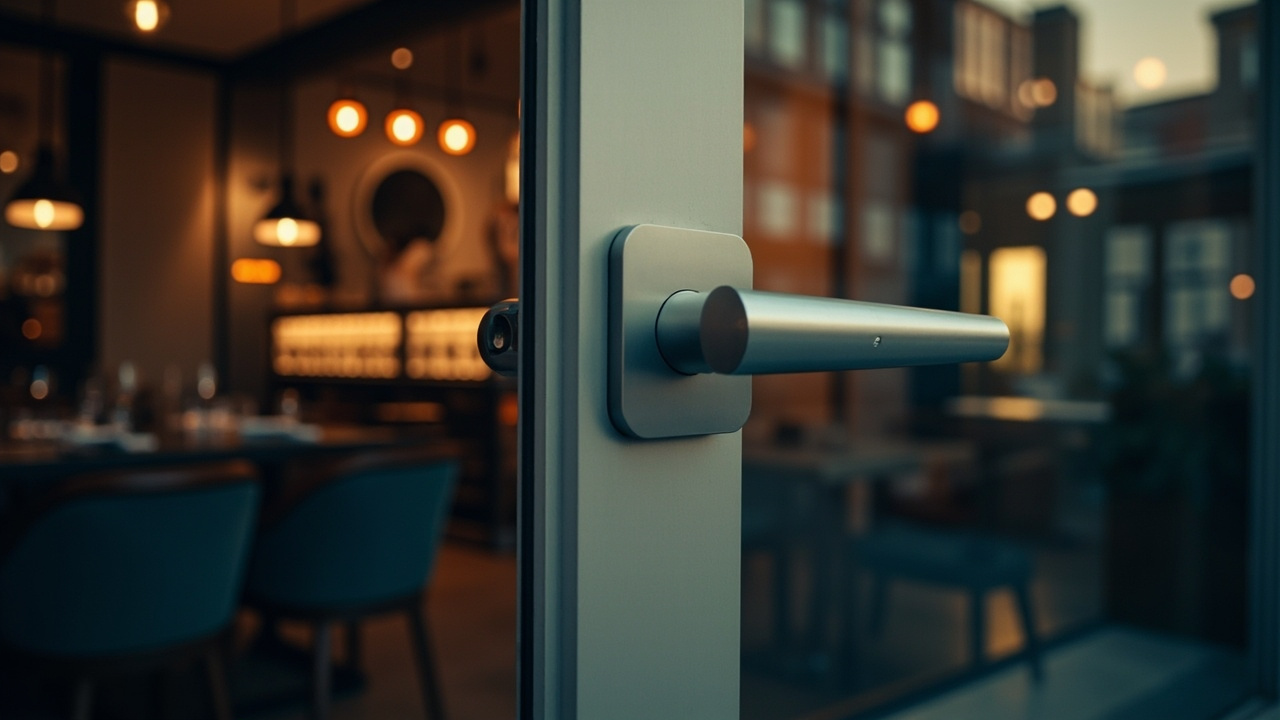
RFQ Template for Smart Locks for Restaurant Groups
A restaurants rfq template should turn a broad request for smart locks into a controlled comparison between suppliers, door types and operating models. The issue is not simply which lock has the longest feature list. It is which response can keep a kitchen, store, front door and other operating entrances usable during a service change, cleaning cycle or equipment failure.
Direct answer. Condensed to the essential point, restaurants rfq template turns a request into a decision record. restaurants rfq template and the decision record are the two parts of restaurants rfq template most often skipped. A restaurants rfq template names the door classes in one building. Each class needs its own specification. restaurants rfq template is the first one restaurants rfq template has to settle.
The phrase restaurants rfq template is anchored in restaurants rfq template. For the rest of this article it denotes the conditions and evidence that restaurants rfq template sets out below. Nothing wider than that.
- Group the doors — sort the door population into classes that behave alike, starting from restaurants rfq template
- Match each class — state what decision this rfq must needs before anything is quoted
- Prove the fit — record the measurement that closes restaurants rfq template
- restaurants rfq template runs this sequence, and restaurants is the record it produces.
This smart lock RFQ for restaurants therefore asks each bidder to answer the same operational questions, provide the same evidence and identify every exception. It gives the property manager a restaurant group access control RFQ that can be issued to one site, reviewed centrally and repeated across a group without changing its meaning.
The decision this RFQ must settle
The RFQ should settle three linked questions: what each door must do, what happens when its intended access method fails, and who owns recovery. A response that performs well at the front door but leaves the kitchen dependent on an unstaffed administrator is not a group-level answer.
Restaurant doors do not form one population. A front door carries the brand and may need a mechanical override. A kitchen or store door sees frequent use, washdown exposure and changing staff. A terrace door faces weather. A cellar introduces a different access environment, while a toilet corridor may need to remain easy to exit and easy for staff to enter. What the specification covers is in the smart door locks.
The comparison arena should therefore test each bidder against the same door scenarios. It should not award a broad “suitable” statement without requiring the bidder to show where that statement stops.
Keep the scope tied to operations the property manager can observe. A restaurant group access control RFQ can identify who issues and removes credentials, who responds to a failed lock, who replaces a damaged unit and who confirms that the manual route works. The RFQ should expose differences before a rollout decision is made.
Put three commercial responses in the ring
Ask suppliers to identify which response route they are offering. A bidder may submit more than one route, but each route must remain separately identifiable.
| Response route | What it must answer | Evidence expected | Common exclusion to challenge |
|---|---|---|---|
| Door-level hardware response | How does the lock fit and operate at each named door? | Door-specific technical response, fit information, recovery method and handover scope | Software, credentials, installation or ongoing support may be assumed |
| Access-workflow response | How are staff credentials managed through joining, role changes and departures? | Role map, credential lifecycle, administrator ownership and audit procedure | Door hardware and physical recovery may be left undefined |
| Lifecycle programme response | Who coordinates hardware, access, installation, service and replacement? | Named responsibilities, service route, replacement method, programme schedule and responsibility matrix | Individual tasks may be assigned to parties that never attend the site |
These routes are not product categories. They expose where responsibility has been placed. The strongest response should connect the three without leaving a gap between the credential administrator, the installer and the person who opens the door when the network, battery or keypad has failed.
Require bidders to identify any function not included in their response. An explicit exclusion is more useful than a broadly worded promise because it allows the evaluation team to determine whether another route is required.
Build the controlled door schedule
Do not ask for a lock “for the restaurant.” Ask for a response against a controlled schedule. The schedule should be based on physical observation, operating ownership and the access pattern for each door class.
| Door class | Operating demand | Evidence to request | RFQ failure signal |
|---|---|---|---|
| Front door | Brand presentation, normal customer entry, staff access and a defined manual route | Handing arrangement, frame conditions, everyday operation and manual-entry procedure | The response treats the front door as an ordinary staff door |
| Kitchen door | Frequent opening at service changes, washdown exposure and uninterrupted food-service access | Cleaning exposure, handle arrangement, status indication and recovery method | Access depends on one keypad or one administrator being present |
| Store and cellar doors | Stock movement, restricted access and separation from public areas | Load condition, credential or code workflow, override procedure and handover process | Staff share a generic code because individual permissions are unavailable |
| Toilet corridor | Clear passage, staff intervention and controlled customer access | Egress arrangement, emergency-release responsibility and local sign-off record | The proposed locking arrangement is assessed without the site authority |
| Terrace or external door | Weather exposure, customer flow and after-hours access | Installation condition, weather enclosure, cleaning effects and service access | Indoor assumptions are carried into an external position |
The Smart Locks for Restaurant Groups: Door Survey and Fit Reality guide can support the survey stage. A published Smart Lock Retrofit Site Survey also provides a useful format for recording existing doors before bidders answer the schedule.
Each schedule line should identify the door owner, the person who authorises access, the person who can open it manually and the service point that receives a fault. Where names are unavailable, require job roles rather than inventing responsibilities.
Copy-ready scope and site instructions
Start the issued document with a fixed scope statement and prohibit silent substitution. The following wording can be adapted without changing the comparison conditions.
Supply one complete technical and operational response for the door classes listed in this RFQ. State which lock, credential method, installation work, commissioning activity and support obligations are included. For every excluded item, identify the party that must provide it and the interface at which responsibility transfers.
Then attach the controlled site information. Require the bidder to mark any missing dimension, unknown door condition, unconfirmed environment or unresolved access requirement as an open question. A bidder that fills gaps with assumptions must identify them and show how the answer changes if the assumption is wrong.
The Office Smart Lock Site Survey offers a published comparison point for collecting the fields needed at each opening. Use consistent field names across every site so a group can combine responses without translating between property-manager terminology and installer terminology.
Include these instructions in the RFQ:
- Answer every question in the order issued.
- Reference the door class and schedule line beside each response.
- Identify any part of the question that does not apply and explain why.
- Separate documented capability from proposed adaptation.
- Attach dated evidence for every statement that affects selection.
- List unresolved dependencies before signature.
- Describe the manual route for each controlled door.
- Confirm who may change or revoke each access credential.
A bidder should also identify the door-handle arrangement, frame condition, opening direction and existing strike arrangement where these affect the proposed response. These are not cosmetic details: they determine whether the proposed sequence can be installed safely and operated consistently.
Test credentials through the real service change
A commercial kitchen smart lock RFQ must examine access during turnover, not just credential creation. Ask the bidder to describe how staff fobs, kitchen codes and store credentials are issued, changed and removed. Require the sequence to be shown from a new starter’s first shift through a leaver’s final shift.
The RFQ should identify:
- Who approves a new staff credential?
- How quickly can access be withdrawn?
- What happens when a role changes without replacing the person?
- Which records show who authorised an access change?
- Who can retrieve or cancel a credential while the responsible manager is absent?
- How are temporary delivery or contractor credentials limited?
- What happens to shared codes when an employee leaves?
- Which actions require attendance at the door?
The Smart Lock Key Control and Master Key Decisions for Restaurant Groups article separates credential hierarchy from master-key decisions. Use that distinction to prevent a bidder from treating one shared emergency route as the answer to every staff-access requirement.
Where a proposal depends on a staff device, network connection or administrator, ask what works when that dependency is unavailable. The answer must identify a usable alternative rather than merely state that the system is managed in the cloud.
Make failure recovery a required response
The critical restaurant question is which door fails at the worst moment and what the manual route is. For the kitchen, that moment may be a service change or a delivery arriving while staff are handling a busy handover. The RFQ must turn that concern into a response test.
Ask each bidder to explain, for every critical door, how staff gain entry when the intended method is unavailable. The response should identify the trigger, the person who acts, the equipment or key involved, the location of that equipment and how the event is recorded.
| Failure scenario | Bidder response required | Evidence that closes the question |
|---|---|---|
| Keypad or reader does not respond | State the alternative entry route and who can execute it | Demonstrated sequence and named operational owner |
| Staff credential is unavailable | State how legitimate access is restored without sharing a broad code | Identity and authorisation procedure |
| Battery power is unavailable | State the warning, override and replacement sequence | Door-specific procedure, not a general product statement |
| Network service is unavailable | State which local functions continue and which require intervention | Written offline or degraded-operation behaviour |
| Door is damaged or obstructed | State the safe isolation and service response | Responsibility matrix and contact route |
| Manual route is used | State how the event is reviewed and the lock restored | Record format and responsibility for closure |
The Smart Lock Failure Triage for Restaurant Groups guide can provide the diagnostic structure, while the RFQ should require each bidder to connect that structure to its own responsibilities. Do not accept “manual override available” without identifying what the override is, where it is held and who has been authorised to use it.
Challenge wash, grease and external exposure
Restaurant locks operate around cleaning routines, grease, moisture and frequent handling. The RFQ should ask for evidence relevant to the proposed installation, not rely on broad statements about suitability.
For interior doors, require the bidder to describe how the proposed product is cleaned, how residues are removed and whether any part of the lock or reader requires protection during service. Ask whether cleaning tasks have been assigned and how a damaged or contaminated unit reaches the responsible service point.
For terrace and external doors, ask about the actual exposure at that position. The response should address weather enclosure, direct rain, sun, salt where relevant and the installation condition. It should also state which parts of the assessment are based on the site survey and which still require confirmation.
The Vandalism, Misuse and Environmental Load on Locks in Restaurant Groups guide provides the appropriate questions for misuse and load. Require the bidder to respond at the door-class level, because one product response cannot cover a protected corridor, a washable kitchen door and an external entrance without qualification.
Separate fit, installation and handover evidence
The restaurant door hardware specification should contain three distinct evidence packages: survey, installation and handover. Combining them into one installation statement hides where a problem will be discovered.
The survey package should identify the measured and observed condition of each door, including leaf, frame, handing, latch, strike, handle, opening direction, frame depth and surrounding wall condition. Any field that could not be observed should remain blank with a reason and the method for resolving it.
The installation package should identify who performs each activity, what preparation is assumed, which site services are required and what must be coordinated with other contractors. It should also state how the installer protects the branded front-door area and how work is sequenced around trading hours.
The handover package should include configuration records, tested operating methods, credential responsibilities, recovery equipment, training completion and the route for reporting a fault. Require the handover to demonstrate the manual route as well as the normal access route.
The Installer Handover and Commissioning for Restaurant Groups article provides a practical model for separating these activities. A bidder that cannot show who completes and signs each activity has not completed the response.
Require comparable installation and support boundaries
Suppliers often use similar wording while allocating different responsibilities. Require every bidder to complete the same responsibility matrix and mark each item as included, excluded, dependent or not applicable.
| Activity | Supplier | Installer | Access administrator | Property manager | Site team | Evidence required |
|---|---|---|---|---|---|---|
| Site survey | Response required | Response required | Optional | Response required | Optional | Method and unresolved fields |
| Installation preparation | Response required | Response required | Not applicable | Response required | Response required | Preparation and access requirements |
| Lock configuration | Response required | Response required | Response required | Optional | Optional | Configuration record |
| Credential enrolment | Response required | Optional | Response required | Optional | Response required | Named administrator and test sequence |
| Commissioning tests | Response required | Response required | Response required | Optional | Optional | Signed test record |
| Training | Response required | Optional | Response required | Response required | Response required | Audience and completion evidence |
| Fault response | Response required | Response required | Response required | Response required | Response required | Contact and escalation route |
| Replacement unit | Response required | Response required | Not applicable | Response required | Response required | Swap procedure and stock responsibility |
No bidder should describe an activity as included without identifying the accountable party. A group property manager needs to know which service can be handled remotely, which needs attendance and which can be performed by restaurant staff under a written procedure.
Set the evaluation arena
Restaurant lock evaluation criteria should test a response against the operating model, not reward the longest submission. Mark fit, manual recovery and access administration as gates. Then compare the responses that pass those gates.
Use a buyer-defined scale from one to five, with zero indicating that the required evidence is absent. The scale should describe observable response quality rather than a marketing adjective.
| Criterion | Question | Strong response | Weak response |
|---|---|---|---|
| Door fit | Can the proposed arrangement be installed at the surveyed doors? | Door-specific evidence with unresolved fields named | General product description |
| Service continuity | Can each critical door be opened when the intended method fails? | Tested sequence, owner and recovery equipment | Feature claim without procedure |
| Credential control | Can access be issued, changed and removed without creating orphan access? | Named workflow, roles and audit record | Shared or transferable access assumed |
| Environmental fit | Does the response address the conditions at that position? | Site-specific cleaning, weather and load evidence | One answer applied to every door |
| Installation control | Are preparation, sequencing and site access defined? | Named responsibilities and handover tests | Installer coordinates everything without detail |
| Serviceability | Can a failed unit be diagnosed and replaced? | Clear triage and replacement route | Support described as a general contact |
| Group repeatability | Can the response be deployed across other restaurants? | Controlled schedule and reusable artefacts | Site-specific narrative only |
| Evidence quality | Can each claim be checked against dated evidence? | Clear references and declared gaps | Unsupported capability language |
Before scoring, remove any response that fails a gate. A high score in a secondary category cannot compensate for an undefined manual route at the kitchen door. Record the reason for exclusion so the decision remains consistent when another bid is requested.
Run the pilot as a comparative test
Use one representative site and the same door scenarios for every bidder allowed into the trial. The Smart Lock Procurement for Restaurant Groups: The Group Trial Then Phased Rollout Route route can help structure that comparison, but the RFQ must preserve the same questions from pilot through approval.
flowchart TD
    A[Issue controlled RFQ] --> B[Classify doors and owners]
    B --> C[Run common pilot scenarios]
    C --> D{All critical gates passed}
    D -->|Yes| E[Compare lifecycle responses]
    D -->|No| F[Record and resolve exceptions]
    E --> G[Approve rollout baseline]
During the pilot, test opening under normal traffic, staff turnover, cleaning, a failed credential process, a low-power condition and a manual-entry event. Use observations rather than supplier commentary. Record the time taken, the people involved, any workaround used and whether the record identifies the door and responsible party.
Require each bidder to explain every deviation from its written response. An undocumented manual step is part of the proposed operating model and must be included in the final scope. Likewise, a successful pilot does not close a question about a different door class or a later site.
Resolve clarifications through a common answer sheet
Most bid comparisons become subjective when bidders answer the same question differently. Issue a clarification sheet containing one row per unresolved point. Do not allow one bidder to receive a private explanation that is not reflected in the common record.
| Clarification ID | Original question | Supplier answer | Evidence checked | Group decision | Condition attached |
|---|---|---|---|---|---|
| C-01 | State the kitchen-door recovery route | Response recorded | Reference recorded | Accepted, revised or rejected | Condition recorded |
| C-02 | Identify the temporary-access owner | Response recorded | Reference recorded | Accepted, revised or rejected | Condition recorded |
| C-03 | Explain external-door exposure treatment | Response recorded | Reference recorded | Accepted, revised or rejected | Condition recorded |
| C-04 | Define the handover test pack | Response recorded | Reference recorded | Accepted, revised or rejected | Condition recorded |
A clarification may change a bid’s score. Keep the original response, the revised answer and the reason for any score change. This prevents the final comparison from becoming a collection of privately negotiated exceptions.
Structure the commercial response without losing scope
The commercial section should state boundaries rather than list product names. Require the bidder to identify quantities by door class, included installation activities, excluded work, programme dependencies, recurring service responsibilities, replacement responsibilities and the evidence that closes each item.
A restaurant group access control RFQ should also state whether the response is offered for one site, a standard group package or both. The bidder must explain which elements remain unchanged between sites and which require a site survey.
For a multi-site lock tender, request a reusable response pack containing the door schedule, responsibility matrix, test scripts, handover record, fault workflow and approval form. The pack should be usable by a property manager without rewriting supplier-specific language for every site.
Do not allow the commercial response to alter the technical assumptions. If a bidder excludes a required function, that function must be shown as an open dependency rather than removed from the comparison.
Record the approvals that control the site decision
Some installation and access arrangements depend on the building, fire and site operating decisions. The RFQ should leave the approval fields open rather than assume that a standard answer applies across the group.
Ask the property manager to record which authority or internal role approves the emergency arrangement, egress behaviour and any alteration to a rated or controlled entrance. The bidder should provide the information required for that review without representing the approval as complete.
CONFIRM-WITH-LOCAL-FIRE-AUTHORITY
CONFIRM-WITH-LOCAL-BUILDING-AUTHORITY
Where the proposed arrangement affects safe use during cleaning, maintenance or a service interruption, ask the responsible health-and-safety adviser to review the operating procedure.
CONFIRM-WITH-LOCAL-HEALTH-AND-SAFETY-ADVISER
Keep these sign-offs attached to the exact door schedule. A statement that applies to the group as a whole is insufficient when the relevant door, frame, escape arrangement or operating procedure differs by site.
Issue the final RFQ checklist
Before release, check that the document contains the controls below. Any missing item should remain visible on the issue sheet rather than being left to a bidder to interpret.
| Control | Included | Owner | Reviewer | Status |
|---|---|---|---|---|
| Controlled door schedule | Yes or no | Named role | Named role | Open, closed or excluded |
| Response-route declaration | Yes or no | Named role | Named role | Open, closed or excluded |
| Manual route for critical doors | Yes or no | Named role | Named role | Open, closed or excluded |
| Credential lifecycle ownership | Yes or no | Named role | Named role | Open, closed or excluded |
| Survey, installation and handover split | Yes or no | Named role | Named role | Open, closed or excluded |
| Environmental response by door class | Yes or no | Named role | Named role | Open, closed or excluded |
| Responsibility matrix | Yes or no | Named role | Named role | Open, closed or excluded |
| Evidence and clarification register | Yes or no | Named role | Named role | Open, closed or excluded |
| Site approval fields | Yes or no | Named role | Named role | Open, closed or excluded |
| Common pilot and scoring method | Yes or no | Named role | Named role | Open, closed or excluded |
The Restaurant Group Smart Lock Evaluation Checklist is not an available published slug, so do not use it. Instead, keep this checklist inside the issued RFQ and use the valid Audit Trail Requirements for Restaurant Groups: What Records Matter guide to define the evidence record that accompanies each scored answer.
Turn the comparison into a release decision
The award should name the selected response route, the approved door schedule, every accepted exception and the evidence attached to each decision. It should also identify which conditions must be closed before installation and which remain tracked for later sites.
This restaurants rfq template is complete when two reviewers can follow the same document and reach the same understanding of the selected response. The selected bidder must still close every declared open item, while the property manager retains the controlled schedule, test records and approval history.
It is worth pairing this with the smart lock ansi mortise. That is the same question restaurants rfq template has to answer here.Use the completed package as the basis for a site-specific request through Request a Quote. Carry forward the same gates, evidence requirements and recovery tests so the commercial response remains tied to the doors, operating owners and failure routes evaluated in the RFQ.