
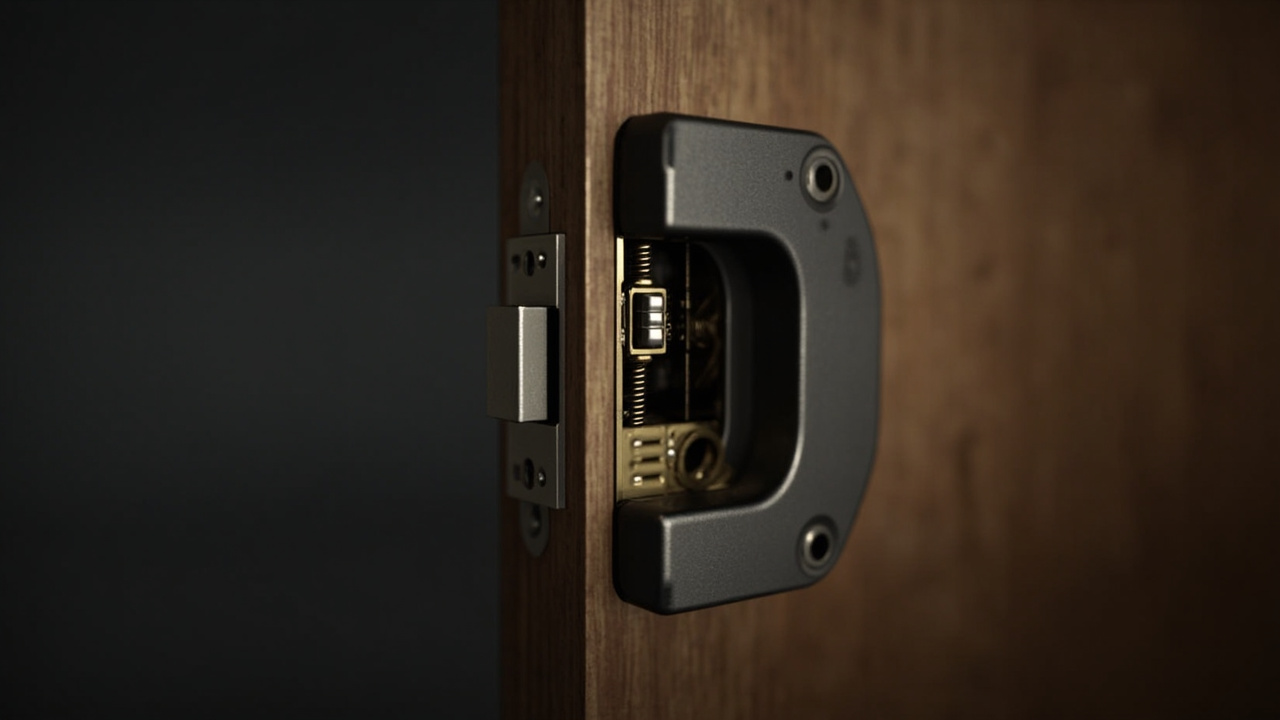
Reading PCB Layout and Protection Claims in a Supplier Datasheet
Border note: the datasheet did not answer the question
In an illustrative cross-border qualification diary, I received a supplier file labelled “datasheet” while reviewing a smart lock for a system integrator project. My task was to test the pcb layout and protection datasheet claims. The document named several protective functions, yet it did not show which board revision they described, which lock configuration included that board, or how each function had been examined. I therefore treated every statement as an unverified claim, not as a feature to carry into the bid. The range this procurement eventually buys from is the smart door locks.
Direct answer. Condensed to the essential point, pcb layout and protection datasheet claims turns a request into a decision record. pcb layout and protection datasheet claims and pcb-layout-and-protection are the two parts of pcb layout and protection datasheet claims most often skipped. A pcb layout and protection datasheet claims is a component behaviour guide. It covers limits. It covers failure modes. pcb layout and protection datasheet claims decides whether pcb layout and protection datasheet claims is acceptable for this build.
The phrase pcb layout and protection datasheet claims is anchored in pcb layout and protection datasheet claims. For the rest of this article it denotes the conditions and evidence that pcb layout and protection datasheet claims sets out below. Nothing wider than that.
- Test what it does — confirm on the dated product page for the specific SKU behind pcb layout and protection datasheet claims
- Test where it stops — record where the technology in pcb-layout-and-protection stops working
- Plan the manual path — name the mechanical path that remains if pcb layout and protection datasheet claims fails
- Treat this as the pcb layout and protection datasheet claims sequence, with pcb layout and protection as the reference.
That distinction matters because a board drawing, component list and test summary may all be genuine documents while still describing different products. A polished diagram is a map, not proof. My first pass therefore separated what the supplier asserted, what I still needed to understand, and what evidence could close each gap.
From cover sheet to a claim register
Smartlockfactory’s verified catalogue spans 79 published models, and its fact base treats the control PCB as one of 35 hardware objects a buyer can measure, specify, inspect or reject. For a proposed SKU, I confirm on the dated product page for the specific SKU that the hardware, board and documentation match. This prevents a sound board claim from being attached to the wrong lock configuration.
A supplier datasheet review becomes useful when each sentence becomes a row. I use this pcb layout and protection datasheet claims register:
| Datasheet wording | Buyer question | Evidence to request |
|---|---|---|
| Protected input | Which interface is protected, and against which event? | Schematic section and defined test condition |
| Wide operating range | Is the range measured at the board, connector or complete lock? | Design limits and characterization record |
| Separate power domains | Which circuits are separated, and where? | Current schematic and rail map |
| Protected radio section | Which layout features provide the separation? | Layout excerpt and engineering explanation |
| Thermal management | Where is heat generated, transferred and measured? | Layout excerpt and thermal record |
| Fault handling | Which conditions are detected or reported? | Fault definition and corresponding test record |
The register prevents one strong statement from covering several unrelated interfaces. Each row closes only when the evidence identifies the protected boundary, operating condition, board revision and document owner.
The route from claim to evidence
I start every technical query with four fields: the exact statement, the engineering question behind it, the missing evidence and the next review action. I do not ask for “more documentation” because that produces another folder but not an answer.
flowchart TD
    A[Receive supplier file] --> B[Split claims into atomic rows]
    B --> C[Link each claim to evidence]
    C --> D{Is the evidence complete}
    D -- No --> E[Issue a technical query]
    D -- Yes --> F[Release for sample review]
A claim becomes reviewable when its document names the tested configuration. If the report, schematic and layout use different board identifiers, I hold the row open until the supplier reconciles them. If no test evidence is required, the supplier should say why the engineering rationale is sufficient.
Where layout and protection get blurred
Control PCB protection is a system property, not merely a component choice. Copper geometry, return paths, component placement, grounding, enclosure arrangements and the location of the antenna region can affect how electrical stress reaches the board. A datasheet that lists protection parts without showing their relationship to the layout leaves an important qualification gap.
Smart lock PCB layout must also be read in its final mechanical context. A board positioned near a metal door, reader, motor, cable route or battery compartment is not electrically isolated from that environment merely because its components are marked as protected. I therefore ask where the board sits, what surrounds it and which physical interfaces cross its boundary.
Protection language without a test condition
A protection headline becomes meaningful only when the condition is defined. For ESD protection evidence, the reviewer needs to know the interface, discharge point, equipment state and applied condition. Similar logic applies to reverse polarity, voltage limiting, overcurrent, transient exposure, heat and moisture. The test method is part of the claim, not an administrative attachment.
| Protection topic | Condition to define | Evidence that closes the topic |
|---|---|---|
| Electrostatic discharge | Interface, discharge point, equipment state and applied level | Method, setup, result and board revision |
| Reverse polarity | Source, duration and affected power rail | Schematic excerpt and test procedure |
| Overvoltage or overcurrent | Load condition, source condition and threshold behavior | Design rationale and characterization record |
| Surge or transient | Coupling path, waveform and protected boundary | Defined method, setup and result |
| Thermal condition | Hotspot, ambient condition and operating duration | Layout excerpt and measurement record |
| Moisture or corrosion | Exposed area, conditioning method and inspection point | Material evidence and environmental procedure |
I also record deviations, unresolved observations and the precise reason another document is needed. “Protected” without those details is not a rejection by itself, but it is not enough to release a board for sample review.
An evidence package that can survive version control
My schematic review checklist has seven document groups. The supplier can redact commercial information, but it should preserve technical identity and traceability.
- Exact proposed lock, control-PCB and assembly revision
- Current schematic and PCB-layout revision identifiers
- Bill of materials or approved protection-component alternatives
- Dated reports with setup, conditions, results and deviations
- Layout excerpts showing the claimed protection features
- A map from each report to the board revision examined
- Open-item owner, next action and expected closure point
Version control deserves particular attention. A board change can alter component placement, grounding or firmware-related behavior without changing the commercial model name. The supplier must identify which drawings and reports remain valid for the proposed build.
An illustrative exchange across two time zones
On the second review day, I sent the open rows to the supplier contact in another time zone. Rather than accept another feature summary, I requested four answers for every row: the controlled document, the applicable condition, the tested configuration and any deviation.
The useful shift came when the supplier replied by row rather than by section. A schematic excerpt could close one row, while another remained open pending a defined test method. This created a compact working record instead of an argument about which paragraph of the original datasheet mattered most.
The lock around the board matters
The control PCB travels inside a product whose geometry and power source are part of the qualification. Metal door construction, reader position, motor current path, battery compartment, emergency power port and enclosure can change what the board encounters during use. I connect electronic claims to installation evidence before judging their relevance to the project.
The Office Smart Lock Site Survey helps establish the intended installation rather than a generic door assumption. The Smart Lock Retrofit Site Survey is equally important where an existing door leaves less room for routing or separation. Neither survey proves a protection claim; both help determine which physical conditions the technical evidence must address.
Handover file for supplier and local teams
Before a technical package crosses a border, I separate supplier-controlled evidence from project-controlled decisions. The first belongs in the technical file. The second must be checked against the destination market and exact product configuration rather than inferred from a component document.
The same question is worked through in more detail in smart lock access permission management. That is the same question pcb layout and protection datasheet claims has to answer here.CONFIRM-WITH-LOCAL-COMPLIANCE-TEAM: Confirm the applicable radio, electrical, environmental, product-safety and import requirements for the destination market, proposed lock and project.
My handover index then contains the claim register, evidence map, controlled-document list, configuration record and unresolved-question log. Supplier evidence remains attributable to its revision, while local approvals remain linked to the project scope.
The qualification scorecard I use
The following weights are a worksheet for lock electronics qualification, not a claim about every project. The review team should change the weighting when the installation or risk profile differs.
| Criterion | Suggested weight | Evidence that closes it | Hold trigger |
|---|---|---|---|
| Claim identity | 20 | Exact interface, condition and protected boundary | Vague feature wording |
| Condition completeness | 25 | Setup, state and applied condition are defined | Test scope is missing |
| Document linkage | 20 | Evidence maps to the current row and board | Unrelated report attached |
| Revision control | 15 | Schematic, layout and report identifiers agree | Version conflict |
| Configuration match | 10 | Evidence applies to the proposed lock build | Different assembly assumed |
| Open-item ownership | 10 | Named owner and next action | Question remains unassigned |
| Result | Meaning | Next action |
|---|---|---|
| Ready | Required evidence is complete and revision-matched | Proceed to the defined review stage |
| Conditional | A bounded issue remains without changing the core design | Close the issue with targeted evidence |
| Hold | Identity, condition or configuration cannot be established | Keep the claim out of the approval record |
The eight-line technical query I
My final query was shorter than the original datasheet. It asked the supplier to:
- Identify the exact lock, control-PCB and assembly revisions under review.
- State which schematic and layout files govern those revisions.
- Identify the boundary and condition for each protection claim.
- Provide the component references used to implement each protection function.
- Explain how the board layout supports the stated claim.
- Supply the dated test method, setup, result and deviations where applicable.
- Reconcile every evidence document with the proposed configuration.
- List unresolved questions, their owners and the next closure action.
The next commercial step is to send the proposed configuration, claim register and open-document list through the request-a-quote route. For deeper review, PCB Layout and Protection Trade-Offs: Cost, Durability and Service examines design choices, PCB Layout and Protection Test Evidence a Buyer Can Actually Request expands the evidence request, and Specifying PCB Layout and Protection: Questions that Get Real Engineering Answers provides a broader qualification structure. The release decision should rest on traceable evidence for the dated configuration, not on a generic statement that the board is protected.