
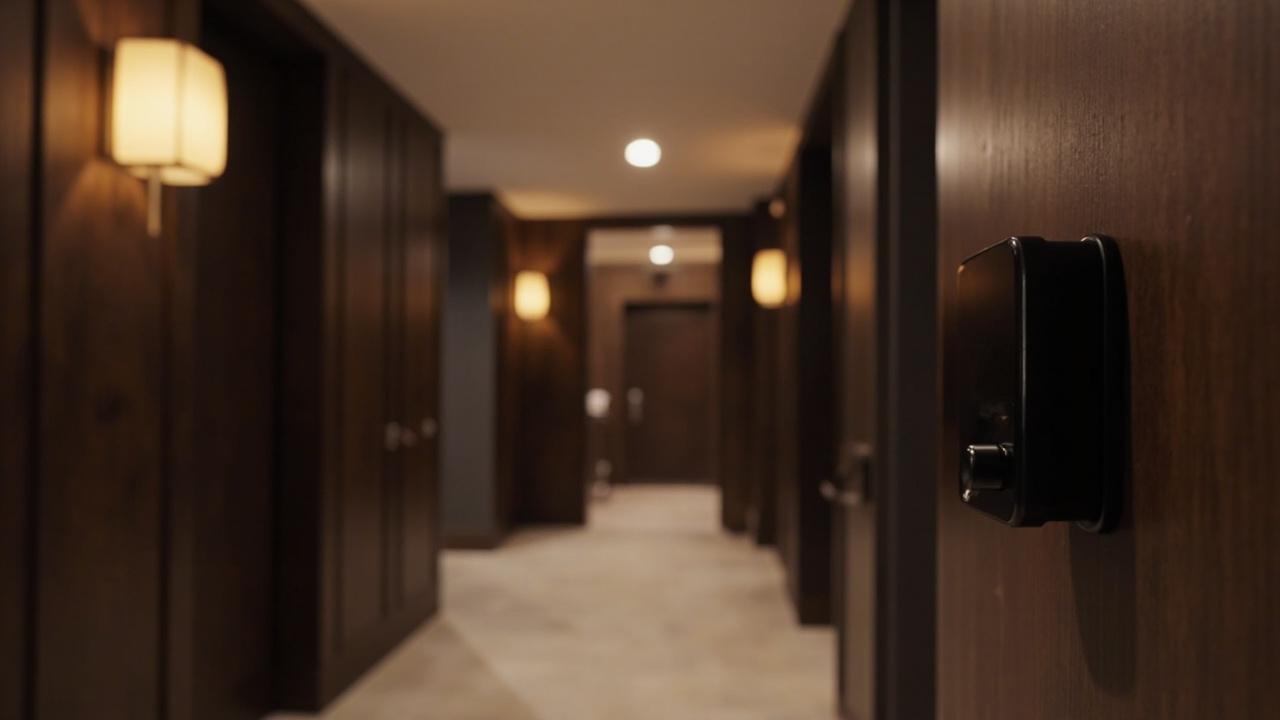
Smart Lock Opportunities for System Integrators
Smart lock opportunities for system integrators are the structured playbook a system integrator (SI) uses to convert the smart-lock catalogue of a manufacturer like SmartLockFactory into a recurring revenue service line across multi-site rollouts — packaged as a five-stage operating manual (capability audit → service-line packaging → scope-letter annex drafting → multi-site rollout economics → post-installation recurring-revenue contract), so that every door an integrator commissions becomes a service relationship, every service relationship becomes a renewal, and every renewal becomes the next property. The opportunity is not "the catalogue has 79 models"; the catalogue has 79 models, 24 hotel locks, 18 keypad locks, 9 RFID locks, 6 face recognition locks, 6 cabinet locks, 3 video camera locks, 3 glass locks, and 10 outdoor locks, across 10+ years and 80+ countries. The opportunity is the integrator role that sits between those 79 models and the property that buys them — the partner who audits the door, chooses the SKU family, writes the scope letter, wires the property management system, commissions the lock, hands the system over, and stays on the contract for the next five years. SmartLockFactory is an OEM/ODM factory that has been operating for 10+ years, has shipped into 80+ countries, and runs a quote-based commerce model that publishes no prices, MOQs, or lead times — every per-deal figure is confirm with the supplier against a written offer letter. The SI's opportunity is to sit at the table where those figures get built per property.
This playbook sits beside two siblings that own adjacent buyer-side instruments. Smart Lock System Integrator Procurement Guide is the buyer-side vetting dialogue the property procurement lead runs when they are hiring an SI: the scorecard the procurement lead carries into the room, the evidence pack the SI walks in with, and the four rounds of dialogue that close the rows before any scope letter is signed. This article (920) is the mirror — the SI-side playbook the integrator runs when they are pitching the property: the capability audit that proves the integrator is qualified to be in the room, the service-line packaging that turns 79 models into a five-bucket offering, the scope-letter annexes that make the offering executable, the multi-site rollout economics that make the offering profitable, and the post-installation recurring-revenue contract that makes the offering renewable. Two articles, two sides of the same room. Article Smart Lock System Integrator Procurement Guide (sibling) and Smart Lock System Integrator Procurement Guide (sibling) extend the same lens into the program-structure and revenue-model decompositions respectively. The three articles plus this one form the four-paper SI opportunity pack.
The playbook is run on five disciplines. Capability-first discipline: every opportunity stage starts from what the integrator has demonstrably done, not what the integrator's deck claims; the same confirm-with-the-supplier / confirm-with-the-integrator rule that governs the procurement scorecard governs the opportunity scorecard. Service-line discipline: every opportunity the integrator pursues is structured as a named service line with explicit deliverables, exit criteria, and price-influencing variables — not as a price quote, not as a feature list. Annex discipline: every opportunity that graduates from a service line into a contract carries a written annex the integrator attaches to the scope letter; an opportunity without an annex is a memo, not a contract. Multi-site discipline: every per-property economic assumption is re-read against the multi-site rollout economics; an opportunity that works for one room rarely works for a hundred rooms unless the integrator has named the variables that change between room one and room one hundred. Recurring-revenue discipline: every opportunity is read against the post-installation recurring-revenue contract; an opportunity that ends at commissioning is a transaction, and an integrator who runs on transactions is an integrator who re-tenders every renewal. Five disciplines; one playbook.
Stage 1 — Capability audit: what the integrator has demonstrably done
Protocol SI-OPS-1.1 — Company-standing audit. Before the integrator walks into a property to sell a smart-lock opportunity, the integrator walks into a mirror to audit what the integrator has closed. The audit is a written register: years operating as a system integrator institution (not years trading as a software shop or a hardware shop); named staff headcount; named subset on the smart-lock integration team; rebrand or acquisition history in the previous five years; insurance coverage with named-additional-insured readiness; parent / subsidiary / related-party exposure. Every cell routes to a document the integrator signs and dates. The first question the property procurement lead will ask is the question this register answers — and the SI-side opportunity collapses if the register is not pre-staged.
Protocol SI-OPS-1.2 — Reference register. The second register is the project register: every project the integrator has commissioned, with property name (with owner consent), property type, door count, model mix (which SLK SKU family and which software build version), the PMS / access-control / mobile-key / credential-issuance platforms wired, the integrator's role on the project (lead integrator / sub-contractor / partner), the commissioning date, and a reference contact with named consent. Per the Smart Lock System Integrator Procurement Guide, the reference row is the row that most often fails the test — an integrator that names five projects without a single reference contact has named five projects without answers. The opportunity side of the same register: the SI cannot win the multi-property rollout unless the SI has a register with at least three reference contacts the property procurement lead can actually call.
Protocol SI-OPS-1.3 — Software-build register. The third register is the software-build literacy register: which software build versions the integrator has commissioned against (TTLock, Tuya, Doodle, hotel PC software, or a property-side platform), on which lock model families, and under what firmware-revision response procedure. For SLK-9936S-anchored hotel-room doors, the PDP-cited spec block specifies that the management software is available in standalone or centralised database mode, is multilingual, supports mechanical emergency access, and stores audit/event records up to 1,000. The integrator's register must name, for each project, which of those modes was used, which audit-record retention window was set, and which language packs were loaded. For every other SKU family on the integrator's shortlist, the build-version lane is whatever the product page and the integrator's written confirmation name — confirm with the supplier against a written offer letter for any per-deal detail.
| Row | Question the integrator asks itself | Document the integrator attaches | Default state |
|---|---|---|---|
| OPS-1.1.1 | Years operating as a system integrator institution (not as a reseller or a hardware shop) | Corporate profile, dated and signed | Open until signed |
| OPS-1.1.2 | Named staff headcount + named smart-lock-integration subset | Roster with named role per person | Open until signed |
| OPS-1.1.3 | Rebrand / acquisition history in previous five years | Signed disclosure statement | Open until signed |
| OPS-1.1.4 | Insurance coverage including named-additional-insured readiness | Certificate of insurance | Open until signed |
| OPS-1.1.5 | Reference projects with named owner-consented contacts | Project register with consent record per contact | Open until signed |
| OPS-1.1.6 | Software-build register per SKU family | Build-version register with date commissioned and named lead | Open until signed |
IF-THEN rule. IF the integrator cannot produce a signed Stage 1 register on the property's first request, THEN the integrator does not yet have a Stage 2 service line; the integrator's next move is to close the register, not to scale the opportunity.
Stage 2 — Service-line packaging: turning 79 models into five buckets the property can buy
Protocol SI-OPS-2.1 — Five-bucket packaging. The integrator's service line is not "we sell smart locks"; the service line is five named buckets, each bucket a deliverable the property can buy separately or together. Bucket A — Door-fit envelope audit: the integrator visits the property, measures each door type on the audit register (door thickness, backset, hand, frame condition, existing prep), and produces a written door-fit report naming which lock family from the 79-model catalogue fits which door. For SLK-9936S-anchored hotel-room doors, the PDP-cited spec block specifies door thickness 36–100 mm, 5-pin cylinder, 3-point latch, stainless steel + alloy body, and multiple finish options; the door-fit report names the per-door variation within that envelope. Bucket B — SKU family selection: the integrator recommends the SKU family per door type, drawing from SmartLockFactory's 24-model hotel-lock catalogue (SLK-9936S, SLK-9936G, SLK-9905A, SLK-9951TH, SLK-9962S, and the 19 other hotel-card / hotel-code models), the 18-model keypad catalogue (including the stainless 022 / 019 series), the 9-model RFID catalogue, the 6-model face-recognition catalogue, the 6-model cabinet catalogue, the 3-model video catalogue, the 3-model glass catalogue, and the 10-model outdoor catalogue. Bucket C — Software-build commissioning: the integrator wires the property management system, the access-control platform, the mobile-key platform, the credential-issuance workflow, and (for the SLK-9936S-anchored doors) the standalone-or-centralised database mode decision per property. Bucket D — Commissioning and hand-over: the integrator commissions each door, trains the property staff on the management software, walks the hand-over register with the property operations lead, and produces a written hand-over document. Bucket E — Post-installation service contract: the integrator stays on the contract for the per-property service window, with named service-level commitments and named response windows.
Protocol SI-OPS-2.2 — Bucket-pricing discipline. The integrator publishes the five buckets as named deliverables, not as a per-door price list. The price-influencing variables per bucket are documented in the service-line offering: per-property visit count for the door-fit envelope audit; per-door measurement time and per-door reporting time; per-SKU family complexity; per-property software-build integration time; per-property hand-over training hours; per-property service-contract window. Every per-deal number on the offering routes to confirm with the supplier against a written offer letter — neither SmartLockFactory nor any other manufacturer publishes integrator pricing in advance of a written offer. The discipline is structural: the integrator names what the property is buying and what influences the per-property number, without quoting a price in advance of a quote.
| Bucket | Deliverable the property receives | Price-influencing variables | Default confirmation |
|---|---|---|---|
| A — Door-fit envelope audit | Written door-fit report naming per-door SKU family | Per-property visit count; per-door measurement time; per-door reporting time | Confirm with the integrator in writing |
| B — SKU family selection | Per-door-type SKU family recommendation with rationale | Property door count; door type mix; finish inventory | Confirm with the supplier per SKU family |
| C — Software-build commissioning | Wired PMS / access-control / mobile-key / credential stack | Property IT estate complexity; platform binding (TTLock / Tuya / Doodle / hotel PC software / property-side) | Confirm with the supplier per platform |
| D — Commissioning and hand-over | Commissioned locks + trained property staff + hand-over document | Per-property commissioning hours; training hours; hand-over document depth | Confirm with the integrator in writing |
| E — Post-installation service contract | Named service-level commitments with response windows | Service-window length; per-incident response target; spare-parts commitment | Confirm with the integrator in writing |
IF-THEN rule. IF the integrator packages the service line as a per-door price list without naming the bucket deliverables, THEN the property procurement lead has no scorecard to evaluate the integrator against, and the integrator's proposal will be benchmarked on price alone. The integrator who publishes bucket deliverables publishes the scorecard; the integrator who publishes price publishes the trap.
Stage 3 — Scope-letter annex: from service line to executable contract
Protocol SI-OPS-3.1 — Annex taxonomy. The scope letter is the contract instrument; the annexes are the instruments the scope letter attaches to. The integrator drafts seven annexes per multi-site rollout: Annex 1 — Door-fit envelope report (Bucket A output, dated and signed); Annex 2 — SKU family selection register (Bucket B output, with named per-door SKU per door type); Annex 3 — Software-build commissioning plan (Bucket C output, with named per-platform integration steps and named per-platform verification); Annex 4 — Hand-over register (Bucket D output, with named hand-over document, named property-side training recipients, and named sign-off); Annex 5 — Service-level commitments (Bucket E output, with named per-incident response window, named per-incident resolution window, and named spare-parts commitment); Annex 6 — Reference contacts register (the project register from Stage 1, re-staged for the property procurement lead's reference call); Annex 7 — Audit-record retention register (the SLK-9936S-anchored audit/event-records-up-to-1,000 specification scoped to that SKU only, plus the per-other-SKU retention window confirm with the supplier per SKU family).
Protocol SI-OPS-3.2 — Annex discipline. Each annex is a separate document the integrator signs and dates. The scope letter references each annex by name and date; if an annex is revised, the scope letter is revised. The discipline is that an opportunity without an annex is a memo, and a memo is not a contract. The property procurement lead who reads the scope letter without the annexes has read the cover page; the integrator who delivers the scope letter without the annexes has delivered a cover page.
| Annex | Reference in scope letter | Document the integrator signs | Default state |
|---|---|---|---|
| 1 — Door-fit envelope report | Bucket A output | Site survey, dated and signed | Open until signed |
| 2 — SKU family selection register | Bucket B output | Per-door SKU register, dated and signed | Open until signed |
| 3 — Software-build commissioning plan | Bucket C output | Per-platform commissioning plan, dated and signed | Open until signed |
| 4 — Hand-over register | Bucket D output | Hand-over document + sign-off page | Open until signed |
| 5 — Service-level commitments | Bucket E output | SLA annex, dated and signed | Open until signed |
| 6 — Reference contacts register | Stage 1 register re-staged | Project register + consent record per contact | Open until signed |
| 7 — Audit-record retention register | Stage 2 register re-staged | SLK-9936S spec block cited; per-other-SKU window routed to supplier | Open until signed |
Protocol SI-OPS-3.3 — Exception handling. The exception cases that break the annex taxonomy are the cases the SI opportunity playbook must pre-name: (a) the property adds a door type mid-rollout (the SI's response is to issue Annex 1-revised and Annex 2-revised, dated and signed; the scope letter is amended); (b) the property changes its PMS mid-rollout (the SI's response is to issue Annex 3-revised with the new platform binding; the software-build commissioning plan is re-validated; the audit-record retention register is re-validated because the per-platform event-log schema may have changed); (c) the supplier publishes a firmware revision during the rollout (the SI's response is to issue Annex 3-revised with the response-procedure named in writing — the named installer, the re-training record, the per-door confirmation); (d) the property asks for a SKU family not on the integrator's shortlist (the SI's response is to issue Annex 2-revised with the new SKU family added, the per-door SKU register updated, and the supplier confirmation cited — confirm with the supplier against a written offer letter for any per-deal figure on the new SKU).
IF-THEN rule. IF an exception case is not pre-named in the scope-letter annex taxonomy, THEN the integrator's response window to the exception is undefined, and the exception will become the negotiation. The SI opportunity playbook names the exception in advance so that the exception becomes the annex, not the dispute.
Stage 4 — Multi-site rollout economics: what changes between room one and room one hundred
Protocol SI-OPS-4.1 — Per-property unit economics. The per-property economics of the integrator's service line have a structural shape that holds across room one and room one hundred — the variables that change between single-room and multi-site are the variables the playbook names in advance. The per-property cost stack has seven named layers: (i) the per-property door-fit envelope audit cost, amortised across the property door count; (ii) the per-door SKU procurement cost, which routes to confirm with the supplier against a written offer letter; (iii) the per-property software-build commissioning cost, which is dominated by the property IT estate complexity on the first property and amortises across subsequent properties on the same platform binding; (iv) the per-property commissioning and hand-over cost, which is dominated by the per-property training hours on the first property and compresses as the integrator's installer crew gains property-specific familiarity; (v) the per-property service-contract cost, which amortises across the service-window length; (vi) the spare-parts commitment cost, which is per-property for the first property and shared across the multi-site pool from property two onwards; (vii) the travel-and-logistics cost, which is per-property in single-room mode and amortises across the multi-site geography.
Protocol SI-OPS-4.2 — Multi-site leverage variables. Four variables shift the per-property economics between single-room and multi-site: Volume leverage — the SKU family procurement cost moves against the supplier's volume ladder as door count compounds across properties (confirm with the supplier against a written offer letter on the per-rung terms). Platform leverage — the software-build commissioning cost compresses as the integrator reuses the same platform binding (e.g. the same PMS, the same access-control platform, the same mobile-key platform, the same credential-issuance workflow) across multiple properties; property one bears the platform integration cost, properties two through n bear the per-property hand-over cost. Crew leverage — the per-property commissioning hours compress as the integrator's installer crew gains property-specific familiarity; the named lead installer on property one becomes the trainer on property two. Spare-parts leverage — the per-property spare-parts commitment amortises across the multi-site pool from property two onwards; the SI's spare-parts inventory becomes a shared asset across the multi-site estate rather than a per-property sunk cost.
| Layer | Single-room shape | Multi-site shape | Variable that shifts |
|---|---|---|---|
| Door-fit envelope audit | Per-property sunk | Per-property sunk; amortises via shared site-survey template | Per-property visit count |
| SKU procurement | Per-door price | Volume-ladder price as door count compounds | Volume ladder rung — confirm with the supplier |
| Software-build commissioning | Dominated by property-one platform integration | Compresses as platform binding is reused | Platform binding (PMS / access-control / mobile-key / credential) |
| Commissioning and hand-over | Per-property commissioning hours + training hours | Crew leverage compresses hours from property two onwards | Named lead installer familiarity |
| Service-contract | Per-property service-window | Per-property service-window; amortises via shared SLA template | Service-window length |
| Spare-parts commitment | Per-property sunk | Shared pool from property two onwards | Multi-site pool size |
| Travel and logistics | Per-property | Amortises across multi-site geography | Multi-site geography |
Protocol SI-OPS-4.3 — Multi-site leverage exception handling. Three exception cases break the multi-site leverage shape: (a) the multi-site spans multiple PMS platforms (each PMS platform requires a separate Annex 3 — the platform leverage compresses only within a platform); (b) the multi-site spans multiple geographies (the travel-and-logistics cost does not amortise across geographies that are not co-located; the SI's response is to nominate a regional crew per geography); (c) the multi-site spans properties with different SKU family requirements (the SKU procurement cost does not volume-leverage across non-coincident SKU families — the SI's response is to negotiate the volume ladder per SKU family, not across SKU families).
IF-THEN rule. IF the integrator pitches the multi-site opportunity on per-property pricing without naming the multi-site leverage variables, THEN the property's procurement lead has no scorecard to validate the per-property number against the multi-site number, and the integrator's multi-site proposal will be benchmarked on the per-property number. The integrator who publishes the seven-layer cost stack publishes the scorecard; the integrator who publishes per-property pricing publishes the trap.
Stage 5 — Post-installation recurring-revenue contract: from transaction to renewal
Protocol SI-OPS-5.1 — Service-contract structure. The post-installation service contract is the bucket that converts the per-property commissioning transaction into a recurring-revenue relationship. The service contract has four named components: Component A — Per-incident response window: the SI commits to a named response window per per-incident severity tier (severity-1: lock offline / property access blocked; severity-2: degraded credentialing; severity-3: cosmetic / configuration). Component B — Per-incident resolution window: the SI commits to a named resolution window per severity tier, with named escalation path on resolution-window breach. Component C — Spare-parts commitment: the SI commits to a named spare-parts inventory pool, with named replenishment cadence. Component D — Audit-record retention extension: the SI commits to a named audit-record retention window beyond the supplier's native retention window — for the SLK-9936S-anchored doors, the PDP-cited spec block specifies audit/event records up to 1,000; for any extension beyond that window the SI confirms with the supplier per SKU family. The four components are documented as a single SLA annex, dated and signed; the SLA annex references Annex 5 from the scope letter.
Protocol SI-OPS-5.2 — Recurring-revenue model. The service contract generates recurring revenue along three named lanes: Lane 1 — Service-contract retainer: the per-property per-window retainer the property pays the SI for the named response windows and named resolution windows. The retainer is not a per-incident fee; the retainer is the named availability commitment. Lane 2 — Spare-parts pool contribution: the per-property contribution to the shared spare-parts pool, with named replenishment cadence and named replenishment trigger. Lane 3 — Renewal and expansion: at each service-window renewal, the SI has the named opportunity to expand the service line — additional doors, additional properties, additional SKU families, additional platform bindings. The renewal-and-expansion lane is the lane that compounds the recurring-revenue relationship into a multi-year estate relationship. Every per-deal figure on the three lanes routes to confirm with the integrator against a written offer letter — neither the integrator nor the supplier publishes service-contract pricing in advance of a written offer.
| Lane | Recurring-revenue source | Confirmation rule |
|---|---|---|
| Service-contract retainer | Per-property per-window retainer for named response and resolution windows | Confirm with the integrator against a written offer letter |
| Spare-parts pool contribution | Per-property contribution to shared spare-parts pool | Confirm with the integrator against a written offer letter |
| Renewal and expansion | Per-renewal per-property / per-door / per-platform expansion revenue | Confirm with the integrator against a written offer letter |
Protocol SI-OPS-5.3 — Renewal-readiness protocol. The recurring-revenue relationship is renewed on three named signals: (i) the per-property hand-over register has been signed and dated (Annex 4 — Bucket D output); (ii) the per-property service-level commitments have been met for the prior service window without unresolved breach (Annex 5 — Bucket E output); (iii) the per-property audit-record retention register is current (Annex 7 — Stage 2 register). The renewal conversation opens 90 days before the service-window expiry, named in the SLA annex; the renewal scope letter is drafted as Annex 1-revised through Annex 7-revised, dated and signed, attached to the renewal scope letter. An integrator who runs the renewal on a sales call runs the renewal on a transactional basis; an integrator who runs the renewal on the renewal-readiness protocol runs the renewal on a recurring-revenue basis.
IF-THEN rule. IF the integrator's service contract ends at commissioning, THEN the integrator is a transactional installer and the property will re-tender the renewal. IF the integrator's service contract names the four components, the three lanes, and the renewal-readiness protocol, THEN the integrator is a recurring-revenue partner and the renewal becomes the next property.
Illustrative scenario — A 120-room mixed-property regional rollout
Consider a 120-room property operated by a regional hospitality group across two properties in adjacent markets — 80 rooms in one property, 40 rooms in the other, both running the same PMS, both targeting the same 1–5 star service posture. The integrator's Stage 1 capability audit produces a written register naming three prior hotel-room projects with named owner-consented reference contacts, a named smart-lock-integration team subset, and a software-build register naming the SLK-9936S management platform commissioned in standalone mode on the most recent prior project and in centralised mode on the prior project before that. Stage 2 service-line packaging positions the SLK-9936S family as the 120-room door anchor (the PDP-cited spec block specifies door thickness 36–100 mm, RFID Mifare 1 @ 13.56 MHz, read distance 0–5 cm, read time <0.25 s, mechanical emergency access, multilingual management software, audit/event records up to 1,000 — positioned for 1–5 star hotels), with the SLK-9936G and SLK-9951TH as the back-of-house and common-area companions and the SLK-9905A as the staff-only corridor companion. Stage 3 scope letter attaches seven annexes; the audit-record retention register cites the SLK-9936S spec block on the SLK-9936S row and routes every other SKU family to confirm with the supplier per SKU family. Stage 4 multi-site economics name the seven-layer cost stack with single-room vs multi-site shape annotations — property one (80 rooms) bears the platform integration cost; property two (40 rooms) bears the per-property hand-over cost; the volume ladder compounds the SKU procurement cost across the 120-room door count (confirm with the supplier against a written offer letter on the per-rung terms). Stage 5 service contract names the four components, the three lanes, and the 90-day renewal-readiness protocol. Per-room and per-property economics — the per-door SKU procurement cost, the per-property commissioning hours, the per-property service-window retainer — are confirmed in writing against an offer letter. The integrator's Stage 1–5 playbook applies the same shape whether the rollout is one room, one hundred rooms, or one thousand rooms; the variables that change are the variables named in Stage 4.
Decision matrix — when does this playbook apply
| Integrator posture | Does the SI opportunity playbook apply? | Why |
|---|---|---|
| Multi-property portfolio integrator with reference contacts on named prior projects | Yes — the playbook is the integrator's go-to-market instrument | Reference register closes Stage 1; multi-site economics apply on Stage 4 |
| Single-property integrator with one prior project and no reference contact | Partial — Stage 1 must close before Stage 2 applies | Reference register is the gate to service-line packaging |
| New-market integrator with no prior smart-lock project | No — the integrator's first move is to commission a pilot property under another integrator or under direct supplier engagement | The integrator has not yet closed Stage 1; the playbook is the destination, not the starting point |
| Reseller / hardware shop without integration capability | No — the integrator role is the integrator's credential; a hardware shop is a channel partner, not a system integrator | Service-line packaging requires the integration capability the reseller does not hold |
| Brand-owner platform team rolling out across owned properties | Partial — Stage 4 multi-site economics apply directly; Stages 1–3 route to the brand's internal procurement function | The brand-owner platform team is the procurement lead and the SI combined; the playbook applies to the internal scope |
Scorecard — is the integrator ready for the opportunity
| Readiness dimension | Score 0 (not ready) | Score 1 (partially ready) | Score 2 (ready) |
|---|---|---|---|
| Stage 1 — Capability audit | No signed corporate profile or reference register | Signed corporate profile + partial reference register (under three owner-consented contacts) | Signed corporate profile + signed reference register (three or more owner-consented contacts) + signed software-build register |
| Stage 2 — Service-line packaging | No named bucket deliverables; quoting per-door price | Named buckets but no price-influencing variables documented | Named five-bucket service line with per-bucket price-influencing variables and per-bucket confirmation rule |
| Stage 3 — Scope-letter annex taxonomy | No annexes; scope letter is a one-page memo | Annexes drafted but not signed | Seven annexes drafted, signed, and referenced by named scope letter |
| Stage 4 — Multi-site economics | No per-property cost stack; quoting per-property lump | Seven-layer cost stack named but multi-site leverage variables not documented | Seven-layer cost stack with single-room vs multi-site shape annotations and named multi-site leverage variables |
| Stage 5 — Recurring-revenue contract | Service contract ends at commissioning | Service contract drafted but no renewal-readiness protocol | Four-component SLA annex + three-lane recurring-revenue model + 90-day renewal-readiness protocol |
A scorecard of 10 (all five dimensions at score 2) is the readiness threshold for the integrator to enter the multi-site opportunity conversation; a scorecard of 5 or below is the readiness gap that the integrator's first 90 days should close.
Confirmation rule index — what the integrator confirms, with whom, against what
| Topic | Confirm with | Against what artefact |
|---|---|---|
| Per-door SKU procurement cost | The supplier (SmartLockFactory or named alternative) | Written offer letter per SKU family |
| Per-rung volume-ladder terms | The supplier | Written offer letter naming the per-rung structure |
| Per-property software-build commissioning cost | The supplier (for per-platform binding) and the property-side IT team (for property IT estate complexity) | Per-platform commissioning plan + property IT confirmation |
| Per-property commissioning and hand-over cost | The integrator's own quote | Written offer letter naming per-property hours and per-property deliverables |
| Per-incident response window and resolution window | The integrator's own SLA | SLA annex, dated and signed |
| Per-property service-contract retainer | The integrator's own quote | Written offer letter naming the per-window retainer |
| Spare-parts pool replenishment cost | The supplier (for spare-parts procurement) and the integrator's own quote (for pool management) | Per-pool replenishment cadence document, dated and signed |
| Audit-record retention extension beyond supplier's native window | The supplier per SKU family | Written confirmation naming the per-SKU retention window |
| Renewal-and-expansion per-renewal scope | The integrator's own quote | Renewal scope letter with revised annexes, dated and signed |
The confirmation rule index is the audit log the property procurement lead and the integrator walk through together at each service-window renewal; the index is also the audit log the supplier walks through with the integrator at each SKU family commissioning.
Closing — the integrator's role is the opportunity
The smart-lock opportunity for a system integrator is not a catalogue of 79 models, 24 hotel locks, 18 keypad locks, 9 RFID locks, 6 face recognition locks, 6 cabinet locks, 3 video camera locks, 3 glass locks, or 10 outdoor locks. The catalogue is the raw material the integrator's playbook converts into a recurring-revenue service line. The opportunity is the integrator's role: the audit, the packaging, the annexes, the multi-site economics, the recurring-revenue contract. An integrator who walks into the supplier conversation with a written Stage 1 register, a named five-bucket service line, a seven-annex scope letter, a seven-layer cost stack, and a four-component SLA annex walks into the conversation as the partner the property procurement lead is hiring — not as a vendor the property procurement lead is benchmarking. SmartLockFactory has been operating as an OEM/ODM factory for 10+ years, has shipped into 80+ countries, and runs a quote-based commerce model that publishes no prices, MOQs, or lead times; the per-deal figures on the integrator's service line are confirmed in writing against an offer letter. The integrator who runs the playbook runs a recurring-revenue estate; the integrator who runs the catalogue runs a transactional pipeline. The playbook is the difference.
For the supplier-side counterpart that completes the integrator's opportunity picture, see the Smart Lock System Integrator Procurement Guide — the buyer-side vetting dialogue the property procurement lead runs when hiring the SI the playbook describes. For the program-structure decomposition that extends this opportunity lens into how the integrator organises the multi-site program internally, see Smart Lock System Integrator Program Structure. For the revenue-model decomposition that extends this opportunity lens into how the integrator monetises the recurring-revenue lanes over a multi-year estate, see Smart Lock System Integrator Revenue Model. To open the supplier-side conversation that the SI playbook attaches to, request a quote — every per-deal figure on the service line is confirmed in writing against an offer letter.