
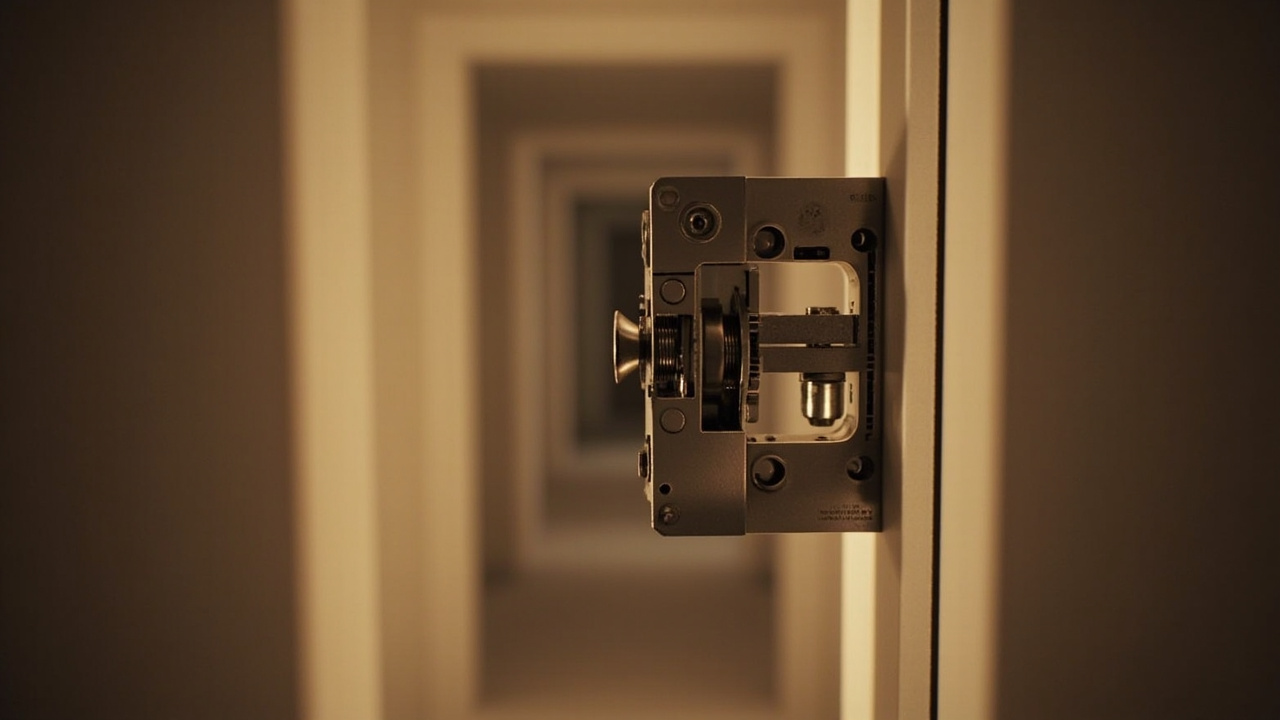
Latch and Bolt Geometry and Door Compatibility: The Fit Envelope
An integrator does not qualify a lock with a general statement that it fits most doors. The lock must be compared with the actual leaf, frame and hardware interface. A latch and bolt geometry door fit envelope is the bounded set of conditions under which those parts can be assembled, close and operate without improvised modification.
Direct answer. Condensed to the essential point, latch and bolt geometry door fit envelope turns a request into a decision record. latch and bolt geometry door fit envelope and latch-and-bolt-geometry are the two parts of latch and bolt geometry door fit envelope most often skipped. A latch and bolt geometry door fit envelope is a component-level look at how the technology behaves. latch and bolt geometry door fit envelope is where the limits sit. latch and bolt geometry door fit envelope is verified on the dated product page.
The phrase latch and bolt geometry door fit envelope is anchored in latch and bolt geometry door fit envelope. For the rest of this article it denotes the conditions and evidence that latch and bolt geometry door fit envelope sets out below. Nothing wider than that.
The envelope should be SKU-specific and dated. It should state the measurements that can be accepted, those that remain unresolved and the evidence behind each boundary. Its purpose is to prevent a late installation discovery: a faceplate that will not cover the cutout, a case that cannot enter the rebate, a spindle that cannot reach, or a keeper that does not match the active bolt. Door compatibility is therefore a controlled approval, not a sales adjective.
The boundary clause for the latch and bolt geometry door
Clause C-01. “The selected lock shall be approved only where the measured door leaf and frame fall within the dated, SKU-specific fit envelope. A match to a nominal backset, a common faceplate or a generic door thickness is not sufficient.”
Use this clause to name the owner of every dimension. The supplier owns the published product limits; the installer owns site measurements; the integrator owns the comparison and exception record. Keeping those roles separate prevents an unresolved value from becoming an assumed fit. For a broader measurement workflow, use the Office Smart Lock Site Survey method, then add the lock-specific clauses below. Include the document-control token latch-and-bolt-geometry on the qualification sheet.
| Boundary element | Clause language | Evidence required | Hold point |
|---|---|---|---|
| Door leaf | “The measured leaf shall remain within the stated thickness and stile limits.” | SKU drawing and field measurement | Any leaf outside the range |
| Lock body | “The case shall enter the prepared rebate without unapproved modification.” | Case drawing and installation guide | Missing cutout data |
| Frame interface | “The latch or bolt shall engage the stated keeper.” | Faceplate and keeper drawing | Unverified projection or throw |
The measurement schedule that qualifies a door leaf
Record every value on the same door schedule, using the same units and datum. A missing value is an unresolved qualification item, not a value the workshop may infer later.
| Measurement point | Record | Acceptance basis |
|---|---|---|
| Door leaf | Minimum and maximum thickness at the scheduled lock position | Dated SKU drawing and site measurement |
| Backset | Door edge to spindle or cylinder centerline | Supplier drawing and measured edge datum |
| Faceplate | Height, width, screw pattern and bevel orientation | Dimension drawing |
| Mortise case | Cutout dimensions, depth and face-to-case offset | Installation guide |
| Spindle and cylinder | Diameter, required reach and collar allowance | SKU-specific drawings |
| Latch or bolt | Projection and travel, or throw and extension | Mechanical specification |
| Frame interface | Keeper opening, jamb depth and engagement condition | Drawing and frame survey |
Mortise case dimensions are not interchangeable with faceplate dimensions, and backset does not determine case handedness by itself.
Clause C-02. “Each dimension shall be taken from an identified datum and recorded with its source. Missing data shall remain open until supported by a dated document or a documented physical measurement.”
Backset, handing and spindle as one coupled decision
Treat backset, handing and spindle position as a single interface. A matching backset does not settle the cylinder centerline, bolt side, case orientation or spindle reach. A project schedule that records only one of those values remains incomplete.
Clause C-03. “The approved lock shall be installed only where the measured backset, handing, spindle interface and cylinder centerline match the dated SKU drawing.”
Review the door as a cross-section rather than as a list of independent attributes. The installer and supplier should mark the same edge datum, spindle line, faceplate edge and active bolt position. That immediately exposes an offset that separate parameter checks can conceal. Design and service considerations for this coupled geometry are covered in Latch and Bolt Geometry Trade-Offs: Cost, Durability and Service.
Faceplate and latch travel without hidden interference
The faceplate must relate correctly to the mortise case, door edge and prepared opening. Its outline, screw pattern, bevel direction and latch position must come from the same SKU drawing. A faceplate that appears similar in outline can still expose the wrong case, aperture or latch relationship.
Clause C-04. “The faceplate and strike geometry shall match the approved case and latch position, including bevel direction, projection and available closing travel.”
Request the supplier’s stated latch projection and travel limits rather than accepting “standard latch” as a qualification statement. Compare those values with the door-edge clearance, frame rebate and closing condition recorded in the survey. Check the door in both open and closed positions so the latch is not relying on forced movement to clear the keeper.
Deadbolt throw, keeper engagement and frame depth
A deadbolt fit depends on more than the hole visible in the door edge. The qualification must connect throw, extension, keep type and jamb depth to the actual frame. A bolt can appear aligned at the face of the jamb while failing to engage fully because the keeper, door position or frame depth differs.
Clause C-05. “The active bolt shall achieve the specified engagement with the stated keeper under normal closing forces without binding, striking or forced retraction.”
For multipoint hardware, identify which leaf carries the active latch or bolt and which interfaces are merely linked. The supplier’s drawing should show the relationship between the lock body, spindle, bolt centres and door edge. Do not transfer a multipoint arrangement to a different case without written confirmation of the relevant dimensions.
Door leaf thickness, rebate and mortise clearance
Door thickness affects more than the visible panel. It can change the relationship among the case, spindle, cylinder, collar or rose, door edge and frame. Record minimum and maximum thickness rather than a single nominal value, and state where each measurement was taken.
Clause C-06. “Backset and door thickness shall be measured on the same identified door and evaluated together with rebate depth, spindle length and cylinder projection. A dimension shall not be substituted from another door.”
For retrofit work, preserve the door identity and survey condition through the Smart Lock Retrofit Site Survey. If the leaf will be modified, resized or replaced, release the lock against the final configuration rather than the opening survey. The same principle applies where a closer, hold-open device or adjacent furniture changes the usable clearance.
Tolerance ownership when survey doors differ
A fit envelope should distinguish product tolerance from site variation. The supplier must state what range the SKU accepts; the installer must show the range observed in the doors. Neither side should average incompatible readings to force an approval.
Clause C-07. “The qualification shall use the least favourable measured condition within each door family. Any value outside the supplier’s stated range shall receive a written disposition before release.”
Assign tolerances by interface: leaf construction, frame condition, installation workmanship and hardware variation should not be collapsed into one unexplained allowance. Record a revised survey whenever manufacturing, frame adjustment or hardware substitution changes a critical dimension. The recurring symptoms associated with neglected interfaces are catalogued in Latch and Bolt Geometry Failure Modes Seen on Smart Lock Projects.
Where a project door is subject to egress, fire-door or accessibility control, the geometry pass is only one input.
CONFIRM-WITH-LOCAL-AUTHORITY: Confirm the applicable egress, fire-door and accessibility requirements for the project location and door type before releasing the hardware schedule.
flowchart TD
  A[Open qualification record] --> B[Record leaf and frame geometry]
  B --> C{All critical values stated}
  C -->|No| D[Request dated evidence]
  C -->|Yes| E{Faceplate case and spindle fit}
  E -->|No| F[Reject or select alternate]
  E -->|Yes| G{Backset handing and keeper fit}
  G -->|No| H[Hold for resolution]
  G -->|Yes| I[Release qualified disposition]
Qualification evidence accepted by the project team
Qualification evidence should be ordered so that drawings establish the intended interface and physical checks confirm the uncertain parts. Request, at minimum:
- A dated dimension drawing for the exact SKU and door family.
- An installation guide identifying the case, faceplate, rebate, spindle and frame preparation.
- The datasheet on request, with any stated dimension limits preserved in context.
- A documented fit trial when site conditions fall near an envelope boundary.
- A change record whenever the leaf, frame or selected lock changes after qualification.
The evidence request and acceptance discipline are detailed in Latch and Bolt Geometry Test Evidence a Buyer Can Actually Request. When reviewing supplier wording, separate a stated limit from an assumed fit by following Reading Latch and Bolt Geometry Claims in a Supplier Datasheet.
The first-party SLK-9936S hotel lock example lists door thickness of 36–100 mm, a 3-point latch and a 5-pin cylinder. These SKU-specific facts show how a clause can cite a concrete datum; confirm on the dated product page for the specific SKU before using them in a procurement decision. They cannot be transferred to another model or door without separate evidence.
Disposition matrix for a fit-envelope review
Every reviewed door should end in a traceable disposition. “Probably fits” is not a release condition.
| Finding | Classification | Required action | Release condition |
|---|---|---|---|
| All critical values fall within the dated envelope | Qualified | Attach drawings, measurements and approved SKU | Integrator signs the door record |
| A noncritical condition differs but has a documented remedy | Conditional | Record the deviation, owner and corrective action | Written acceptance closes the exception |
| A critical interface conflicts with the SKU geometry | Rejected | Do not release the lock for that door | Alternate hardware or door configuration is qualified |
| A critical dimension or drawing is unavailable | Unresolved | Keep the door on hold and request evidence | Dated evidence completes the comparison |
| The door or frame changes after approval | Re-survey required | Invalidate the previous measurement record | The revised condition passes the same checks |
Illustrative retrofit sequence for one door family
The following is an illustrative qualification sequence, not a customer project record. A building contains several visually similar leaves, so the first task is to give each door a unique identity and determine whether they belong to one controlled door family.
For Door A, the measured backset, faceplate, case, spindle and keeper agree with the dated lock drawing. It receives a qualified disposition. Door B has a leaf thickness outside the stated range, so the team rejects that lock-to-door combination and asks for an alternative. Door C has no documented handing or keeper dimension, so it remains unresolved rather than being grouped with Doors A and B.
The same question is worked through in more detail in the smart lock network architecture. That is the same question latch and bolt geometry door fit envelope has to answer here.The sequence prevents an average door description from concealing different conditions. It also produces a precise question for the supplier: which dimension or interface prevents this configuration from entering the published fit envelope?
Copy-ready clauses for the qualification record
- C-08 — Evidence precedence: The dated SKU drawing and measured site record shall govern the fit decision; promotional descriptions shall not expand the stated envelope.
- C-09 — Critical dimensions: Backset, door thickness, faceplate, mortise case, spindle, latch or bolt, and keeper shall be recorded before release.
- C-10 — Same-door evidence: All measurements used for one approval shall refer to the same door identity and configuration.
- C-11 — No unapproved modification: The lock case, faceplate, rebate, spindle or keeper shall not be altered to create fit unless the supplier approves the change in writing.
- C-12 — Exceptions: Every deviation shall identify its affected interface, corrective action, responsible party and closure condition.
- C-13 — Revalidation: A changed leaf, frame, hardware selection or installation condition shall trigger review of all affected measurements.
- C-14 — Release: A door record shall be released only with an identified SKU, dated evidence, completed measurements and an explicit disposition.
Package the completed record—SKU, drawings, measured door schedule, exceptions and dispositions—with the request a quote. Ask the supplier to state what is included for that exact configuration instead of accepting a generic compatibility statement. The resulting quote basis is easier to compare and easier for the installer to execute.