
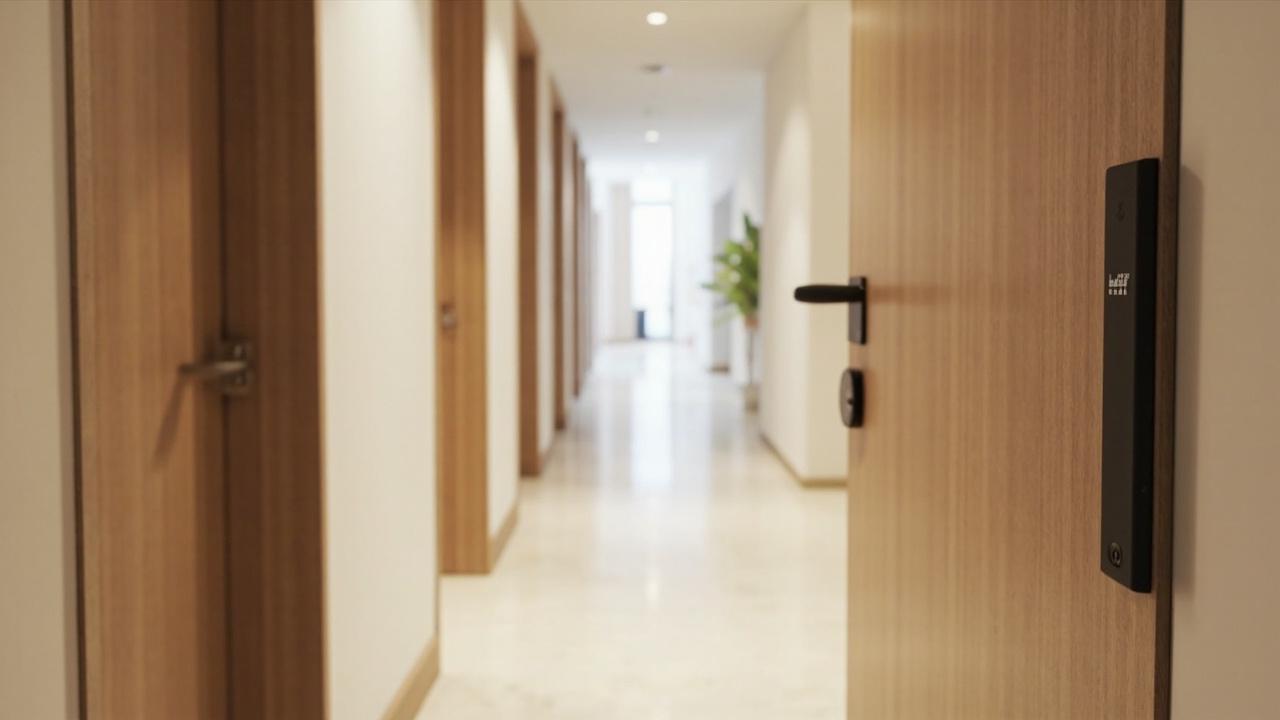
Smart Locks for Apartment Leasing Offices
Consider a brand-new 240-unit garden-style community nine weeks past first move-in. The leasing office is a converted ground-floor unit next to the model unit, holding two desks, one printer, one small kitchenette, and an electronic lock on the front door that the leasing team already argues about. Every Tuesday and Saturday the appointment calendar is full — about fifty prospect appointments a week at the moment, climbing toward sixty in the next lease-up month, plus another eight to fifteen unannounced walk-ins each Saturday. Two external brokerages bring their own agents on different days; each agent gets a tour slot under their own name. The community is still under construction on Phase Two, the dog-park amenity opens in three weeks, and the property manager spends more of her week chasing door access than chasing leases. This is an illustrative scenario assembled from what we see order-side at a factory that has shipped smart locks for more than ten years — not a customer story, not a testimonial — but the pattern behind it is real and recurring in new-build communities in lease-up.
Here is the direct answer, stated before anything else for extractability:
Smart locks for apartment leasing offices are an access program, not a product. A leasing office runs on four doors that behave differently — the leasing-office front door, the leasing-team back-of-house door, the model-unit door, and any on-site amenities still in handover — and the same prospect will touch three of them in a single visit. The right design separates three credential populations (prospects who only ever need a per-appointment code, leasing staff who need a stable lane for an eight-hour shift, and outside brokers who need an auditable ID-issued credential they cannot lend each other), picks a model that supports those lanes the way you intend to use them, and treats daily open and close as a written discipline rather than a memory. Off-the-shelf retail smart locks do most of this poorly because they were designed for a household of four, not a leasing team of six with fifty prospect-issued credentials a week flowing through the same door.
What follows earns that paragraph door by door, then turns it into a specification conversation you can take to a supplier without inventing facts about any one model.
What makes a leasing office's door different from any other apartment door
Door traffic at a leasing office is concentrated. It is also credential-novel almost every time. A household of four rotates maybe forty distinct credentials across a year. A leasing office at lease-up velocity can rotate that many prospect PIN codes in a single week, plus leasing-team shifts, plus outside broker rotations, plus the model-unit showing for a contractor or VIP walkthrough that nobody gave a slot in the calendar. Add the people-flow surprises — a resident stops in to drop off a key fob, a vendor arrives for the coffee machine, a Phase Two construction supervisor needs to look at an as-built — and the front door is genuinely the busiest door in the community.
The first decision you make is not "which model." It is what each door is for, who is allowed to use it, and how a credential is taken back the day the relation ends. Without that written down, the lock catalog reduces to a price race and ends with a key in a cash drawer.
Five traffic realities drive every recommendation in this article:
- A prospect appointment is a defined-window credential. The prospect needs to enter twice — once for the office, once for the model unit. Nobody needs to enter at other times. The credential should expire when the appointment ends, automatically and irreversibly, with no staff action required.
- A walk-in is an unbounded-window credential. The walk-in arrives without a code, walks up to the office counter, signs in, and is handed (or issued) a code or card that lasts the tour. The walk-in path will be hammered on Saturdays; it cannot depend on staff remembering to revoke anything.
- A leasing agent needs a stable, shift-spanning credential. Their lane has to work for eight hours of running between desks and the model unit, handing off a hot-lead handoff at the desk, and occasionally re-entering while carrying a refreshments tray. That lane is the door's workhorse, not the prospect lane.
- An outside broker needs an ID-bound credential. Same physical lane as a leasing agent for the tour, but the audit argument is different: which broker brought the resident who signed, who walked a same-week prospect who applied elsewhere, who took the second showing. If you cannot answer those questions from your lock's event log six months later, the broker program is being governed by handshake memory.
- A staff member's credential outlives the day. It also outlives the job. The leasing team churns in lease-up markets; you cannot have ghosts in the lock on week twenty-six because someone forgot to remove week-three's leasing assistant.
The four doors behind a leasing office — door schedule as the spine
Before any spec sheet is written, you sit down with the leasing manager and walk the office as a prospect would, room by room. Below is the door schedule the exercise produces for a community roughly the size of our illustrative scenario. Every line below is a buyer's planning output. Whether a particular model covers the lanes named in each cell is a separate question — that is the to verify in writing step that no proxy answer can replace.
| Door | Class | Primary credential | Backup lane | Egress / failure | Audit-grade requirement |
|---|---|---|---|---|---|
| Leasing-office front door | Visitor-facing staff door | Time-bounded prospect codes (per-appointment) + stable leasing-staff lane | Mechanical key in the leasing-office safe | Mechanical override accessible from inside; outside fail-secure, inside free-egress | Per-credential issuance + revocation log |
| Leasing back-of-house (kitchenette / printer / coat) | Staff-only door | Stable leasing-staff lane (code or card per agent) | Mechanical key in office | Same — fail-secure outside, free inside | Lane does not see prospect traffic; lower audit pressure |
| Model-unit door | High-value show door | Time-bounded prospect code (same credential as office, or second-stage) | Stable leasing-staff lane | Free egress inside; fail-secure outside; mechanical key in office safe, with custody log | Tour-by-tour log — which prospect code, when, who issued it |
| On-site amenity not yet handed over (gym, dog park, clubroom) | Handover-phase amenity | Time-bounded codes by reservation + leasing-staff lane | Mechanical key on site | Free egress inside at all times | Reservation-tied codes if amenities are already booked; bare mechanical until opened |
Three things are worth naming about the schedule above. First, the front door and the model-unit door are intentionally separate credentials even if they share a code value during a single appointment — that way, a prospect who legitimately got into the office can be revoked from the model unit without being revoked from the office. Second, the back-of-house door exists specifically so the leasing-staff lane and the prospect lane do not share a lock, which makes per-lane revocation cheaper. Third, the handover amenity is named in the schedule because it will be in the schedule for eight to twelve weeks during lease-up; pretending it will not exist in the design is the most common reason a community buys the wrong model on opening day.
Tour-appointment flow — what the prospect actually experiences
The flow is where most under-cooked designs crack. The calendar tool — Google, Outlook, an actual CRM, a paper diary — is the source of truth for "who is expected at the leasing office and when." The lock is downstream of the calendar, not the other way around. A successful tour-appointment flow does five things in sequence, and most modern electronic locks handle four of them competently when the model is correctly chosen.
| Step | Calendar / staffing action | Lock-side behavior | Failure mode |
|---|---|---|---|
| 1. Appointment booked | Slot recorded with prospect name, agent name, prospect phone/email, marketing source | (none yet) | Prospect double-booked — staffing issue, not a lock issue |
| 2. Confirmation 24 h prior | Automated message with simple parking and arrival instructions | (none yet) | No-show appointment eats an unused slot; lock-side code generation is wasted |
| 3. Code issued ~2 h before arrival | Office generates time-bounded code, valid for the appointment window only | Code enters lock as a per-use / per-window credential | Code expired at wrong window — useless in the lock; leasing team loses the tour |
| 4. Prospect arrives | Prospect punches the code, opens the leasing-office door, walks in | Lock logs the issuance and the entry event | Lock has no code-generation lane — issue breaks the design |
| 5. Tour runs + tour-end sweep | Leasing agent escorts prospect through the model unit using the same or a second code; code auto-expires at end of slot | Lock records end-of-window automatically; no staff action needed | "I forgot to delete the code" — credential sits valid until manually cleared |
The same five steps read from the prospect's side are a handshake between the calendar, the leasing desk and two separate door locks — one credential lane, two doors:
sequenceDiagram
    participant PR as Prospect
    participant CA as Booking calendar
    participant LA as Leasing agent
    participant OL as Office door lock
    participant ML as Model-unit door lock
    PR->>CA: Book slot · name, agent, phone, source recorded
    CA-->>PR: Confirmation 24 h prior with arrival notes
    LA->>OL: Issue time-bounded code ~2 h before the slot
    Note over OL: Code lands as a per-use window credential
    PR->>OL: Punch code and enter the office
    OL->>OL: Log issuance and entry event
    LA->>ML: Escort the tour · same or second code
    ML-->>LA: Slot ends · code expires with no staff action
    Note over PR,ML: Walk-ins overlay the same lanes with a window-bounded code or a returned card
Steps 3 and 5 are the lock-side answers. Step 3 requires the model to support per-credential windows and remote or app-side issuance — that capability is model-dependent and is confirmed on the product page. Step 5 requires either an expiry policy managed centrally or a per-credential TTL baked into each issued code, again model-dependent. Treat any answer you read in marketing copy as a question: "show me, on this product page, the field that says how long this code is valid." If the page doesn't say it, the model doesn't have it for your purposes.
The walk-in track runs on top of the same infrastructure but with a different posture.
Walk-in traffic — handling Saturday's surge without a line at the door
A lease-up community typically sees between eight and fifteen unannounced walk-ins on a Saturday between 11 a.m. and 2 p.m. — the "after-morning-errands" window. The leasing team is already busy; the office is loud; coffee is being made. Asking the team to generate a fresh code for each walk-in while explaining the dog-park amenities is asking for a mistake. Two pragmatic answers dominate.
Answer A — a permanent walk-in code printed on the parking-map flyer. This is not a secret. It is a four-digit code that is valid during office hours only — say 9 a.m. to 6 p.m., Monday through Saturday — and is replaced or rotated monthly. The model must support a credential that is time-of-day and day-of-week bounded, with a TTL of weeks rather than minutes. Whether your shortlisted model supports that exact combination is a product-page question. The walk-in lane is functional, not aspirational, and there is no shame in it; the alternative is staff generating codes for fifteen simultaneous walk-ins under pressure.
Answer B — a permanent walk-in card handed out at the door. A leasing office issues a small stack of cards from a locked drawer. A walk-in picks up a card at the door (or at the model-unit exterior), inserts it to ring the bell or unlock the entry, and the office greets them. The card is returned at the end of the visit and reused. This requires a model with a card lane and a stock of credentials you govern physically. It is more friction at the entry but more accountable, because every walk-in has to be greeted and the card has to come back.
The decision between A and B is not a lock decision. It is a staffing-and-theft decision: an open card drawer and a Saturday morning auditor explains a lot about whether the community trusts walk-ins to return cards. Most lease-up communities land on Answer A for the office door and Answer B for the model-unit door — codes are "I have an appointment" and cards are "I'm being personally shown around" — because the model-unit value is higher than the office's.
Model-unit ingress — the door with the highest unit value per credential
The model unit is the door that costs the least to secure and the most to neglect. It is locked open during staged showings and locked closed overnight and on Mondays. It holds furniture that was bought with the developer budget, fittings that may not be available in the spec, paint that no longer matches the production colour book. The leasing team walks through it twenty times a day. Prospects walk through it three to seven times a Saturday. Brokers walk through it three to four times a week, often on their own between staff-led tours.
Three rules keep this door problem-small.
Rule one — the model-unit door has its own credential lane, not a shared lane with the office. This is the single largest mistake in under-designed leasing office security. A shared office-and-model credential means that revoking a prospect from the model unit (because they returned a second time unaccompanied) revokes them from the office too, where they had a legitimate appointment. Separate credentials, even at the cost of a more elaborate issuance routine, is the cheaper mistake-avoidance.
Rule two — the mechanical key is in the office safe, not on a hook. The mechanical key exists for fire service, lockout, model-unit re-staging after hours, and the rare day the model unit has to be re-keyed because a key was lost. Its location is the office safe, never a leasing desk. Every mechanical-key removal is logged in a paper register next to the safe — that is the audit trail an inspector or an insurance adjuster will ask for first, and it is the cheapest audit you will ever build.
Rule three — model-unit events are part of the tour record. The card or code used for the model unit should be recorded against the appointment, not issued at the office desk and lost to the lock. Whether the model you intend to buy has an event log that holds tour-by-tour records is confirmed on the product page; the SLK-9936S-style audit-traffic figures show up on hotel locks where the design point is exactly this kind of mid-volume usage, and the same idea scaled down to leasing office traffic is the analogue the spec is asking for. Confirm per-model record capacity before committing to a rollout that depends on the log being readable in month six of lease-up.
Broker access — the per-broker-ID credential is a relationship question
External brokers are the most expensive credential population to govern badly. They are also the population that does the most work. Two brokerages serving a new-build community can each rotate two to four agents a quarter, often more. The leasing manager needs to know who brought the prospect, who the broker of record was on a converted application, and which brokers are actually generating tours versus which are showing up to "stay visible." None of that is answerable from a shared community code.
The honest design is per-broker-ID credentials, one per individual outside agent, each on its own TTL. Whether the lock model supports per-credential individual IDs at the volume you need is a product-page fact; the question to ask is, in plain words:
"On the model we are buying, can I issue one credential per agent, attach it to the agent's name, and turn it off when that agent leaves the brokerage — without affecting the rest of the brokerage's agents?"
If the answer is yes, the broker program is governable. If the answer is "we share one PIN with the brokerage office and they hand it around," the broker program is being governed by a handshake. We are not aware of a defensible reason a multifamily operator should accept a handshake in 2026 — every successful broker channel we see audit-side names agents one at a time and tracks tour counts to the individual, not the firm.
The decision matrix below names the choice once and moves on.
| Broker-program pattern | Credential shape | Audit grade | Operational cost | Risk if a broker leaves |
|---|---|---|---|---|
| Shared brokerage PIN | One code per brokerage | None beyond "they used the code" | Very low | All tours undistinguished; the brokerage's former agent still has the code at their next firm |
| Per-agent PIN (anonymous) | One code per agent, no name attached | Audit tells you which credential was used, not who | Low | Old code can be transferred to a new agent by the brokerage; rotation is informal |
| Per-broker-ID PIN (named) | One credential per agent, named in the lock register or app, TTL or manual expiry | Audit ties the tour to the agent by name, written record | Moderate — requires register upkeep | Old code is dead on the day the agent leaves the brokerage; you rotate cleanly |
| Card per agent | Physical card kept by the brokerage, one card per agent | Audit reads the card's serial number, the card is held by the named agent | Highest — physical stock to manage | Cards are returned on off-boarding, named and tracked |
The matrix is not a recommendation for any one row. It is a vocabulary. The leasing manager chooses a row, the lock spec flows from the row, and the supplier answers the per-model capability question.
Daily open/close discipline — the part that lives or dies on paper
A leasing-office smart lock program that has not been written down will collapse inside ninety days. Lease-up markets burn through leasing agents in six to twelve months; vendors rotate; the property manager gets pulled into a Phase Two opening; a regional manager visits every Tuesday. Memory is not a discipline. A short, signed morning-and-evening checklist attached to the office door is the cheapest insurance policy you can buy.
| Cadence | Owner | Action | Document produced | Goes wrong if skipped |
|---|---|---|---|---|
| Daily, office opening | Assigned leasing agent on first shift | Check office safe intact, mechanical keys present, walk-in code posted on door, code issue log started | Date-stamped opening note | Code issue log lost day one → no audit of prospect codes for that day |
| Daily, every prospect appointment | Issuing agent | Issue code in lock, log prospect name + code + appointment window | Tour register line | Code issued verbally, not logged, cannot be revoked by name later |
| Daily, model-unit walk-in | Assigned agent | Issue walk-in card, mark card serial out, mark back in on return | Card-register line | Cards disappear; first replacement order bleeds the budget |
| Daily, mid-day check (~13:00) | Any leasing agent | Confirm walk-in code is still active for the day, no anomalous traffic in the morning log | Mid-day note | A prospect code compromised at 11 a.m. is still in the door at 4 p.m. |
| Daily, office closing | Last leasing agent leaving | Confirm mechanical key is in safe; model-unit locked; broker codes TTL checked; day's register signed | Date-stamped closing note with signature | A key forgotten on the leasing desk overnight is recoverable; a code revoked late at 11 p.m. is not |
| Weekly, Friday afternoon | Leasing manager | Reconcile tour register against lock event log; flag any unused codes still valid | Weekly reconciliation report | Unused codes accumulate across the calendar year |
| Monthly, last working day | Leasing manager | Rotate walk-in code; reconcile card stock; remove any ex-leasing-agent credentials | Monthly rotation note | Old code goes from "Saturday-only" to "common knowledge" |
Two of those rows — daily open and daily close — are the only two that have to be signed every day, including on days the leasing team is fully staffed. The rest of the list is a ladder of escalation: if a row is skipped, the one below catches it. If two are skipped in the same week, the leasing manager sits down with the team and rewrites the discipline. A lock program that has only the top two rows printed by the office door is more secure than a lock program with all seven rows in a binder nobody opens.
Leasing-team credential rotation — the personnel traffic nobody plans for
Lease-up has a turnover problem of its own: leasing agents stay six to eighteen months on average, and the office is rarely fully staffed for the first six months of the program. The lock is the silent observer of every personnel change, and the discipline that handles it is the staff-credential rotation register.
| Transition | Action before the move-out date | Action on the day | Audit posture |
|---|---|---|---|
| Leasing agent stays | Re-confirm their credential at quarter end (active? working?) | None | Lane stable; register unchanged |
| Leasing agent promoted off site | Manager issues a written notice to admin lane | Revoke agent's credential within 24 hours; mechanical-key safe access transferred in same window | If revocation lagged: confirmed by lock event log on the day |
| Leasing agent off-boarded under performance pressure | Manager prepares same-day revocation pack with name and credential ID | Revoke before the exit interview; verify with negative test (their credential does not work) | If still works at the door: incident; trigger cylinder re-pin on the leasing-office door |
| New leasing agent starts | HR notifies manager 5 days in advance | Issue credential at first-shift orientation; do not hand mechanical-key access for 30 days | If mechanical-key access handed same day as credential: violates the safe custody rule |
| Brokerage changes agent on the door | Broker notifies manager | Issue credential under the new agent's name; revoke the previous agent's | If old credential still working: the broker relationship is being governed by handshake, not lock |
The "negative test" line in the off-boarding row deserves a sentence of its own: any time a leasing agent's credential is revoked, somebody walks to the door with that credential and confirms it does not open the lock. A lock program with revocation on paper and no negative test is a program that waits three weeks for a complaint to surface.
What to specify per door — the spec-capture sheet the supplier fills
This is the worksheet you take to a supplier before issuing a purchase order. Every cell is a question, not an assertion. No model we know of supports every lane a leasing office could want; the spec's job is to find the model whose product page supports the lanes you actually need and to verify that by reading the page, not by trusting a salesperson.
| Question | Where it lives | Why it matters at a leasing office |
|---|---|---|
| Per-credential time-bounded PIN issuance — minimum window length and maximum window length? | Product page (per-model) | Defines whether your 30-min tour slots can be issued as a single code or whether they have to be a half-day |
| Per-broker-ID credential issuance — one credential per named agent, individually revocable? | Product page (per-model) | Without this, the broker program is governed by handshake |
| Lease-team shift credential — how many stable leasing-staff credentials can the lock hold? | Product page (per-model) | Defines whether you staff 4 or 8 agents per shift without per-agent rotation |
| Card lane — does the model support an RFID card lane in addition to PIN? | Product page (per-model) | The model-unit walk-in card stock depends on this lane |
| Mechanical-key override — is a mechanical key shipped with each unit, and what is the key-control story? | Product page (per-model) + safe custody rule | Without this, fire service access is broken at 2 a.m. |
| Audit log capacity and read-out path — how many events, app-export or PC-software cable, etc? | Product page (per-model) | Defines whether weekly reconciliation is possible at month six |
| Door-fit range — minimum and maximum door thickness supported? | Product page (per-model) | Leasing-office doors are converted unit doors; ranges vary |
| Connectivity dependencies — does any of the above require app-connected mode or a centralized software stack? | Product page (per-model) | A model that requires connectivity is a model that fails at the desk on Saturday morning if the office Wi-Fi drops |
| Confirm-on-product-page rule | Discipline, applied row-by-row | If the page doesn't say it, the model doesn't have it for your design |
The connectivity row is the one that gets over-promised most. Marketing copy reads as if every model is app-connected and every credential can be issued from a phone; the page will tell you which models actually require connectivity for the lane you are buying. The honest spec is per-model. There is no central rule that says "smart locks always work remotely." Confirm per model.
A six-question pre-order conversation with a supplier
A short, blunt pre-order conversation is more valuable than a long slide deck from a salesperson. Below are the six questions that, answered honestly, will save the leasing manager a year of operational pain. None of them is a "gotcha" — they are the questions any manufacturer who has shipped more than ten years of this product should be able to answer in writing.
- "On the model under discussion, can I issue a per-appointment PIN with a window of exactly the appointment's start-to-end time, with no staff action required at expiry?" The answer should name the model and quote the window-setting feature from the product page.
- "Can one credential be revoked without affecting other active credentials on the same lock?" The answer should describe the revocation path — app, software, or physical — and what happens to other credentials.
- "What is the audit event capacity on this lock, how is the log read out, and is it the same model on hotel-class and on residential-class?" The answer should quote a number from the product page and an export path. If the supplier cites the SLK-9936S hotel block figures, listen carefully — hotel-class record capacity and residential-class record capacity are not the same line and should not be conflated. Treat any per-model spec as model-bound until the product page says otherwise.
- "For each lane I will use, what is the connectivity dependency? Which lanes work standalone, which require an app or a centralized software stack, and what is the failure mode if the connectivity is offline at issue time?" The answer should be a row-per-lane matrix, not a paragraph.
- "What is the mechanical-key override story — is a mechanical key shipped with every lock, is the cylinder re-keyable by the property manager with a kit, and what is the recommended custody chain?" The answer should name the cylinder type and the kit, if any.
- "For the door thickness of the leasing-office converted unit (which will not be a stock 38 mm), what is the fit range and what does the install look like at the edge cases?" The answer should name the supported range against your actual door measurement.
If a supplier will not answer these in writing, treat that as the answer to a seventh question you didn't have to ask.
Where the four doors leave you — and who they cross-reference to
A leasing-office access program is four doors, three credential populations, seven daily disciplines, and one weekly reconciliation. The lock is the easy half; the discipline is the hard half. Buy the lock that matches the four doors you have, not the four doors the brochure says you should have, and commit to the seven-line daily discipline from day one of lease-up — not month three, when the first leasing agent has already left and the first card is already missing.
The applicant of this program is reading this in the middle of a stack of decisions about a new community, and three of the questions on the stack have already been answered in sibling guides:
- The developer's spec workbook: Smart Locks for Apartment Developers covers the developer's lock specification before handover — useful if you are buying this for a community that is still being built and the developer will be the first owner of the spec.
- The property management company's fiduciary-spec memo: Smart Locks for Property Management Companies covers the operating-company side when a third party runs the building — useful if a third-party PM company is taking over the leasing office and inheriting the design.
- The buyer guide: Smart Locks for Apartment Buildings — Buyer Guide covers the unit, common-area and staff-door rules for a single multi-zone apartment building — useful if the leasing office is part of a wider building acquisition rather than a free-standing office.
If you are evaluating candidate locks for a leasing office specifically — single door, ten-leasing-team, ~50 prospect-issued codes a week — and need to verify in writing the per-model questions in the spec-capture sheet, the most efficient first move is a sample order against your actual office door at /order-samples, then a quote against the confirmed list at /request-a-quote. Lead times, MOQs, prices, warranty terms and certification status are quote-conversation topics, not article topics — we publish the doors and disciplines, not the commercial terms.
The community down the road from your site already has a competitor's lock on its leasing-office door. Yours does not have to be better than theirs. It has to be the one your leasing team will actually use every Saturday morning for the next two years, every Tuesday for the two years after that, and every time a leasing agent leaves for the next decade.